Iron Deficiency Anaemia Calculator
In short: Assess iron deficiency anaemia in women with WHO haemoglobin thresholds, ferritin and TSAT interpretation, and the Ganzoni iron deficit formula. Use the calculator above, then read the guide below to interpret your result and its limitations.
Enter your blood results below to classify your haemoglobin against WHO thresholds, judge whether the pattern fits iron deficiency from ferritin, TSAT and MCV, and estimate your total iron deficit with the Ganzoni formula. Pregnancy is handled separately because the cutoffs differ by trimester.
References and further reading
How this calculator assesses iron deficiency anaemia
The tool works in three steps. First, it compares your haemoglobin to World Health Organization cutoffs, which differ for non-pregnant and pregnant women and, since the 2024 WHO update, by trimester of pregnancy. Second, it judges iron deficiency likelihood from serum ferritin, the best single test of iron stores, supported by transferrin saturation and MCV when you provide them. Third, it estimates your total iron deficit in milligrams with the Ganzoni formula, the standard method used to dose intravenous iron.
Iron deficiency anaemia is the most common nutritional deficiency in the world, and women of reproductive age carry the highest burden because of menstrual losses and the demands of pregnancy. A 2026 analysis of US women aged 18 to 49 (Singh et al., Anemia) found iron deficiency remains widespread, and many people live with fatigue, weakness, dizziness or difficulty concentrating for months or years before iron deficiency is recognised, as the American Society of Hematology noted when it raised ferritin thresholds in 2025.
WHO haemoglobin thresholds explained
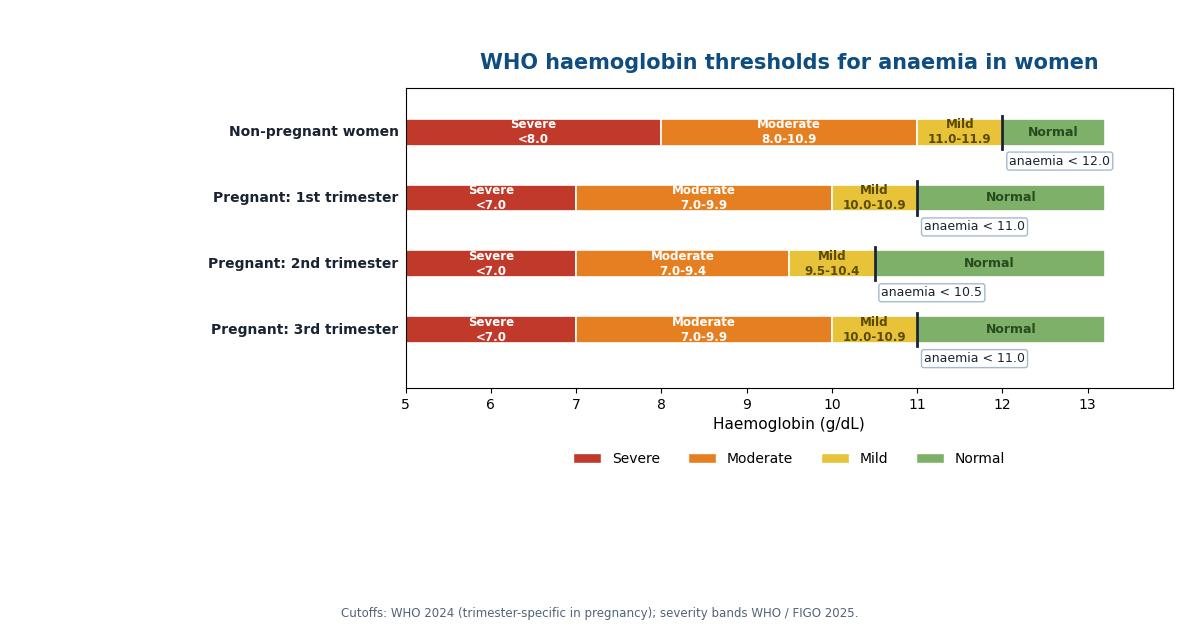
WHO defines anaemia when haemoglobin falls below a population-based cutoff. For non-pregnant women aged 15 and older the cutoff is 12.0 g/dL. For pregnant women the picture changed in 2024: WHO replaced the single 11.0 g/dL cutoff with trimester-specific values, because plasma volume expansion dilutes the blood most in the second trimester. Anaemia in pregnancy is now defined as haemoglobin below 11.0 g/dL in the first and third trimesters and below 10.5 g/dL in the second trimester. FIGO good-practice guidance (2025) additionally endorses 11.0 g/dL as a universal pregnancy cutoff where trimester-specific testing is impractical, and this calculator lets you pick the trimester so the right cutoff is applied.
| Group | Anaemia if Hb below | Mild | Moderate | Severe |
|---|---|---|---|---|
| Non-pregnant women | 12.0 g/dL | 11.0-11.9 | 8.0-10.9 | <8.0 |
| Pregnant, 1st trimester | 11.0 g/dL | 10.0-10.9 | 7.0-9.9 | <7.0 |
| Pregnant, 2nd trimester | 10.5 g/dL | 9.5-10.4 | 7.0-9.4 | <7.0 |
| Pregnant, 3rd trimester | 11.0 g/dL | 10.0-10.9 | 7.0-9.9 | <7.0 |
The severity bands come from WHO and FIGO classifications. Non-pregnant severity bands are mild 11.0-11.9 g/dL, moderate 8.0-10.9 g/dL and severe below 8.0 g/dL; in pregnancy they are mild 10.0-10.9, moderate 7.0-9.9 and severe below 7.0 g/dL, with the second-trimester mild band shifted to 9.5-10.4 per the 2024 WHO table. Severity matters because it changes management: mild anaemia is usually treated with oral iron and dietary measures, while severe anaemia may need urgent review and, in pregnancy, transfusion planning.
Ferritin: the key test of iron stores
Serum ferritin reflects the body's iron stores and is the first laboratory test to become abnormal as stores fall. It is the single most specific test for iron deficiency: in women of reproductive age a level under 15 ng/mL is 98% specific for absent bone-marrow iron (Hallberg et al., 1993), but waiting for that level misses early deficiency. The widely adopted clinical action threshold is 30 ng/mL: ferritin at or below 30 indicates iron deficiency that will worsen unless treated (van den Broek et al., 1998, sensitivity 90%, specificity 85%), ACOG supports under 30 in pregnancy, and the 2025 ASH guideline (Blood Advances) set 30 ng/mL or lower for adults and menstruating or pregnant individuals, with 50 ng/mL or lower for high-risk groups such as women with heavy menstrual bleeding or pregnant women with anaemia.
There is one important trap. Ferritin is an acute-phase reactant: it rises with infection, inflammation, chronic disease and even after heavy exercise. In inflammatory states, iron deficiency can hide behind a ferritin of 50, 100 or more. That is why this calculator also reads your TSAT and MCV when you supply them. With inflammation, a ferritin under 100 ng/mL combined with transferrin saturation under 20% should raise suspicion of coexisting iron deficiency (UCSF Hospital Handbook; ASH 2025 guidance sets the same pair of thresholds for adults with inflammation).
TSAT and MCV: the supporting clues
Transferrin saturation (TSAT) measures how much of the blood's iron-transport protein is carrying iron. It reflects the iron supply available to tissues right now, whereas ferritin reflects the warehouse. A TSAT under 20% supports iron deficiency; the classic older criterion for iron deficient erythropoiesis was under 16%, and ASH 2025 uses under 20% for adults with inflammation. Because serum iron and TSAT fluctuate through the day and after meals, they are weaker tests alone than ferritin, but a low TSAT alongside borderline ferritin strengthens the case for treatment.
MCV, the average red cell volume, describes the shape of the anaemia. Iron deficiency classically produces microcytic red cells with MCV under 80 fL, appearing as small pale cells with a wide size range (raised RDW) on the blood film. MCV under 80 fL therefore supports iron deficiency, though thalassaemia trait, lead poisoning and sideroblastic anaemia also cause microcytosis, so MCV never diagnoses iron deficiency on its own. Note that early iron deficiency can be normocytic: the cells only shrink once deficiency is established.
The Ganzoni formula and your iron deficit
When iron tablets are not enough, clinicians replace iron intravenously, and the dose needs to cover both the haemoglobin shortfall and the empty stores. The Ganzoni formula (Koch et al., Anemia 2015, doi:10.1155/2015/763576) is the standard method: total iron deficit in mg equals body weight (kg) x (target Hb - actual Hb) x 2.4 + 500 mg for depot stores in adults. The 2.4 factor combines blood volume (about 7% of body weight), the iron content of haemoglobin (0.34%) and the gram-to-milligram conversion. This calculator uses a target haemoglobin of 12.5 g/dL for non-pregnant women and 11.5 g/dL in pregnancy, sitting inside the 12-13 g/dL range commonly used with the formula. The worked example in the FAQ shows a 60 kg woman with Hb 9 g/dL and target 12 g/dL: 60 x 3 x 2.4 + 500 = 932 mg, a typical full replacement dose given as one or two infusions depending on the product label.
Practical notes: the formula assumes the weight entered is actual body weight; some clinicians substitute lean or ideal weight in marked obesity. Product labels for ferric carboxymaltose and ferric derisomaltose now use simplified weight-and-Hb dosing tables rather than the formula, and trials suggest the simplified regimens work at least as well, but the Ganzoni estimate remains the reference calculation your doctor can cross-check.
Iron in pregnancy: higher needs, lower thresholds
Pregnancy raises total iron requirements to roughly 1200 mg across gestation, driven by expansion of maternal red cell mass, placental and fetal growth, and blood loss at birth (FIGO 2025). Daily demand averages about 4.4 mg, rising from 0.8 mg/day in the first trimester to 4-5 mg/day in the second and up to 7.5-10 mg/day in the last weeks. Few diets supply that, which is why iron deficiency is responsible for about half of all anaemia in pregnancy worldwide. Because of this predictable shortfall, FIGO recommends screening every pregnant woman with a full blood count at booking and again at 28 weeks, and many guidelines advise starting oral iron when ferritin is under 30 ng/mL even if haemoglobin is still normal. Anaemia in pregnancy is linked to preterm birth, low birth weight and maternal complications, so correction should not wait.
Treatment: oral iron first, intravenous when needed
Oral iron is the first-line treatment. A common regimen is ferrous sulfate 325 mg (containing 65 mg elemental iron) once or twice daily on an empty stomach, sometimes with vitamin C to aid absorption (CMAJ 2017). Taking it every other day can actually improve absorption and reduce side effects, because daily dosing raises hepcidin, the hormone that blocks iron uptake (Moretti et al., Blood 2015). Continue treatment for about 3 months after haemoglobin normalises to rebuild the stores, and expect a recheck of blood counts after 4-8 weeks. Common side effects are constipation, nausea, dark stools and metallic taste; taking the tablet with a small amount of food reduces gut upset at some cost to absorption.
Intravenous iron is second-line. Guidelines consider it when two different oral preparations have failed over about three months, when side effects are intolerable, when absorption is impaired (inflammatory bowel disease, bariatric surgery, coeliac disease), or when anaemia needs rapid correction, for example in late pregnancy or before surgery. It is given in an infusion setting and carries a small risk of allergic reaction, so it is a clinic decision, not a home one. This calculator's Ganzoni output is the estimate a clinician would start from when planning that dose.
Diet and absorption: what helps and what hinders
Heme iron from meat, fish and poultry is absorbed two to three times better than non-heme iron from plants, and it is absorbed as ferrous iron (Fe2+), the form the gut prefers; ferric iron (Fe3+) from plants must be reduced first. Vitamin C with a meal converts ferric to ferrous iron and meaningfully boosts uptake, while tea, coffee, calcium-rich foods and high-dose antacids taken at the same time inhibit it. Practical habits that help: pair lentils, beans or fortified cereals with citrus or peppers, cook in cast-iron pans, and keep tea and coffee to between meals rather than with iron-rich food. In pregnancy, where daily needs climb to 7.5 mg or more late on, diet alone rarely closes the gap, so supplements remain the backbone of treatment even with an excellent diet.
Finding the cause matters as much as replacing the iron
Iron deficiency always has a reason. In menstruating women the usual cause is heavy menstrual bleeding, and in pregnancy it is the physiological demand described above. But in non-menstruating women, and in any woman with iron deficiency anaemia and no obvious menstrual cause, guidelines direct a search for gastrointestinal blood loss or malabsorption: coeliac screening, review of NSAID or aspirin use, H. pylori testing, and, from middle age, consideration of endoscopy and colonoscopy to exclude colorectal pathology (BSG adult IDA guideline). Blood donation, vegetarian diets, hookworm infestation in endemic areas, and PPI or H2-blocker use that lowers stomach acid all reduce iron availability and belong in the history. Treating the number without finding the cause lets the deficiency recur.
Limitations of this calculator
This tool applies population thresholds and a standard dosing formula; it cannot account for your individual context. Ferritin interpretation needs clinical judgement when inflammation, liver disease, malignancy, hyperthyroidism or heavy alcohol intake is present, because all can raise ferritin independently of iron status. The Ganzoni estimate is a planning number for clinicians, not a prescription, and actual IV dosing follows product labels and local protocols. Thalassaemia trait can mimic the microcytic pattern of iron deficiency while ferritin is normal, so microcytosis with normal iron studies should prompt haemoglobinopathy review rather than iron tablets. Finally, thresholds differ slightly between laboratories and guidelines, so your clinician's reference ranges and the trimester-specific WHO cutoffs used here should be read together.
Key takeaways
- The World Health Organization defines anaemia as haemoglobin below 12.0 g/dL in non-pregnant women.
- The 2025 American Society of Hematology guideline (Blood Advances) sets the iron deficiency threshold at serum ferritin of 30 ng/mL or lower for adults and menstruating or pregnant individuals, and 50 ng/mL or lower for high-risk groups such as women with heavy menstrual bleeding or pregnant women with anaemia.
- The Ganzoni formula estimates total iron deficit in milligrams as: body weight in kg multiplied by (target haemoglobin minus actual haemoglobin in g/dL) multiplied by 2.4, plus 500 mg to replenish iron stores in adults.
- Yes.
Frequently asked questions
What haemoglobin level counts as anaemia in women?
The World Health Organization defines anaemia as haemoglobin below 12.0 g/dL in non-pregnant women. In pregnancy, the 2024 WHO guideline uses trimester-specific cutoffs: below 11.0 g/dL in the first and third trimesters, and below 10.5 g/dL in the second trimester, when plasma volume expansion dilutes the blood most.
What ferritin level means iron deficiency?
The 2025 American Society of Hematology guideline (Blood Advances) sets the iron deficiency threshold at serum ferritin of 30 ng/mL or lower for adults and menstruating or pregnant individuals, and 50 ng/mL or lower for high-risk groups such as women with heavy menstrual bleeding or pregnant women with anaemia. ACOG also supports the under-30 cutoff in pregnancy. Ferritin is an acute-phase reactant, so it can look falsely normal during infection or inflammation, and TSAT under 20% then raises suspicion of iron deficiency even when ferritin is higher.
What is the Ganzoni formula for iron deficit?
The Ganzoni formula estimates total iron deficit in milligrams as: body weight in kg multiplied by (target haemoglobin minus actual haemoglobin in g/dL) multiplied by 2.4, plus 500 mg to replenish iron stores in adults. For example, a 60 kg woman with haemoglobin 9 g/dL and a target of 12 g/dL has a deficit of 60 x 3 x 2.4 + 500 = 932 mg. Clinicians use it mainly to dose intravenous iron.
Can you have iron deficiency without anaemia?
Yes. Iron deficiency without anaemia, sometimes called latent iron deficiency, means ferritin is low (30 ng/mL or lower) while haemoglobin is still normal. It can cause fatigue, restless legs, hair shedding and reduced exercise tolerance before anaemia develops. Guidelines recommend treating it, especially in pregnancy, where ACOG advises starting iron when ferritin is under 30 even without anaemia.
Is intravenous iron better than oral iron?
Oral iron is first-line treatment for iron deficiency anaemia in most women. Intravenous iron is considered when there is no response to two different oral iron preparations after about three months, when side effects are intolerable, or when a rapid correction is needed, for example late in pregnancy. IV dosing is often calculated with the Ganzoni formula so the full deficit is replaced.
When should I see a doctor about low iron?
Seek prompt medical care for severe anaemia (haemoglobin under 8 g/dL in non-pregnant women or under 7 g/dL in pregnancy), chest pain, breathlessness at rest, fainting, a racing heartbeat, or very heavy menstrual bleeding. Any anaemia in pregnancy deserves timely review because of the added demands on the mother and the developing baby.
Related calculators
Explore more women's health calculators or browse the full calculator library on Doctor With Data.