Your cycle tracker
Predictions are estimates based on population averages. They are most reliable for regular cycles and are not contraception advice. See the limitations section below.
How this tracker calculates your dates
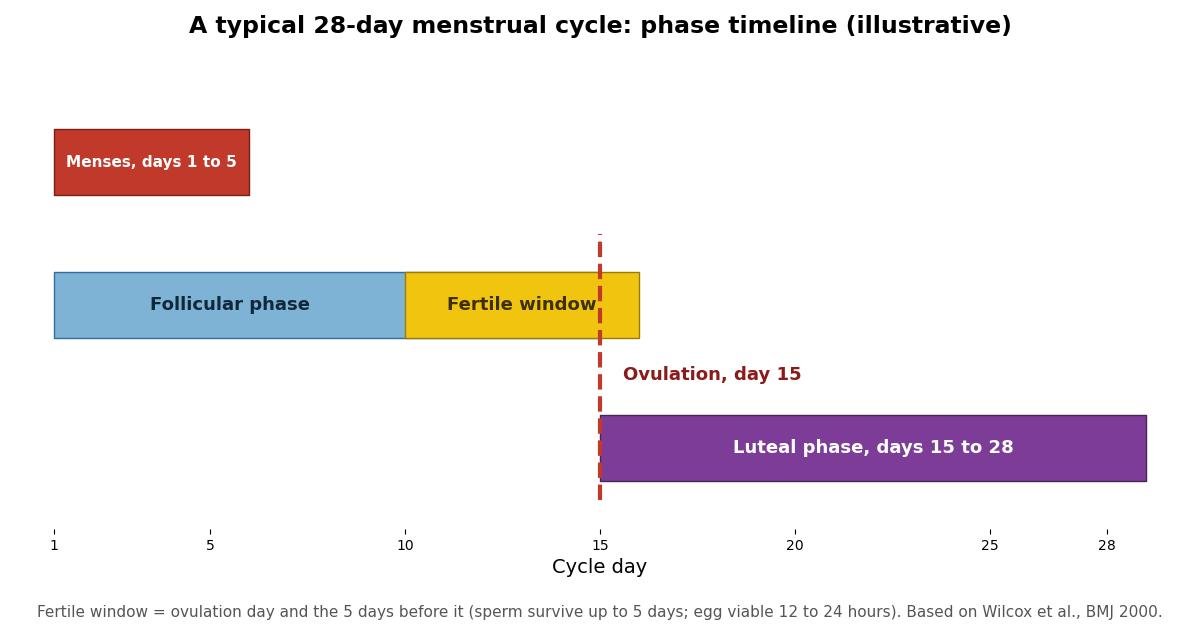
Every prediction on this page comes from three inputs and three widely published rules of menstrual physiology. First, your next period is estimated by adding your average cycle length to the first day of your last period. This is the standard calendar method: a cycle is counted from the first day of one period up to, but not including, the first day of the next.
Second, your ovulation day is estimated by counting back from the predicted next period by the length of the luteal phase, which defaults to 14 days. This backward counting is more reliable than counting forward from the last period, because the luteal phase, the part of the cycle after ovulation, is relatively constant between women, while the follicular phase before ovulation is the part that varies. So in a 28-day cycle ovulation falls about 14 days before the next period, but in a 35-day cycle it falls later, around day 21, and in a 21-day cycle it falls earlier, around day 7.
Third, your fertile window is the day of ovulation plus the five days before it, giving a six-day window. This definition comes from a landmark prospective study by Wilcox and colleagues, published in the BMJ in 2000, which estimated day-specific probabilities of conception. Sperm can survive in the female reproductive tract for up to five days, while the egg remains viable for only about 12 to 24 hours after release. That asymmetry is why the window stretches five days before ovulation but essentially ends on ovulation day itself.
The four phases of the menstrual cycle
It helps to know what is happening in the body behind each date the tracker shows. Day 1 of the cycle is the first day of menstrual bleeding, when the uterine lining is shed. Bleeding typically lasts from about 4.5 to 8 days according to FIGO normal limits, although most people bleed for around three to seven days. This is the menstrual phase.
The follicular phase runs from the first day of the period until ovulation. Rising oestrogen from developing ovarian follicles rebuilds the uterine lining, and one dominant follicle matures an egg. This phase is the variable part of the cycle: a longer cycle almost always means a longer follicular phase, not a longer luteal phase.
Ovulation is the release of the mature egg from the ovary, triggered by a surge in luteinising hormone. The egg travels down the fallopian tube, where fertilisation can occur. Some people notice brief lower abdominal discomfort, light spotting or increased clear cervical mucus around this time, although many notice nothing at all.
The luteal phase follows ovulation and lasts until the next period, about 14 days in most cycles. Progesterone rises to prepare the uterine lining for a possible pregnancy. If fertilisation does not occur, hormone levels fall, the lining breaks down, and menstruation begins, starting a new cycle. A consistently short luteal phase can be worth discussing with a clinician if you are trying to conceive.
The fertile window explained
Conception is only possible on a small number of days each cycle, but pregnancy can result from intercourse on any of the six days of the fertile window because sperm wait in the reproductive tract for the egg. Wilcox and colleagues showed that the probability of conception rises through the days leading up to ovulation and is highest in the days just before ovulation and on ovulation day itself.
This is also why calendar estimates alone are weak contraception. If your cycle is a few days longer or shorter than average, ovulation shifts, and with it the whole fertile window. Anyone relying on timing to avoid pregnancy should know that the calendar method on its own has a high failure rate, and should discuss reliable contraceptive methods with a clinician or pharmacist.
For those trying to conceive, regular intercourse every two to three days across the fertile window is the practical approach recommended in fertility guidance, rather than trying to pinpoint a single day.
What cycle length counts as normal
The International Federation of Gynecology and Obstetrics revised its definition of normal menstruation in 2018. Using large population datasets and the 5th to 95th percentiles, FIGO System 1 defines normal menstrual frequency as 24 to 38 days. Cycles consistently shorter than 24 days are classified as frequent and those longer than 38 days as infrequent. Older textbooks and many patient leaflets still quote 21 to 35 days, which remains a useful rule of thumb, but the FIGO range is the current evidence-based standard.
Regularity matters as much as length. FIGO considers a cycle regular when the difference between your shortest and longest cycle over a year is within about 7 to 9 days, depending on age. A variation of 10 days or more is classified as irregular and is a good reason to discuss your cycles with a clinician.
Cycle length also changes across the reproductive lifespan. Cycles in the first years after menarche and in the years before menopause tend to be longer and more variable, which is normal physiology, not necessarily disease. Tracking for several months is the only way to know your own pattern.
Why irregular cycles make predictions less reliable
This tracker assumes your cycle length stays roughly the same from month to month. When it does not, every estimate becomes fuzzier, because ovulation, the anchor for the fertile window, moves around. A prediction built on a 30-day average will be several days off in a month that turns out to be 35 days.
Many ordinary things temporarily change cycle length: acute stress, illness, significant travel, intense exercise, rapid weight change and disrupted sleep. Longer-lasting irregularity can reflect hormonal conditions such as polycystic ovary syndrome, thyroid disorders, high prolactin, or the transition into perimenopause. If your cycles are persistently irregular, the most useful thing you can do is bring several months of recorded dates to a clinician rather than relying on a single average.
Getting the most out of cycle tracking
Good tracking starts with recording the first day of each period, not the last day of bleeding. After three to six months you can compute your own average cycle length and, more importantly, see how much it varies. Update the average in this tracker as you collect more data; predictions improve with better inputs.
Consider noting more than dates: flow heaviness, pain, mood, sleep, cervical mucus and any spotting between periods. These details turn a date list into a health record that helps a clinician spot patterns, such as heavy bleeding that FIGO defines as more than 80 millilitres per cycle, or pain that is getting worse over time.
If you are trying to conceive and your cycles are regular, ovulation predictor kits that detect the luteinising hormone surge can refine the calendar estimate for your actual luteal phase length. Enter that number in the optional field above and the tracker will use it instead of the default 14 days.
Limitations
This tool uses a simplified calendar model. It does not account for anovulatory cycles, hormonal contraception, recent pregnancy or breastfeeding, all of which make predictions meaningless. It cannot diagnose conditions, and it cannot tell you whether you are pregnant: if your period is late, take a pregnancy test rather than waiting on a recalculated date. The model also assumes a typical luteal phase; a small minority of people have consistently shorter or longer luteal phases, which is why the input is adjustable.
References and further reading
Key takeaways
- It is an estimate, not a guarantee.
- No.
- About 14 days before the start of your next period, which in a regular 28-day cycle falls around cycle day 14 to 15.
- The International Federation of Gynecology and Obstetrics (FIGO), in its 2018 revision of normal bleeding criteria, defines normal menstrual frequency as 24 to 38 days, based on the 5th to 95th percentiles of population data.
Frequently asked questions
How accurate is this period predictor?
It is an estimate, not a guarantee. The tracker works best for people with regular cycles: if your cycle length is stable from month to month, the next period date is usually close. With irregular cycles the prediction can be off by several days, because ovulation timing shifts. Treat the result as a planning guide and keep recording your actual start dates.
Can I use this tracker as contraception?
No. Calendar-based estimates are not reliable contraception. Your fertile window moves whenever your cycle length changes, and sperm can survive in the body for up to five days, so intercourse several days before the estimated ovulation can still lead to pregnancy. If you want to avoid pregnancy, discuss effective methods with a clinician.
When do I ovulate in a 28-day cycle?
About 14 days before the start of your next period, which in a regular 28-day cycle falls around cycle day 14 to 15. The luteal phase, the part of the cycle after ovulation, is relatively constant at roughly 14 days, while the follicular phase before ovulation is the part that varies with cycle length.
What is the normal length of a menstrual cycle?
The International Federation of Gynecology and Obstetrics (FIGO), in its 2018 revision of normal bleeding criteria, defines normal menstrual frequency as 24 to 38 days, based on the 5th to 95th percentiles of population data. Older references commonly used 21 to 35 days. Regular cycles that fall inside the FIGO range are considered normal.
Why was my predicted period date wrong?
The most common reason is natural variation: stress, illness, travel, intense exercise, weight changes and hormonal conditions such as polycystic ovary syndrome or thyroid disorders can all shift ovulation and change cycle length. Perimenopause also brings longer, more variable cycles. Tracking for several months and averaging your lengths improves the estimate.
When should I talk to a doctor about my periods?
See a clinician if your cycles are consistently shorter than 24 days or longer than 38 days, if the variation between your shortest and longest cycle is 10 days or more, if you miss periods, bleed between periods, have bleeding that soaks through a pad or tampon every hour for several hours, or have severe period pain that interferes with daily life.
Sources
- Wilcox AJ, Weinberg CR, Baird DD. Timing of sexual intercourse in relation to ovulation: effects on the probability of conception, survival of the pregnancy, and sex of the baby. New England Journal of Medicine. 1995;333:1517-21. Day-specific conception probabilities summarised in Bull JR et al., Real-world menstrual cycle characteristics of more than 600,000 menstrual cycles, npj Digital Medicine. 2019.
- Munro MG, Critchley HOD, Fraser IS; FIGO Working Group on Menstrual Disorders. The two FIGO systems for normal and abnormal uterine bleeding symptoms and classification of causes of abnormal uterine bleeding in the reproductive years: 2018 revisions. International Journal of Gynecology and Obstetrics. 2018;143(3):393-408. Normal frequency 24 to 38 days; duration 4.5 to 8.0 days; volume 5 to 80 mL.
- Reed BG, Carr BR. The normal menstrual cycle and the control of ovulation. Endotext. Updated 2018. Median cycle length 28 days; luteal phase almost always 14 days.
Related: all Doctor With Data calculators and the women's health tools.
Medically reviewed by Dr. Taimoor Asghar, physician and community medicine researcher. Last reviewed: 5 October 2026.