Methotrexate Dose Calculator for Ectopic Pregnancy
In short: Calculate methotrexate doses for ectopic pregnancy across all three ACOG protocols: single-dose, two-dose, and multi-dose with leucovorin rescue. BSA-based and weight-based dosing with a full monitoring schedule. Use the calculator above, then read the guide below to interpret your result and its limitations.
Dose calculator
Enter the patient's weight and height, then choose one of the three published methotrexate protocols. The calculator computes body surface area with the Du Bois formula, the exact per-dose amount, and a full day-by-day schedule with hCG monitoring steps.
Contraindication safety checklist
Tick any item that applies. Flagged items appear below. This checklist screens against the ACOG contraindications and does not replace clinical judgment.
Understanding methotrexate for ectopic pregnancy
An ectopic pregnancy is a pregnancy implanted outside the uterine cavity, most often in the fallopian tube. When diagnosed early, before the tube has ruptured and while the patient is hemodynamically stable, the pregnancy can sometimes be treated medically with methotrexate instead of surgery. Methotrexate is a folic acid antagonist: it binds to the catalytic site of the enzyme dihydrofolate reductase, which blocks the production of tetrahydrofolic acid. Without tetrahydrofolic acid, cells cannot synthesize the purine bases and nucleic acids needed for DNA replication, so rapidly dividing cells stop dividing. In an ectopic gestation, this halts the proliferation of the trophoblast cells that make up the early placenta, which cuts off trophoblast production of beta human chorionic gonadotropin (hCG) and lets the body reabsorb the pregnancy tissue over the following weeks. The same mechanism explains why methotrexate also affects other rapidly dividing healthy tissues, which is why the drug carries real toxicity and why patient selection, correct dosing, and reliable follow-up matter so much.
Methotrexate has been used for ectopic pregnancy since the 1980s, and the single-dose regimen remains the most widely used approach in the United States, as recommended in the American College of Obstetricians and Gynecologists (ACOG) Practice Bulletin on tubal ectopic pregnancy. Three protocols are published and described in that bulletin: the single-dose regimen, the two-dose regimen, and the fixed multi-dose regimen. The single-dose protocol is the simplest and has the fewest side effects, but it may require an additional dose in up to a quarter of patients. The two-dose protocol has a high success rate with a similar monitoring pattern to the single-dose protocol, and a review suggested it is more successful while exposing patients to only minimal, transient side effects compared with the single dose, with better results at higher hCG levels. The multi-dose protocol has the highest reported success rates but the most complex schedule and the greatest side effect burden, because it uses higher cumulative doses and requires leucovorin rescue to protect normal cells. The clinician chooses between them based on the patient's hCG level, the size of the ectopic mass, prior treatment, and the ability to comply with the schedule.
Who can be treated with methotrexate
Methotrexate is indicated for hemodynamically stable patients with a confirmed, unruptured ectopic pregnancy who are willing and able to attend close follow-up monitoring, because hCG must be tracked for weeks after treatment. Typical selection criteria used in practice are an ectopic mass generally smaller than 3.5 cm on transvaginal ultrasound, no embryonic cardiac activity seen on ultrasound, and a serum hCG level below about 5,000 mIU per mL, although higher hCG levels can be treated with the two-dose or multi-dose regimens rather than the single-dose regimen. Before the drug is given, baseline laboratory tests are required: a complete blood count with differential and platelet count, liver transaminases, and serum creatinine, because methotrexate is directly toxic to hepatocytes and is cleared from the body by renal excretion, and it must not be used in women with liver or kidney disease or with bone marrow dysfunction. These laboratory tests are typically repeated one week after administration to detect any effect on renal, hepatic, or hematologic function. Folic acid supplements must be stopped before treatment because they counteract the drug's mechanism of action, and the patient is counseled to avoid sexual intercourse, pelvic examinations, nonsteroidal anti-inflammatory drugs, and sun exposure during treatment, for reasons explained below.
The three published protocols in detail
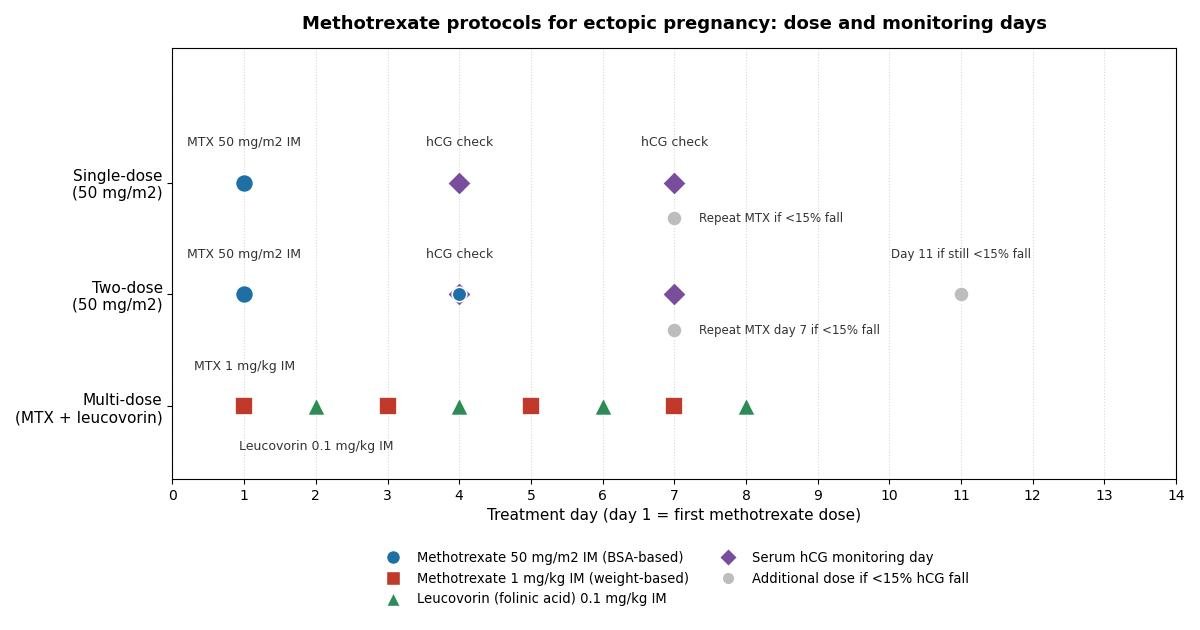
Single-dose protocol. Methotrexate 50 mg per square meter of body surface area is given as a single intramuscular injection on day 1. Serum hCG is measured on post-treatment day 4 and day 7. If the decrease between day 4 and day 7 is greater than 15 percent, hCG is then measured weekly until it reaches the nonpregnant level. If the decrease is less than 15 percent, methotrexate 50 mg per square meter is readministered and hCG is measured on days 4 and 7 after the second dose; this can be repeated as necessary. If hCG does not decrease after two doses, surgical management should be considered. Leucovorin is not used in the single-dose protocol.
Two-dose protocol. Methotrexate 50 mg per square meter is given intramuscularly on day 1 and again on day 4. Serum hCG is measured on days 4 and 7, and a decrease of at least 15 percent between day 4 and day 7 is expected. If the decrease is greater than 15 percent, hCG is measured weekly until the nonpregnant level. If the decrease is less than 15 percent, methotrexate 50 mg per square meter is readministered on day 7 and hCG is checked on day 11. If hCG falls by at least 15 percent between day 7 and day 11, weekly monitoring continues until the nonpregnant level. If the fall is still less than 15 percent between day 7 and day 11, another dose of methotrexate 50 mg per square meter is given on day 11 with hCG checked on day 14. If hCG does not decrease after four doses, surgical management should be considered. Note that some sources number the first treatment day as day 0, but the calculator and chart here use day 1 for the first dose, matching the ACOG box.
Fixed multi-dose protocol. Methotrexate 1 mg per kg is given intramuscularly on days 1, 3, 5, and 7, alternating with folinic acid (leucovorin) 0.1 mg per kg intramuscularly on days 2, 4, 6, and 8. Leucovorin is a reduced folate that rescues normal cells from methotrexate toxicity, allowing higher cumulative doses to be used. Serum hCG is measured on the methotrexate dose days and treatment continues until hCG has fallen by 15 percent from its previous measurement. Importantly, hCG may rise initially above the pretreatment value, so the first measurement is compared against the most recent one rather than the baseline; after a 15 percent fall is achieved, hCG is monitored weekly until the nonpregnant level. If hCG plateaus or rises, repeating methotrexate with the same regimen can be considered.
Reported success rates help put the protocols in context. In pooled data, the single-dose regimen achieved successful resolution without surgery in about 87 percent of cases across 304 patients, although 11.5 percent of participants needed more than one dose. The multi-dose regimen achieved successful resolution in about 94 percent of 325 cases in studies published between 1982 and 1997, with about 79 percent of tested women showing patent fallopian tubes afterward. A meta-analysis found the multi-dose regimen more effective than the single dose, though the two have not always been compared directly in randomized trials. Success is always judged by the same laboratory standard: the 15 percent hCG fall.
hCG monitoring and the 15 percent rule
The single number that defines treatment success is a fall of at least 15 percent in serum hCG between day 4 and day 7 after the dose. Patients and clinicians should know that hCG levels may actually rise or plateau between days 1 and 4 before they start to fall, because syncytiotrophoblast cells can keep producing hCG for a few days after methotrexate treatment; this early rise is expected and is not by itself a sign of treatment failure. Once the 15 percent fall is documented, hCG is measured weekly until it reaches the nonpregnant level, which usually takes several weeks. If hCG plateaus or increases during follow-up, repeating methotrexate for treatment of a persistent ectopic pregnancy should be considered. During treatment, a transient episode of abdominal pain can occur 3 to 7 days after the start of therapy and can last 4 to 12 hours; this can reflect a tubal bleed, hematoma formation, or tubal abortion as the pregnancy tissue separates, but it must be distinguished from tubal rupture, which is an indication for emergency surgery. Clinical indications for surgery are abdominal pain that is severe and persistent beyond 12 hours, signs of low blood pressure on standing, or falling hematocrit values.
Contraindications and the safety checklist
The ACOG contraindications to methotrexate therapy divide into absolute and relative categories, and the calculator's checklist above mirrors them. The absolute contraindications are: an intrauterine pregnancy, evidence of immunodeficiency, moderate to severe anemia, leukopenia, or thrombocytopenia, known sensitivity to methotrexate, active pulmonary disease, active peptic ulcer disease, clinically important hepatic dysfunction, clinically important renal dysfunction, breastfeeding, a ruptured ectopic pregnancy, a hemodynamically unstable patient, and inability to participate in follow-up. Each has a clear rationale: methotrexate is teratogenic and will destroy a wanted intrauterine pregnancy; it suppresses bone marrow and is toxic to liver and kidney; it can provoke pneumonitis in diseased lungs and ulceration in the gastrointestinal tract; it passes into breast milk and can accumulate in neonatal tissues; and without follow-up, treatment failure or rupture can go undetected. The relative contraindications, where treatment can be considered with caution and counseling, are: embryonic cardiac activity detected on transvaginal ultrasound, a high initial hCG concentration above 5,000 mIU per mL, an ectopic pregnancy larger than 3.5 to 4 cm on transvaginal ultrasound, and refusal to accept blood transfusion. Higher hCG and larger masses carry higher failure rates, so many clinicians prefer the two-dose or multi-dose regimen, or surgery, in those situations.
Side effects and what to expect after the injection
Methotrexate is generally well tolerated at the doses used for ectopic pregnancy, but patients should be warned about the common effects. These include nausea and vomiting, mouth sores (stomatitis), a transient mild elevation of liver enzymes, and the abdominal pain described above occurring 3 to 7 days after the injection. Because methotrexate causes photosensitivity dermatitis, patients should avoid sun exposure for about a week. Nonsteroidal anti-inflammatory drugs should be avoided for 72 hours after the injection because of potential drug interactions with methotrexate. Folic acid or prenatal vitamin supplements should be stopped, since folate counteracts the drug. Sexual intercourse should be avoided until hCG is undetectable, and pelvic examinations should be avoided until hCG has normalized, because of the theoretical risk of provoking tubal rupture. Rh-negative women should receive anti-D immunoglobulin because of the risk of alloimmunization. The most serious complication is ruptured ectopic pregnancy, which can occur even after treatment has begun; warning signs needing immediate emergency care are severe abdominal pain, signs of hemodynamic instability such as fainting or dizziness on standing, heavy vaginal bleeding, and shoulder tip pain. Patients also need to know that the ectopic mass may appear to enlarge on ultrasound after treatment because of hematoma formation, which does not by itself mean failure.
After treatment and future pregnancy
Follow-up continues with weekly hCG measurements until the level is undetectable, which confirms complete resolution. Most guidelines advise waiting about 3 months after methotrexate treatment before attempting another pregnancy, because the drug is a folate antagonist that can persist in tissues, and reliable contraception should be used during treatment and the waiting period. The good news is that successful medical treatment preserves the fallopian tube: in the multi-dose studies, about 79 percent of tested women had patent tubes afterward, and among women hoping to conceive, about 58 percent had a subsequent intrauterine pregnancy while about 7 percent had a recurrent ectopic pregnancy. These figures support counseling that fertility is generally preserved after successful methotrexate treatment, while acknowledging that a future ectopic pregnancy remains possible. Anyone with a history of ectopic pregnancy should seek early ultrasound in the next pregnancy.
Related calculators
Browse the full women's health calculator collection on Doctor With Data, or return to the main calculator index for tools across all categories.
Key takeaways
- For the single-dose and two-dose protocols, methotrexate is dosed by body surface area at 50 mg per square meter, so you need the patient's height and weight to compute BSA with the Du Bois formula.
- The three published protocols are: (1) single-dose: methotrexate 50 mg per square meter intramuscularly on day 1; (2) two-dose: methotrexate 50 mg per square meter on days 1 and 4; and (3) fixed multi-dose: methotrexate 1 mg per kg on days 1, 3, 5, and 7, alternating with leucovorin 0.1 mg per kg on days 2, 4, 6, and 8.
- Treatment success is judged by a fall of at least 15 percent in serum hCG between day 4 and day 7 after the dose.
- Absolute contraindications include breastfeeding, evidence of immunodeficiency, moderate to severe anemia, leukopenia, or thrombocytopenia, active pulmonary disease, active peptic ulcer disease, clinically important liver or kidney dysfunction, known sensitivity to methotrexate, a ruptured ectopic pregnancy, hemodynamic instability, and inability to attend follow-up.
Frequently asked questions
How is the methotrexate dose calculated for ectopic pregnancy?
For the single-dose and two-dose protocols, methotrexate is dosed by body surface area at 50 mg per square meter, so you need the patient's height and weight to compute BSA with the Du Bois formula. For the multi-dose protocol, methotrexate is dosed by body weight at 1 mg per kg, with leucovorin rescue at 0.1 mg per kg, so only weight is needed.
What are the three ACOG methotrexate protocols for ectopic pregnancy?
The three published protocols are: (1) single-dose: methotrexate 50 mg per square meter intramuscularly on day 1; (2) two-dose: methotrexate 50 mg per square meter on days 1 and 4; and (3) fixed multi-dose: methotrexate 1 mg per kg on days 1, 3, 5, and 7, alternating with leucovorin 0.1 mg per kg on days 2, 4, 6, and 8. All three come from the ACOG Practice Bulletin on tubal ectopic pregnancy.
What hCG drop confirms that methotrexate treatment is working?
Treatment success is judged by a fall of at least 15 percent in serum hCG between day 4 and day 7 after the dose. If the fall is less than 15 percent, another methotrexate dose is given according to the protocol, and hCG is then monitored weekly until it reaches the nonpregnant level.
Who should not receive methotrexate for ectopic pregnancy?
Absolute contraindications include breastfeeding, evidence of immunodeficiency, moderate to severe anemia, leukopenia, or thrombocytopenia, active pulmonary disease, active peptic ulcer disease, clinically important liver or kidney dysfunction, known sensitivity to methotrexate, a ruptured ectopic pregnancy, hemodynamic instability, and inability to attend follow-up. Relative contraindications include embryonic cardiac activity, a high initial hCG above 5,000 mIU per mL, an ectopic mass larger than 3.5 cm, and refusal of blood transfusion.
What side effects should patients expect after methotrexate?
Common effects include nausea and vomiting, mouth sores (stomatitis), abdominal pain 3 to 7 days after the injection as the tube expels tissue, and a temporary rise in liver enzymes. Patients should avoid sun exposure, NSAIDs, folic acid supplements, sexual intercourse, and pelvic examinations until hCG is undetectable, and should seek emergency care for severe abdominal pain, fainting, or heavy bleeding, which can signal tubal rupture.
How long after methotrexate should a patient wait before trying to conceive again?
Most guidelines advise waiting about 3 months after methotrexate treatment before attempting another pregnancy, because the drug is a folate antagonist and persists in tissues. Reliable contraception should be used during treatment and the waiting period.
References
- American College of Obstetricians and Gynecologists. Practice Bulletin No. 193: Tubal Ectopic Pregnancy. Protocols for methotrexate administration (single-dose, two-dose, and fixed multi-dose regimens), the 15 percent hCG fall criterion between days 4 and 7, and the contraindications to methotrexate therapy.
- Creogsovercoffee. Methotrexate notes summarizing ACOG Practice Bulletin 191/193: three regimens, absolute and relative contraindications, and the 14.3 percent failure rate at hCG above 5,000 mIU per mL versus 3.7 percent below that level. https://creogsovercoffee.com/notes/tag/methotrexate
- Medscape. Ectopic Pregnancy: Diagnosis and Management, medical management section: multi-dose protocol details, pretreatment laboratory testing, expected early hCG rise, transient abdominal pain, and indications for surgery. https://www.medscape.com/viewarticle/568726_5
- OBG Management (mdedge.com). Ectopic pregnancy: a 5-step plan for medical management: pooled success rates of 87.2 percent for single-dose (6 studies, 304 patients) and 93.8 percent for multi-dose therapy (12 studies, 325 cases). https://www.mdedge.com/obgyn/article/61686/ectopic-pregnancy-5-step-plan-medical-management/page/0/2?channel=49
- Doncaster and Bassetlaw Teaching Hospitals NHS Foundation Trust. Medical management of ectopic pregnancy with methotrexate patient leaflet: about 90 percent effectiveness, 7 percent still requiring surgery, the day 4 and 7 hCG checks, the 15 percent fall expectation, and the 3-month wait before conceiving. https://www.dgt.nhs.uk/application/files/5917/3462/4071/Medical_Management_of_Ectopic_Pregnancy_with_Methotrexate_new_leaflet.docx.pdf
- MultiCare Health System. Methotrexate for ectopic pregnancy physician order set (2025): height and weight required for BSA dosing, calculated dose rounded to the nearest 5 mg, doses above 75 mg divided into two injections, and post-injection patient instructions including avoiding NSAIDs for 72 hours and sun exposure for 1 week. https://www.multicare.org/wp-content/uploads/2025/02/78-0027-9MR-Methotrexate-for-Ectopic-Pregnancy-Amb.pdf
- American College of Obstetricians and Gynecologists
- WHO: Women's Health