Ovulation Calculator: Find Your Fertile Window and Peak Days
In short: Estimate your ovulation date, fertile window, and peak fertility days from your last period start date and average cycle length. Built on the 14-day luteal phase method with timing data from Wilcox et al. (NEJM 1995). Use the calculator above, then read the guide below to interpret your result and its limitations.
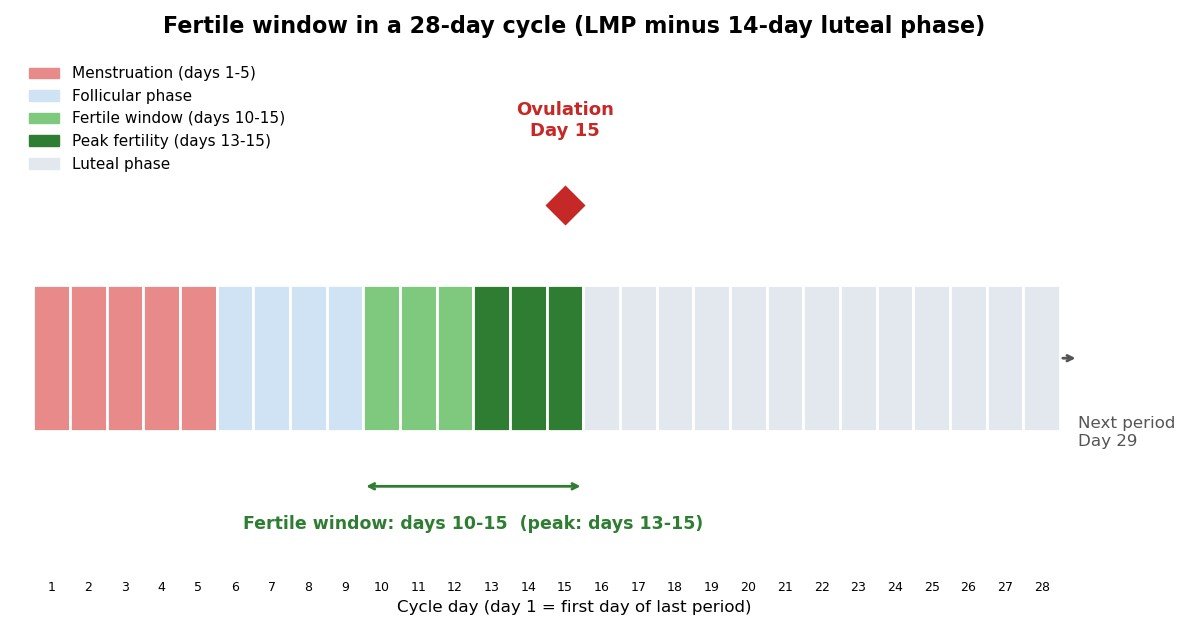
Enter the first day of your last period and your average cycle length to estimate your ovulation date, your fertile window, your next expected period, and your peak fertility days. The estimate uses the standard 14-day luteal phase method: ovulation is assumed to occur about 14 days before the next period, and the fertile window covers the five days before ovulation plus ovulation day itself, matching the six-day fertile window reported by Wilcox et al. in the New England Journal of Medicine in 1995.
The Calculator
| Estimated ovulation date | |
|---|---|
| Fertile window | |
| Peak fertility days | |
| Next expected period | |
| Cycle day of estimated ovulation |
How this calculator estimates your ovulation
The calculator above uses a method that reproductive medicine has relied on for decades: it counts backwards from your next expected period. The phase of the cycle between ovulation and the start of the next period is called the luteal phase, and it is remarkably consistent. For most women it lasts about 14 days, typically in a range of 12 to 16 days. Because the luteal phase is the stable part of the cycle, estimating ovulation as 14 days before the next expected period works far better than simply guessing the middle of the cycle.
Here is the arithmetic. You enter the first day of your last period and your average cycle length in days. Adding the cycle length to your last period start gives the next expected period. Subtracting 14 days from that date gives the estimated ovulation day. For example, with a last period starting on 1 January and a 28-day cycle, the next period is expected on 29 January, and 14 days earlier is 15 January, the estimated ovulation date. The fertile window then runs five days before ovulation through ovulation day itself, and the peak days are the two days before ovulation plus ovulation day.
Why count backwards rather than forwards? Because the part of the cycle before ovulation, the follicular phase, is where almost all the variation between cycles lives. Stress, illness, travel, and the natural shortening of cycles with age mostly shift the follicular phase, while the luteal phase stays close to 14 days. That is the biological reason a "next period minus 14" estimate beats a "day 14 of the cycle" guess, especially when your cycle is not exactly 28 days.
Why the fertile window lasts about six days
You can only conceive during a short stretch of each cycle, known as the fertile window. The reason it is wider than a single day comes down to the two very different lifespans of the cells involved. Sperm can survive inside the female reproductive tract for up to five days after intercourse, waiting in the fallopian tubes. The released egg, by contrast, stays viable for only about 12 to 24 hours after ovulation. Put those two facts together and you get a window that opens about five days before ovulation and closes on ovulation day itself.
This is not just theory. In a landmark 1995 study published in the New England Journal of Medicine, Wilcox and colleagues tracked 625 menstrual cycles in healthy women trying to conceive, pinning down the day of ovulation with urinary hormone measurements. They found that nearly all 192 pregnancies could be attributed to intercourse during a six-day period ending on the estimated day of ovulation. A 2023 Cochrane review of timed intercourse for couples trying to conceive describes the fertile window the same way: approximately six days when conception can take place, reflecting the limited lifespan of sperm and egg.
Notice what this means for timing. Intercourse on any of the five days before ovulation can lead to pregnancy because the sperm simply wait for the egg. Intercourse on the day of ovulation works because the egg is still fresh. Once that short egg-viability window passes, the chance of conception in that cycle is essentially gone, which is why identifying the window in advance matters so much more than reacting after ovulation.
Your chances on each day of the fertile window
Not all days of the fertile window are equal. The Wilcox study estimated day-specific probabilities of conception among healthy women trying to conceive, and the pattern is clear: the closer intercourse is to ovulation, the higher the chance. The probability was about 0.10 when intercourse occurred five days before ovulation and rose to about 0.33 on the day of ovulation itself. The two days before ovulation sit at the top of the range, with probabilities near 0.30.
That is why the calculator highlights peak fertility days: the two days before estimated ovulation and ovulation day. If you can only pick a few days to focus on, those three give you the best odds per act of intercourse. A Cochrane review of timed intercourse echoes the point, noting that intercourse one to two days before ovulation is believed to carry the highest probability of conception.
One caution keeps these numbers honest. The Wilcox day-specific probabilities apply to the estimated day of ovulation, and real ovulation days scatter around the estimate. In follow-up work by the same research group, only about 10 percent of women with 28-day cycles ovulated exactly 14 days before their next period, and the day of ovulation ranged from 7 to 19 days before menstruation. So treat the peak-day marker as the center of your best-effort timing, not as a guarantee of what is happening inside your body that morning.
How to time intercourse when trying to conceive
If you are actively trying to conceive, the practical strategy is simple: have intercourse regularly through the fertile window rather than aiming at a single day. Because sperm survive for up to five days, intercourse every one to two days across the six-day window covers the whole period when the egg might arrive. This removes the pressure of pinpointing one morning and matches what the biology actually rewards.
Some couples worry about whether frequent intercourse lowers sperm quality enough to hurt their chances. The Wilcox researchers checked this directly in their data: cycles with more frequent intercourse did not produce fewer pregnancies than the day-specific probabilities predicted. For couples with normal semen parameters, having intercourse every day or every other day through the fertile window is a sound approach.
Avoid making the window narrower than it is. A common mistake is to treat ovulation day as the only day that matters and to skip the days before it. The data show the opposite: sperm deposited a day or two before ovulation have some of the highest success rates of all, because they are already in place when the egg is released. Starting intercourse at the beginning of the estimated fertile window and continuing through ovulation day covers both the waiting-sperm strategy and ovulation day itself.
Body signs and tests that confirm ovulation is near
A calendar estimate is a good starting point, but combining it with your body's signals makes your timing far more reliable. The most practical home tool is an ovulation predictor kit, which detects the luteinizing hormone (LH) surge in urine. Ovulation typically follows the LH peak by about 10 to 12 hours, so a positive test means your peak fertility days are happening right now, and it can correct a calendar estimate that is off by a day or two.
Cervical mucus is the free, always-available signal. In the days leading up to ovulation, rising estrogen makes the mucus clear, stretchy, and slippery, often described as resembling raw egg white. This fertile-quality mucus helps sperm survive and swim, and its appearance lines up closely with the opening of the fertile window. When the mucus turns thick and cloudy again after ovulation, the window is closing.
Basal body temperature tells a different, retrospective story. Your resting temperature rises slightly, usually less than a degree, within 12 to 24 hours after ovulation, and it stays elevated until your next period. A sustained rise confirms that ovulation did happen, which is useful for learning your personal pattern over several cycles, but it arrives too late to help with timing in the current cycle. Many people use temperature charting to validate and refine their calendar estimates for future months.
Some women also notice mittelschmerz, a mild one-sided cramp or twinge around ovulation, along with breast tenderness or a rise in libido. These signs are real but inconsistent: not everyone feels them, and they are too imprecise to time intercourse by. Use them as supporting clues alongside a predictor kit or mucus tracking, not as the plan itself.
When a calendar estimate is less reliable
The 14-day luteal phase method assumes your cycles are reasonably regular, and its accuracy falls when they are not. If your cycle length swings by more than a few days from month to month, an average built from past cycles can easily misplace ovulation by several days in either direction. The Wilcox data are a useful reality check here: even among women with textbook 28-day cycles, the fertile window landed in different places for different women, and standard clinical guidelines predicted the fertile days correctly for only a minority.
Irregular cycles have common, treatable causes. Polycystic ovary syndrome can make ovulation infrequent or absent. Thyroid disorders, significant weight changes, intense exercise, and high stress can all stretch, shorten, or skip cycles. Certain medications affect ovulation too. If your cycles are consistently shorter than 21 days or longer than 35 days, the calendar arithmetic becomes a rough guess, and ovulation predictor kits or follicular tracking with a clinician will serve you better. This calculator flags cycle lengths outside the 21 to 35 day range with exactly this warning.
Perimenopause brings its own unpredictability. In the years before menopause, hormone fluctuations make ovulation erratic and some cycles anovulatory, meaning no egg is released at all. A calendar tool cannot detect anovulatory cycles, so perimenopausal women trying to conceive, or trying to understand their cycles, should rely on direct signs and clinical guidance rather than date math alone.
When to see a doctor about fertility
Calendar tools help with timing, but they cannot fix a conception problem, and there are clear points at which professional evaluation beats another month of charting. The standard clinical guidance is straightforward: if you are under 35 and have been having regular unprotected intercourse for 12 months without conceiving, see a clinician for a fertility workup. If you are 35 or older, that threshold drops to 6 months, because fertility declines more steeply from the mid-30s and earlier evaluation leaves more options open.
See a doctor sooner, regardless of how long you have been trying, if your periods are absent for three months or more, if cycles are consistently very irregular, if you have known conditions that affect ovulation such as PCOS or endometriosis, if you have a history of pelvic infection or surgery, or if a male partner has known fertility concerns. Bring your cycle tracking data with you: several months of recorded cycle lengths, fertile window estimates, and any ovulation test results give the clinician a genuine head start.
A fertility evaluation usually starts simply, with hormone blood tests timed to your cycle, a semen analysis for the male partner, and often an ultrasound to check the ovaries and uterus. Many causes of delayed conception identified at this stage are treatable, which is the strongest argument for not waiting too long before asking for help.
A clear word on using this tool to prevent pregnancy
This calculator is built for one purpose: helping people time intercourse when they are trying to conceive. It must not be used as a contraceptive method. Calendar-based prediction is far too imprecise for pregnancy prevention. Ovulation can arrive days earlier or later than the estimate, sperm survive for up to five days, and a single misjudged day can result in pregnancy. The research summarized above shows that standard calendar guidelines misidentify the fertile days for most women.
If avoiding pregnancy is your goal, use a proven contraceptive method and discuss the options with a clinician. Modern contraception, from long-acting reversible methods to daily pills, is orders of magnitude more reliable than any calendar estimate. The fertile window knowledge on this page is still useful to you: understanding when pregnancy is possible helps you use contraception consistently and correctly through the whole cycle.
Key takeaways
- It takes the first day of your last period and your average cycle length, adds the cycle length to get the next expected period, then subtracts 14 days to estimate ovulation, because the luteal phase between ovulation and the next period is about 14 days for most cycles.
- It is an estimate, not a measurement.
- The highest conception chances fall on the two days before ovulation and the day of ovulation itself.
- It is very unlikely but not impossible, because the true day of ovulation can differ from the estimate.
Frequently asked questions
How does an ovulation calculator estimate the fertile window?
It takes the first day of your last period and your average cycle length, adds the cycle length to get the next expected period, then subtracts 14 days to estimate ovulation, because the luteal phase between ovulation and the next period is about 14 days for most cycles. The fertile window is set as the five days before estimated ovulation plus ovulation day itself, matching the six-day fertile window reported in Wilcox et al. (NEJM 1995).
How accurate is an ovulation calculator?
It is an estimate, not a measurement. In the Wilcox 2000 follow-up data, only about 10 percent of women with 28-day cycles ovulated exactly 14 days before their next period, and the day of ovulation ranged from 7 to 19 days before menstruation. So a calendar estimate can be off by several days, especially if your cycles vary in length, and it should be combined with body signs or ovulation tests when timing matters.
What are my most fertile days?
The highest conception chances fall on the two days before ovulation and the day of ovulation itself. In Wilcox et al. (NEJM 1995), day-specific conception probabilities were about 0.33 on the day of ovulation, roughly 0.31 one day before, and 0.10 five days before, among healthy women trying to conceive.
Can I get pregnant if I have intercourse outside the fertile window?
It is very unlikely but not impossible, because the true day of ovulation can differ from the estimate. In Wilcox et al. (NEJM 1995), nearly all 192 pregnancies in 625 cycles could be attributed to intercourse during the six-day window ending on the estimated day of ovulation. Intercourse outside that window produced essentially no pregnancies in that dataset.
Can I use an ovulation calculator to avoid pregnancy?
No. Calendar-based estimates are too unreliable for contraception: ovulation timing varies widely between women and even between cycles in the same woman, and most other ovulation calculators, including this one, warn that they are for conception planning only. If you want to avoid pregnancy, use a proven contraceptive method and discuss options with a clinician.
I have irregular cycles or am in perimenopause. Can I use this calculator?
A calendar estimate is much less reliable with irregular cycles, because the arithmetic assumes a stable average cycle length that irregular cycles do not have. In perimenopause, ovulation becomes unpredictable and some cycles are anovulatory. Track your actual cycle lengths for several months first, use ovulation predictor kits or cervical mucus tracking alongside the calendar, and see a clinician if cycles are consistently irregular or absent.
References
- Wilcox AJ, Weinberg CR, Baird DD. Timing of sexual intercourse in relation to ovulation: effects on the probability of conception, survival of the pregnancy, and sex of the baby. N Engl J Med. 1995;333(23):1517-1521. DOI: 10.1056/NEJM199512073332301. Reported a six-day fertile window ending on the estimated day of ovulation, with day-specific conception probabilities from 0.10 five days before ovulation to 0.33 on the day of ovulation.
- Wilcox AJ, Dunson D, Baird DD. The timing of the "fertile window" in the menstrual cycle: day specific estimates from a prospective study. BMJ. 2000;321(7270):1259-1262. Found that only about 10 percent of women with 28-day cycles ovulated exactly 14 days before the next period, with ovulation occurring 7 to 19 days before menstruation.
- Gibbons T, Reavey J, Georgiou EX, Becker CM. Timed intercourse for couples trying to conceive. Cochrane Database Syst Rev. 2023. Describes the fertile window as approximately six days reflecting the limited lifespan of sperm and egg, and notes that intercourse one to two days before ovulation is believed to carry the highest probability of conception.
- Stanford JB, White GL, Hatasaka H. Timing intercourse to achieve pregnancy: current evidence. Obstet Gynecol. 2002;100(6):1333-1341. Evidence review supporting peak conception probability with intercourse one to two days before ovulation.
- American College of Obstetricians and Gynecologists
- WHO: Women's Health