Perimenopause Symptom Score Calculator
Based on the validated Menopause Rating Scale (MRS): 11 symptoms, three domains, one total score from 0 to 44. Answer every question honestly about the past month, then get your score and its published severity band instantly. Everything runs in your browser; nothing is uploaded or stored.
In short: Based on the validated Menopause Rating Scale (MRS): 11 symptoms, three domains, one total score from 0 to 44. Answer every question honestly about the past month, then get your score and its published severity band instantly. Everything runs in your browser; nothing is uploaded or stored. Use the calculator above, then read the guide below to interpret your result and its limitations.
The calculator
For each symptom, choose the option that best describes how you have felt. 0 means the symptom was not present at all; 4 means it was very severe.
What the Menopause Rating Scale measures
The Menopause Rating Scale, usually shortened to MRS, is one of the most widely used questionnaires for capturing how menopause-related symptoms affect daily life. It was developed in the early 1990s by Professor Heinemann at the Center of Epidemiology and Health Research in Berlin, first used in 1992, and formally evaluated in a representative German sample of 689 women aged 40 to 60 in 1996. Since then it has been translated into many languages and used in research and clinical practice around the world. A large validation study of the scale analysed data from 9,311 women with a mean age of 49.8 years (standard deviation 6.4), of whom 51.9% were perimenopausal and 48.1% postmenopausal.
What the MRS measures is health-related quality of life as impaired by menopausal complaints. That is a deliberate choice. Rather than asking whether you are in perimenopause (a question answered by your bleeding pattern and, where needed, a clinical assessment), it asks how much each of 11 typical symptoms is bothering you. This makes it a practical tool for two jobs: getting a snapshot of your current symptom burden, and tracking change over time, for example to see whether a treatment or a lifestyle change is actually helping. The validation study showed that the scale is sensitive to improvement after therapy across all three of its domains, which is why researchers use it as an outcome measure in trials of menopause treatments.
Because the MRS is short, plainly worded and self-completed, it is also useful as a conversation starter with a clinician. Many women find it hard to describe a mix of physical, emotional and intimate symptoms in a short appointment. Walking in with a completed score, plus the knowledge of which domain bothers you most, can make that conversation far more productive. Nothing about the scale replaces clinical judgement, but it gives structure to something that is often experienced as a confusing blur of unrelated complaints.
The 11 symptoms and the three domains
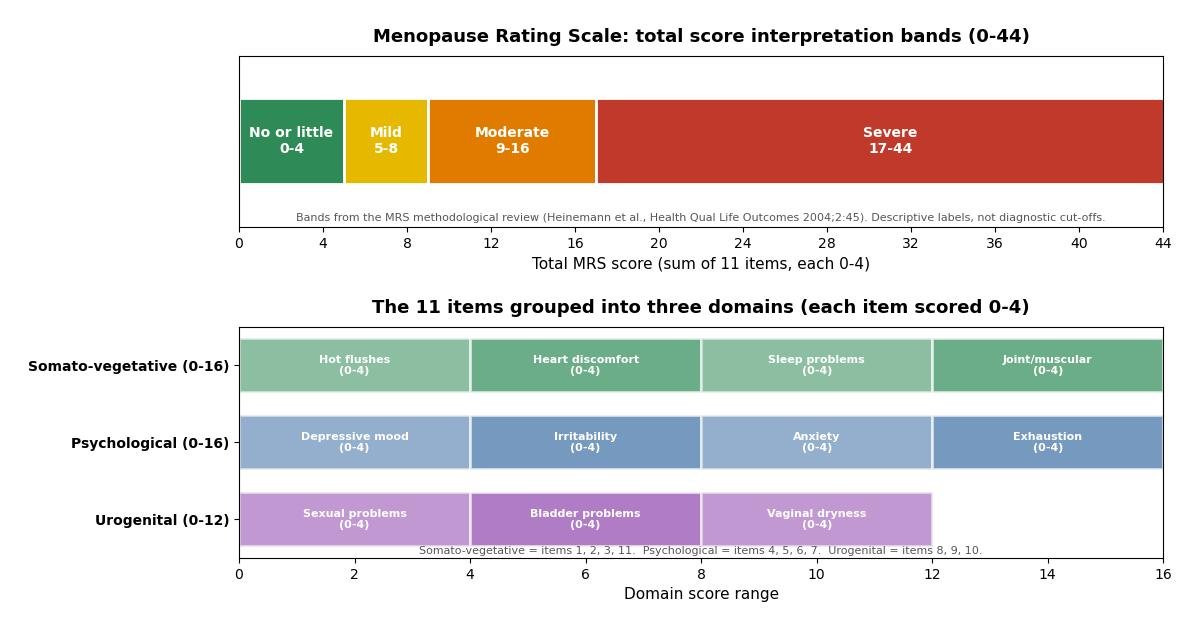
The 11 items of the MRS are not a random list. They fall into three domains that reflect the different ways the menopause transition shows up in the body and mind. The somato-vegetative domain (items 1, 2, 3 and 11) covers the bodily symptoms: hot flushes and sweating, heart discomfort such as palpitations or a racing heart, sleep problems, and joint and muscular discomfort. The psychological domain (items 4, 5, 6 and 7) covers depressive mood, irritability, anxiety, and physical and mental exhaustion, including the poor concentration and forgetfulness many women describe as brain fog. The urogenital domain (items 8, 9 and 10) covers sexual problems, bladder problems such as urgency or leaking, and vaginal dryness.
| Domain | Items | Score range |
|---|---|---|
| Somato-vegetative | 1. Hot flushes, sweating 2. Heart discomfort 3. Sleep problems 11. Joint and muscular discomfort | 0 to 16 |
| Psychological | 4. Depressive mood 5. Irritability 6. Anxiety 7. Physical and mental exhaustion | 0 to 16 |
| Urogenital | 8. Sexual problems 9. Bladder problems 10. Vaginal dryness | 0 to 12 |
Each symptom is rated on a five-point scale from 0 (none) to 4 (very severe), where 1 is mild, 2 is moderate and 3 is severe. The domain scores are the sums of their items, so the two four-item domains each range from 0 to 16 and the three-item urogenital domain ranges from 0 to 12. The total MRS score is the sum of all 11 items and ranges from 0 to 44. Looking at the domain scores separately is often more revealing than the total alone: a woman with a moderate total driven entirely by the psychological domain needs a different conversation from one whose score is driven by urogenital symptoms.
How your score is worked out
This calculator follows the standard MRS scoring exactly. It adds your 11 answers (each 0 to 4) to give the total from 0 to 44, and adds the relevant items for each of the three domain subscores. Every question must be answered; the tool will tell you if any are missing rather than guessing. The published severity bands for the total score are: no or little complaints, 0 to 4; mild, 5 to 8; moderate, 9 to 16; severe, 17 and above. These bands come from the methodological review of the scale published in Health and Quality of Life Outcomes in 2004.
There are also published bands for each domain, which this calculator shows alongside your subscores. For the somato-vegetative domain the bands are no or little 0 to 2, mild 3 to 4, moderate 5 to 8 and severe 9 and above. For the psychological domain they are no or little 0 to 1, mild 2 to 3, moderate 4 to 6 and severe 7 and above. For the urogenital domain they are no or little 0, mild 1, moderate 2 to 3 and severe 4 and above. A note of honesty is needed here: a second published paper, the 2004 validation study of the MRS as an outcome measure, used slightly different total-score bands (moderate 9 to 15, severe 16 and above). This calculator uses the more widely quoted version from the methodological review. The difference only affects a total of exactly 16.
What the severity bands mean, and what they do not
The bands are descriptive labels for how much your symptoms are currently impairing your quality of life. A score of 0 to 4 means no or few complaints: you may be in perimenopause with barely any symptoms, or you may not be in the transition at all. Scores of 5 to 8 (mild) and 9 to 16 (moderate) describe increasing levels of bother that many women experience during the transition years. A score of 17 or more (severe) describes a heavy symptom burden that is very likely to be affecting sleep, work or relationships, and is a strong prompt to seek help rather than endure it.
Crucially, the bands are not diagnostic. There is no score that proves you are in perimenopause and no score that rules it out. Menopause itself is diagnosed from your bleeding history: menopause is the final menstrual period, recognised after 12 consecutive months without a period, and perimenopause is the transition leading up to it, defined by changes in cycle regularity. The MRS also cannot tell you what is causing a symptom. Low mood, poor sleep and joint aches are common in perimenopause but also have many other causes, from thyroid disorders to depression to ordinary midlife stress. A high score means your symptoms deserve attention; it does not tell you their cause.
It also helps to know that these symptoms are extremely common. In the UK the mean age of natural menopause is 51, with most women reaching menopause between 45 and 55. NICE estimates that about 84% of women experience one or more of the classic menopausal symptoms, and about 70% have vasomotor symptoms such as hot flushes and sweats. For most these are short lived, but in around 25% they cause significant problems, and in about 10% of symptomatic women they can last up to 15 years. A moderate or severe MRS score therefore puts you in large company, and effective help exists.
Perimenopause in context: the STRAW+10 stages
Clinicians and researchers stage reproductive ageing with an international framework called STRAW+10, the Stages of Reproductive Aging Workshop plus 10, published by Harlow and colleagues in the Journal of Clinical Endocrinology and Metabolism in 2012. It anchors everything on the final menstrual period (stage 0) and defines perimenopause as the early and late menopausal transition. The early transition is marked by a persistent difference of 7 or more days in the length of consecutive cycles. The late transition is marked by gaps of 60 days or more without bleeding and typically lasts 1 to 3 years. After the final period comes early postmenopause (stages +1a to +1c) and then late postmenopause.
This framework explains why perimenopause feels so unpredictable. The early transition is driven by variable ovarian function: some cycles ovulate normally, others do not, and hormone levels swing widely. That variability is exactly what produces the fluctuating pattern of the MRS symptoms. Hot flushes may be intense for a few weeks and then quieten; sleep may be fine until night sweats start waking you; mood may track the hormonal swings. Because of this, a single MRS score is a snapshot, not a verdict. Repeating the questionnaire every month or two, and noting your bleeding pattern alongside it, builds a much more useful picture than any one number.
STRAW+10 also deliberately does not use age to stage the transition, because the timing varies. In the UK the mean age of natural menopause is 51, and women typically enter perimenopause in their mid-40s, but the transition can start earlier or later. Menopause between 40 and 45 is called early menopause, and loss of ovarian function before 40 is called premature ovarian insufficiency; both are associated with greater long-term health risks and deserve specialist input. If your periods changed markedly before your mid-40s, mention that specifically to your clinician rather than assuming it is ordinary perimenopause.
When to seek care: red flags
Most perimenopausal symptoms are benign even when they are miserable, but some bleeding patterns always need prompt medical evaluation. Any vaginal bleeding that occurs after 12 months without a period is called postmenopausal bleeding and must be investigated to exclude endometrial cancer or its precursors. Guidance from the American College of Obstetricians and Gynecologists calls for prompt and efficient evaluation of postmenopausal bleeding; published estimates suggest roughly 10% of women presenting with it turn out to have endometrial cancer, while about 95% of women with endometrial cancer present with bleeding, which is why the symptom must never be ignored.
During perimenopause itself, seek care if your bleeding becomes very heavy or prolonged (for example soaking through protection every hour or two for several hours, or bleeding that lasts far longer than your usual pattern), if you bleed between periods, or if you bleed after sex. These can have benign explanations such as fibroids or polyps, but they need assessment. Beyond bleeding, contact your clinician promptly for chest pain or a racing heart that is new, severe or accompanied by breathlessness or fainting; for mood symptoms that include thoughts of harming yourself; or for any symptom rated severe or very severe on this scale that is disrupting your sleep, work or daily functioning. A severe MRS score is not an emergency by itself, but it is a clear signal that you do not have to just put up with it.
What can help with symptoms
The right approach depends on which symptoms dominate, how much they bother you and your personal medical history, which is why a conversation with a clinician matters more than any generic list. That said, the broad options are well established. For troublesome vasomotor symptoms, menopausal hormone therapy is the most effective treatment for suitable candidates, and NICE guidance supports discussing it with women whose symptoms affect quality of life. Non-hormonal prescription options also exist for hot flushes. Vaginal dryness and related urogenital symptoms often respond to local vaginal oestrogen or moisturisers, which act locally with minimal systemic absorption. Bladder symptoms may improve with pelvic floor exercises as well as treatment of the underlying dryness.
Sleep, mood and exhaustion often improve together when the dominoes are addressed in order: night sweats fragment sleep, broken sleep worsens mood and concentration, and fatigue then colours everything. Practical steps that help many women include keeping the bedroom cool, cutting back on alcohol and caffeine (both can trigger flushes and fragment sleep), regular daytime activity, and a consistent wind-down routine. Cognitive behavioural approaches have good evidence for insomnia and for the distress associated with hot flushes. For mood symptoms that are persistent or severe, the same treatments used for depression outside perimenopause apply, and psychological support should not be delayed while waiting to see whether hormones settle.
Whatever you try, the MRS gives you a way to judge whether it is working. Complete the questionnaire before starting something new and again after a reasonable interval, such as 6 to 12 weeks, and compare the total and the domain scores. The scale was validated precisely for this purpose: in the 2004 validation study, MRS scores fell significantly after six months of hormone treatment across the total scale and all three domains, with the greatest relative improvement in women who started with the most severe scores. Your own before-and-after comparison is one of the most useful things you can bring to a follow-up appointment.
Limits of this tool
This calculator implements the published MRS scoring faithfully, but it has the same limits as the questionnaire itself. It relies entirely on your own ratings, which are subjective by design; two women with identical physiology can score very differently. It covers 11 symptoms and therefore misses others that women commonly associate with the transition, such as weight change, skin changes or headaches. It is a snapshot of recent weeks, and perimenopausal symptoms fluctuate. It has not been individually validated in this web format, though the underlying paper questionnaire has extensive validation. Finally, it gives information, not advice: it cannot weigh your medical history, your risks or your preferences, and it must not be used to start, stop or change any treatment on your own.
Key takeaways
- No.
- The MRS is short (11 items), covers three domains (somato-vegetative, psychological and urogenital) and was designed to measure health-related quality of life, which makes it useful for tracking change over time, for example before and after starting a treatment.
- Perimenopause is driven by fluctuating ovarian function, so symptoms such as hot flushes, sleep disturbance and mood changes genuinely vary from week to week and month to month.
- There is no diagnostic threshold, so no single number means you must seek care.
Frequently asked questions
Is the Menopause Rating Scale the same as a perimenopause diagnosis?
No. The MRS measures how much menopause-related symptoms are bothering you right now; it does not diagnose perimenopause or any other condition. Menopause is diagnosed clinically, usually after 12 months without a period, and perimenopause is defined by changes in your bleeding pattern. The score bands are descriptive labels for symptom burden, not diagnostic cut-offs.
How is the MRS different from other menopause questionnaires?
The MRS is short (11 items), covers three domains (somato-vegetative, psychological and urogenital) and was designed to measure health-related quality of life, which makes it useful for tracking change over time, for example before and after starting a treatment. It was developed in the early 1990s, evaluated in a representative German sample of 689 women aged 40 to 60, and has since been translated into many languages and used internationally.
Why does my score change from month to month?
Perimenopause is driven by fluctuating ovarian function, so symptoms such as hot flushes, sleep disturbance and mood changes genuinely vary from week to week and month to month. A score that moves up or down by a few points between sittings is expected. If you track your score, answer about the same recent period each time (for example the past month) and note anything that changed, such as starting a new treatment.
What score should prompt a conversation with my doctor?
There is no diagnostic threshold, so no single number means you must seek care. As a practical guide, scores in the moderate (9 to 16) or severe (17 and above) bands, any single symptom rated severe or very severe, or any symptom that interferes with work, sleep or daily life is worth discussing with a clinician. Seek prompt care for red flags such as bleeding after 12 months without periods, very heavy bleeding, bleeding between periods, or bleeding after sex.
Can I use this score if I am already postmenopausal or on hormone therapy?
Yes. The MRS was validated in samples that included both perimenopausal and postmenopausal women (in the large validation study, 51.9% were perimenopausal and 48.1% postmenopausal, with a mean age of 49.8 years). If you are on hormone therapy or another treatment, your score simply reflects how you feel now; it is actually designed for exactly this kind of before-and-after comparison.
Are the severity bands the same in every version of the MRS?
Not exactly. Two slightly different published versions exist: the methodological review uses no or little (0 to 4), mild (5 to 8), moderate (9 to 16) and severe (17 and above), while the 2004 outcome-measure validation study used moderate (9 to 15) and severe (16 and above). This calculator uses the first, more widely quoted version. The difference only matters if your total is exactly 16, which falls in the moderate band here and the severe band there.
Sources
- Heinemann LAJ, DoMinh T, Strelow F, Gerbsch S, Schnitker J, Schneider HPG. The Menopause Rating Scale (MRS) scale: a methodological review. Health and Quality of Life Outcomes. 2004;2:45. (11 items scored 0 to 4, total 0 to 44, three domains, and the published severity bands used here.)
- Heinemann LA, Potthoff P, Schneider HPG. The Menopause Rating Scale (MRS) as outcome measure for hormone treatment? A validation study. Health and Quality of Life Outcomes. 2004;2:67. (9,311 women; mean age 49.8, SD 6.4; 51.9% perimenopausal, 48.1% postmenopausal; alternative bands moderate 9 to 15, severe 16 and above; score improvement with treatment.)
- Harlow SD, Gass M, Hall JE, et al. Executive summary of the Stages of Reproductive Aging Workshop + 10. Journal of Clinical Endocrinology and Metabolism. 2012;97(4):1159-1168. (STRAW+10 staging: early transition 7-day cycle variability; late transition 60-day amenorrhoea, 1 to 3 years; perimenopause defined as early plus late transition.)
- National Institute for Health and Care Excellence. Menopause: diagnosis and management. NICE guideline NG23. nice.org.uk/guidance/ng23 (UK mean age of natural menopause 51; about 84% of women experience classic symptoms; about 70% have vasomotor symptoms; around 25% significant morbidity; about 10% of symptomatic women affected up to 15 years.)
- NICE Clinical Knowledge Summary. Menopause: background information, definition. cks.nice.org.uk/topics/menopause/background-information/definition/ (menopause usually 45 to 55; diagnosed after 12 months amenorrhoea; perimenopause characterised by irregular cycles; premature ovarian insufficiency before 40.)
- American College of Obstetricians and Gynecologists. The role of transvaginal ultrasonography in evaluating the endometrium of women with postmenopausal bleeding. Committee Opinion. Obstetrics and Gynecology. 2018;131(5):e124-e129. (Prompt evaluation of postmenopausal bleeding to exclude endometrial carcinoma.)
- Australasian Menopause Society. Bleeding: perimenopausal, postmenopausal and breakthrough bleeding on MHT/HRT. Information sheet. (Postmenopausal bleeding defined as bleeding 12 months after the final period; roughly 10% likelihood of endometrial carcinoma among presenters; about 95% of endometrial malignancies present with bleeding.)