Preeclampsia risk assessment tool
Answer the questions below about your medical history and current pregnancy. The tool counts your high-risk and moderate-risk factors using the lists from the American College of Obstetricians and Gynecologists (ACOG) and the US Preventive Services Task Force (USPSTF), then places you in one of three prevention tiers. If you are experiencing any warning signs right now, the tool will flag them first, whatever your score.
What is preeclampsia?
Preeclampsia is a pregnancy-specific disorder that usually appears after 20 weeks of gestation. It begins with new-onset high blood pressure and can then affect several organ systems, including the kidneys, the liver, blood clotting, the lungs, and the brain. Because it can develop and worsen without obvious symptoms, it is one of the main reasons blood pressure and urine are checked at every antenatal appointment.
The American College of Obstetricians and Gynecologists defines preeclampsia as a systolic blood pressure of 140 mmHg or higher, or a diastolic blood pressure of 90 mmHg or higher, measured on two occasions at least four hours apart after 20 weeks of gestation in a woman with previously normal blood pressure, together with proteinuria: 300 mg or more of protein in a 24-hour urine collection, a protein to creatinine ratio of 0.3 or higher, or a dipstick reading of 2+. Preeclampsia can also be diagnosed without proteinuria when new-onset hypertension is accompanied by a severe feature, such as a low platelet count, impaired liver function, kidney problems, fluid in the lungs, or a new headache or visual disturbance that cannot be explained another way.
Preeclampsia is both common and consequential. The US Preventive Services Task Force notes that it complicates approximately 4% of pregnancies in the United States, and describes it as one of the most serious health problems affecting pregnant people and the second most common cause of maternal morbidity and mortality worldwide. It accounts for 6% of preterm births and 19% of medically indicated preterm births in the US. The definitive treatment is delivery of the baby and placenta, which is why identifying risk early matters so much: prevention has to start weeks before any symptoms could appear.
Why assess your risk early in pregnancy
The only widely recommended preventive treatment for preeclampsia is daily low-dose aspirin, and its window is narrow. The American College of Obstetricians and Gynecologists and the Society for Maternal-Fetal Medicine recommend starting aspirin between 12 and 28 weeks of gestation, optimally before 16 weeks, and continuing it daily until delivery. A risk assessment at the first antenatal visit therefore has a clear purpose: to identify, in time, who should be offered aspirin while it can still help.
Risk assessment for preeclampsia is deliberately simple. Unlike some prediction models that combine blood tests and ultrasound measurements, the approach endorsed by the US Preventive Services Task Force uses only information from the medical history: previous pregnancies, existing health conditions, age, body mass index, and family history. The Task Force notes that more complex models, such as those combining serum biomarkers with uterine artery Doppler ultrasound, have limited evidence from external validation studies to support their routine clinical use. A careful history, taken early, remains the recommended tool, and it is exactly what this assessment reproduces.
High-risk factors for preeclampsia
Six factors place a pregnant person at high risk of preeclampsia. Any single one is enough for the low-dose aspirin recommendation, because each is associated with a substantially raised likelihood of the condition.
Previous preeclampsia
Having had preeclampsia in an earlier pregnancy is one of the strongest predictors of developing it again. The risk is particularly high when the previous episode began early in pregnancy or was accompanied by a serious complication, so this history should always be mentioned at the booking appointment.
Chronic hypertension
High blood pressure that predates the pregnancy, or is diagnosed before 20 weeks of gestation, counts as chronic hypertension. The already strained vascular system is more vulnerable to the placental and inflammatory changes that drive preeclampsia, and blood pressure needs close monitoring throughout.
Pregestational diabetes
Type 1 or type 2 diabetes diagnosed before pregnancy is a high-risk factor. Diabetes affects small blood vessels and kidney function, both of which are closely tied to how preeclampsia develops. Good glucose control before and during pregnancy remains important for many reasons beyond preeclampsia.
Kidney disease
Chronic kidney disease of any cause raises the risk, partly because the kidneys play a central role in blood pressure regulation and partly because proteinuria, a hallmark of preeclampsia, is harder to interpret when kidney function is already impaired.
Autoimmune disease
Conditions such as systemic lupus erythematosus and antiphospholipid syndrome are listed as high-risk factors. These disorders involve chronic inflammation and, in the case of antiphospholipid syndrome, abnormal blood clotting, both of which can disturb normal placental development.
Multifetal gestation
Carrying twins, triplets, or more increases the demand on the placenta and the maternal circulation. The larger placental mass is thought to raise the levels of factors in the blood that contribute to the widespread vascular dysfunction seen in preeclampsia.
Moderate-risk factors for preeclampsia
Eight factors each carry a smaller individual increase in risk. On their own they do not trigger the aspirin recommendation, but any two together do, because the combined risk reaches the level at which prevention is worthwhile.
First pregnancy (nulliparity)
Preeclampsia is more common in a first pregnancy than in later ones. The leading explanation involves the maternal immune adaptation to the placenta, which appears to work more smoothly after a first successful pregnancy.
Pre-pregnancy BMI above 30
Obesity, defined here as a pre-pregnancy body mass index greater than 30, is a moderate-risk factor. Excess adipose tissue is linked to chronic low-grade inflammation and insulin resistance, both of which overlap with the pathways involved in preeclampsia.
Maternal age of 35 or older
The risk of preeclampsia rises with maternal age, and 35 years is the threshold used in the guidance. Age-related changes in blood vessels and a higher background rate of conditions such as hypertension contribute to this increase.
Family history of preeclampsia
Having a mother or sister who had preeclampsia raises your own risk, which points to a genetic component in how susceptible someone is to the condition.
Conception by IVF or assisted reproduction
Pregnancies conceived by in vitro fertilisation or other assisted reproductive technologies carry a moderately increased risk. This factor was added to the guidance in the 2021 USPSTF update as the evidence accumulated.
Sociodemographic characteristics
The USPSTF lists lower income, and notes higher rates among Black persons, as moderate-risk factors. It is explicit that these differences arise from environmental, social, and historical inequities shaping health exposures, access to health care, and the unequal distribution of resources, not from biological propensities. In other words, this factor marks unequal conditions, not unequal bodies.
Previous adverse pregnancy outcome
A history of problems such as a low-birth-weight baby, a small-for-gestational-age baby, or a preterm birth counts as a moderate-risk factor, because these outcomes can reflect the same placental difficulties that underlie preeclampsia.
Ten or more years since the last pregnancy
A long interval since the previous birth, defined as more than 10 years, is a moderate-risk factor. After such a gap, the protective adaptation seen in closely spaced pregnancies appears to fade, and the risk resembles that of a first pregnancy.
How this tool turns your answers into guidance
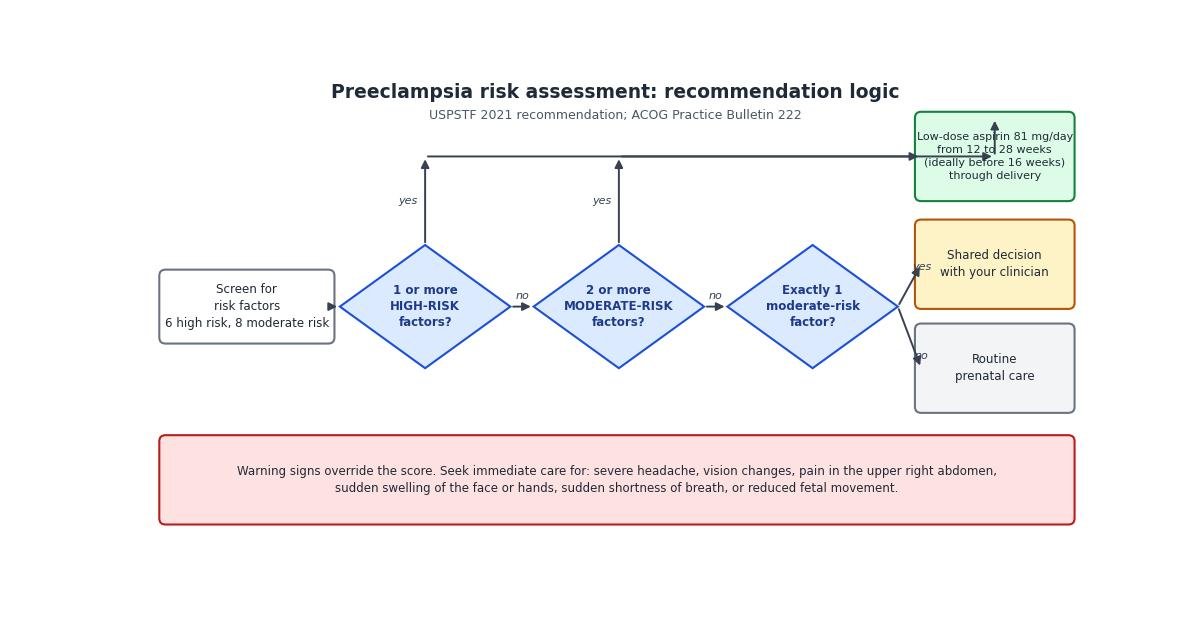
The tool applies the USPSTF 2021 logic exactly as written. It counts your high-risk factors and your moderate-risk factors separately, then assigns one of three tiers. If you report one or more high-risk factors, or two or more moderate-risk factors, you fall into the aspirin tier: daily low-dose aspirin (81 mg) from 12 to 28 weeks of gestation, ideally started before 16 weeks, continued until delivery, is recommended, subject to your clinician confirming it is suitable for you. If you report exactly one moderate-risk factor and no high-risk factors, you fall into the shared decision-making tier: the USPSTF advises that you and your clinician weigh your values, preferences, and clinical judgement together. If you report no risk factors at all, routine antenatal care continues, with its regular blood pressure and urine checks.
Two points deserve emphasis. First, the USPSTF stresses that clinicians should use clinical judgement in assessing risk and should discuss the benefits and harms of aspirin with each patient, because no checklist captures every nuance of an individual history. Second, the tool treats warning signs as a separate, overriding track. A risk score describes the chance of a future problem; a warning sign describes a possible present emergency. If you tick any warning sign, the result tells you to seek immediate care first and shows the risk-factor result second.
You can explore more health calculators from Doctor With Data, all built on published clinical guidance.
Low-dose aspirin: what the evidence shows
The recommendation rests on a substantial body of trial evidence. The systematic review commissioned for the 2021 USPSTF statement pooled 16 randomised trials with more than 14,000 participants at increased risk of preeclampsia. Compared with placebo, low-dose aspirin was associated with a pooled relative risk of 0.85 for preeclampsia (95% confidence interval 0.75 to 0.95), which translates to roughly a 15% relative reduction in risk. The same review found reductions in preterm birth (pooled relative risk 0.80), in babies born small for gestational age or with growth restriction (0.82), and in perinatal mortality (0.79).
On safety, the review is reassuring. Trials did not demonstrate evidence of harms from daily low-dose aspirin during pregnancy. Bleeding complications were uncommon, and pooled results were not statistically significant for placental abruption (relative risk 1.15), postpartum haemorrhage (1.03), or fetal intracranial bleeding (0.90). Weighing these benefits and harms, the Task Force concluded with moderate certainty that there is a substantial net benefit of daily low-dose aspirin for pregnant people at high risk of preeclampsia.
A few practical details matter. The dose studied in trials ranged from 50 to 150 mg per day, and because 81 mg tablets are the standard low-dose preparation in the United States, the USPSTF considers 81 mg daily a reasonable dose for prevention. Aspirin should be started after 12 weeks of gestation; the trials most often started it before 20 weeks, and ACOG and the Society for Maternal-Fetal Medicine advise starting between 12 and 28 weeks, optimally before 16 weeks, and continuing daily until delivery. The recommendation applies to people with no prior adverse effects from, and no contraindications to, low-dose aspirin, which is why the final decision always belongs to your clinician.
What this assessment cannot do
This tool screens for risk factors; it does not predict whether you will develop preeclampsia, and it does not diagnose anything. Most people with one or more risk factors never develop preeclampsia, and a small number of people with no known risk factors do. Risk factors describe groups, and every pregnancy is individual. A result in any tier is a starting point for a conversation with your clinician, not a verdict.
Separately, learn the warning signs and act on them without delay, whatever your score. Seek immediate medical care for a severe headache that does not ease with rest or medication, vision changes such as blurred vision, seeing spots, or flashing lights, pain in the upper right side of the abdomen, sudden swelling of the face, hands, or feet, sudden shortness of breath, or reduced fetal movement. These symptoms can signal preeclampsia, eclampsia, or a related complication such as placental abruption, and they need urgent assessment in a maternity unit or emergency department.
Talking to your clinician about your result
Bring your result to your next antenatal appointment, or book one sooner if the tool placed you in the aspirin tier. Useful questions include: is low-dose aspirin suitable for me given my full medical history; given how many weeks pregnant I am, when should it start; how will my blood pressure and urine be monitored; and are extra growth scans planned for the baby. If you are already past 28 weeks, ask whether starting aspirin is still worthwhile, since the guidance centres on initiation between 12 and 28 weeks. Finally, agree a clear plan for what to do and whom to call if any warning sign appears, including out of hours.
Key takeaways
- Preeclampsia is a pregnancy-specific disorder that usually appears after 20 weeks of gestation.
- No.
- Six factors count as high risk: preeclampsia in a previous pregnancy, chronic (pre-existing) hypertension, pregestational diabetes (type 1 or type 2), kidney disease, an autoimmune disease such as lupus or antiphospholipid syndrome, and carrying twins or more (multifetal gestation).
- Eight factors count as moderate risk: a first pregnancy, a pre-pregnancy body mass index above 30, maternal age of 35 years or older, a mother or sister who had preeclampsia, conception by IVF or other assisted reproductive technology, sociodemographic characteristics linked to higher rates, a previous adverse pregnancy outcome such as low birth weight or preterm birth, and 10 or more years since the last pregnancy.
Frequently asked questions
What is preeclampsia?
Preeclampsia is a pregnancy-specific disorder that usually appears after 20 weeks of gestation. It is defined by new-onset high blood pressure, a systolic reading of 140 mmHg or higher or a diastolic reading of 90 mmHg or higher, together with protein in the urine or signs that an organ system is affected, such as low platelet counts, impaired liver function, or severe headache. It can develop without obvious symptoms, which is why blood pressure and urine are checked at every antenatal appointment. The American College of Obstetricians and Gynecologists sets out the full diagnostic criteria in Practice Bulletin 222.
Does this tool predict whether I will develop preeclampsia?
No. This tool is a risk-factor screen, not a prediction and not a diagnosis. It checks your answers against the high-risk and moderate-risk factor lists used by the American College of Obstetricians and Gynecologists and the US Preventive Services Task Force, and places you in one of three prevention tiers. Having risk factors does not mean you will develop preeclampsia, and having none does not guarantee you will avoid it. Only your midwife, obstetrician, or doctor can assess your individual situation, so take your result to your next appointment.
Which factors count as high risk for preeclampsia?
Six factors count as high risk: preeclampsia in a previous pregnancy, chronic (pre-existing) hypertension, pregestational diabetes (type 1 or type 2), kidney disease, an autoimmune disease such as lupus or antiphospholipid syndrome, and carrying twins or more (multifetal gestation). If any one of these applies to you, the US Preventive Services Task Force supports offering daily low-dose aspirin after clinical review from 12 to 28 weeks of gestation, ideally started before 16 weeks and continued until delivery, subject to your clinician's judgement.
Which factors count as moderate risk?
Eight factors count as moderate risk: a first pregnancy, a pre-pregnancy body mass index above 30, maternal age of 35 years or older, a mother or sister who had preeclampsia, conception by IVF or other assisted reproductive technology, sociodemographic characteristics linked to higher rates, a previous adverse pregnancy outcome such as low birth weight or preterm birth, and 10 or more years since the last pregnancy. Two or more moderate factors support the same clinician discussion about aspirin as one high-risk factor. With exactly one moderate factor, the decision is shared between you and your clinician.
When and how is low-dose aspirin used to prevent preeclampsia?
The US Preventive Services Task Force recommends 81 mg of aspirin daily, started between 12 and 28 weeks of gestation and ideally before 16 weeks, and continued until delivery, for people at high risk of preeclampsia. Its evidence review found that aspirin was associated with a lower risk of preeclampsia, preterm birth, and perinatal mortality, and found no evidence of increased bleeding harms. Aspirin is not suitable for everyone, for example people with an aspirin allergy or certain bleeding disorders, so the final decision always rests with your clinician.
What are the warning signs of preeclampsia?
Seek immediate medical care if you develop a severe headache that does not ease with rest or medication, vision changes such as blurred vision, seeing spots, or flashing lights, pain in the upper right side of the abdomen, sudden swelling of the face, hands, or feet, sudden shortness of breath, or if your baby is moving less than usual. These symptoms can signal preeclampsia or a related complication whatever your risk score, so do not wait for your next scheduled appointment.
References
- American College of Obstetricians and Gynecologists. Gestational hypertension and preeclampsia: ACOG Practice Bulletin, Number 222. Obstet Gynecol. 2020;135(6):e237-e260. doi:10.1097/AOG.0000000000003891. https://doi.org/10.1097/AOG.0000000000003891
- Davidson KW, Barry MJ, Mangione CM, et al. Aspirin use to prevent preeclampsia and related morbidity and mortality: US Preventive Services Task Force recommendation statement. JAMA. 2021;326(12):1186-1191. doi:10.1001/jama.2021.14781. https://doi.org/10.1001/jama.2021.14781
- Henderson JT, Thompson JH, Burda BU, Cantor A. Preeclampsia screening: evidence report and systematic review for the US Preventive Services Task Force. JAMA. 2021;325(16):1633-1647. doi:10.1001/jama.2021.7025. https://doi.org/10.1001/jama.2021.7025
- US Preventive Services Task Force. Aspirin use to prevent preeclampsia and related morbidity and mortality: preventive medication. Final recommendation statement, 28 September 2021. USPSTF recommendation page
- American College of Obstetricians and Gynecologists
- WHO: Women's Health
Medical disclaimer
This tool provides general health information only. It is not a substitute for professional medical advice, diagnosis, or treatment. It does not diagnose preeclampsia and does not predict whether you will develop it. Always discuss your result with your midwife, obstetrician, or doctor, and never start, stop, or change any medication on the basis of this tool alone.
If you experience warning signs such as severe headache, vision changes, upper right abdominal pain, sudden swelling, sudden shortness of breath, or reduced fetal movement, seek urgent medical care immediately.