How pregnancy due dates are calculated
A pregnancy due date, known clinically as the estimated date of delivery (EDD), is calculated from gestational age, not from the age of the embryo. Gestational age is counted from the first day of the last menstrual period (LMP), roughly two weeks before ovulation and conception in a typical cycle. This convention exists because the first day of bleeding is an event most people can date, while the exact moment of conception usually cannot be observed. A full term human pregnancy lasts 280 days, or 40 weeks, from the first day of the LMP, which is equivalent to 266 days, or 38 weeks, from conception.
The classic method is Naegele's rule, named after the German obstetrician Franz Karl Naegele. It can be stated two equivalent ways. The day count version: add 280 days to the first day of the last menstrual period. The calendar version: subtract three months, add seven days, and add one year. For example, if the first day of the last period was 1 January, subtracting three months gives 1 October, adding seven days gives 8 October, and adding one year gives 8 October of the following year. Naegele's rule assumes a regular 28 day cycle with ovulation on day 14. When cycles are consistently longer or shorter, clinicians adjust the estimate by the difference: for a regular 35 day cycle, for instance, ovulation typically occurs about seven days later, so roughly seven days are added to the Naegele estimate. This calculator uses the 280 day form of the rule, which handles month lengths, year changes and leap years exactly.
Four ways to date a pregnancy
1. Last menstrual period: Naegele's rule
LMP dating is the default when the date of the last period is certain and cycles are regular. It needs only one date and applies the 280 day rule. Its weakness is biological: ovulation does not always occur on day 14, and it can be late after stopping hormonal contraception, during breastfeeding, or in cycles that vary in length. When the LMP is uncertain or cycles are irregular, ACOG advises against relying on it alone and recommends ultrasound dating instead (ACOG Committee Opinion 611, reaffirmed 2022).
2. Conception date
When the date of conception is known with confidence, for example from a single act of intercourse, a known ovulation date, or intrauterine insemination, the due date is 266 days later. Because gestational age is defined from the LMP, a known conception date corresponds to a gestational age of about two weeks on that day, and the calculator's result is identical to Naegele's rule applied to an LMP fourteen days earlier.
3. IVF dating
Assisted reproduction dates pregnancy from a documented event, which makes it the most precise clinical dating available. For oocyte (egg) retrieval, add 266 days, the same as a known conception date, because fertilisation occurs on the day of retrieval. For embryo transfer, subtract the embryo's age from 266: a day 3 embryo transfer gives an EDD 263 days after transfer, and a day 5 blastocyst transfer gives an EDD 261 days after transfer. This calculator implements all three IVF options exactly this way.
4. Ultrasound crown-rump length
A first trimester ultrasound is the gold standard for dating a pregnancy, accurate to about five days (ACOG Committee Opinion 611). The sonographer measures the crown-rump length (CRL), the length of the embryo or fetus from head to bottom, and converts it to a gestational age. This calculator uses the Robinson and Fleming 1975 regression, gestational age in days = 8.052 times the square root of the CRL in millimetres, plus 23.73, published in the British Journal of Obstetrics and Gynaecology (Robinson HP, Fleming JEE, "A critical evaluation of sonar crown-rump length measurements", 1975;82(9):702-710). The formula is validated for first trimester measurements, and this calculator accepts CRL values from 5 to 100 mm. As a check, a CRL of 25 mm gives about 64 days, or 9 weeks and 1 day, matching published dating tables.
Which date should you trust? The ACOG hierarchy
When more than one dating method is available, ACOG Committee Opinion 611 ("Method for Estimating Due Date", reaffirmed 2022) sets a clear order of reliability. The date of conception in assisted reproduction comes first, then a first trimester ultrasound, then a certain last menstrual period. A second or third trimester ultrasound is the least reliable option and is used only when no earlier dating exists, because fetal size varies more between individuals as pregnancy advances.
The same opinion defines exactly when a scan result should replace an LMP based date. Redating is recommended when the ultrasound estimate and the LMP estimate differ by more than the threshold for the gestational age at the time of the scan:
| Gestational age at ultrasound | Redate if discrepancy exceeds |
|---|---|
| Up to 8 6/7 weeks | 5 days |
| 9 0/7 to 13 6/7 weeks | 7 days |
| 14 0/7 to 15 6/7 weeks | 7 days |
| 16 0/7 to 21 6/7 weeks | 10 days |
| 22 0/7 to 27 6/7 weeks | 14 days |
| 28 0/7 weeks and beyond | 21 days |
Two points matter in practice. First, a smaller difference does not justify changing the date, even if the scan feels more modern and therefore more trustworthy. Second, once a reliable first trimester due date has been established, it is generally kept for the rest of the pregnancy and not revised on the basis of later scans, because later biometry reflects fetal growth as much as fetal age.
Understanding your result: trimesters and term
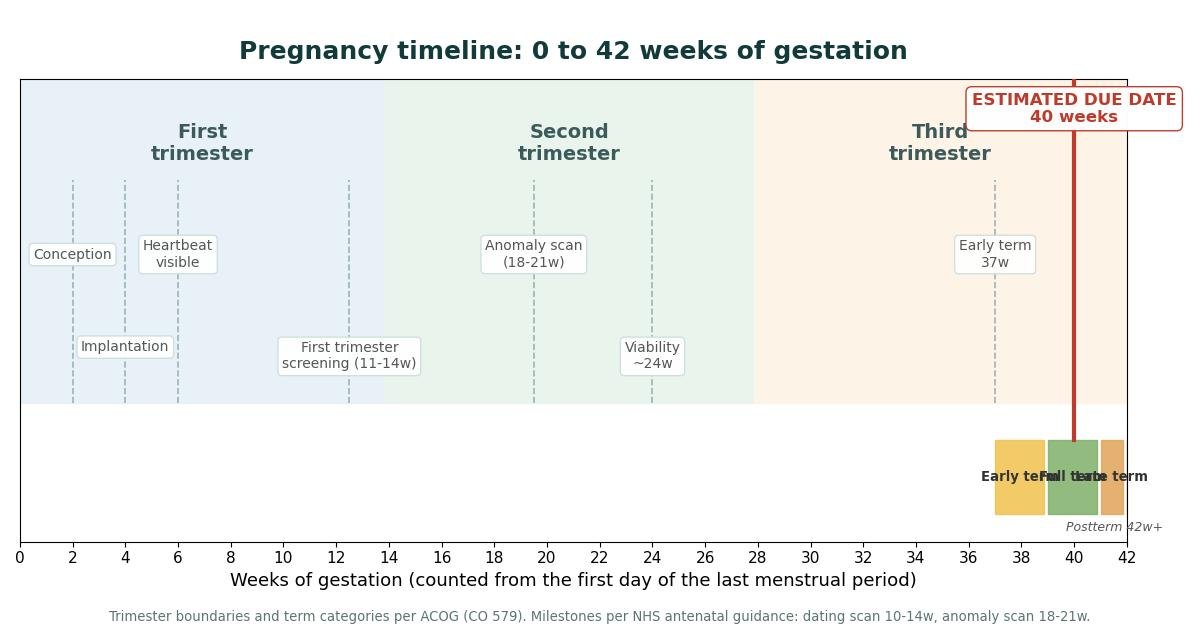
Pregnancy is conventionally divided into three trimesters. The first trimester runs from the last menstrual period to 13 6/7 weeks, the second from 14 0/7 to 27 6/7 weeks, and the third from 28 0/7 weeks until birth. These boundaries are built into this calculator's trimester result.
The word "term" itself was redefined by ACOG in Committee Opinion 579 ("Definition of Term Pregnancy", 2013, reaffirmed) because outcomes differ meaningfully across the old single label of "term". The current categories are:
| Category | Gestational age range |
|---|---|
| Preterm | Under 37 0/7 weeks |
| Early term | 37 0/7 to 38 6/7 weeks |
| Full term | 39 0/7 to 40 6/7 weeks |
| Late term | 41 0/7 to 41 6/7 weeks |
| Postterm | 42 0/7 weeks and beyond |
Notice that the estimated due date, at exactly 40 0/7 weeks, sits in the middle of the full term window rather than at its end. Research summarised in the ACOG opinion found the lowest rates of newborn complications among births at 39 to 40 6/7 weeks, which is why elective delivery is generally not recommended before 39 weeks without a medical reason. The due date is best understood as the midpoint of the healthiest window, not a deadline. Only a small proportion of babies arrive on the exact date, and birth within a week or two on either side is entirely ordinary.
Why due dates get revised, and when they should not
A due date is an estimate made from indirect evidence, so revision is sometimes correct. The most common legitimate reason is late ovulation: a person with 35 day cycles who ovulates around day 21 will have a true gestational age about a week less than Naegele's rule suggests, and an early scan will reveal the gap. Irregular cycles, recent hormonal contraception, and breastfeeding can all make the LMP unreliable in the same way. In these situations the first trimester ultrasound, accurate to about five days, properly takes over.
Later scans deserve more scepticism as dating tools. From the second trimester onward, ultrasound estimates fetal age from measurements such as head circumference, abdominal circumference and femur length, and healthy fetuses of the same age differ in size. That is why the ACOG redating thresholds widen with gestational age, from 5 days early on to 21 days after 28 weeks. A third trimester scan that suggests a different date is usually describing growth, not age, and changing the due date on that basis can misclassify a normally grown baby. If your dates were set by a first trimester scan, expect them to stand.
Using your due date: what happens next
The due date anchors the whole antenatal timetable, so an early, accurate date has practical value beyond curiosity. In the UK, the NHS advises contacting a GP or midwife as soon as pregnancy is confirmed so that the first booking appointment can happen ideally by 10 weeks; the dating ultrasound is usually offered between 10 and 14 weeks, and the anomaly scan that checks the baby's anatomy is offered between 18 and 21 weeks (NHS pregnancy week-by-week guide). Screening choices, such as the combined test for Down's syndrome, Edwards' syndrome and Patau's syndrome, are only valid inside specific week windows, so correct dating determines which options are actually available.
The date also organises the rest of life around the pregnancy: telling an employer, planning maternity or parental leave, arranging childcare for older children, and timing the practical preparations. None of this requires precision to the day, but a date that is wrong by two weeks can put screening outside its valid window, which is the real clinical reason dating accuracy matters. Keep the result of this calculator as a working estimate, bring it to the booking appointment, and let the dating scan confirm or refine it. If the scan moves your date, use the new one for everything from that point on and discard the old estimate rather than averaging the two.