Pregnancy Weight Gain Tracker
Based on the Institute of Medicine 2009 guidelines: enter your pre-pregnancy weight, height, current weight and week to see your BMI category, your expected gain window for this week, whether you are below, within or above it, and your personalised total target. Works for singleton and twin pregnancies. Everything runs in your browser; nothing is uploaded or stored.
In short: Based on the Institute of Medicine 2009 guidelines: enter your pre-pregnancy weight, height, current weight and week to see your BMI category, your expected gain window for this week, whether you are below, within or above it, and your personalised total target. Works for singleton and twin pregnancies. Everything runs in your browser; nothing is uploaded or stored. Use the calculator above, then read the guide below to interpret your result and its limitations.
The calculator
Why tracking pregnancy weight gain matters
Pregnancy changes the body in ways the bathroom scale only partly captures. By full term, a typical singleton pregnancy adds somewhere between 5 and 18 kg depending on the mother's starting point, and only part of that is the baby. The rest is the placenta, the amniotic fluid, a larger uterus and breasts, about a litre or more of extra blood and other body fluids, and fat stores laid down as an energy reserve for late pregnancy and breastfeeding.
Why does the total matter? The Institute of Medicine committee behind the 2009 guidelines reviewed a large body of observational research and found a consistent pattern. Gaining well below the recommended range is associated with higher chances of preterm birth and of babies born small for their gestational age. Gaining well above it is associated with larger babies, more caesarean deliveries and more weight retained after birth, which in turn predicts longer term maternal weight gain. These are associations, not certainties: many women outside the ranges have perfectly healthy pregnancies, and many inside them still face complications. But at population level the ranges mark the zone where outcomes look best on average, which is why clinicians use them as the starting point for advice.
A tracker like this one does not replace that clinical conversation. Its job is narrower: to show you, week by week, where your gain sits relative to the published guidelines, so you arrive at appointments informed rather than guessing.
How the IOM 2009 guidelines were developed
In 2009 the Institute of Medicine (IOM) of the US National Academies, working with the National Research Council, published Weight Gain During Pregnancy: Reexamining the Guidelines, edited by Kathleen Rasmussen and Ann Yaktine. (The IOM has since become the National Academy of Medicine, which is why newer citations sometimes use that name.) The committee re-examined the 1990 guidelines in light of nearly two decades of new evidence, rising rates of maternal overweight and obesity, and a more diverse childbearing population.
Rather than picking round numbers, the committee anchored each range to the weight gains linked with the best balance of maternal and infant outcomes in the available studies, then expressed them as ranges rather than single targets to reflect real human variation. For singletons the ranges are set by pre-pregnancy BMI category, because starting body composition predicts both the risks of gaining too little and the risks of gaining too much. For twins, where the evidence was thinner, the committee issued provisional ranges only.
The guidelines were quickly taken up in clinical practice. The American College of Obstetricians and Gynecologists endorsed the IOM ranges in its Committee Opinion No. 548 (2013, reaffirmed 2023), and they remain the most widely used reference for pregnancy weight gain worldwide.
The four pre-pregnancy BMI categories and their recommended totals
Your pre-pregnancy BMI is your weight in kilograms divided by your height in metres squared, using your weight from before pregnancy (or from the first weeks, before much gain has occurred). The IOM sorts women into four categories and gives each a total recommended gain for a singleton pregnancy:
| Pre-pregnancy BMI | Category | Singleton total gain | Twin total gain |
|---|---|---|---|
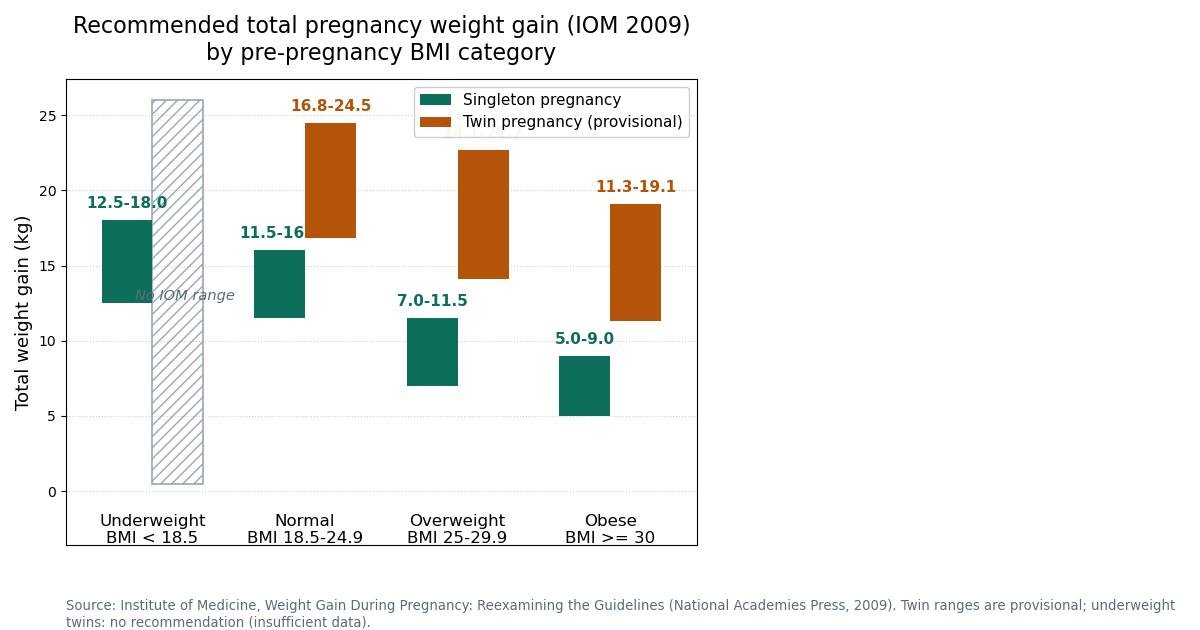
| Below 18.5 | Underweight | 12.5 to 18 kg (28 to 40 lb) | No range: insufficient data |
| 18.5 to 24.9 | Normal | 11.5 to 16 kg (25 to 35 lb) | 16.8 to 24.5 kg (37 to 54 lb) |
| 25 to 29.9 | Overweight | 7 to 11.5 kg (15 to 25 lb) | 14.1 to 22.7 kg (31 to 50 lb) |
| 30 or above | Obese | 5 to 9 kg (11 to 20 lb) | 11.3 to 19.1 kg (25 to 42 lb) |
Note the pattern: the higher the starting BMI, the narrower and lower the recommended range. This is deliberate. Women who begin pregnancy underweight need to gain more to support foetal growth, while women who begin with obesity face higher baseline risks from excess gain, so their advised range is smaller. The categories are a guide rather than a set of cliffs: a woman at the top of the normal band and one at the bottom of the overweight band are nearly identical physiologically, and the committee never intended the cut-offs to be read as sharp dividing lines.
Twin pregnancies: provisional ranges
Carrying twins changes the arithmetic: two babies, usually two placentas, more amniotic fluid and greater demands on the mother's reserves. The IOM committee offered provisional ranges for twins, explicitly labelling them provisional because they rest on a smaller evidence base than the singleton figures. They represent the 25th to 75th percentile of total weight gain among women who delivered twins averaging at least 2.5 kg at term: a description of what happened in healthier outcomes rather than a tested prescription.
For underweight women carrying twins, the committee judged the data insufficient and published no range at all. If that is your situation, this tracker's twin mode will tell you so plainly rather than inventing a number, and your clinician should set an individual target.
Research since 2009 has broadly supported the provisional ranges. A large retrospective cohort study found that twin pregnancies with gain below the IOM ranges had higher odds of small-for-gestational-age infants, low birth weight and longer neonatal intensive care stays, while gain above the ranges was associated with higher odds of labour induction. As with singletons, these are associations to inform care, not verdicts on any individual pregnancy.
What to expect trimester by trimester
Weight gain in pregnancy is front-loaded with waiting: the IOM assumes just 0.5 to 2 kg (1.1 to 4.4 lb) across the entire first trimester. Many women gain nothing at all in these weeks, and some lose a little with nausea and vomiting, which is usually not a concern if appetite returns in the second trimester.
From the second trimester onward the guidelines describe average weekly rates that differ by starting BMI:
| Pre-pregnancy BMI category | Average rate, weeks 14 to 40 |
|---|---|
| Underweight | 0.44 to 0.58 kg per week (about 1.0 to 1.3 lb) |
| Normal | 0.35 to 0.50 kg per week (about 0.8 to 1.1 lb) |
| Overweight | 0.23 to 0.33 kg per week (about 0.5 to 0.7 lb) |
| Obese | 0.17 to 0.27 kg per week (about 0.4 to 0.6 lb) |
These rates are averages, not speed limits. Real gain comes in spurts: a week of no change followed by a jump is normal, which is why the tracker judges the trend rather than any single week, and why clinicians usually look at the pattern across a month. The weekly rates also assume a roughly steady climb from week 13; in practice the curve often steepens a little in the late second trimester and flattens near term.
How this tracker calculates your expected range
The calculator first works out your pre-pregnancy BMI and its IOM category, then builds the expected window for your current week. For weeks up to 13, it takes a proportional share of the first-trimester assumption of 0.5 to 2 kg: at week 6, for example, the window is roughly half of that range. From week 14 onward, the window is the full first-trimester range plus your category's weekly rate multiplied by the number of weeks since week 13. At week 20 with a normal BMI, that gives 0.5 + (0.35 × 7) = 2.95 kg at the lower edge and 2 + (0.50 × 7) = 5.5 kg at the upper edge.
Your personalised total target is simply the IOM total range for your category, or the twin range in twin mode. The verdict compares your gain so far, which is your current weight minus your pre-pregnancy weight, with the expected window: below it, inside it, or above it.
One honest limitation: the IOM publishes no week-by-week rates for twins, only totals. For twin pregnancies the tracker scales the singleton curve proportionally so that its midpoint matches the midpoint of your twin total range, and it labels the result as an estimate. It is a reasonable way to follow the trend, but it is not an IOM guideline value, and your clinician's judgement takes precedence.
Understanding your result: below, within or above
A within result means your gain so far sits inside the expected window for your week and BMI category. Treat it as reassurance about the trend, not a guarantee about the outcome: the guidelines describe population averages.
A below result is common in the first trimester, when nausea suppresses appetite, and it often corrects itself as eating normalises. Later in pregnancy, persistently low gain deserves a conversation with your midwife or doctor, who may check foetal growth. It is not a cue to force-feed yourself: rapid catch-up eating rarely helps and can cause considerable discomfort.
An above result is also common, particularly in the late second and third trimesters when appetite returns strongly and fluid retention begins. A single high reading means little; a sustained climb well above the window is worth discussing, since the committee linked excess gain with larger babies, more interventions and more postpartum weight retention. What the tracker cannot do is tell you why: only clinical assessment can separate extra tissue from extra fluid.
In all three cases the useful question is the same: what does the trend look like over the last month, and how do you feel? Bring the numbers to your appointment; decisions belong with your clinician.
When the scales can mislead
A kilogram on the scale is not always a kilogram of pregnancy tissue. In the third trimester especially, fluid retention (oedema) can add noticeable weight quickly; so can extra amniotic fluid (polyhydramnios), constipation, a large meal, or simply weighing at a different time of day in different clothes. Different scales can disagree by a kilogram or more, which is why switching scales mid-pregnancy can create a phantom jump or stall.
Most of these confounders are harmless noise, and consistent weighing habits filter most of them out. There is one pattern that should not wait for the next routine appointment: a sudden large gain over a few days, especially with swelling of the face or hands, severe headache, visual disturbances or upper abdominal pain. These can accompany pre-eclampsia, and guidance on hypertension in pregnancy advises prompt same-day assessment for such symptoms. When in doubt, call your midwife or maternity unit; they would far rather reassure you than see you too late.
Weighing yourself well: practical tips
You do not need to weigh yourself daily; weekly is plenty, and some clinicians prefer fortnightly. Pick one scale, keep it on a hard flat floor, and weigh first thing in the morning after using the toilet, in similar light clothing, before breakfast. Write the number down or log it the same day: memory smooths trends in flattering directions.
Do not weigh yourself after exercise, after a large meal, or late in the evening and then compare that number with a morning one; the difference is mostly food, fluid and timing. If a single reading looks alarming, repeat it the next morning under your usual conditions before worrying: one-off spikes are usually water, weighing conditions or an uncalibrated scale.
Finally, keep the scale in perspective. It is one instrument among many: fundal height measurements, ultrasound growth scans and how you feel all contribute to the clinical picture. If stepping on the scale is making you anxious, say so at your appointment; your midwife can take over the weighing and simply tell you the trend.
Key takeaways
- For a singleton pregnancy, the Institute of Medicine 2009 guidelines recommend total weight gain based on your pre-pregnancy BMI: 12.5 to 18 kg (28 to 40 lb) if you were underweight (BMI below 18.5), 11.5 to 16 kg (25 to 35 lb) for a normal BMI (18.5 to 24.9), 7 to 11.5 kg (15 to 25 lb) for overweight (BMI 25 to 29.9), and 5 to 9 kg (11 to 20 lb) for obesity (BMI 30 or above).
- The IOM 2009 twin ranges are provisional: 16.8 to 24.5 kg (37 to 54 lb) for a normal pre-pregnancy BMI, 14.1 to 22.7 kg (31 to 50 lb) for overweight, and 11.3 to 19.1 kg (25 to 42 lb) for obesity.
- The IOM assumes 0.5 to 2 kg (1.1 to 4.4 lb) of gain across the whole first trimester.
- The tracker compares your gain so far with the expected window for your BMI category and week, built from the IOM first-trimester assumption plus the weekly rates.
Frequently asked questions
How much weight should I gain during pregnancy?
For a singleton pregnancy, the Institute of Medicine 2009 guidelines recommend total weight gain based on your pre-pregnancy BMI: 12.5 to 18 kg (28 to 40 lb) if you were underweight (BMI below 18.5), 11.5 to 16 kg (25 to 35 lb) for a normal BMI (18.5 to 24.9), 7 to 11.5 kg (15 to 25 lb) for overweight (BMI 25 to 29.9), and 5 to 9 kg (11 to 20 lb) for obesity (BMI 30 or above). These are ranges, not single targets: landing anywhere inside your range counts as within the guidelines. They are population-level recommendations, so discuss your personal target with your midwife or doctor.
What are the recommended weight gain ranges for twin pregnancies?
The IOM 2009 twin ranges are provisional: 16.8 to 24.5 kg (37 to 54 lb) for a normal pre-pregnancy BMI, 14.1 to 22.7 kg (31 to 50 lb) for overweight, and 11.3 to 19.1 kg (25 to 42 lb) for obesity. They were set from the 25th to 75th percentile of weight gain among women who delivered twins averaging at least 2.5 kg at term. For underweight women carrying twins the committee found the data insufficient and gave no range, so your clinician should set an individual target. Because the evidence base is smaller, treat the twin figures as guidance to discuss, not as strict cut-offs.
How fast should I gain weight in each trimester?
The IOM assumes 0.5 to 2 kg (1.1 to 4.4 lb) of gain across the whole first trimester. After week 13, the suggested average weekly rates are 0.44 to 0.58 kg per week for underweight, 0.35 to 0.50 for normal BMI, 0.23 to 0.33 for overweight, and 0.17 to 0.27 for obesity. Real weight gain is rarely this smooth: many women gain little in the first trimester (nausea can even cause a small loss) and then gain in spurts. The trend over several weeks matters more than any single week.
What does below, within or above mean on this tracker?
The tracker compares your gain so far with the expected window for your BMI category and week, built from the IOM first-trimester assumption plus the weekly rates. Within means your gain sits inside that window; below or above means it sits outside it. These labels describe where your number falls, not a diagnosis: a single reading outside the window is common and not by itself a problem. What matters is the pattern over time and your overall health, which is why persistent or large deviations are worth discussing with your midwife or doctor rather than acting on alone.
Why might my weight differ from the expected range even when everything is fine?
Scales measure everything, not just pregnancy tissue. Fluid retention (oedema) in late pregnancy, extra amniotic fluid, constipation, the time of day, a heavy meal, different clothing and different scales can each shift a reading by a kilogram or more. Weighing under consistent conditions smooths out most of this noise. One exception: a sudden large jump over a few days, especially with swelling of the face or hands, severe headache or visual changes, can signal pre-eclampsia and needs same-day medical assessment.
Are the IOM ranges a target I must hit exactly?
No. The IOM ranges are guidelines drawn from population studies, not prescriptions for any individual pregnancy. Your age, height, ethnicity, medical history, whether you are carrying twins, and how your pregnancy is progressing all shape what is right for you. Use the range as a starting point for a conversation with your midwife or doctor, who can personalise it. Never try to lose weight or follow a restrictive diet during pregnancy without medical supervision.
Sources
- Rasmussen KM, Yaktine AL, editors; Institute of Medicine (US) and National Research Council (US) Committee to Reexamine IOM Pregnancy Weight Guidelines. Weight Gain During Pregnancy: Reexamining the Guidelines. Washington (DC): National Academies Press (US); 2009. (Singleton total gain ranges by pre-pregnancy BMI category; 0.5 to 2 kg first-trimester assumption; second and third trimester weekly rates by category; provisional twin ranges; no twin range for underweight BMI owing to insufficient data.)
- American College of Obstetricians and Gynecologists. Weight gain during pregnancy. Committee Opinion No. 548. Obstet Gynecol. 2013;121(1):210-212. Reaffirmed 2023. (Clinical endorsement of the IOM 2009 ranges.)
- MSD Manual Professional Edition. Table: Guidelines for Weight Gain During Pregnancy. Adapted from the IOM 2009 report and ACOG Committee Opinion No. 548. (Twin ranges expressed in kg: normal 16.8-24.5, overweight 14.1-22.7, obese 11.3-19.1.)
- Examining the provisional guidelines for weight gain in twin pregnancies: a retrospective cohort study. BMC Pregnancy and Childbirth. 2017. doi:10.1186/s12884-017-1530-2. (Twin gain below the provisional IOM ranges associated with higher odds of small-for-gestational-age infants, low birth weight and longer neonatal intensive care stays; gain above associated with higher odds of labour induction.)
- National Institute for Health and Care Excellence. Hypertension in pregnancy: diagnosis and management. NICE guideline NG133. (Sudden swelling of face or hands, severe headache, visual disturbance or upper abdominal pain need prompt assessment.)