Teratogenic Drug Risk Checker in Pregnancy
Select a medicine and the trimester to see its evidence-based pregnancy risk band, with trimester-specific guidance drawn from FDA labeling, MotherToBaby fact sheets and ACOG guidance. An information tool, not medical advice: always confirm with your clinician.
In short: Select a medicine and the trimester to see its evidence-based pregnancy risk band, with trimester-specific guidance drawn from FDA labeling, MotherToBaby fact sheets and ACOG guidance. An information tool, not medical advice: always confirm with your clinician. Use the calculator above, then read the guide below to interpret your result and its limitations.
Evidence sources for this entry:
This band summarises published evidence and cannot account for your dose, exact timing, other medicines or medical history. Discuss the result with your doctor, midwife or pharmacist before making any change.
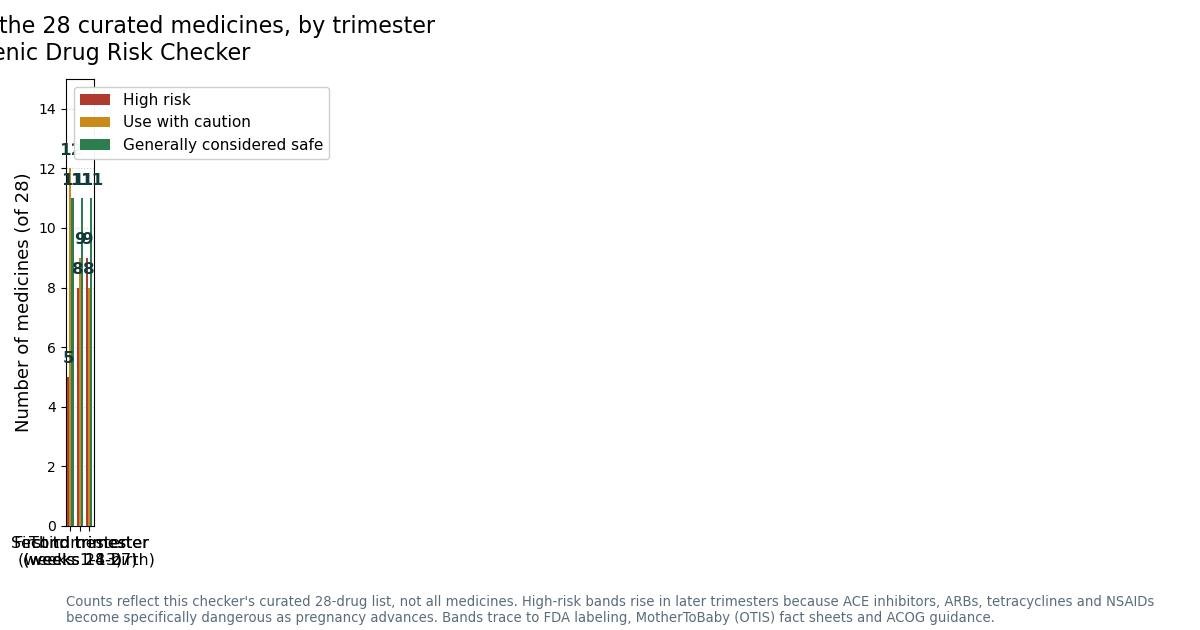
How medicines can affect a developing baby
A teratogen is any substance that can disturb the development of an embryo or fetus and cause a birth defect. Medicines are only one possible source of teratogenic exposure, alongside infections, radiation, alcohol and some maternal illnesses, but they are the source pregnant women most often ask about, because medication decisions feel both urgent and controllable.
The single most important idea in teratology is timing. The developing baby is not equally vulnerable at every stage of pregnancy:
- The first two weeks after conception are often called the "all or none" period. The fertilised egg is dividing and implanting, and an exposure at this stage tends either to end the pregnancy very early or to have no lasting effect, because the cells are not yet specialised.
- Weeks 3 to 8 after conception (about weeks 5 to 10 counted from the last menstrual period) are the period of organogenesis, when the heart, brain, limbs, face and other organs form. This is the window of highest vulnerability to structural birth defects, and it is why first trimester exposures get the most attention.
- The second and third trimesters are dominated by growth and maturation. Structural malformations are less likely to be caused then, but medicines can still disturb function: kidney development, brain development, tooth and bone formation, blood clotting and the baby's adaptation after birth can all be affected.
Three other factors shape the real risk of any exposure. Dose and duration matter: a single low dose rarely carries the same implications as weeks of treatment. Route matters: a medicine swallowed or injected reaches the bloodstream in far larger amounts than most skin creams. And the placenta, while an impressive filter, is not a wall: many drugs cross it freely, a few (such as heparins) barely cross at all, and some are actively transported to the fetus.
It also helps to keep perspective on the baseline. The US Centers for Disease Control and Prevention (CDC) reports that about 1 in 33 babies in the United States is born with a birth defect, most of them with no identifiable cause. Every pregnancy therefore starts from a background risk of roughly 3 percent, and the question a clinician asks about any medicine is whether it raises that background risk, and by how much, in a way that matters.
Trimester-by-trimester guidance
First trimester (weeks 1 to 13)
This is the trimester when most structural birth defects originate, and the period the evidence base concentrates on. Many women do not know they are pregnant until week 4 to 6, which is exactly when organogenesis is under way, so unintended first trimester exposure is extremely common. If that has happened to you, the practical step is the same as for any exposure: write down the medicine, the dose and the dates, and take that information to your clinician, who can map the timing against the known critical windows rather than guessing.
The checker reflects this by being strictest where the evidence is strictest: known potent teratogens such as isotretinoin, valproic acid, methotrexate and warfarin sit in the high risk band in every trimester, because their danger begins here. For drugs where the evidence is mixed or limited, such as ondansetron or levetiracetam, the band is "use with caution" with an honest statement of the uncertainty, rather than a false reassurance.
Second trimester (weeks 14 to 27)
With the organs formed, the focus shifts to growth and function. This is the trimester where several medicines change band in this checker, and those changes are among the most clinically important results it gives:
- ACE inhibitors and ARBs (for example lisinopril and losartan) move to high risk. They carry an FDA boxed warning against use in the second and third trimesters because they can cause fetal kidney failure, dangerously low amniotic fluid and underdevelopment of the skull, with injury or death of the fetus. Women taking these drugs are advised to switch to a pregnancy-safe alternative such as labetalol or methyldopa when pregnancy is planned.
- Tetracycline antibiotics such as doxycycline move to high risk after about 16 weeks, because they can permanently stain the baby's developing teeth and disturb bone growth.
- NSAIDs such as ibuprofen stay in the use with caution band in the second trimester, but with an important boundary inside it: the FDA advises avoiding NSAIDs from 20 weeks of pregnancy onward because they can cause low amniotic fluid (oligohydramnios).
The second trimester is also when many chronic-disease medicines settle into their long-term pattern: antiepileptic drugs often need dose adjustments because blood levels fall as pregnancy progresses, and thyroid hormone doses usually need to rise. These are monitoring questions for your clinician, not reasons to stop treatment.
Third trimester (weeks 28 to birth)
Late pregnancy brings a different set of concerns: effects on the newborn around delivery rather than on organ formation. The checker's band changes here reflect that shift:
- NSAIDs move to high risk in the third trimester because they can cause premature closure of the ductus arteriosus, a blood vessel the fetus needs open until birth, and can contribute to bleeding problems around delivery.
- Warfarin remains high risk, with the added late-pregnancy danger of bleeding in the mother and baby during labour and delivery.
- SSRIs such as sertraline stay in the use with caution band, but the trimester note flags that third trimester exposure can occasionally cause transient newborn adaptation symptoms such as jitteriness or feeding difficulty, which maternity teams know how to manage.
- Lithium requires careful blood-level monitoring through late pregnancy and delivery, because fluid shifts around birth can change levels quickly.
Medicines that are generally considered safe, such as insulin, levothyroxine, heparin and paracetamol, keep that band through the third trimester, because their safety evidence covers the whole of pregnancy.
What the three risk bands mean
The checker assigns every medicine one of three bands for the selected trimester. These bands are simplifications of published evidence, designed to guide a conversation with your clinician, not to replace it.
| Band | What it means | What to do |
|---|---|---|
| High risk | The medicine is a known teratogen or is contraindicated in pregnancy by its FDA labeling. The evidence of harm is clear. | Do not start it. If you are already taking it, contact your clinician urgently to discuss alternatives. Do not stop abruptly on your own if sudden withdrawal is dangerous (for example with antiepileptic drugs). |
| Use with caution | The medicine is sometimes needed in pregnancy. The absolute risk appears low, the evidence is mixed, or human data are limited. The decision depends on your dose, timing and medical history. | Discuss it with your clinician, who can weigh the medicine against the risks of your untreated condition. This band is the most common outcome and usually means a conversation, not an alarm. |
| Generally considered safe | Large studies or long clinical experience have not shown a pattern of birth defects, and major guidelines consider the medicine acceptable in pregnancy. | Use as directed by your clinician, at the lowest effective dose. "Generally considered safe" still means a medicine, not a guarantee, and your clinician should know you are taking it. |
The honest limits of what we know
Drug safety in pregnancy is one of the least complete areas of medicine, and this checker is built around that incompleteness rather than hiding it. Pregnant women are routinely excluded from clinical drug trials for ethical reasons, so almost everything we know comes from weaker sources: pregnancy registries that collect outcomes voluntarily, observational studies that compare women who did and did not take a drug, case reports, and animal studies that do not always predict human effects.
Each of these sources has blind spots. Registries can be slow to accumulate enough pregnancies for rare outcomes. Observational studies struggle with confounding: women who take a medicine differ from women who do not, often because of the illness being treated, so it can be hard to separate the effect of the drug from the effect of the disease. Case reports describe the worst outcomes and say nothing about how common they are. This is why several entries in this checker say plainly that human data are limited: for drugs like levetiracetam, atorvastatin and fluconazole, the honest scientific answer is that we do not yet know enough, and a tool that pretended otherwise would be misleading.
There is also an important distinction between absence of evidence and evidence of absence. A medicine in the "generally considered safe" band has positive reassuring evidence behind it: large studies, long clinical use, or both. A medicine with almost no published pregnancy data would not earn that band; it would sit in "use with caution" until better evidence exists. The checker applies that rule consistently.
Finally, this checker cannot capture the details that often decide real cases: your exact dose and how long you took it, the precise gestational age at exposure, your other medicines and supplements, your medical history, and how new the evidence is. Two women taking the "same" drug can face different situations. Treat every result as a starting point for clinical advice, never as a final answer.
If you take regular medicine and are pregnant or planning pregnancy
The best time to review medicines is before conception. A preconception medication review lets you and your clinician switch risky drugs to safer alternatives while there is still time, adjust doses, and start folic acid. Folic acid (usually 400 to 800 micrograms daily) taken before conception and through the first trimester reduces the risk of neural tube defects; women at higher risk, for example those taking antiepileptic drugs or with diabetes, are usually advised higher doses on specialist guidance.
If you are already pregnant and taking a regular medicine, the single most important rule is: do not stop it abruptly without medical advice. Sudden withdrawal can be more dangerous than the medicine itself. Stopping antiepileptic drugs can trigger seizures that deprive the baby of oxygen. Stopping antidepressants suddenly can cause severe relapse. Stopping blood pressure medicine can lead to dangerous hypertension. Every one of these scenarios is worse than a planned, supervised medication review.
Keep a complete list of everything you take, including over the counter products, vitamins, herbal supplements and occasional medicines, and bring it to every antenatal appointment. Many exposures that worry women turn out, on careful timing, to have happened before conception or outside the critical window, and a clinician with the full list and dates can often give genuine reassurance.
Questions to ask your clinician
A short list of questions makes the medication conversation far more productive. Consider asking:
- Is this medicine necessary for my health during pregnancy, or are there safer alternatives with similar benefit?
- What is the lowest effective dose, and does the dose need to change as pregnancy progresses?
- Are there specific weeks when this medicine is more or less of a concern?
- Do I need extra monitoring, such as blood levels, growth scans or fetal echocardiography?
- Is there anything I should plan for labour and delivery because of this medicine?
- Where can I read reliable information myself, such as the MotherToBaby fact sheets?
Sources
- US Food and Drug Administration (FDA) drug labeling, including boxed warnings for isotretinoin, valproic acid, methotrexate, warfarin, ACE inhibitors and ARBs; the 2020 NSAID pregnancy safety communication (avoid use from 20 weeks); and the 2021 statin labeling update.
- MotherToBaby / Organization of Teratology Information Specialists (OTIS) fact sheets on isotretinoin, valproic acid, methotrexate, warfarin, ACE inhibitors, doxycycline, NSAIDs, SSRIs, lamotrigine, levetiracetam, ondansetron, fluconazole, corticosteroids, lithium, statins, metformin, levothyroxine, amoxicillin, acetaminophen, heparins, antihistamines, omeprazole and vitamin A.
- American College of Obstetricians and Gynecologists (ACOG) guidance on medication use in pregnancy, chronic hypertension in pregnancy, and diabetes in pregnancy.
- LactMed (Drugs and Lactation Database), National Library of Medicine, for perinatal pharmacology references.
- Rothman KJ et al. Teratogenicity of high vitamin A intake. New England Journal of Medicine. 1995;333(21):1369-73 (vitamin A intakes above 10,000 IU per day linked to birth defects).
- Centers for Disease Control and Prevention (CDC): birth defects affect about 1 in 33 babies in the United States (background risk figure).
Key takeaways
- No.
- Try not to panic: this is very common, since many pregnancies are unplanned and most women do not know they are pregnant until several weeks in.
- No.
- Because the evidence rarely supports a simple yes or no.
Frequently asked questions
Can I use this checker for any medicine I am taking?
No. This checker covers 28 commonly prescribed medicines that were selected because their pregnancy evidence is well documented. It does not cover the thousands of other prescription drugs, over the counter products, herbal supplements or combination products. For any medicine not listed here, ask your doctor or pharmacist, or consult the free MotherToBaby fact sheets (OTIS) or the LactMed database, and never guess from this tool.
I took a medicine before I knew I was pregnant. What should I do?
Try not to panic: this is very common, since many pregnancies are unplanned and most women do not know they are pregnant until several weeks in. Note down the medicine name, the dose, and the dates you took it, then discuss it with your clinician as soon as possible. What matters most is the exact timing of exposure relative to conception, which your clinician can map against the known critical windows. MotherToBaby also offers free expert counselling on exposures in pregnancy.
Are over the counter medicines and herbal supplements automatically safe in pregnancy?
No. Over the counter does not mean risk free in pregnancy: for example, NSAID painkillers such as ibuprofen should be avoided from 20 weeks of pregnancy onward, and high dose vitamin A supplements are teratogenic. Herbal and natural products are generally the least studied of all, with very little human pregnancy data. Tell your clinician about everything you take, including supplements, so the full picture can be assessed.
Why is a medicine labelled use with caution rather than simply safe or unsafe?
Because the evidence rarely supports a simple yes or no. A use with caution band means the medicine is sometimes needed in pregnancy, the absolute risk of harm appears low or is still uncertain, and the decision depends on your dose, timing, trimester and medical history. It is a signal to have a proper conversation with your clinician, not a verdict on its own.
I need my medicine to stay healthy. How do I balance the risks?
Untreated illness is itself a risk to pregnancy: uncontrolled epilepsy, severe depression, high blood pressure and asthma flares can all harm mother and baby. The right question is rarely medicine versus no medicine, but which medicine, at what dose, with what monitoring. For chronic conditions this balance is best worked out before conception with your specialist, and drug levels often need adjusting during pregnancy.
How current is the information in this checker?
Each drug entry was written from current FDA labeling, MotherToBaby (OTIS) fact sheets, LactMed and ACOG guidance, and the page carries a last reviewed date. Drug labels and guidance do change: for example, the FDA updated statin and NSAID pregnancy labeling in 2021 and 2020. Always check the current product label and your clinician's advice alongside this tool.
Medically reviewed by Dr. Taimoor Asghar, physician and community medicine researcher. Last reviewed: 5 October 2026.