Pregnancy Thyroid Function Interpreter
Enter your TSH, your trimester, and (optionally) your free T4 to see how the result sits against trimester-specific reference limits based on the American Thyroid Association 2017 guideline, with a plain-language explanation of what the pattern means and what to do next. Everything runs in your browser; nothing is uploaded or stored.
In short: Enter your TSH, your trimester, and (optionally) your free T4 to see how the result sits against trimester-specific reference limits based on the American Thyroid Association 2017 guideline, with a plain-language explanation of what the pattern means and what to do next. Everything runs in your browser; nothing is uploaded or stored. Use the calculator above, then read the guide below to interpret your result and its limitations.
The calculator
Why thyroid function matters so much in pregnancy
The thyroid gland, a small butterfly-shaped organ at the front of the neck, produces the hormones thyroxine (T4) and triiodothyronine (T3), which set the pace of metabolism in virtually every tissue. In pregnancy, demand for these hormones rises, and the consequences of getting the balance wrong fall on two patients at once. For roughly the first half of pregnancy, until about 18 to 20 weeks, the foetus cannot make meaningful amounts of its own thyroid hormone and depends entirely on maternal thyroxine crossing the placenta. That maternal supply supports normal brain development, which is why thyroid disorders in pregnancy receive far more clinical attention than the same numbers would outside pregnancy.
Overt maternal hypothyroidism, where thyroid hormone levels are frankly low, has been linked in observational research with higher chances of miscarriage, preterm birth, pre-eclampsia, low birth weight and impaired neurocognitive development in the child. Overt hyperthyroidism, most often caused by Graves disease, has been associated with miscarriage, preterm birth, low birth weight, maternal heart failure and, rarely, thyroid storm. These are associations found in population studies, not certainties for any individual pregnancy, and they describe mainly the overt forms of disease. The milder subclinical patterns, where TSH is abnormal but free T4 is still normal, are much more common and their significance is more nuanced, which is exactly why guidelines devote so much space to them.
An interpreter like this one cannot diagnose a thyroid disorder; only a clinician with the full clinical picture can do that. Its job is narrower and practical: to place your TSH and free T4 against the right pregnancy-specific reference limits, explain in plain language what the pattern usually means, and tell you what the sensible next step is, so you arrive at your appointment informed rather than anxious.
What TSH and free T4 actually measure
TSH (thyroid-stimulating hormone) is made by the pituitary gland and tells the thyroid how hard to work; free T4 is the unbound, biologically active fraction of thyroxine circulating in the blood. They operate as a feedback loop: when free T4 falls, the pituitary releases more TSH to drive the thyroid harder, and when free T4 rises, TSH is suppressed. That is why TSH is the most sensitive single marker of thyroid status. A high TSH with a low free T4 means the thyroid is failing despite strong stimulation (hypothyroidism), while a suppressed TSH with a raised free T4 means the thyroid is overactive despite minimal stimulation (hyperthyroidism).
Pregnancy complicates this tidy loop in two important ways. First, the pregnancy hormone hCG shares a molecular subunit with TSH and weakly stimulates the TSH receptor, so as hCG rises in the first trimester, TSH physiologically falls. A TSH that would look suppressed outside pregnancy can be entirely normal at 10 weeks gestation. Second, rising oestrogen increases thyroid-binding globulin, the protein that carries thyroid hormone in the blood, which raises total T4 without changing the free, active fraction. That is why free T4, not total T4, is the measurement guidelines prefer in pregnancy, and why the non-pregnant reference range printed on many lab reports is the wrong yardstick for a pregnant patient.
One more property of TSH matters for interpretation: it moves slowly. After a change in thyroid status or in levothyroxine dose, TSH takes about four to six weeks to reach its new steady state. A TSH drawn two weeks after a dose change mostly reflects the old dose, which is why clinicians recheck at four to six week intervals rather than sooner.
The ATA 2017 trimester-specific reference ranges
The reference this calculator follows is the 2017 guideline of the American Thyroid Association on thyroid disease during pregnancy and the postpartum period (Alexander and colleagues, published in the journal Thyroid). It is the most widely used international standard for these decisions. Its central recommendation on reference ranges is easy to state and frequently ignored in practice: every laboratory should establish its own population-based trimester-specific reference ranges, derived from healthy pregnant women who are negative for thyroid antibodies and have adequate iodine intake. Thyroid assays differ enough between manufacturers that a range validated on one platform does not transfer cleanly to another.
Because most laboratories have never done that work, the guideline provides a fallback: when population-based trimester-specific ranges are unavailable, an upper reference limit of 4.0 mIU/L may be used. This was a deliberate step back from the 2011 ATA guideline, which had suggested 2.5 mIU/L as a first-trimester upper limit. Experience showed that applying 2.5 classified large numbers of healthy pregnancies as abnormal, triggering treatment that the evidence did not support, so the 2017 guideline replaced it with the more conservative 4.0 fallback. The lower limit of TSH is lowest in the first trimester, when hCG stimulation peaks, and rises as pregnancy progresses; published cohorts typically place it around 0.1 to 0.2 mIU/L in early pregnancy.
The practical takeaway is a hierarchy. Best is your own laboratory's trimester-specific pregnancy range, printed on your report or available on request. Next best is the ATA 2017 fallback used here: an upper limit of 4.0 mIU/L in every trimester. What should never be used is the non-pregnant range, which misclassifies healthy pregnancies in both directions.
The reference limits this calculator uses
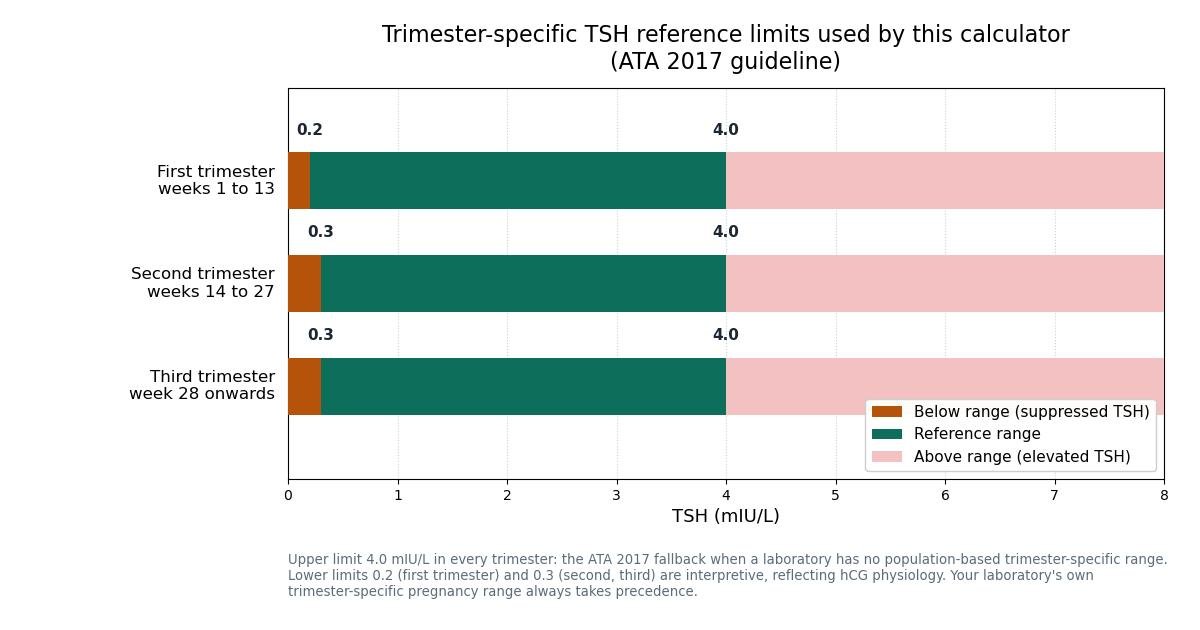
To make the fallback concrete and testable, this calculator implements the following trimester-specific TSH reference limits, in mIU/L:
| Trimester | Weeks | Lower limit | Upper limit | Source |
|---|---|---|---|---|
| First | 1 to 13 | 0.2 | 4.0 | ATA 2017 (upper limit); interpretive lower limit reflecting hCG physiology |
| Second | 14 to 27 | 0.3 | 4.0 | ATA 2017 (upper limit); interpretive lower limit |
| Third | 28 onwards | 0.3 | 4.0 | ATA 2017 (upper limit); interpretive lower limit |
A result exactly on a limit counts as within the range. The upper limit of 4.0 is the ATA 2017 recommendation for use when no population-based trimester-specific range exists. The lower limits of 0.2 in the first trimester and 0.3 thereafter are interpretive simplifications consistent with the physiological TSH dip under hCG stimulation in early pregnancy, and they are stated here openly rather than hidden in the code. If your laboratory provides its own trimester-specific pregnancy range, use that instead of these fallback limits and discuss any discrepancy with your clinician. Free T4 is never judged against a built-in range in this calculator, because free T4 assays vary too much between manufacturers; it is classified only against the lower and upper limits from your own lab report, which you can enter optionally above.
How this calculator interprets your result
The logic follows three steps. First, your TSH is compared with the trimester-specific limits above and classified as below, within or above the reference range. Second, if you entered a free T4 together with your lab's reference limits, the free T4 is classified as low, normal or high. Third, the two classifications are combined into an interpretation band:
| Band | TSH | Free T4 | Plain meaning |
|---|---|---|---|
| Overt hypothyroidism | Above range | Low | Thyroid hormone is low; treatment is recommended in pregnancy |
| Subclinical hypothyroidism | Above range | Normal | Mild underactivity; treatment decision usually hinges on TPO antibodies |
| Normal | Within range | Normal (or not entered) | No thyroid dysfunction evident from these numbers |
| Subclinical hyperthyroidism | Below range | Normal | Mild overactivity pattern; usually monitored, not treated |
| Overt hyperthyroidism | Below range | High | Thyroid hormone is high; needs prompt specialist assessment |
When free T4 is missing, the calculator reports honest intermediate bands instead of guessing: an elevated TSH with a note that free T4 is needed to distinguish overt from subclinical hypothyroidism, or a suppressed TSH with a note that free T4 is needed to distinguish overt from subclinical hyperthyroidism. A normal TSH with a low free T4 produces a separate band, isolated hypothyroxinaemia, which the ATA 2017 guideline discusses as a pattern of uncertain significance that is not routinely treated. Occasionally the two hormones point in unexpected directions, for example a low TSH with a low free T4; the calculator flags these discordant patterns and suggests retesting, because assay interference is a more common explanation than a rare disease.
Every band comes with next-step guidance rather than just a label, because the value of an interpreter lies in what you do after reading it. Those steps are suggestions to discuss with your clinician, not prescriptions.
Subclinical hypothyroidism and the TPO antibody question
Subclinical hypothyroidism, a raised TSH with a normal free T4, is the pattern that generates the most uncertainty in antenatal clinics, and the ATA 2017 guideline resolves much of it with a single blood test: TPO antibodies. These antibodies mark autoimmune thyroid disease (Hashimoto thyroiditis), the commonest cause of hypothyroidism in iodine-sufficient countries. Their presence changes both the meaning of a raised TSH and what to do about it.
The guideline's position is explicit. For TPO antibody-positive women with subclinical hypothyroidism, levothyroxine treatment is recommended. For TPO antibody-negative women with subclinical hypothyroidism, treatment may be considered: a weaker recommendation that leaves room for clinical judgement about the TSH level, the trimester, symptoms and patient preference. Either way, the antibody result is what moves the decision, which is why the calculator's next steps for this band point you toward asking for it rather than toward a treatment verdict. If treatment is deferred, thyroid function is typically rechecked in about four weeks, because subclinical patterns can evolve as pregnancy progresses.
This antibody-centred approach is also the reason a single raised TSH should never trigger self-treatment. Many women with a mildly raised TSH and negative antibodies are simply monitored, and that monitoring is a legitimate, guideline-supported plan, not neglect.
A suppressed TSH in early pregnancy is often physiological
Few lab results cause more unnecessary alarm than a low TSH in the first trimester. Because hCG directly stimulates the thyroid, TSH physiologically dips in early pregnancy, reaching its lowest point near the end of the first trimester when hCG peaks. In women with severe nausea and vomiting of pregnancy (hyperemesis gravidarum), where hCG runs particularly high, this can go further: the pattern of a suppressed TSH with a raised free T4, without any underlying thyroid disease, is called gestational transient thyrotoxicosis. It typically peaks with the vomiting and resolves on its own by mid-pregnancy.
The ATA 2017 guideline is clear about what not to do here: antithyroid drugs are not indicated for gestational transient thyrotoxicosis. Management is supportive, fluids, antiemetics and nutrition, while the thyroid pattern is watched until it settles. Treating it as Graves disease would expose the foetus to drug risks for no benefit.
Graves disease, the autoimmune cause of hyperthyroidism, is the pattern that does need treatment, and several clues distinguish it. A history of hyperthyroidism or Graves disease before pregnancy, a visibly enlarged thyroid (goitre), eye involvement, symptoms that clearly predate the pregnancy, and positive TSH-receptor antibodies (TRAb) all point toward Graves rather than a transient gestational effect. When antithyroid drug treatment is needed for Graves disease in pregnancy, the choice of drug is trimester-specific under ATA 2017 guidance, which is one more reason a suppressed TSH with a raised free T4 deserves prompt endocrinology input rather than watchful waiting alone. The calculator cannot make this distinction from numbers alone; it flags the pattern and explains why the clinical context decides.
Already taking levothyroxine: what pregnancy changes
Women who enter pregnancy already treated for hypothyroidism need a plan, not just a prescription refill. Thyroid hormone requirements rise in pregnancy, and a dose that was perfect before conception is often insufficient by the end of the first trimester. The ATA 2017 guideline gives unusually concrete advice for this situation: increase the levothyroxine dose by about 25 to 30 percent, in practice roughly two extra tablets per week, as soon as the pregnancy test is positive, and confirm the adjustment with your clinician.
Monitoring then follows a fixed rhythm: check TSH about every four weeks until mid-pregnancy, and at least once around week 30. The goal is to keep TSH within the trimester-specific reference range, adjusting the dose as the numbers dictate. After delivery, requirements usually fall back toward the pre-pregnancy dose, so a postpartum TSH check about six weeks after birth is standard, with the dose reduced accordingly under medical guidance.
Absorption details matter as much as the dose. Levothyroxine should be taken on an empty stomach, ideally 30 to 60 minutes before breakfast or at bedtime well after the last meal, because food, coffee and several supplements impair absorption. Iron, calcium and prenatal vitamins should be kept at least four hours apart from the levothyroxine tablet. Many dose "failures" in pregnancy turn out to be absorption problems from a prenatal vitamin taken at the same time as the thyroid tablet, so spacing the doses is one of the highest-value habits in this situation.
If you are planning pregnancy rather than already pregnant, the time to optimise is before conception: ask your clinician to review your dose and check your TSH ahead of trying, so you enter pregnancy on a stable, appropriate dose rather than chasing it in the first trimester.
Iodine: the nutrient pregnancy uses more of
Thyroid hormone is built from iodine, so anything that increases hormone production increases iodine demand, and pregnancy does both. The World Health Organization recommends a total iodine intake of 250 micrograms per day during pregnancy, and the ATA 2017 guideline recommends that women who are planning pregnancy, pregnant or breastfeeding take a daily supplement containing 150 micrograms of iodine. These two numbers describe different things, total intake versus the supplement on top of diet, so they are complementary rather than contradictory.
In practice, much dietary iodine comes from iodised salt, dairy products and fish, and intake varies widely by country and diet. Women who avoid dairy, eat little fish, or use non-iodised specialty salts are the most likely to fall short, and they are the group for whom the supplement recommendation matters most. Discuss supplementation with your clinician or midwife rather than starting high-dose iodine products on your own: excess iodine can itself disturb thyroid function, particularly in the foetus, so more is not better. If you take a prenatal multivitamin, check its label, since many but not all contain iodine in the recommended amount.
After birth: postpartum thyroiditis
Thyroid vigilance should not end at delivery. In the year after birth, the immune system rebounds from its pregnancy-suppressed state, and in a substantial minority of women this triggers postpartum thyroiditis, an painless inflammation of the thyroid that is commonly reported to affect around 5 to 10 percent of women. The classic course has two phases: first a hyperthyroid phase, as stored hormone leaks from the inflamed gland, then a hypothyroid phase as the gland recovers, each lasting weeks to a few months.
Several features distinguish it from other thyroid disorders. The hyperthyroid phase is destructive rather than productive, the gland is leaking hormone rather than overproducing it, so antithyroid drugs do not help and are not indicated; beta blockers may be used for troublesome symptoms such as palpitations. The hypothyroid phase is treated with levothyroxine if symptoms or TSH warrant it, but the treatment is often temporary, with the gland recovering within the year. A minority of women do not recover fully and remain permanently hypothyroid, which is why guidelines recommend long-term follow-up of thyroid function after an episode.
The strongest risk factor is being TPO antibody positive during pregnancy, which is one more reason antibody testing during pregnancy has value beyond the pregnancy itself: it identifies women worth watching postpartum. Any woman with a thyroid history who develops palpitations, unexplained fatigue, or mood changes in the months after delivery should have her thyroid function checked rather than having the symptoms attributed solely to new parenthood.
Limitations of a single TSH result
This calculator interprets the numbers you enter against published reference limits, but several real-world factors can make a single TSH misleading, and they are worth knowing before you act on any result. Laboratory assays differ: the same blood sample can give slightly different TSH values on different manufacturers' platforms, which is why trimester-specific ranges are ideally local. Biotin, a B-vitamin present in high doses in many hair, skin and nail supplements and in some prenatal formulas, can falsely alter thyroid immunoassay results in either direction; the US Food and Drug Administration issued a safety communication about biotin interference with laboratory tests in 2017, and you should tell your clinician and laboratory about any biotin-containing supplements before retesting.
Physiology also shifts the numbers. Twin pregnancies produce more hCG and therefore suppress TSH more deeply in the first trimester. Severe vomiting, acute illness and some medications alter thyroid measurements without reflecting true thyroid disease. And as noted earlier, TSH lags four to six weeks behind real changes, so a result drawn shortly after a dose adjustment or an illness describes the past more than the present.
None of this makes thyroid testing useless; it makes single results provisional. The clinical pattern that earns confidence is a repeated abnormal result, ideally with free T4 and antibodies, interpreted alongside symptoms and history. Treat this calculator as a well-informed first read of your numbers, and let your clinician provide the second one.
Key takeaways
- There is no single normal TSH for all of pregnancy: the reference range shifts by trimester because the pregnancy hormone hCG suppresses TSH, most strongly in the first trimester.
- That pattern is called subclinical hypothyroidism, and whether it is treated in pregnancy usually depends on your TPO antibody status.
- Often not.
- Thyroid hormone demand rises in pregnancy, so the ATA 2017 guideline advises women already treated for hypothyroidism to increase their levothyroxine dose by about 25 to 30 percent (roughly two extra tablets per week) as soon as pregnancy is confirmed, then to have TSH checked about every four weeks until mid-pregnancy and at least once around week 30.
Frequently asked questions
What TSH level is normal in pregnancy?
There is no single normal TSH for all of pregnancy: the reference range shifts by trimester because the pregnancy hormone hCG suppresses TSH, most strongly in the first trimester. The American Thyroid Association 2017 guideline recommends that each laboratory use its own population-based trimester-specific reference range; when that is unavailable, an upper reference limit of 4.0 mIU/L may be used. This calculator uses 0.2 to 4.0 mIU/L in the first trimester and 0.3 to 4.0 mIU/L in the second and third trimesters, and your own laboratory's trimester-specific range always takes precedence over these fallback limits.
My TSH is high but my free T4 is normal. Do I need treatment?
That pattern is called subclinical hypothyroidism, and whether it is treated in pregnancy usually depends on your TPO antibody status. The ATA 2017 guideline recommends levothyroxine for TPO antibody-positive subclinical hypothyroidism, and says treatment may be considered when antibodies are negative. So the useful next step is to ask your clinician to check TPO antibodies and to repeat the thyroid panel in about four weeks, rather than starting or skipping treatment on the basis of one TSH alone.
My TSH is low in the first trimester. Is that dangerous?
Often not. In the first trimester the pregnancy hormone hCG stimulates the thyroid and physiologically suppresses TSH, so a mildly low TSH with a normal free T4 is common and usually needs only monitoring. It becomes more concerning when free T4 is raised, when there are symptoms of hyperthyroidism such as palpitations, tremor or unexplained weight loss, or when there is a history of Graves disease. The important distinction is between Graves disease, which may need trimester-specific antithyroid drug treatment, and gestational transient thyrotoxicosis, which usually resolves on its own and should not be treated with antithyroid drugs.
I already take levothyroxine. What should change when I become pregnant?
Thyroid hormone demand rises in pregnancy, so the ATA 2017 guideline advises women already treated for hypothyroidism to increase their levothyroxine dose by about 25 to 30 percent (roughly two extra tablets per week) as soon as pregnancy is confirmed, then to have TSH checked about every four weeks until mid-pregnancy and at least once around week 30. Confirm the new dose with your clinician rather than adjusting it on your own, take the tablet on an empty stomach, and keep iron, calcium and prenatal vitamins at least four hours apart from it.
Can I judge my result against my lab's normal (non-pregnant) reference range?
No, and this is one of the most common sources of confusion. Pregnancy shifts thyroid reference ranges: hCG suppresses TSH in the first trimester and oestrogen raises thyroid-binding proteins, so the non-pregnant range misclassifies many healthy pregnancies. Ask your laboratory for its trimester-specific pregnancy reference range; if it does not have one, the ATA 2017 fallback of an upper TSH limit of 4.0 mIU/L is the accepted substitute, which is what this calculator uses.
Do I need extra iodine during pregnancy?
Pregnancy increases iodine needs because thyroid hormone, which is made from iodine, is in higher demand. The World Health Organization recommends a total intake of 250 micrograms of iodine per day in pregnancy, and the ATA 2017 guideline recommends a daily supplement containing 150 micrograms of iodine for women who are planning pregnancy, pregnant or breastfeeding. Iodised salt, dairy products and fish contribute dietary iodine. Discuss supplementation with your clinician rather than starting high-dose iodine on your own, because excess iodine can also disturb thyroid function.
Sources
- Alexander EK, Pearce EN, Brent GA, et al. 2017 Guidelines of the American Thyroid Association for the diagnosis and management of thyroid disease during pregnancy and the postpartum. Thyroid. 2017;27(3):315-389. (Trimester-specific reference ranges: laboratories should use population-based ranges; upper reference limit of 4.0 mIU/L when unavailable. Levothyroxine recommended for TPO antibody-positive subclinical hypothyroidism, may be considered when antibody-negative. Treated hypothyroid women should increase levothyroxine by about 25 to 30 percent at pregnancy confirmation, with TSH monitoring every 4 weeks until mid-gestation and at least once near week 30. Daily supplement of 150 micrograms iodine for women planning pregnancy, pregnant or breastfeeding. Antithyroid drugs not indicated for gestational transient thyrotoxicosis; trimester-specific drug choice for Graves disease.)
- De Groot L, Abalovich M, Alexander EK, et al. Management of thyroid dysfunction during pregnancy and postpartum: an Endocrine Society clinical practice guideline. J Clin Endocrinol Metab. 2012;97(8):2543-2565. (Background on trimester-specific thyroid reference ranges; postpartum thyroiditis commonly reported in around 5 to 10 percent of women in the year after delivery.)
- World Health Organization. Assessment of iodine deficiency disorders and monitoring their elimination: a guide for programme managers. 3rd ed. Geneva: WHO; 2007. (Recommended iodine intake of 250 micrograms per day during pregnancy.)
- Stagnaro-Green A, Abalovich M, Alexander E, et al. Guidelines of the American Thyroid Association for the diagnosis and management of thyroid disease during pregnancy and postpartum. Thyroid. 2011;21(10):1081-1125. (Earlier trimester-specific TSH framework, including the first-trimester upper limit of 2.5 mIU/L that the 2017 guideline stepped back from in favour of the 4.0 fallback.)
- U.S. Food and Drug Administration. The FDA warns that biotin may interfere with laboratory tests. FDA Safety Communication; 2017 (updated 2019). (Biotin in supplements can cause falsely high or low results on immunoassays including thyroid tests; patients should inform clinicians and laboratories of biotin use.)