What are TOLAC and VBAC?
A trial of labor after caesarean, usually shortened to TOLAC, is a planned attempt at vaginal birth by a woman who has previously given birth by caesarean section. When the attempt succeeds, the outcome is called a vaginal birth after caesarean, or VBAC. When labor does not progress safely or a complication develops, the trial ends in a repeat caesarean. Across large studies, about 60 to 80% of women who attempt a trial of labor achieve a vaginal birth, which is why TOLAC is offered as a genuine option rather than an exception in many guidelines, including those of the American College of Obstetricians and Gynecologists (ACOG).
The alternative is a planned or elective repeat caesarean, scheduled before labor begins. Both options carry benefits and risks, and the right choice varies from one woman to another. A successful VBAC avoids major abdominal surgery, usually means a shorter hospital stay and faster recovery, and reduces the cumulative surgical risks that grow with each additional caesarean. A planned repeat caesarean offers predictability and eliminates the small but real risk of uterine rupture during labor. Because no single answer fits everyone, clinicians use prediction tools to estimate the chance of success, so that the decision can be based on evidence rather than guesswork. The Flamm and Geiger score, the system used by this calculator, was one of the first widely used tools of this kind.
The Flamm and Geiger scoring system
The score was published by Flamm and Geiger in 1997 in the journal Obstetrics and Gynecology as an admission scoring system, based on a multicenter study of women attempting a trial of labor after a previous caesarean. The researchers asked a practical question: which facts, known at the time of admission, best predicted who would deliver vaginally? They found five such facts and assigned each a point value reflecting its predictive strength. The total ranges from 0 to 10, and the published study reported the observed VBAC success rate for each score band.
| Factor | Criterion | Points |
|---|---|---|
| Prior vaginal delivery history | None | 0 |
| Vaginal delivery before the caesarean only | +1 | |
| Vaginal delivery after the caesarean (prior VBAC) only | +2 | |
| Vaginal deliveries both before and after the caesarean | +4 | |
| Maternal age | Under 40 years at delivery | +2 |
| Indication for prior caesarean | Non-recurrent: not failure to progress or cephalopelvic disproportion | +1 |
| Cervical effacement at admission | Less than 25% | 0 |
| 25% to 75% | +1 | |
| More than 75% | +2 | |
| Cervical dilation at admission | 4 cm or more | +1 |
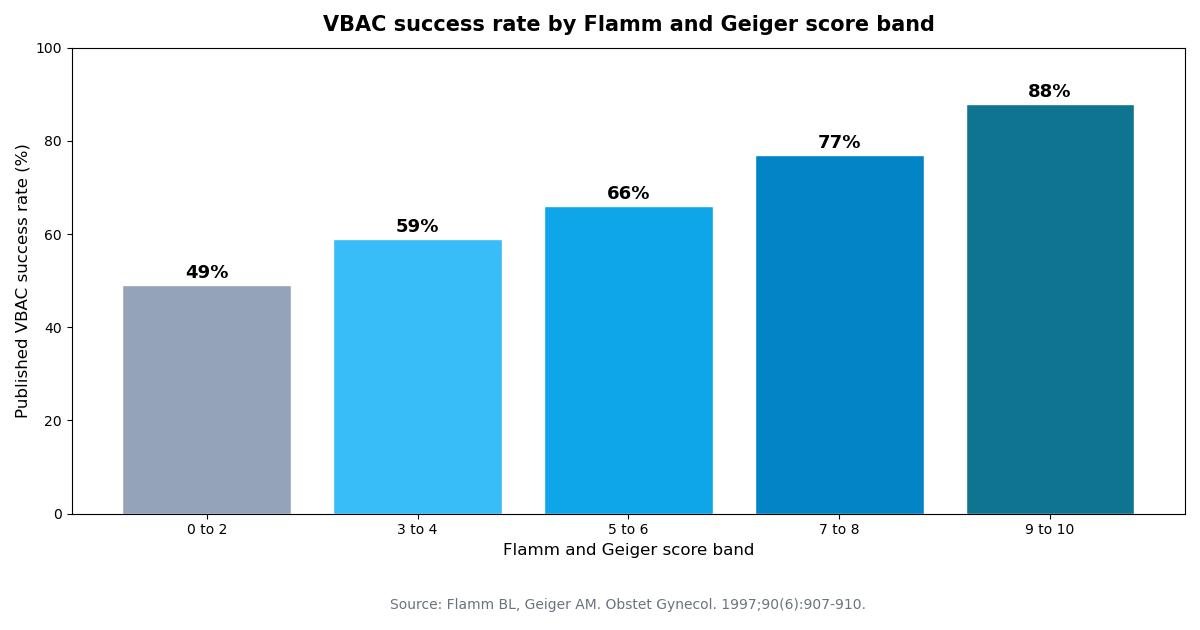
The published VBAC success rates by score band were:
| Score band | Published VBAC success rate |
|---|---|
| 0 to 2 | 49% |
| 3 to 4 | 59% |
| 5 to 6 | 66% |
| 7 to 8 | 77% |
| 9 to 10 | 88% |
Notice that even the lowest band achieved vaginal birth in about half of cases. A low score is not a prediction of failure, and a high score is not a guarantee of success. The numbers describe what happened to groups of women with similar scores in the study, and they are best understood as a starting point for counseling.
Why these five factors predict success
Each factor in the score reflects something plausible about the physiology of labor. A prior vaginal delivery history is the strongest predictor, worth up to 4 points, because a pelvis that has already delivered a baby vaginally has demonstrated that it can do so again; the score gives extra weight to a prior VBAC, and the most weight to vaginal births both before and after the caesarean. In the study, women with a vaginal birth history had markedly higher VBAC rates. Age under 40 carries 2 points because advancing maternal age is associated with slower labor progress and higher intervention rates, a pattern seen across obstetric research.
The prior caesarean indication, worth 1 point, separates recurrent from non-recurrent problems. If the first caesarean was performed because labor failed to progress or because the baby was too large for the pelvis (cephalopelvic disproportion), the same problem may recur in the next labor. If the caesarean was for a reason unlikely to repeat, such as a breech presentation or a one-off fetal concern, the outlook for a vaginal birth is better. The cervical factors are graded: effacement scores 0, 1, or 2 points across three bands, and dilation of 4 cm or more adds 1 point. A cervix that is already thin and open suggests the body is preparing for labor, which predicts smoother progress and a higher chance of vaginal delivery.
Uterine rupture: what the evidence shows
The main risk specific to a trial of labor after caesarean is uterine rupture, a tear through the wall of the uterus, usually at the site of the old scar. It is uncommon but serious, because it can cause severe bleeding, compromise the baby's oxygen supply, and require emergency surgery. According to ACOG Practice Bulletin 205, the risk of uterine rupture for women with one prior low transverse caesarean who attempt a trial of labor is approximately 0.5 to 0.9%, which is roughly 1 in 110 to 1 in 200. For comparison, the risk with a planned repeat caesarean is about 0.02%, or roughly 1 in 5,000.
The type of the previous uterine incision matters enormously. A low transverse incision, the horizontal cut used in the vast majority of modern caesareans, carries the lowest rupture risk. A classical incision (vertical in the upper uterus), a T-shaped incision, or a low vertical incision carries a substantially higher risk, and a trial of labor is generally not recommended in those cases. A history of prior uterine rupture is a firm contraindication to TOLAC. Certain methods of labor induction, particularly prostaglandin medications, increase the rupture risk and are used with caution or avoided. This is why one of the most important steps in VBAC planning is obtaining the operative report from the previous caesarean to confirm the incision type, rather than relying on the skin scar, which does not always match the uterine incision.
It is worth keeping these numbers in perspective. A 0.5 to 0.9% risk means that more than 99 in 100 trials of labor do not end in rupture. The risk is real enough to require planning, namely a hospital with immediate access to obstetric, anaesthesia, and surgical teams, but small enough that most guidelines support offering TOLAC to eligible women.
Benefits of a successful VBAC, and the trade-offs
A successful vaginal birth after caesarean avoids major abdominal surgery. Compared with a repeat caesarean, it is associated with less blood loss, lower rates of infection and blood clots, a shorter hospital stay, and faster recovery, which matters when there are other children to care for at home. It also reduces the risks linked to multiple caesareans: with each additional caesarean, the chance rises of placenta previa, placenta accreta spectrum (where the placenta grows into the uterine wall), and injury to nearby organs during surgery. For a woman planning a larger family, the cumulative benefit of avoiding repeat surgery grows with each pregnancy.
The trade-off is that a trial of labor carries the rupture risk described above, plus the chance of an unplanned caesarean during labor, which has slightly higher complication rates than a planned one. When a trial of labor ends in a caesarean after a long labor, recovery can be harder than after a scheduled procedure. A frank discussion weighs the predicted chance of success, reflected in scores like this one, against these competing risks and the woman's own preferences about the birth experience.
Limitations of the score, and the newer nomograms
The Flamm and Geiger score has real limitations, and honesty about them is part of good counseling. First, it was developed in 1997, in a specific study population, and obstetric practice has changed since then: induction methods, monitoring, and thresholds for intervention have all shifted. Second, it groups women into broad bands, so a woman with a score of 9 and a woman with a score of 10 receive the same estimate even though their profiles differ. Third, it omits factors now known to influence VBAC success, such as body mass index, estimated fetal weight, and the number of prior caesareans.
Newer models address some of these gaps. The Grobman nomogram, first published in 2007 and later updated in 2021, estimates an individualized probability of VBAC using continuous variables, including age and body mass index, alongside obstetric history. Because it produces a single percentage rather than a band, it can feel more personal. Other models exist as well. None of them, including this score, can predict what will happen to an individual woman; they all estimate the experience of similar women in the past. The Flamm and Geiger score endures in teaching and counseling because it is simple, transparent, and quick to use at the bedside. A clinician may use a newer nomogram for a more individualized number, but the counseling conversation, risks, benefits, and planning, remains the same.
How to use this score in counseling
Use the score early, not at the end of pregnancy. Two of its factors, effacement and dilation, are only known once labor assessment begins, but the other three, prior vaginal delivery, age, and the indication for the prior caesarean, can be established at the first antenatal visit. A provisional score from those three factors gives a rough early estimate; adding the cervical findings later refines it. Write the score and the band into the birth plan discussion, alongside the operative report confirming the incision type and the plan for where the birth will take place.
Remember that the score describes groups, not individuals. A woman with a score of 2 has roughly a one-in-two published chance, which some women will find encouraging and others will not. The purpose of the number is to anchor the conversation in evidence so that values and preferences, not fear or guesswork, drive the decision. A woman who strongly values a vaginal birth may reasonably attempt TOLAC with a moderate score; a woman who strongly values predictability may reasonably choose a planned repeat caesarean with a high score. Both are legitimate decisions when made with full information.
When to talk to your obstetrician
Begin the VBAC conversation early in pregnancy, or ideally before conceiving, so there is time to gather the operative report, confirm the uterine incision type, and choose a birth setting equipped for a trial of labor. A suitable hospital has obstetric, anaesthesia, and operating theatre staff immediately available throughout labor. If you move or change providers, carry the operative report with you. Discuss the plan again near term, when the cervical factors can be assessed and the estimated fetal weight is known, and confirm what will trigger a change of plan during labor.
Key takeaways
- The Flamm and Geiger score is a clinical admission scoring system published in 1997 that estimates the chance of vaginal birth after caesarean (VBAC).
- In the Flamm and Geiger study, the observed VBAC success rates by score band were: scores 0 to 2, about 49%; scores 3 to 4, about 59%; scores 5 to 6, about 66%; scores 7 to 8, about 77%; and scores 9 to 10, about 88%.
- According to the American College of Obstetricians and Gynecologists Practice Bulletin 205, the risk of uterine rupture for women with one prior low transverse caesarean who attempt a trial of labor is approximately 0.5 to 0.9%, compared with about 0.02% for a planned repeat caesarean.
- No.
Frequently asked questions
- What is the Flamm and Geiger VBAC score?
- It is a five-factor admission scoring system published in 1997 that estimates the chance of vaginal birth after caesarean. Points are awarded for vaginal delivery history (0 to 4 points: none, before the caesarean, after it, or both), age under 40 (2 points), a non-recurrent indication for the prior caesarean (1 point), cervical effacement at admission (0 to 2 points across three bands), and cervical dilation of at least 4 cm (1 point). The total of 0 to 10 maps to published success bands from 49% to 88%.
- What VBAC success rate does each score band predict?
- Scores 0 to 2: about 49%. Scores 3 to 4: about 59%. Scores 5 to 6: about 66%. Scores 7 to 8: about 77%. Scores 9 to 10: about 88%. These are group-level results from the original study, not personal guarantees.
- What is the risk of uterine rupture during a trial of labor after caesarean?
- About 0.5 to 0.9% with one prior low transverse caesarean, according to ACOG Practice Bulletin 205, compared with about 0.02% for a planned repeat caesarean. The risk is higher with a classical or T-shaped incision, a prior uterine rupture, or certain induction methods.
- Does this calculator decide whether I can attempt a VBAC?
- No. It is a counseling aid, not a decision rule. Eligibility depends on your uterine incision type, obstetric history, current pregnancy factors, and hospital resources, and must be assessed by your obstetrician or midwife.
- Are there newer prediction models than the Flamm and Geiger score?
- Yes. The Grobman nomogram (2007, updated 2021) gives an individualized probability using continuous variables such as age and body mass index. The Flamm and Geiger score remains useful for its simplicity and transparency at the bedside.
- When should I talk to my obstetrician about VBAC?
- Early in pregnancy, or before conceiving, so there is time to review the operative report, confirm the incision type, and plan a birth setting with immediate obstetric and surgical cover.
Sources
Flamm BL, Geiger AM. Vaginal birth after cesarean delivery: an admission scoring system. Obstet Gynecol. 1997;90(6):907-910. The point values and success bands in this calculator come from that study.
Grobman WA, Lai Y, Landon MB, et al. Development of a nomogram for prediction of vaginal birth after cesarean delivery. Obstet Gynecol. 2007;109(4):806-812.
American College of Obstetricians and Gynecologists. Practice Bulletin No. 205: Vaginal Birth After Cesarean Delivery. Obstet Gynecol. 2019;133(2):e110-e127 (uterine rupture risk figures).
Browse all Doctor With Data calculators · Women's health calculators