Canadian Syncope Risk Score Calculator
In short: Free Canadian Syncope Risk Score calculator: 8 ED variables scored from -3 to +10 to estimate 30-day risk after syncope. Educational tool, not medical advice. Use the calculator above, then read the guide below to interpret your result and its limitations.
Score eight emergency department predictors from -3 to +10 to estimate the 30-day risk of a serious adverse event after syncope. Five validated risk bands run from very low (about 0.4 to 0.7%) to very high (about 26.5% and above).
The calculator
Result
Not yet calculated
Select one option for each of the eight predictors
Why syncope needs a score
Syncope, a transient loss of consciousness from cerebral hypoperfusion, is one of the most common reasons for emergency department visits, accounting for roughly 1 to 3 percent of ED presentations. Most episodes are benign: vasovagal syncope in a young, otherwise healthy person carries an excellent prognosis. But a minority of syncope is cardiac, caused by arrhythmias, structural heart disease, or other life-threatening conditions, and these patients can die suddenly if sent home without proper evaluation. The clinical challenge is telling the two groups apart during a single ED visit, often with limited information.
Before the Canadian Syncope Risk Score, disposition decisions relied heavily on unstructured clinical judgement, and practice varied widely: some low-risk patients were admitted unnecessarily, while some high-risk ones were discharged. The score was designed to replace gestalt with a validated, reproducible estimate, so that admission decisions, monitoring, and follow-up could be matched to actual risk.
The eight predictors
| Predictor | Points |
|---|---|
| Predisposition to vasovagal symptoms | -1 |
| History of heart disease | +1 |
| Any SBP below 90 or above 180 mmHg in the ED | +2 |
| Troponin above the 99th percentile | +2 |
| Abnormal QRS axis (below -30 or above +100 degrees) | +1 |
| QRS duration above 130 ms | +1 |
| Corrected QT interval above 480 ms | +1 |
| ED diagnosis of vasovagal syncope | -2 |
| ED diagnosis of cardiac syncope | +2 |
Note the structure: the two negative predictors identify the classic benign phenotype, a young patient with typical vasovagal prodrome and triggers, while the positive predictors cluster around cardiac disease, haemodynamic instability, and electrical abnormalities. The ED diagnosis itself contributes, which means the score formalises the physician's synthesis rather than replacing it. The total ranges from -3 to +10.
Interpreting the bands
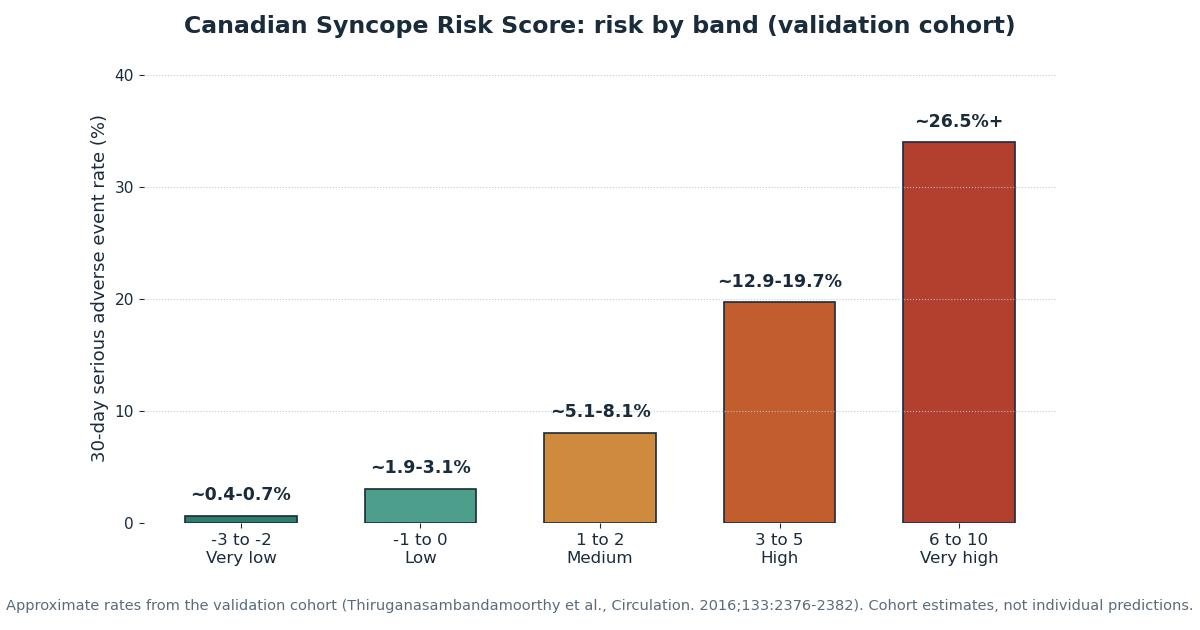
The validation study reported the following approximate 30-day rates of serious adverse events per band:
- -3 to -2: very low risk, about 0.4 to 0.7%.
- -1 to 0: low risk, about 1.9 to 3.1%.
- 1 to 2: medium risk, about 5.1 to 8.1%.
- 3 to 5: high risk, about 12.9 to 19.7%.
- 6 to 10: very high risk, about 26.5% and above.
These are cohort estimates from the Canadian validation population, and they should be read as honest approximations, not precise individual probabilities. A patient at the top of one band and a patient at the bottom of the next are not as different as the band labels suggest. The score's value is in sorting patients into actionable groups: the very low band supports discharge, the very high band demands admission, and the middle bands call for judgement about observation, expedited testing, and follow-up timing.
How the score was built
Thiruganasambandamoorthy and colleagues enrolled thousands of adults presenting to six Canadian emergency departments with syncope, recorded candidate predictors during the ED stay, and followed patients for 30 days for serious outcomes including death, arrhythmia, myocardial infarction, aortic dissection, pulmonary embolism, severe pulmonary hypertension, and procedural interventions. The eight predictors survived multivariable modelling, and the point values were assigned from the regression coefficients. The score was then validated in a separate cohort, which is where the band-specific risk estimates come from. It was published in Circulation in 2016.
Using the score in practice
In the emergency department, the score is typically calculated once the ECG and troponin are back, which is usually well before the disposition decision has to be made. The very low band is the most useful in practice: a young patient with a classic vasovagal story, a normal ECG, and no red flags can be discharged with confidence and a plan for primary care follow-up. At the other end, the very high band makes the admission decision easy and justifies telemetry monitoring. The middle three bands are where the score earns its keep as a communication tool: telling a patient "your estimated 30-day risk is around 5 to 8 percent, which is why we want you seen by cardiology this week" is clearer and more honest than a vague "we want to be safe". Several centres have built the score into their syncope pathways and order sets so it is calculated routinely rather than from memory.
What the score does not do
The score applies to adults evaluated in the emergency department for syncope. It does not apply to children, to inpatients who faint on the ward, or to people who fainted days ago and are now being seen in clinic. It also does not identify the cause of syncope: a high score says the patient is at risk, not why. And like every prediction rule, it is only as good as its inputs: an ECG misread for QRS duration or a troponin drawn too early to rise will feed the score bad data. The score organises risk; it does not replace the history, the examination, or the physician.
What does the Canadian Syncope Risk Score predict?
The Canadian Syncope Risk Score predicts the 30-day risk of a serious adverse event, such as death, arrhythmia, myocardial infarction, or a procedure to treat an arrhythmia, after an emergency department visit for syncope. It combines eight predictors available during the ED stay into a score from -3 to +10, which maps to five risk bands from very low to very high.
What are the eight predictors in the score?
The eight predictors are: a predisposition to vasovagal symptoms (minus 1 point), a history of heart disease (plus 1), any systolic blood pressure below 90 or above 180 in the ED (plus 2), troponin above the 99th percentile (plus 2), an abnormal QRS axis (plus 1), QRS duration over 130 milliseconds (plus 1), a corrected QT interval over 480 milliseconds (plus 1), and the ED diagnosis itself: vasovagal syncope scores minus 2, cardiac syncope scores plus 2.
What do the risk bands mean?
The validated bands and their approximate 30-day serious adverse event rates from the validation cohort are: minus 3 to minus 2, very low risk (about 0.4 to 0.7 percent); minus 1 to 0, low risk (about 1.9 to 3.1 percent); 1 to 2, medium risk (about 5.1 to 8.1 percent); 3 to 5, high risk (about 12.9 to 19.7 percent); and 6 to 10, very high risk (about 26.5 percent and above). These are cohort estimates, not individual predictions.
Where does the Canadian Syncope Risk Score come from?
The score was derived and validated by Thiruganasambandamoorthy and colleagues in a large prospective Canadian cohort, published in Circulation in 2016. It was developed specifically to help emergency physicians decide which syncope patients need admission or urgent follow-up and which can be safely discharged.
Can a low score send a syncope patient home?
A very low score supports discharge with routine follow-up, but the score is a decision aid, not a discharge rule. Clinical judgement still governs: concerning features not captured by the eight predictors, patient reliability, access to follow-up, and shared decision-making all matter. The score helps quantify risk so the disposition decision is explicit rather than gestalt alone.
Can I use this score on myself after fainting?
No. The score requires emergency department data, including an ECG and a troponin result, and it was validated in ED patients evaluated for syncope. Fainting can have dangerous causes, including cardiac arrhythmias, and anyone who faints should be evaluated promptly by a clinician. This calculator is educational and cannot assess you.
Key takeaways
- The Canadian Syncope Risk Score predicts the 30-day risk of a serious adverse event, such as death, arrhythmia, myocardial infarction, or a procedure to treat an arrhythmia, after an emergency department visit for syncope.
- The eight predictors are: a predisposition to vasovagal symptoms (minus 1 point), a history of heart disease (plus 1), any systolic blood pressure below 90 or above 180 in the ED (plus 2), troponin above the 99th percentile (plus 2), an abnormal QRS axis (plus 1), QRS duration over 130 milliseconds (plus 1), a corrected QT interval over 480 milliseconds (plus 1), and the ED diagnosis itself: vasovagal syncope scores minus 2, cardiac syncope scores plus 2.
- The validated bands and their approximate 30-day serious adverse event rates from the validation cohort are: minus 3 to minus 2, very low risk (about 0.4 to 0.7 percent); minus 1 to 0, low risk (about 1.9 to 3.1 percent); 1 to 2, medium risk (about 5.1 to 8.1 percent); 3 to 5, high risk (about 12.9 to 19.7 percent); and 6 to 10, very high risk (about 26.5 percent and above).
- The score was derived and validated by Thiruganasambandamoorthy and colleagues in a large prospective Canadian cohort, published in Circulation in 2016 (doi: 10.1161/CIRCULATIONAHA.115.021697).
References and further reading
Medical disclaimer
This calculator is an educational aid only. It does not diagnose syncope, does not predict your individual outcome, and does not advise on admission or discharge. The Canadian Syncope Risk Score is one instrument among many that emergency clinicians use, and its result must be interpreted by a qualified clinician in the context of the full evaluation. If you have fainted, seek medical evaluation promptly. Never make decisions about emergency care on the basis of a score alone.