What is NEWS2?
NEWS2 stands for the National Early Warning Score 2. It was published in December 2017 by the Royal College of Physicians as an update to the original NEWS, and it was endorsed by NHS England and NHS Improvement as the standard early warning system for identifying acutely ill patients in hospitals in England, including patients with sepsis.
The idea is simple. Small changes in vital signs often appear hours before a patient collapses. NEWS2 turns seven routine observations into numbers: each observation is scored 0, 1, 2 or 3 depending on how far it sits from the normal range, and the scores are added to give a total between 0 and 20. A rising total means a rising risk of deterioration, cardiac arrest or unplanned intensive care admission, and the RCP chart links each score band to a specific clinical response, from routine monitoring up to emergency assessment by a critical-care competent team.
NEWS2 is an aggregate weighted scoring system: the weights are fixed by the chart, not by opinion, so two clinicians scoring the same observations always get the same number. That consistency is the point. It gives ward staff, rapid response teams and doctors a common language for "how worried should we be right now" and a clear escalation ladder to climb.
Two things make NEWS2 different from the original NEWS. First, it adds a second oxygen saturation scale for patients with hypercapnic respiratory failure, who are harmed by too much oxygen. Second, it scores new confusion, agitation, or any drop from Alert on the consciousness scale, recognising delirium as an early warning sign. Both refinements are built into this calculator.
The seven NEWS2 parameters
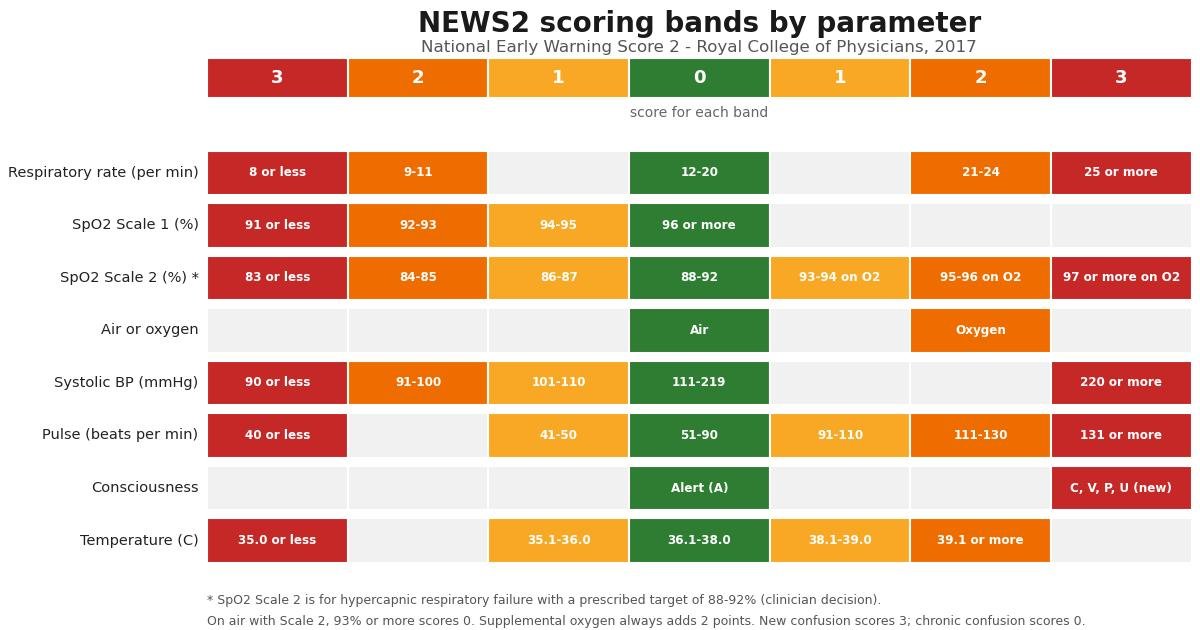
NEWS2 scores seven observations. Three describe breathing and oxygenation: respiratory rate, oxygen saturation, and whether the patient is breathing air or receiving supplemental oxygen. One describes circulation: systolic blood pressure (diastolic pressure is recorded but never scored). One describes the heart: pulse rate. One describes the brain: level of consciousness. One describes metabolism: temperature. Each parameter is scored independently from 0 to 3 using the bands below, which are transcribed directly from the RCP 2017 chart. The oxygen saturation scale and the consciousness scale have special rules, explained in the sections that follow.
| Parameter | Score 0 | Score 1 | Score 2 | Score 3 |
|---|---|---|---|---|
| Respiratory rate (per min) | 12-20 | 9-11 | 21-24 | 8 or less, 25 or more |
| SpO2 Scale 1 (%) | 96 or more | 94-95 | 92-93 | 91 or less |
| SpO2 Scale 2 (%) | 88-92, or 93 or more on air | 86-87; 93-94 on oxygen | 84-85; 95-96 on oxygen | 83 or less; 97 or more on oxygen |
| Air or oxygen | Air | - | Oxygen | - |
| Systolic BP (mmHg) | 111-219 | 101-110 | 91-100 | 90 or less, 220 or more |
| Pulse (per min) | 51-90 | 41-50 or 91-110 | 111-130 | 40 or less, 131 or more |
| Consciousness | Alert | - | - | New confusion, responds to voice, responds to pain, unresponsive |
| Temperature (C) | 36.1-38.0 | 35.1-36.0 or 38.1-39.0 | 39.1 or more | 35.0 or less |
SpO2 Scale 1 or SpO2 Scale 2: choosing correctly
This is the part of NEWS2 that causes the most mistakes, so read it carefully.
SpO2 Scale 1 is the default. It is used for the great majority of patients, with the usual target range of 94 to 98 percent. Under Scale 1, a saturation of 96 or more scores 0, 94 to 95 scores 1, 92 to 93 scores 2, and 91 or less scores 3.
SpO2 Scale 2 exists for one specific group: patients with hypercapnic respiratory failure who have a prescribed oxygen saturation target of 88 to 92 percent. These are most often patients with acute exacerbations of chronic obstructive pulmonary disease, but the group can include severe asthma, obesity hypoventilation and other conditions where the blood gas shows retained carbon dioxide. For these patients, too much oxygen can rapidly worsen hypercapnia and cause death, so the chart scores high saturations as abnormal rather than reassuring.
Under Scale 2, 88 to 92 percent scores 0, the safe target zone. Lower readings score as usual: 86 to 87 scores 1, 84 to 85 scores 2, 83 or less scores 3. The distinctive part is what happens above 92. If the patient is breathing air, a saturation of 93 or more scores 0: nothing to add. If the patient is receiving supplemental oxygen, the same readings score points, because oxygen is driving the saturation above the prescribed range: 93 to 94 on oxygen scores 1, 95 to 96 on oxygen scores 2, and 97 or more on oxygen scores 3.
Two rules sit alongside this. First, the decision to use Scale 2 must be made by a competent clinical decision maker, a consultant or registrar in most hospital policies, and recorded on the chart; it is never a bedside guess. Second, receiving any supplemental oxygen always adds 2 points on the separate air-or-oxygen parameter, whichever SpO2 scale is in use.
NEWS2 score bands and recommended clinical response
Add the seven parameter scores to get the NEWS2 total, from 0 to 20. The RCP links the total to four response levels. One extra rule applies at every level: a score of 3 in any single parameter always triggers an urgent clinician review, even when the total is low, because one badly abnormal observation can matter more than a middling total.
| Total | Risk band | Recommended response (RCP) |
|---|---|---|
| 0-4 | Low | Routine monitoring per local policy; re-score at the next scheduled observation round. |
| 3 in any single parameter (total 0-4) | Low-medium | Urgent review by a clinician competent to decide on escalation; increase monitoring frequency. |
| 5-6 | Medium | Urgent review by a ward-based doctor or a nurse competent in acute illness assessment; decide on escalation. |
| 7 or more | High | Emergency assessment by a team or doctor with critical-care competencies, usually the medical team; consider a higher-dependency setting. |
These responses are the RCP recommended minimums. Local escalation policies may respond faster, and any clinician who is worried about a patient should escalate regardless of the number: the chart is an aid to judgment, never a replacement for it.
How to use this calculator
- Measure the seven observations with your usual equipment: count the respiratory rate over a full minute, take the SpO2 from a reliable trace, record systolic blood pressure, pulse, temperature and the true level of consciousness.
- Choose the oxygen saturation scale. Leave Scale 1 selected unless the patient is a known hypercapnic CO2 retainer with a prescribed 88 to 92 percent target, decided by a competent clinician and documented.
- Record whether the patient is breathing air or receiving supplemental oxygen. Any oxygen, at any flow rate or device, adds 2 points.
- Score consciousness honestly: Alert scores 0; new confusion or agitation, response only to voice, response only to pain, or unresponsive each score 3. Long-standing confusion from dementia, with no new change, scores 0.
- Press Calculate. Read the per-parameter scores to see which observation is driving the total, then the band and the recommended response. Re-score at the frequency your local policy sets for the band.
Worked example
A 68-year-old man with COPD and known hypercapnic failure, target 88 to 92, breathing air. Respiratory rate 22 scores 2, SpO2 90 percent on Scale 2 scores 0, air scores 0, systolic BP 118 scores 0, pulse 96 scores 1, Alert scores 0, temperature 37.4 scores 0. Total: 3. No single parameter scores 3, so the band is Low: continue routine monitoring.
The same man two hours later, now on 2 litres of oxygen. Respiratory rate 26 scores 3, SpO2 96 percent on Scale 2 on oxygen scores 2, oxygen scores 2, systolic BP 112 scores 0, pulse 104 scores 1, new confusion scores 3, temperature 37.8 scores 0. Total: 11, with three parameters scoring 3. Band: High. Emergency assessment by a critical-care competent team, now. Note how the two oxygen-driven parameters and the new confusion did most of the work: the total alone does not tell you that, which is why the calculator shows every parameter score.
Limitations: what NEWS2 cannot do
NEWS2 is validated for adults aged 16 and over in acute hospital settings. It is not validated for children, and it should not be used in pregnancy without local guidance, because normal vital-sign ranges differ.
The score does not diagnose anything. A high NEWS2 says "this patient is deteriorating", not why. Sepsis, bleeding, pulmonary embolism and many other emergencies can all drive the number up, and the response is assessment, not a specific treatment.
Some patients will score points for their normal baseline. A patient with chronic confusion from dementia scores 0 for consciousness unless there is a new change, per the chart, but other chronic abnormalities (for example a habitually low blood pressure) still score, and clinicians are expected to interpret the total in context. This is why the RCP insists that trends matter: a score rising from 2 to 5 is more alarming than a stable 4, and this one-off calculator cannot show you the trend. Record every set of observations on the chart and look at the direction.
Finally, NEWS2 depends on accurate measurement. A respiratory rate counted for 15 seconds and multiplied by four, a saturation probe on a cold finger, a blood pressure cuff of the wrong size: each can move the total by several points. Measure carefully, and if the number does not match the patient in front of you, trust the patient.
Key takeaways
- NEWS2 is used to detect early signs of clinical deterioration in acutely ill adult patients, usually in hospital.
- Scale 2 is used only for patients with hypercapnic respiratory failure who have a prescribed oxygen saturation target of 88 to 92 percent, most commonly during acute exacerbations of COPD.
- A total of 5 or 6 is the medium-risk band and 7 or more is the high-risk band.
- Yes.
Frequently asked questions
What is NEWS2 used for?
NEWS2 is used to detect early signs of clinical deterioration in acutely ill adult patients, usually in hospital. By converting seven routine observations into a single score from 0 to 20, it gives staff a common language for how sick a patient is and links the score to a recommended level of clinical response, from routine monitoring to emergency assessment. NHS England and NHS Improvement endorsed it as the standard early warning system for hospitals in England.
When should SpO2 Scale 2 be used instead of Scale 1?
Scale 2 is used only for patients with hypercapnic respiratory failure who have a prescribed oxygen saturation target of 88 to 92 percent, most commonly during acute exacerbations of COPD. The decision must be made by a competent clinical decision maker and recorded on the chart. Everyone else uses Scale 1. Using Scale 2 for the wrong patient hides real hypoxia; using Scale 1 for a CO2 retainer misses the danger of excess oxygen.
What does a NEWS2 score of 5 or more mean?
A total of 5 or 6 is the medium-risk band and 7 or more is the high-risk band. A score of 5 or 6 calls for urgent review by a ward-based doctor or a nurse competent in assessing acute illness, with a decision about escalation and more frequent monitoring. A score of 7 or more calls for emergency assessment by a team with critical-care competencies. Any clinician worried about a patient should escalate even if the score is lower.
Does a score of 3 in one parameter matter if the total is low?
Yes. The RCP rule is that a score of 3 in any single parameter triggers an urgent review by a clinician competent to decide on escalation, even when the aggregate total is 0 to 4. A single severely abnormal observation, such as a respiratory rate of 26 or new unresponsiveness, can signal danger that the total hides.
Can NEWS2 replace clinical judgment?
No. The RCP is explicit that NEWS2 is an aid to clinical judgment, not a substitute for it. Escalate whenever you are worried about a patient, regardless of the score, and interpret the number in the context of the patient's baseline, the trend over time, and the underlying diagnosis. A score that does not fit the patient in front of you should never overrule bedside assessment.
Is this calculator suitable for use at home?
This page is an educational tool that shows how the RCP chart works; it is not a medical device and it does not give medical advice. NEWS2 was designed for trained staff caring for acutely ill adults in clinical settings, where observations are measured with proper equipment and every score feeds into an escalation pathway. If you or someone near you is unwell, seek professional care promptly instead of relying on a score.
References
- Royal College of Physicians. National Early Warning Score (NEWS) 2: Standardising the assessment of acute-illness severity in the NHS. Updated report of a working party. London: RCP; 2017. All scoring bands, the SpO2 Scale 1 and Scale 2 definitions, the air-or-oxygen rule, and the 0-4 / 5-6 / 7-or-more response thresholds on this page are transcribed from the NEWS2 chart in this report.
- NHS England and NHS Improvement endorsement of NEWS2 as the early warning system for identifying acutely ill patients, including those with sepsis, in hospitals in England, as cited in the RCP 2017 report.
- American College of Emergency Physicians
- NICE Guidance