San Francisco Syncope Rule Calculator
In short: Calculate short-term serious-outcome risk after syncope with the San Francisco Syncope Rule: the 5 CHESS criteria, derivation performance, and limitations explained. Use the calculator above, then read the guide below to interpret your result and its limitations.
Check the 5 CHESS criteria
Answer each criterion for a patient evaluated for syncope or near-syncope in the emergency department. Any single positive criterion means HIGH risk of a serious outcome within 7 days.
What the San Francisco Syncope Rule is
Syncope is a transient loss of consciousness caused by a brief period of inadequate blood flow to the brain. It is one of the most common and most challenging presentations in emergency medicine, because most episodes turn out to be benign, yet a minority signal a dangerous underlying condition such as a cardiac arrhythmia, myocardial infarction, pulmonary embolism, stroke, or significant hemorrhage. The clinical dilemma is deciding which patients can be safely discharged and which need admission or urgent observation.
The San Francisco Syncope Rule, published by Quinn and colleagues in the Annals of Emergency Medicine in 2004, is a clinical decision aid designed to answer that question for the short term. It predicts the risk of a serious outcome within 7 days in emergency department patients evaluated for syncope or near-syncope. The rule was derived from a prospective cohort of patients presenting to a single emergency department, and it identifies high-risk patients with a simple binary rule: if any one of five criteria is present, the patient is considered high risk.
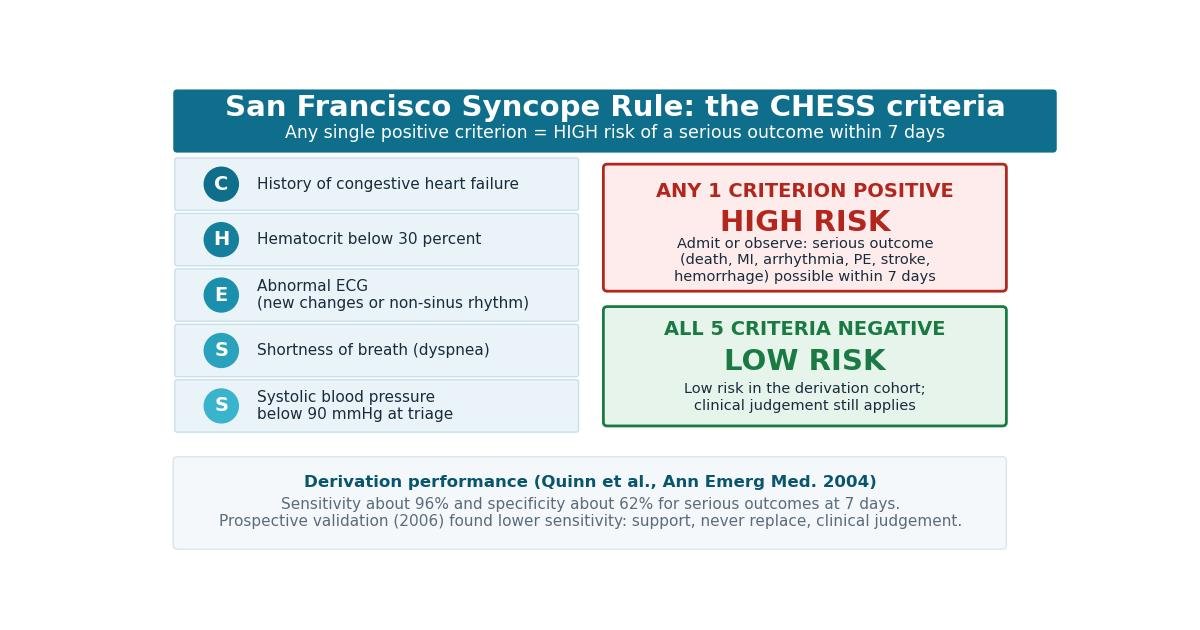
The five criteria are remembered with the mnemonic CHESS: history of congestive heart failure, hematocrit below 30 percent, abnormal ECG, shortness of breath, and systolic blood pressure below 90 mmHg at triage. The rule is deliberately simple so that it can be applied at the bedside from information routinely available during the initial evaluation: the history, the vital signs, the ECG, and a basic blood count.
It is important to understand what the rule does and does not do. It does not diagnose the cause of syncope, and it does not predict long-term risk. It estimates the probability of a serious short-term outcome, defined in the original study as events such as death, myocardial infarction, arrhythmia, pulmonary embolism, stroke, subarachnoid hemorrhage, significant hemorrhage, or a return emergency department visit with hospitalization for a related event within 7 days. A high-risk classification is a prompt for admission or close observation, not a diagnosis in itself.
The five CHESS criteria explained
C: History of congestive heart failure
A known history of congestive heart failure reflects underlying structural heart disease and reduced cardiac reserve. Patients with heart failure are more likely to have malignant arrhythmias, and they tolerate brief periods of low output poorly. In the derivation study, this historical feature was one of the independent predictors of a serious short-term outcome. When taking the history, ask specifically about a prior diagnosis of heart failure, hospitalizations for fluid overload, and current use of heart failure medications, since patients do not always use the exact term.
H: Hematocrit below 30 percent
A hematocrit strictly below 30 percent indicates significant anemia, which in the context of syncope raises concern for occult bleeding, such as gastrointestinal hemorrhage, or for reduced oxygen-carrying capacity compounding a cardiac cause. The threshold is a strict cutoff: a hematocrit of 29.9 percent is positive, while exactly 30 percent is negative. Anemia alone does not explain syncope in every case, but as a risk marker it flags patients who deserve a search for a bleeding source and closer monitoring.
E: Abnormal ECG (new changes or non-sinus rhythm)
The ECG criterion is positive when the presenting ECG shows new changes compared with a previous tracing, or a non-sinus rhythm. New ischemic changes, new conduction abnormalities, or an ectopic or non-sinus rhythm all count as positive in the original definition. The emphasis on newness matters: a patient whose ECG is unchanged from a known abnormal baseline is a gray area, so comparison with a prior ECG is valuable whenever one is available. Because many dangerous causes of syncope are electrical, the ECG is the single most informative bedside test in the syncope workup.
S: Shortness of breath (dyspnea)
Shortness of breath at presentation suggests that the syncopal event may be tied to cardiopulmonary compromise rather than a simple vasovagal episode. Dyspnea can accompany pulmonary embolism, acute heart failure, significant anemia, or arrhythmia with poor forward flow. Like the other criteria, it is a marker of risk rather than a diagnosis: it prompts the clinician to look harder for a cardiopulmonary cause before considering discharge.
S: Systolic blood pressure below 90 mmHg at triage
A triage systolic blood pressure strictly below 90 mmHg indicates hypotension and possible shock physiology. In a patient who has just syncopized, persistent hypotension raises concern for ongoing bleeding, sepsis, massive pulmonary embolism, or a failing pump. The cutoff is strict: 89 mmHg is positive, while exactly 90 mmHg is negative. A single low reading should be confirmed with a repeat measurement and considered alongside the rest of the vital signs.
How to use this calculator
This calculator applies the rule exactly as derived. Work through the five criteria in order, using the history, triage vital signs, ECG, and hematocrit from the initial evaluation:
- History of congestive heart failure: select Yes if the patient has a known diagnosis, otherwise No.
- Hematocrit below 30 percent: type the hematocrit value and the calculator applies the strict less-than-30 cutoff for you, or answer Yes/No directly if you have already interpreted the result.
- Abnormal ECG: select Yes if there are new changes or a non-sinus rhythm on the presenting ECG.
- Shortness of breath: select Yes if dyspnea is reported or observed.
- Systolic blood pressure below 90 mmHg at triage: type the triage systolic value and the calculator applies the strict less-than-90 cutoff, or answer Yes/No directly.
Press "Calculate risk" to see the verdict. If you entered a hematocrit or blood pressure value, it takes precedence over the Yes/No buttons for that criterion, so you do not need to answer both. If any criterion has neither a value nor a Yes/No answer, the calculator will tell you exactly which one is missing instead of guessing.
Interpreting the result
The San Francisco Syncope Rule is binary. If any one of the five CHESS criteria is positive, the patient is classified as HIGH RISK for a serious outcome within 7 days. In the derivation study, this simple rule captured about 96 percent of patients who went on to have a serious outcome, which is why a high-risk classification should prompt admission or at least urgent observation with monitoring and further testing.
If all five criteria are negative, the rule classifies the patient as low risk. In the derivation cohort, very few patients with a completely negative rule had a serious 7-day outcome. That said, "low risk" is not "no risk": the validation studies showed lower sensitivity, and no decision rule replaces the clinician's assessment of the story, the examination, and any red flags that fall outside the five criteria.
The calculator names every positive criterion in its result so you can see exactly what drove the classification. This transparency matters, because the appropriate next step depends on which criterion is positive: a low hematocrit prompts a bleeding workup, an abnormal ECG prompts cardiac monitoring and cardiology input, and hypotension prompts resuscitation and a search for shock.
Derivation performance
Quinn and colleagues derived the rule in a prospective cohort of emergency department patients presenting with syncope or near-syncope, published in the Annals of Emergency Medicine in 2004. Using recursive partitioning, they identified the five CHESS variables as the combination that best predicted serious outcomes at 7 days. In that derivation cohort, the rule achieved a sensitivity of about 96 percent and a specificity of about 62 percent for serious 7-day outcomes.
What do those numbers mean in practice? A sensitivity of about 96 percent means the rule correctly flagged nearly all patients who went on to have a serious outcome: very few high-risk patients slipped through as low risk. A specificity of about 62 percent means that among patients who did not have a serious outcome, roughly six in ten were correctly classified as low risk, while the rest were flagged as high risk and would have been admitted or observed without ultimately having a serious event. For a screening rule in a potentially lethal presentation, that trade-off is deliberate: it is designed to miss as few dangerous cases as possible, at the cost of admitting some patients who turn out to be fine.
The rule's performance also depends on the population. The prevalence of serious outcomes in the derivation cohort shapes how the rule behaves when applied elsewhere, which is one reason external validation matters so much for any decision aid.
Limitations you must know
The most important limitation is that the rule performed less well when tested prospectively by other investigators and even by the original group. In the 2006 prospective validation study by Quinn and colleagues, published in the Annals of Emergency Medicine, the sensitivity was lower than in the derivation study, roughly in the range of 74 to 89 percent. That drop matters enormously: a sensitivity of 74 percent means about one in four patients with a serious outcome would be misclassified as low risk. This is the central reason the rule should support, never replace, clinical judgement.
Second, the rule predicts short-term serious outcomes only. It says nothing about the long-term risk of recurrent syncope, the underlying diagnosis, or outcomes beyond 7 days. A patient can be low risk by the rule and still have a condition that needs prompt outpatient follow-up, such as newly discovered atrial fibrillation or orthostatic hypotension from a medication.
Third, the rule was derived in emergency department patients with syncope or near-syncope. Its accuracy in other settings, such as primary care clinics, urgent care centers, or hospital wards, has not been established, and applying it there is extrapolation. The definitions of the criteria also leave room for interpretation: the ECG criterion depends on what counts as a new change, and near-syncope was included alongside frank syncope in the derivation cohort.
Finally, the rule is only as good as the data fed into it. An ECG misread as normal, a hematocrit drawn after fluids, or a blood pressure taken with the wrong cuff size can all flip the classification. Treat the calculator as a structured second check on a complete clinical evaluation, not as a shortcut around one.
Key takeaways
- The San Francisco Syncope Rule is a clinical decision aid derived by Quinn and colleagues in 2004 to estimate the risk of a serious short-term outcome within 7 days in emergency department patients evaluated for syncope or near-syncope.
- In the original derivation study, an abnormal ECG meant new changes compared with a previous tracing or a non-sinus rhythm.
- If any one of the five CHESS criteria is positive, the rule classifies the patient as HIGH risk for a serious outcome within 7 days, and admission or urgent observation is generally recommended.
- In the 2004 derivation study by Quinn and colleagues, the San Francisco Syncope Rule had a sensitivity of about 96 percent and a specificity of about 62 percent for predicting serious outcomes at 7 days.
Frequently asked questions
What is the San Francisco Syncope Rule?
The San Francisco Syncope Rule is a clinical decision aid derived by Quinn and colleagues in 2004 to estimate the risk of a serious short-term outcome within 7 days in emergency department patients evaluated for syncope or near-syncope. It uses five criteria remembered by the CHESS mnemonic: history of congestive heart failure, hematocrit below 30 percent, abnormal ECG, shortness of breath, and systolic blood pressure below 90 mmHg at triage.
What counts as an abnormal ECG in the San Francisco Syncope Rule?
In the original derivation study, an abnormal ECG meant new changes compared with a previous tracing or a non-sinus rhythm. New ischemic changes, a new conduction abnormality, or an ectopic or non-sinus rhythm at presentation counted as positive. An unchanged ECG that was already abnormal at baseline was less clearly defined, so compare with a prior ECG when one is available.
How do I interpret the result of this calculator?
If any one of the five CHESS criteria is positive, the rule classifies the patient as HIGH risk for a serious outcome within 7 days, and admission or urgent observation is generally recommended. If all five criteria are negative, the rule classifies the patient as low risk in the derivation cohort, but this never overrides clinical judgement or local observation protocols.
How accurate was the rule in the original study?
In the 2004 derivation study by Quinn and colleagues, the San Francisco Syncope Rule had a sensitivity of about 96 percent and a specificity of about 62 percent for predicting serious outcomes at 7 days. However, a 2006 prospective validation study by the same group found lower sensitivity, roughly in the range of 74 to 89 percent, which is why the rule should support rather than replace clinical judgement.
Does the rule apply to patients who fainted outside the emergency department?
The rule was derived and validated in emergency department patients presenting with syncope or near-syncope. Its performance in other settings, such as primary care, urgent care, or inpatient wards, has not been established, so it should be applied only in the population it was studied in.
Can a low-risk result be used to discharge a patient?
A low-risk result does not guarantee safety. Syncope can be caused by dangerous conditions such as arrhythmia or pulmonary embolism that the rule may miss, especially given the lower sensitivity seen in validation. Disposition decisions must always incorporate the full clinical picture, further testing, and observation when uncertainty remains.
Medical disclaimer
This calculator is an educational tool for qualified clinicians. It does not diagnose any condition, does not establish a treatment plan, and does not replace clinical judgement. Syncope can be the first sign of a life-threatening illness: any concerning presentation warrants urgent in-person evaluation regardless of this calculator's output. If you are a patient or caregiver, do not use this tool to make medical decisions; seek emergency care for fainting, chest pain, palpitations, or shortness of breath. Doctor With Data publishes this content for information only and accepts no liability for decisions made with or without it.
References
- Quinn JV, Stiell IG, McDermott DA, Sellers KL, Kohn MA, Wells GA. Derivation of the San Francisco Syncope Rule to predict patients with short-term serious outcomes. Ann Emerg Med. 2004;43(5):613-623.
- Quinn JV, McDermott DA, Stiell IG, Kohn MA, Wells GA. Prospective validation of the San Francisco Syncope Rule to predict patients with serious outcomes. Ann Emerg Med. 2006;47(5):448-454.
- American College of Emergency Physicians
- NICE Guidance