SMART-COP Pneumonia Severity Calculator
In short: Free SMART-COP calculator: predict need for intensive respiratory or vasopressor support in community-acquired pneumonia. Educational tool, not medical advice. Use the calculator above, then read the guide below to interpret your result and its limitations.
Score eight clinical criteria to predict the need for intensive respiratory or vasopressor support (IRVS) in community-acquired pneumonia. Total 0 to 11 points; higher scores mean higher risk.
The calculator
Result
Not yet calculated
Answer each criterion above
What SMART-COP predicts
Most pneumonia severity scores, including the widely used CURB-65, were built to predict death, and they do that job well. But the harder bedside question is different: which patient with pneumonia, who does not look critically ill right now, is going to need invasive ventilation or vasopressor drugs in the next day or two? That outcome, intensive respiratory or vasopressor support (IRVS), is what SMART-COP was designed to predict. Charles and colleagues derived it from Australian adults hospitalised with community-acquired pneumonia and validated it as a practical triage tool. The score identifies the subgroup that deteriorates despite modest initial illness, the exact patients that mortality scores tend to miss.
The eight criteria
| Criterion | Threshold | Points |
|---|---|---|
| Systolic blood pressure | Below 90 mmHg | 2 |
| Multilobar chest X-ray | Two or more lobes involved | 1 |
| Albumin | Below 35 g/L | 1 |
| Respiratory rate | 25 or more (age 50 or under); 30 or more (over 50) | 1 |
| Tachycardia | Heart rate 125 per minute or more | 1 |
| Confusion | New disorientation or altered mental state | 1 |
| Oxygenation | PaO2 below 70 mmHg, or SpO2 93% or less, or PaO2/FiO2 below 333 (age 50 or under) or 250 (over 50) | 2 |
| pH | Arterial pH below 7.35 | 2 |
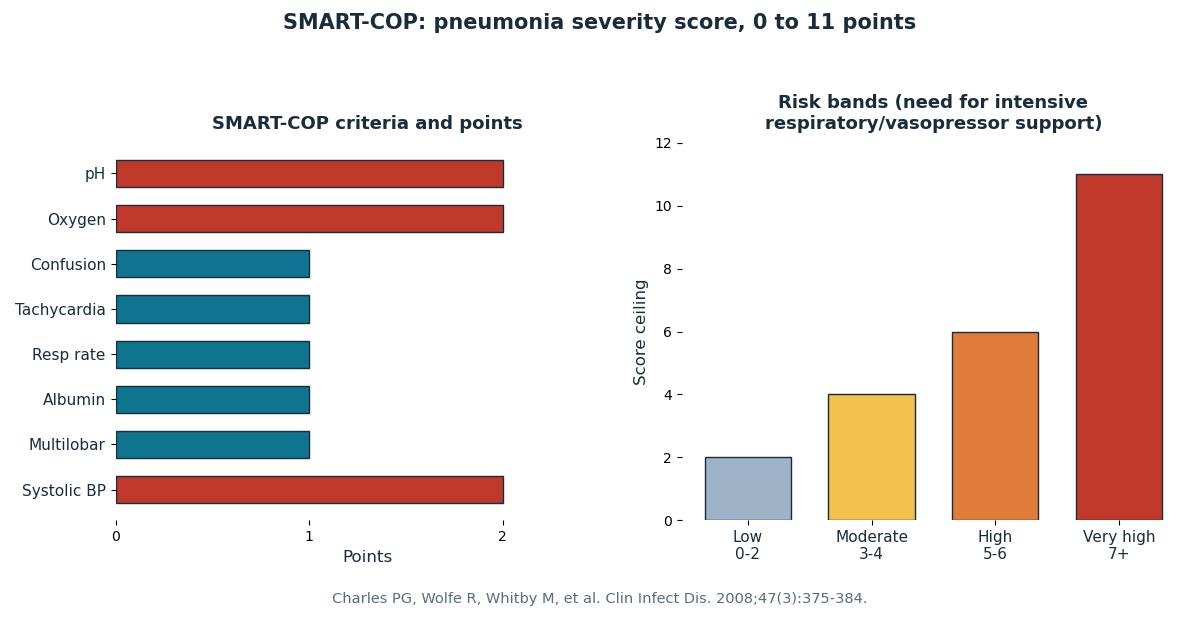
Note the weighting: hypotension, poor oxygenation, and acidosis carry two points each because they were the strongest predictors of needing intensive support. The maximum possible score is 11. This calculator asks for each criterion as a yes or no decision, since in practice the clinician has already applied the thresholds to the patient's numbers; the age-adjusted rules are shown so the underlying definitions stay transparent.
Interpreting the total
| Score | Risk category | Practical meaning |
|---|---|---|
| 0 to 2 | Low | Ward-level care is usually appropriate |
| 3 to 4 | Moderate | Closer monitoring; consider high-dependency review |
| 5 to 6 | High | Intensive care review; likely to need intensive support |
| 7 or more | Very high | Plan for intensive care; deterioration is likely |
The practical value sits in the middle of the scale. A score of 3 or 4 in a patient who looks comfortable is the score doing its real work: flagging risk that the eye misses. Scores of 5 or more should prompt an early conversation with intensive care, ideally before the patient crashes, because the whole point of the tool is to move the decision earlier in the illness.
Why hypotension, oxygenation, and pH carry double weight
The 2-point criteria are not arbitrary: they reflect the physiology of pneumonia killing people. A systolic pressure below 90 means perfusion is failing, and failing perfusion in the setting of infection is the definition of septic shock physiology. Poor oxygenation, captured through PaO2, SpO2, or the PaO2 to FiO2 ratio, is the direct measure of how badly the infected lung is exchanging gas; it is the earliest hard signal that the patient is heading for respiratory failure. Acidosis below pH 7.35 means tissues are already being starved of oxygen or perfusion, a late and ominous sign. In the derivation study, these three carried the strongest independent association with needing intensive support, which is why they outweigh a fast heart rate or a low albumin on their own. When you see a score driven mainly by 2-point criteria, treat it with particular respect: the patient is not just at risk of deterioration, they may already be deteriorating.
Using SMART-COP at triage
The score works best as a triage ritual in the emergency department, computed once the chest X-ray, blood gas, and albumin are back. Score every pneumonia admission the same way, document the total alongside CURB-65, and let the band drive the destination: low scores to the ward with routine observations, moderate scores to a monitored bed with an escalation plan, high and very high scores to intensive care review before the night team inherits the problem. Recompute the score if anything changes, because pneumonia is dynamic and the first score is only a snapshot. Teams that use the score this way report a specific benefit: fewer surprised overnight calls about the patient nobody thought was sick, because the score saw what the initial examination did not.
SMART-COP versus CURB-65
The two scores answer different questions and complement each other. CURB-65 (confusion, urea, respiratory rate, blood pressure, age 65) predicts 30-day mortality and drives the admission decision: treat at home, admit to the ward, or consider intensive care. SMART-COP predicts the need for intensive respiratory or vasopressor support and drives the level-of-care decision within the hospital. A patient can have a reassuring CURB-65 but a concerning SMART-COP, particularly a younger patient with severe hypoxaemia and acidosis, and that combination is exactly why both scores exist. Use CURB-65 to decide whether to admit, and SMART-COP to decide where in the hospital the patient belongs.
Limitations
SMART-COP needs an arterial blood gas and a chest X-ray, so it cannot be completed in settings without them; missing data should prompt caution, not a falsely reassuring low score. It was derived in hospitalised adults with community-acquired pneumonia and should not be applied to hospital-acquired pneumonia, immunocompromised patients, or children without recognising that it was not built for them. Like every severity score, it captures a moment: a score of 2 at admission can become a 5 by the evening, so the score should be repeated when the patient changes. And no threshold replaces clinical judgement; a patient who looks unwell with a low score still needs escalation.
What does SMART-COP stand for?
Each letter is a criterion: Systolic blood pressure, Multilobar chest X-ray involvement, Albumin, Respiratory rate, Tachycardia, Confusion, Oxygenation, and pH. The score predicts whether a patient with community-acquired pneumonia will need intensive respiratory or vasopressor support (IRVS), such as invasive ventilation or inotropes.
How is the SMART-COP score interpreted?
Scores range from 0 to 11. A score of 0 to 2 is low risk, 3 to 4 moderate risk, 5 to 6 high risk, and 7 or more very high risk of needing intensive respiratory or vasopressor support. Higher scores support earlier intensive care review, while low scores support ward-based management, always alongside clinical judgement.
Why do some SMART-COP criteria have age-adjusted thresholds?
Normal respiratory rate and oxygenation differ by age, so the criteria adjust: tachypnoea counts at 25 breaths per minute or more in patients aged 50 or under, but 30 or more in older patients. The PaO2 to FiO2 ratio threshold is 333 in younger patients and 250 in older patients. This keeps the score calibrated across age groups.
How does SMART-COP differ from CURB-65?
CURB-65 predicts 30-day mortality and guides admission decisions, while SMART-COP predicts the need for intensive respiratory or vasopressor support and guides the level of care. SMART-COP includes oxygenation and acidosis criteria that CURB-65 lacks, making it more sensitive to patients who will deteriorate despite not looking severely ill at first.
Where does the SMART-COP score come from?
SMART-COP was developed by Charles and colleagues and published in Clinical Infectious Diseases in 2008, derived from Australian patients with community-acquired pneumonia. It was designed specifically to identify the subgroup needing intensive respiratory or vasopressor support, which older scores predicted poorly.
Can a low SMART-COP score rule out deterioration?
No score rules out deterioration on its own. SMART-COP is a decision aid, not a substitute for clinical assessment: patients with low scores can still deteriorate, and scores are only as good as the data entered. Trend the score, reassess the patient, and escalate on clinical concern regardless of the number.
Key takeaways
- Each letter is a criterion: Systolic blood pressure, Multilobar chest X-ray involvement, Albumin, Respiratory rate, Tachycardia, Confusion, Oxygenation, and pH.
- Scores range from 0 to 11.
- Normal respiratory rate and oxygenation differ by age, so the criteria adjust: tachypnoea counts at 25 breaths per minute or more in patients aged 50 or under, but 30 or more in older patients.
- CURB-65 predicts 30-day mortality and guides admission decisions, while SMART-COP predicts the need for intensive respiratory or vasopressor support and guides the level of care.
References and further reading
Medical disclaimer
This calculator is an educational aid only. It does not diagnose pneumonia, predict individual outcomes, or advise on admission or intensive care decisions. Pneumonia severity must be assessed by a qualified clinician using the full clinical picture. If you are concerned about pneumonia, seek medical advice promptly.