What is the PSI/PORT score?
The Pneumonia Severity Index (PSI), also known as the PORT score, is a clinical prediction rule for community-acquired pneumonia, which is pneumonia acquired outside hospitals and long-term care facilities. It was developed by the Pneumonia Patient Outcomes Research Team (PORT) and published by Fine and colleagues in the Journal of the American Medical Association (JAMA) in 1997. The paper is cited as: Fine MJ, et al. A prediction rule to assess severity and adverse outcomes in community-acquired pneumonia. JAMA. 1997;277(4):321-327. The full text is indexed under DOI 10.1001/jama.1997.03540280039030.
The rule combines 20 demographic, comorbidity, physical examination, laboratory and imaging variables into a single point total. That total maps to one of five risk classes, numbered I to V. Each class was associated with an observed 30-day mortality in the original derivation and validation cohorts, and the classes translate directly into guidance on where the patient should be treated: at home as an outpatient, under brief observation, or admitted to hospital.
The PSI was created to solve a very practical problem. Before it existed, decisions about who to admit with pneumonia were inconsistent: many low-risk patients were admitted unnecessarily, occupying beds and raising costs, while some high-risk patients were sent home. A validated, reproducible rule lets clinicians identify low-risk patients who can be treated safely as outpatients, and flags the high-risk patients who genuinely need inpatient monitoring and early aggressive therapy. Since 1997 the PSI has become one of the most widely validated prognostic instruments in respiratory and emergency medicine, and it remains the reference standard against which newer pneumonia scores are compared.
It is important to understand what the score is and is not. The PSI estimates the probability of death within 30 days for a group of similar patients; it does not predict the fate of any individual with certainty. It is a decision aid that supports, but never replaces, the judgement of the treating clinician, who must also weigh factors the score cannot see, such as the patient's social situation, functional status and preferences.
How to use this calculator
Work through the four sections of the form in order. Only age and sex are mandatory; everything else can be left blank if the information is not available. The original rule treats a missing variable as normal, and this calculator follows that convention: a blank field contributes zero points.
- Patient: enter the age in years and select the sex. Age is the single largest contributor to the score: men add their age in years, women add their age minus 10. This adjustment reflects the lower observed mortality in women in the original cohorts.
- History and comorbidities: tick each condition that applies, including nursing home residence. Neoplastic (cancer) disease carries the heaviest weight at +30 points; liver disease adds +20; congestive heart failure, cerebrovascular disease and renal disease each add +10.
- Examination: record mental status and the vital signs. Altered mental status, a respiratory rate of 30 per minute or more, and a systolic blood pressure below 90 mmHg each add +20 points. A temperature below 35 C or of 40 C or more adds +15 points, and a heart rate of 125 per minute or more adds +10 points. Enter the temperature in degrees Celsius.
- Laboratory and imaging: enter the arterial pH, blood urea nitrogen (BUN), sodium, glucose, hematocrit and arterial oxygen (PaO2) if available, and tick pleural effusion if present on imaging. An arterial pH below 7.35 adds +30 points; BUN of 30 mg/dL or more and sodium below 130 mmol/L each add +20; glucose of 250 mg/dL or more, hematocrit below 30%, PaO2 below 60 mmHg and pleural effusion each add +10.
Press "Calculate PSI/PORT score". The result panel shows the total points, the risk class (I to V), the 30-day mortality range observed for that class in the Fine et al. cohorts, the recommended site of care, and a full breakdown of which variables contributed points. Use the "Reset" button to clear the form for the next patient.
Note the special rule for class I: it is assigned by clinical criteria, not by the point total. A patient under 50 years of age with no listed comorbidities, normal mental status and normal vital signs is class I regardless of points. Everyone else is classified by the point thresholds shown in the interpretation table below.
The complete PSI scoring table
Every variable in the original Fine et al. rule, with its point value, is listed below. The calculator above applies exactly these values.
| Variable | Points |
|---|---|
| Age: men (one point per year of age) | age in years |
| Age: women (age minus 10) | age - 10 |
| Nursing home resident | +10 |
| Neoplastic disease | +30 |
| Liver disease | +20 |
| Congestive heart failure | +10 |
| Cerebrovascular disease | +10 |
| Renal disease | +10 |
| Altered mental status | +20 |
| Respiratory rate 30/min or more | +20 |
| Systolic blood pressure below 90 mmHg | +20 |
| Temperature below 35 C or 40 C or more | +15 |
| Heart rate 125/min or more | +10 |
| Arterial pH below 7.35 | +30 |
| Blood urea nitrogen 30 mg/dL or more | +20 |
| Sodium below 130 mmol/L | +20 |
| Glucose 250 mg/dL or more | +10 |
| Hematocrit below 30% | +10 |
| PaO2 below 60 mmHg | +10 |
| Pleural effusion | +10 |
Risk classes: mortality and site of care
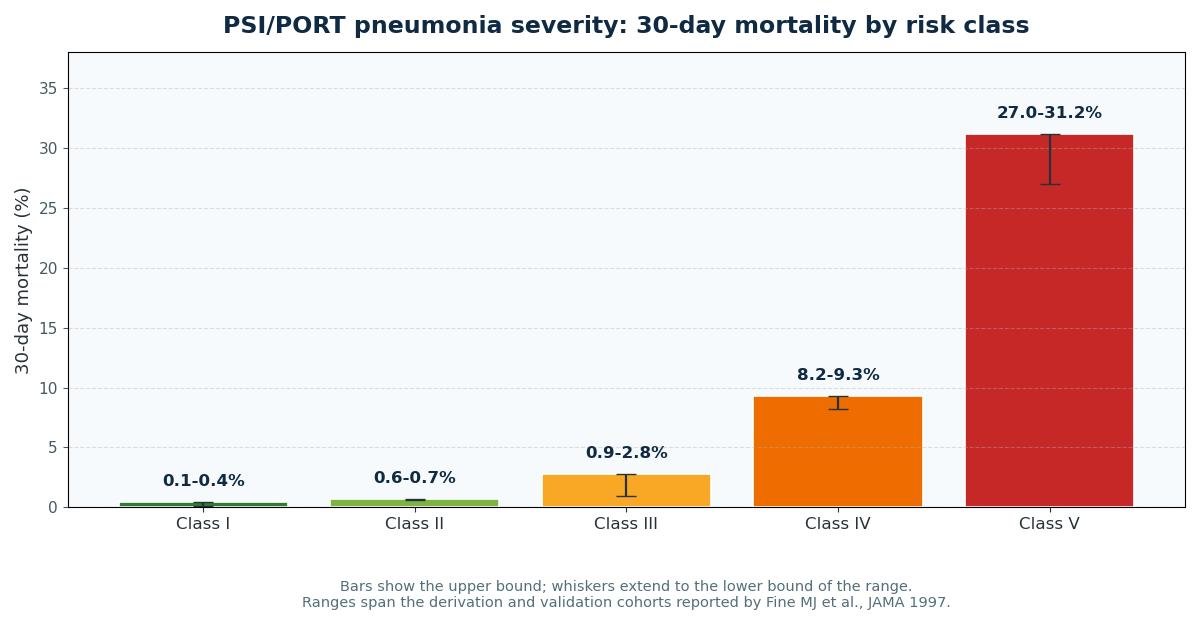
The point total maps to five risk classes. Class I is assigned by the clinical criteria described above (under 50, no comorbidities, normal mental status and normal vital signs); classes II to V are assigned by the point thresholds. Each class carries a 30-day mortality range spanning the derivation and validation cohorts reported by Fine et al. in 1997, and each class has a recommended site of care.
| Risk class | Points | 30-day mortality | Recommended site of care |
|---|---|---|---|
| Class I | clinical criteria (see below) | 0.1-0.4% | Outpatient treatment |
| Class II | 70 or fewer | 0.6-0.7% | Outpatient treatment |
| Class III | 71-90 | 0.9-2.8% | Outpatient treatment or brief observation |
| Class IV | 91-130 | 8.2-9.3% | Hospital admission |
| Class V | more than 130 | 27-31.2% | Hospital admission (consider intensive care) |
Read the mortality figures as ranges across the two original cohorts, not as exact predictions for one patient. A class V patient, for example, belonged to a group in which roughly one in three to one in four patients died within 30 days; most individuals in that group survived. The gradient is what matters for decisions: the jump in observed mortality between class III and class IV is the reason the admission threshold sits there.
Class I deserves a closer look because it works differently. The original algorithm assigns class I without counting points at all: the patient must be under 50, have none of the five listed comorbidities (neoplastic, liver, heart failure, cerebrovascular or renal disease), have normal mental status, a pulse below 125, a respiratory rate below 30, a systolic pressure of 90 or above, and a temperature between 35 C and 39.9 C. This group had the lowest observed mortality (0.1-0.4%) and is the clearest candidate for outpatient care.
In practice, the score's greatest value is at the low end: it gives clinicians defensible, evidence-based backing for sending suitable low-risk patients home with oral antibiotics and a clear follow-up plan, rather than admitting them "to be safe". At the high end, classes IV and V identify patients who need inpatient care, early broad therapy where indicated, and monitoring for deterioration. Class III is the judgement zone: many of these patients do well as outpatients, but brief observation or early review is reasonable when anything about the case feels uncertain.
Limitations
No prediction rule captures the whole patient, and the PSI is no exception. Understanding its limits is as important as knowing how to score it.
First, the score estimates group-level risk. A class II patient belongs to a group with 0.6-0.7% observed mortality, but that figure says nothing about which individual in the group will deteriorate. Clinical deterioration, hypoxemia that is worsening, inability to take oral medication, vomiting, unstable comorbid illness, frailty, confusion that is new, poor social support and patient preference can all justify admission despite a reassuring score. The PSI complements clinical judgement; it never replaces it.
Second, the rule was developed and validated in adults with community-acquired pneumonia. It is not designed for hospital-acquired or ventilator-associated pneumonia, for aspiration pneumonia as a distinct entity, or for severely immunocompromised patients, whose risk profile differs from the original cohorts. Children were not part of the derivation or validation populations either.
Third, the full 20-variable score needs laboratory results and imaging. At the bedside without labs, the score is incomplete, and this calculator (like the original rule) treats missing values as normal, which can underestimate risk if the missing value is actually abnormal. When a variable is unknown, the safest interpretation is that the resulting class is a minimum estimate. Simpler scores that need fewer inputs exist for settings where labs are unavailable, but they answer a slightly different question and should not be treated as interchangeable with the PSI.
Fourth, mortality ranges from 1997 reflect the patients and the care of that era and of the study settings. Observed outcomes in any given hospital today will differ with case mix, local pathogens, antibiotic resistance patterns and standards of care. Use the ranges as an ordering of risk and a guide to the site of care, not as a precise forecast.
Finally, the score is a snapshot. Pneumonia is a dynamic illness: a patient who scores as class II on arrival can deteriorate, and a high score does not mandate interventions the patient would not want. Reassessment, clear safety-netting advice for outpatients, and attention to goals of care matter more than any single number.
Key takeaways
- The Pneumonia Severity Index (PSI), also called the PORT score, stratifies adults with community-acquired pneumonia into five risk classes (I to V).
- Twenty variables are scored and summed.
- Across the derivation and validation cohorts of Fine et al.: class I 0.1-0.4%, class II 0.6-0.7%, class III 0.9-2.8%, class IV 8.2-9.3%, and class V 27-31.2%.
- Classes I and II are generally managed as outpatients, class III as outpatients or with brief observation, while classes IV and V warrant hospital admission, with intensive care considered for class V.
Frequently asked questions
What is the PSI/PORT score used for?
The Pneumonia Severity Index (PSI), also called the PORT score, stratifies adults with community-acquired pneumonia into five risk classes (I to V). Each class carries an observed 30-day mortality from the original Fine et al. (JAMA 1997) cohorts and guides the site of care: outpatient treatment for low-risk classes, hospital admission for high-risk classes.
How is the PSI score calculated?
Twenty variables are scored and summed. Age contributes the most: men add their age in years, women add their age minus 10. Comorbidities, vital-sign abnormalities and laboratory or imaging findings add fixed points (from +10 to +30). The total maps to a risk class: 70 or below is class II, 71 to 90 is class III, 91 to 130 is class IV, and above 130 is class V. Class I is assigned by clinical criteria (under 50, no comorbidities, normal vitals) rather than points.
What 30-day mortality does each PSI risk class carry?
Across the derivation and validation cohorts of Fine et al.: class I 0.1-0.4%, class II 0.6-0.7%, class III 0.9-2.8%, class IV 8.2-9.3%, and class V 27-31.2%.
Which patients can be treated as outpatients?
Classes I and II are generally managed as outpatients, class III as outpatients or with brief observation, while classes IV and V warrant hospital admission, with intensive care considered for class V. These are recommendations from the original rule; the final decision always rests on clinical judgement and the patient's circumstances.
How does the PSI compare with CURB-65?
Both are validated for community-acquired pneumonia. The PSI uses 20 variables and is better at identifying low-risk patients who can be treated safely as outpatients. CURB-65 uses only 5 variables, is quicker at the bedside, and is better at flagging high-risk patients. Many clinicians use the PSI for the admission decision and CURB-65 as a rapid bedside check.
Can a low PSI score ever be misleading?
Yes. The score estimates group-level risk and does not capture everything: severe hypoxemia, inability to take oral medication, unstable comorbid illness, frailty, poor social support, or a deteriorating course can all justify admission despite a low score. The PSI complements clinical judgement; it never replaces it.
References and further reading
Medically reviewed by Dr. Taimoor Asghar, Physician and Community Medicine Researcher. Reference: Fine MJ, et al. A prediction rule to assess severity and adverse outcomes in community-acquired pneumonia. JAMA. 1997;277(4):321-327. DOI: 10.1001/jama.1997.03540280039030.