What is corrected calcium?
Corrected calcium is an estimate of what a person's total serum calcium would be if their albumin level were normal. It matters because calcium does not travel through the blood alone. Roughly half of the calcium in serum is bound to proteins, mostly albumin, about one tenth is complexed with small anions such as citrate and phosphate, and roughly half circulates as free, ionized calcium. Only the ionized fraction is biologically active: it is the form that nerves, muscles and the heart actually use.
When albumin is low, a large share of the protein bound calcium disappears from the measurement, so the laboratory reports a low total calcium even though the active ionized calcium may be perfectly normal. Conversely, when albumin is high, extra calcium is carried on the extra protein and the measured total looks higher than the active fraction. Correcting for albumin lets a clinician judge the calcium level against the standard normal range instead of being misled by the protein level. The correction was introduced by Payne, Little, Williams and Milner in 1973, based on a study of 200 blood samples in which calcium correlated closely with albumin (r = 0.867). Their widely used version of the formula is: corrected calcium (mg/dL) = measured calcium (mg/dL) + 0.8 x (4.0 - albumin in g/dL).
Why albumin changes the total calcium result
Albumin is the main protein in blood plasma, and each albumin molecule carries calcium ions bound to its surface. This binding is reversible and depends on the pH of the blood, but under normal conditions a fairly fixed amount of calcium attaches to each gram of albumin. That is the entire physiological basis of the correction: because the bound fraction rises and falls with albumin, total calcium rises and falls with albumin too, without any change in the calcium that the body can actually use.
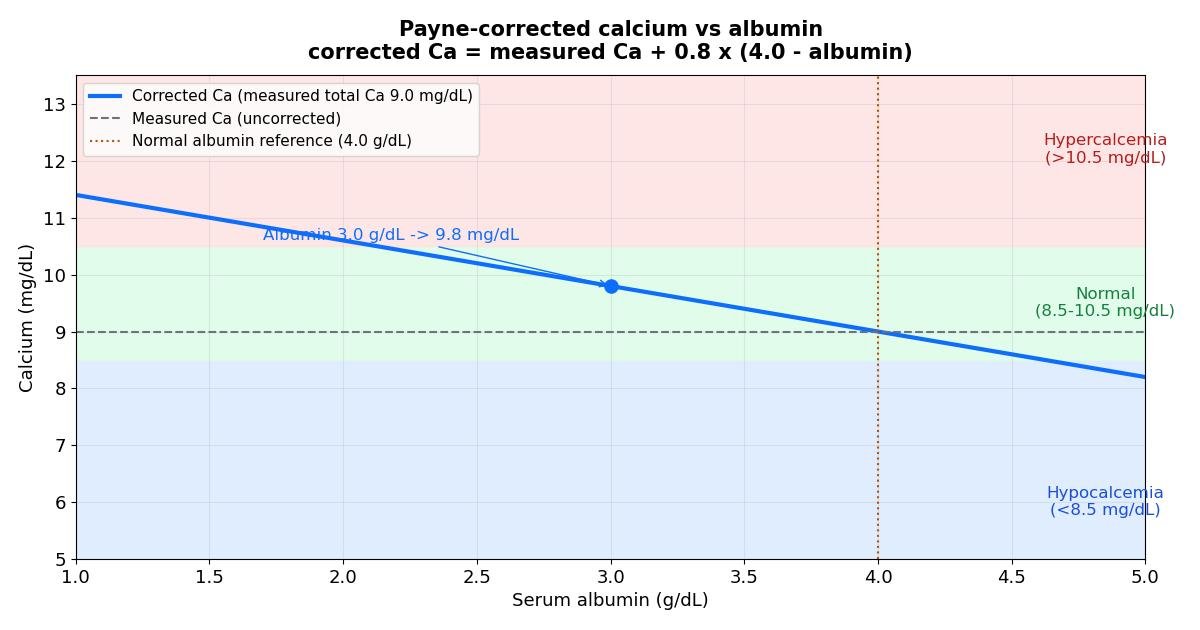
The number 0.8 in the formula is the regression slope from the 1973 study: on average, each 1 g/dL change in albumin changes total calcium by about 0.8 mg/dL. The number 4.0 g/dL is the assumed normal albumin concentration, the point at which the correction is zero. If your albumin is exactly 4.0 g/dL, corrected calcium equals measured calcium. If albumin is 3.0 g/dL, the formula adds 0.8 mg/dL; if it is 2.0 g/dL, it adds 1.6 mg/dL. When albumin is above 4.0 g/dL, the bracketed term turns negative and the formula subtracts calcium, because the extra protein is carrying calcium that inflates the measured total.
Importantly, the correction does not change, create or estimate the ionized calcium directly. It is a statistical adjustment that works well for typical patients with mild to moderate albumin abnormalities, which is why it has survived in clinical practice for more than fifty years. It is not a substitute for measuring ionized calcium when precision matters.
The formula in both unit systems
Most laboratories in the United States report calcium in mg/dL and albumin in g/dL. The conventional formula is:
In the United Kingdom, Europe and most other countries, laboratories report calcium in mmol/L and albumin in g/L. Because 1 mg/dL of calcium equals about 0.2495 mmol/L (the atomic weight of calcium is 40.08, so you divide mg/dL by 4.008), and because 1 g/dL of albumin equals 10 g/L, the published SI version of the formula is:
The two formulas express the same correction on different scales. The 0.02 coefficient is the rounded equivalent of 0.8 mg/dL per g/dL of albumin deficit (the exact unit conversion gives 0.01996, a difference with no clinical meaning). The normal reference albumin shifts from 4.0 g/dL to 40 g/L for the same reason. Choose the unit set that matches your laboratory report; mixing units is the most common source of meaningless corrected calcium results.
Worked examples
Take a patient with a measured total calcium of 9.0 mg/dL and an albumin of 3.0 g/dL. Applying the formula: 9.0 + 0.8 x (4.0 - 3.0) = 9.0 + 0.8 = 9.8 mg/dL. The uncorrected result of 9.0 sits inside the normal range but near its lower edge; the corrected value of 9.8 mg/dL is comfortably normal, which is a more reassuring and usually more accurate picture.
A second example shows a deeper correction. With calcium 8.0 mg/dL and albumin 2.5 g/dL, the correction is 0.8 x 1.5 = 1.2 mg/dL, giving 9.2 mg/dL. The raw value looks like clear hypocalcemia, while the corrected value is normal. This pattern is common in hospitalized patients, where low albumin from acute illness or poor nutrition makes uncorrected calcium look falsely low again and again.
In SI units, a calcium of 2.20 mmol/L with an albumin of 30 g/L gives 2.20 + 0.02 x (40 - 30) = 2.40 mmol/L. A calcium of 2.62 mmol/L with a normal albumin of 40 g/L is unchanged at 2.62 mmol/L, since the correction term is zero. And a high albumin example: calcium 10.0 mg/dL with albumin 4.5 g/dL gives 10.0 + 0.8 x (4.0 - 4.5) = 10.0 - 0.4 = 9.6 mg/dL, showing that the correction can move the number down as well as up.
Interpreting the corrected result
Once you have the corrected calcium, read it against the standard adult normal range for total calcium: 8.5 to 10.5 mg/dL, which is 2.12 to 2.62 mmol/L. A corrected calcium below 8.5 mg/dL (2.12 mmol/L) is hypocalcemia. A value above 10.5 mg/dL (2.62 mmol/L) is hypercalcemia. Values between the two limits are normal. The boundary values themselves, exactly 8.5 or exactly 10.5 mg/dL, count as normal.
Low corrected calcium can cause tingling around the mouth and in the fingers, muscle cramps, and in severe cases seizures or heart rhythm disturbances. Common causes include vitamin D deficiency, chronic kidney disease, hypoparathyroidism, and low magnesium, which impairs parathyroid hormone release. High corrected calcium can cause thirst, frequent urination, constipation, fatigue, confusion and, when severe, dangerous cardiac effects. The most common causes are primary hyperparathyroidism and malignancy. Values above roughly 14 mg/dL (3.5 mmol/L) are generally treated as a medical emergency, whatever the albumin level.
Keep in mind that the interpretation ranges apply to the corrected value. An uncorrected calcium of 8.2 mg/dL with an albumin of 2.8 g/dL corrects to 9.16 mg/dL, which is normal; treating that number with calcium supplements based on the raw value alone would be treating a laboratory artifact. On the other hand, a normal looking raw calcium in a patient with very high albumin can hide real hypocalcemia, because the correction subtracts from it.
When corrected calcium helps, and when it misleads
Corrected calcium is most useful in the everyday outpatient setting: a routine blood panel shows a lowish calcium together with low albumin, and the clinician wants to know whether the calcium itself is truly abnormal. In that setting the formula performs reasonably, and it is far better than reading the uncorrected number at face value.
But the formula has well documented limits, and honest discussion of them is part of using the tool safely. First, it was derived from a modest sample of 200 specimens and the 0.8 slope is an average; individual patients and individual laboratories differ, and later work has shown that the ideal coefficient varies between assay methods. Second, the correction loses accuracy in severe hypoalbuminemia: when albumin is very low, the relationship between calcium and albumin is no longer linear, and the formula can overcorrect. Third, in kidney failure the binding of calcium to proteins is altered by uremia and by phosphate and citrate shifts, so corrected calcium frequently disagrees with the ionized level. Fourth, in paraproteinemia, the abnormal proteins of conditions such as multiple myeloma bind calcium unpredictably, and correction formulas can be badly misleading. Fifth, acid-base disturbances change protein binding directly: acidosis displaces calcium from albumin and raises ionized calcium, while alkalosis does the reverse, and the formula knows nothing about pH.
Because of these limits, ionized calcium measured directly from a blood gas analyzer is the preferred test in critical illness. A prospective intensive care study comparing albumin-corrected calcium with ionized calcium found the correction to be of limited diagnostic value in that setting. In plain terms: use the correction as a screening adjustment on routine labs, but order ionized calcium when the patient is critically ill, has kidney failure, has a plasma cell disorder, or has a major acid-base disturbance.
How this calculator handles your numbers
The calculator above applies Payne's formula exactly as published. Select the unit set matching your laboratory report, enter the measured total calcium and the serum albumin, and press the button. You will get the corrected calcium in the units you entered, the equivalent value in the other unit system, and an interpretation of low, normal or high against the 8.5 to 10.5 mg/dL (2.12 to 2.62 mmol/L) range. It also shows the arithmetic it performed, so you can check the result by hand. Values that look implausible for the chosen units, or missing inputs, produce a clear message instead of a number.
Key takeaways
- Corrected calcium is an estimate of what a person's total serum calcium would be if their albumin were normal.
- In conventional units: corrected calcium (mg/dL) equals measured calcium (mg/dL) plus 0.8 times (4.0 minus albumin in g/dL).
- Yes.
- The correction loses accuracy in severe hypoalbuminemia, in kidney failure, when abnormal proteins are present (paraproteinemia such as multiple myeloma), and during acid-base disturbances, because these conditions change how calcium binds to proteins in ways the simple formula cannot capture.
Frequently asked questions
What is corrected calcium and why do we calculate it?
Corrected calcium is an estimate of what a person's total serum calcium would be if their albumin were normal. About 40 percent of calcium in blood is bound to albumin, so when albumin is low, measured total calcium looks low even though the active, ionized fraction may be normal. Payne's formula adds 0.8 mg/dL of calcium for every 1 g/dL that albumin falls below 4.0 g/dL, so the result can be judged against the standard normal range of 8.5 to 10.5 mg/dL.
What is the formula for corrected calcium?
In conventional units: corrected calcium (mg/dL) equals measured calcium (mg/dL) plus 0.8 times (4.0 minus albumin in g/dL). In SI units: corrected calcium (mmol/L) equals measured calcium (mmol/L) plus 0.02 times (40 minus albumin in g/L). The formula comes from Payne RB and colleagues, published in the British Medical Journal in 1973.
Can corrected calcium be lower than the measured calcium?
Yes. If albumin is above 4.0 g/dL, the term (4.0 minus albumin) is negative, so the formula subtracts calcium. For example, a measured calcium of 10.0 mg/dL with an albumin of 4.5 g/dL gives a corrected calcium of 9.6 mg/dL. A high albumin binds extra calcium, so the measured total overstates the calcium that is physiologically available.
When is corrected calcium unreliable?
The correction loses accuracy in severe hypoalbuminemia, in kidney failure, when abnormal proteins are present (paraproteinemia such as multiple myeloma), and during acid-base disturbances, because these conditions change how calcium binds to proteins in ways the simple formula cannot capture. In critical illness, directly measuring ionized calcium is preferred. Studies in intensive care patients have shown that albumin-corrected calcium agrees poorly with ionized calcium.
Is a corrected calcium of 11 mg/dL dangerous?
A corrected calcium above 10.5 mg/dL is hypercalcemia and needs medical follow up. Values above about 14 mg/dL are considered severe hypercalcemia and can cause confusion, dehydration, kidney injury and cardiac rhythm problems. Do not try to treat an abnormal corrected calcium on your own; see a clinician, who will check ionized calcium, parathyroid hormone and other tests.
Should I use mg/dL or mmol/L in this calculator?
Use whichever units your laboratory report uses. In the United States, calcium is usually reported in mg/dL and albumin in g/dL. In the UK, Europe and most of the rest of the world, calcium is reported in mmol/L and albumin in g/L. Choose the matching unit set on the calculator so the albumin correction uses the right scale, 4.0 g/dL or 40 g/L.
Sources
- Payne RB, Little AJ, Williams RB, Milner JR. Interpretation of serum calcium in patients with abnormal serum proteins. Br Med J. 1973;4(5893):643-646. doi:10.1136/bmj.4.5893.643. Source of the corrected calcium formula used on this page.
- Limited diagnostic utility of albumin-corrected calcium in the intensive care unit: a prospective comparison with ionised calcium. PLoS One. Shows that Payne-corrected calcium (corrected calcium in mg/dL = total calcium + 0.8 x (4.0 - albumin in g/dL)) agrees poorly with ionized calcium in critically ill patients; supports the recommendation to measure ionized calcium in critical illness.
- Poor performance of albumin or protein-adjusted plasma calcium to diagnose dyscalcemia in hospitalized patients: a confirmatory study in a general internal medicine department. Reports published albumin-adjustment formulas including Payne 1973 and documents their limited diagnostic accuracy outside the derivation setting.
Medical disclaimer
This calculator is an educational tool and is not medical advice. It implements the published Payne formula and does not replace clinical judgment, laboratory quality review, or measurement of ionized calcium where indicated. Calcium results should always be interpreted by a qualified clinician in the context of the full clinical picture, including symptoms, kidney function, vitamin D status, parathyroid hormone and magnesium. If your result is abnormal, or if you have symptoms such as tingling, muscle cramps, confusion, excessive thirst or an irregular heartbeat, seek medical care promptly. Do not start, stop or change any treatment based on this calculator. This page was medically reviewed by Dr. Taimoor Asghar, physician and community medicine researcher.