Non-HDL Cholesterol Calculator
Find your non-HDL cholesterol from a standard lipid panel: total cholesterol minus HDL cholesterol, with guideline-based risk categories in mg/dL or mmol/L.
In short: Find your non-HDL cholesterol from a standard lipid panel: total cholesterol minus HDL cholesterol, with guideline-based risk categories in mg/dL or mmol/L. Use the calculator above, then read the guide below to interpret your result and its limitations.
What is non-HDL cholesterol?
Non-HDL cholesterol is the cholesterol carried by every atherogenic lipoprotein in your blood: low-density lipoprotein (LDL), very-low-density lipoprotein (VLDL), intermediate-density lipoprotein (IDL), lipoprotein(a), and the cholesterol-rich remnants left behind as these particles are processed. The name is literal: take everything in total cholesterol and remove the high-density lipoprotein (HDL) fraction, and what remains is, by definition, non-HDL. That remainder is the full set of plaque-forming cholesterol carriers, which is why many guidelines treat non-HDL cholesterol as the more complete single summary of atherogenic risk than LDL cholesterol alone. The non-HDL cholesterol calculator above performs this subtraction and places your result in the guideline-based categories described below.
The reason this matters is that LDL cholesterol, the number most people focus on, is only one part of the atherogenic burden. In people with elevated triglycerides, insulin resistance, or the metabolic syndrome, VLDL and its remnants carry a meaningful share of the cholesterol that drives atherosclerosis. A person can have a "normal" LDL cholesterol while their non-HDL cholesterol is high, and the non-HDL value captures the risk the LDL value missed. This is exactly the scenario the 2018 AHA/ACC cholesterol guideline (Grundy et al., Circulation. 2019;139:e1082-e1143, DOI: 10.1161/CIR.0000000000000625) had in mind when it endorsed nonfasting non-HDL cholesterol as a reasonable initial screening test and treated a non-HDL cholesterol of 100 mg/dL or more as a risk enhancer in primary prevention decisions.
How the non-HDL cholesterol calculator works
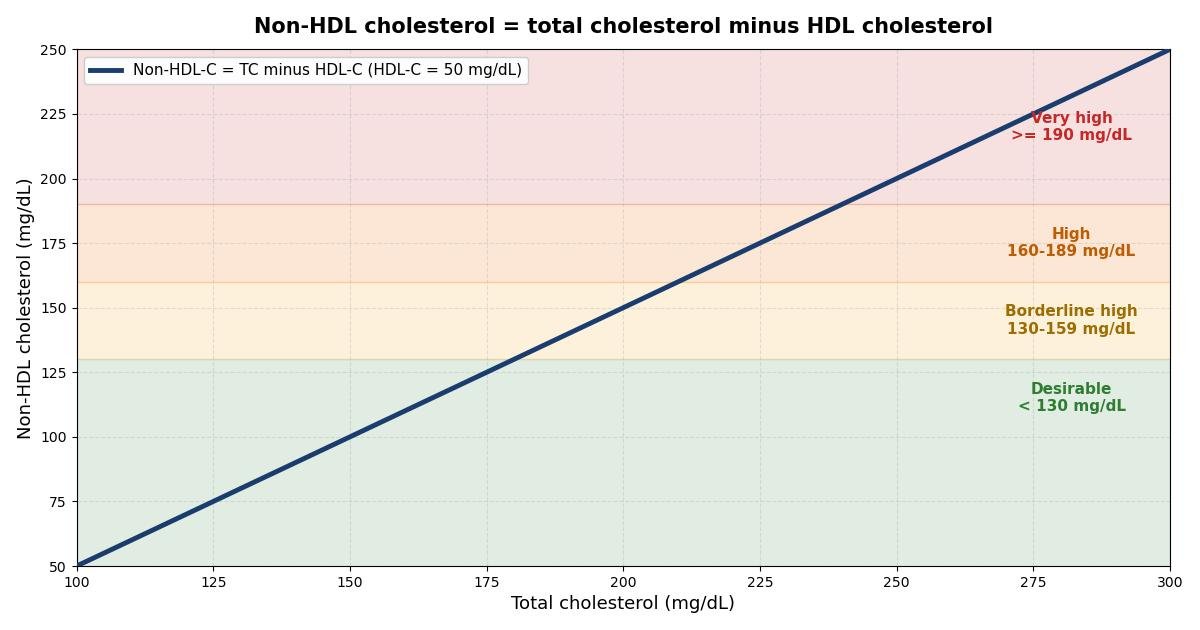
The calculation could hardly be simpler: non-HDL cholesterol = total cholesterol - HDL cholesterol, with both values in the same units. No triglyceride value is needed, no fasting is required, and there is no estimation equation to break down. For example, a total cholesterol of 220 mg/dL and an HDL cholesterol of 45 mg/dL gives 220 - 45 = 175 mg/dL of non-HDL cholesterol. In mmol/L the same arithmetic applies: 5.7 mmol/L of total cholesterol minus 1.2 mmol/L of HDL gives 4.5 mmol/L of non-HDL cholesterol. The calculator above performs this subtraction, validates the inputs, and places the result into the risk categories described below. HDL cholesterol cannot exceed total cholesterol, so the calculator refuses that combination and asks you to recheck the numbers.
Understanding your result: the guideline categories
The categories used here are the commonly applied tiers built on the NCEP Adult Treatment Panel III (ATP III) convention: the LDL cholesterol cutpoints of 100, 130, and 160 mg/dL shifted upward by 30 mg/dL to give non-HDL thresholds of 130, 160, and 190 mg/dL. The mmol/L cutpoints are the rounded equivalents obtained by dividing by 38.67 (130/38.67 = 3.36, 160/38.67 = 4.14, 190/38.67 = 4.91).
| Non-HDL cholesterol (mg/dL) | Non-HDL cholesterol (mmol/L) | Category |
|---|---|---|
| Below 130 | Below 3.4 | Desirable |
| 130 - 159 | 3.4 - 4.1 | Borderline high |
| 160 - 189 | 4.1 - 4.9 | High |
| 190 or above | 4.9 or above | Very high |
Note the boundary behaviour, which the calculator applies consistently: a result of exactly 130 mg/dL falls into "borderline high", exactly 160 mg/dL into "high", and exactly 190 mg/dL into "very high", because the lower bands are defined as strictly below the threshold. A value of 129.9 mg/dL is still desirable, while 160 mg/dL is already high. These are population categories for interpretation, not personal treatment targets: the 2018 guideline sets treatment decisions by overall atherosclerotic cardiovascular disease (ASCVD) risk, statin benefit groups, and the clinician-patient discussion, not by the category label alone.
The "30 mg/dL above the LDL target" rule
A convention inherited from NCEP ATP III holds that for any given person, the non-HDL cholesterol goal is set 30 mg/dL above the LDL cholesterol goal. If the LDL target is 100 mg/dL, the non-HDL target is 130 mg/dL; if the LDL target is 70 mg/dL, the non-HDL target is 100 mg/dL. In mmol/L the equivalent offset is about 0.8 mmol/L. This is a planning convention for treatment goals, not a law of biology, and it is particularly useful when triglycerides are elevated, because it keeps the VLDL and remnant cholesterol inside the target instead of ignoring it. Your clinician sets the actual target from your overall risk profile.
Why guidelines prefer non-HDL cholesterol when triglycerides are high
There are three linked reasons. First, the Friedewald equation that most laboratories use to estimate LDL cholesterol divides triglycerides by 5 (in mg/dL) as a stand-in for VLDL cholesterol, and that approximation breaks down as triglycerides rise, becoming unreliable above 400 mg/dL. Non-HDL cholesterol needs no such approximation because VLDL and remnant cholesterol are already inside the subtraction. Second, when triglycerides are high, VLDL and its remnants make up a larger share of the atherogenic particles, so a risk summary that includes them is more faithful to the underlying biology. Third, non-HDL cholesterol is far less sensitive to fasting status than calculated LDL, which is why the 2018 guideline accepts nonfasting non-HDL cholesterol as a reasonable initial screening test: the patient does not need to fast, and a recent meal does not meaningfully distort the result.
Practically, this means non-HDL cholesterol is the safer single number to follow in anyone with hypertriglyceridaemia, diabetes, or the metabolic syndrome. It is also the number that cannot be "gamed" by a low reported LDL that hides a high remnant burden.
Non-HDL cholesterol versus apolipoprotein B
Non-HDL cholesterol and apolipoprotein B (apoB) answer two closely related but distinct questions. Non-HDL cholesterol measures how much cholesterol is carried inside all atherogenic particles. ApoB counts the particles themselves, because each atherogenic lipoprotein carries exactly one apoB molecule. In most people the two track together, but they can disagree: small, cholesterol-poor particles raise the particle count without raising the cholesterol mass much, and this discordance is most common in hypertriglyceridaemia and diabetes. In such cases the particle number may reflect risk better than the cholesterol content.
The practical trade-off is availability. Non-HDL cholesterol is free: it is derivable from every standard lipid panel ever drawn, needs no extra assay, and has decades of epidemiological and guideline support. ApoB requires a separate immunoassay that not every laboratory runs and adds cost. A reasonable approach, consistent with the guideline spirit, is to use non-HDL cholesterol as the routine workhorse and consider apoB when triglycerides are high, when diabetes is present, or when the clinical picture and the lipid panel seem to disagree.
What to do with your result, and the limits of this number
A desirable result is reassuring but not a clean bill of health: blood pressure, smoking, diabetes, family history, and age all shape cardiovascular risk independently of cholesterol. A borderline-high, high, or very-high result is a prompt to talk to a clinician, who will interpret it alongside the rest of the lipid panel, overall ASCVD risk, and any secondary causes of dyslipidaemia such as hypothyroidism, nephrotic syndrome, or excess alcohol. Lifestyle measures, heart-healthy eating patterns, regular physical activity, maintaining a healthy weight, and not smoking remain the foundation of risk reduction across the life course, as the 2018 guideline emphasises for everyone.
The calculator has deliberate limits. It validates that both inputs are present, non-negative, and within plausible laboratory ranges, and it rejects the impossible case of HDL exceeding total cholesterol, but it cannot verify that the numbers were transcribed correctly from the laboratory report, and it does not know your medications, conditions, or overall risk. Values near a category boundary can move between categories on repeat testing because of normal biological and analytical variation. Treat the category as guidance for a clinical conversation, not as a diagnosis.
Key takeaways
- Non-HDL cholesterol is the cholesterol carried by every atherogenic lipoprotein in the blood: LDL, VLDL, IDL and lipoprotein(a), plus their remnants.
- Subtract your HDL cholesterol from your total cholesterol: non-HDL-C = total cholesterol - HDL-C.
- The commonly used categories are: below 130 mg/dL desirable, 130 to 159 mg/dL borderline high, 160 to 189 mg/dL high, and 190 mg/dL or above very high.
- The 30 mg/dL rule says the non-HDL cholesterol target is conventionally set 30 mg/dL above the LDL cholesterol target, for the same person.
Frequently asked questions
What is non-HDL cholesterol?
Non-HDL cholesterol is the cholesterol carried by every atherogenic lipoprotein in the blood: LDL, VLDL, IDL and lipoprotein(a), plus their remnants. It is calculated simply as total cholesterol minus HDL cholesterol. Because it captures the cholesterol in all plaque-forming particles rather than only LDL, many guidelines treat it as a more complete single summary of atherogenic risk than LDL cholesterol alone.
How is non-HDL cholesterol calculated?
Subtract your HDL cholesterol from your total cholesterol: non-HDL-C = total cholesterol - HDL-C. For example, a total cholesterol of 220 mg/dL and an HDL of 45 mg/dL gives a non-HDL cholesterol of 175 mg/dL. Both values must be in the same units, either mg/dL or mmol/L. No fasting or triglyceride value is needed for the subtraction itself.
What are the normal ranges for non-HDL cholesterol?
The commonly used categories are: below 130 mg/dL desirable, 130 to 159 mg/dL borderline high, 160 to 189 mg/dL high, and 190 mg/dL or above very high. In mmol/L the rounded equivalents are below 3.4, 3.4 to 4.1, 4.1 to 4.9, and 4.9 or above. These tiers follow the NCEP ATP III convention of the LDL cutpoints plus 30 mg/dL. The 2018 AHA/ACC cholesterol guideline additionally treats non-HDL cholesterol of 100 mg/dL or more as a risk enhancer when deciding about statin therapy in primary prevention.
What is the 30 mg/dL rule for non-HDL cholesterol?
The 30 mg/dL rule says the non-HDL cholesterol target is conventionally set 30 mg/dL above the LDL cholesterol target, for the same person. It comes from the NCEP ATP III convention: the LDL cutpoints of 100, 130 and 160 mg/dL become non-HDL targets of 130, 160 and 190 mg/dL. In mmol/L the equivalent offset is about 0.8 mmol/L. This rule is a planning convention for treatment goals, not a law of biology, and the exact target should be set with a clinician based on overall cardiovascular risk.
Why is non-HDL cholesterol preferred when triglycerides are high?
When triglycerides are high, very-low-density lipoprotein (VLDL) and its cholesterol-rich remnants make up a larger share of the atherogenic burden, and the Friedewald equation used to estimate LDL cholesterol becomes unreliable above 400 mg/dL of triglycerides. Non-HDL cholesterol includes the VLDL and remnant cholesterol directly, needs no triglyceride input, and is not degraded by high triglycerides. The 2018 AHA/ACC guideline also endorses nonfasting non-HDL cholesterol as a reasonable initial screening test, since it is much less sensitive to fasting status than calculated LDL.
How does non-HDL cholesterol compare with apoB?
Non-HDL cholesterol measures the amount of cholesterol inside all atherogenic particles, while apolipoprotein B (apoB) counts the number of those particles, because each atherogenic lipoprotein carries exactly one apoB molecule. The two usually move together, but they can disagree when particles are cholesterol-poor or cholesterol-rich, for example in hypertriglyceridaemia or diabetes, where particle number may better reflect risk. Non-HDL cholesterol is available on every standard lipid panel at no extra cost, whereas apoB requires a separate test.
References and further reading
References. Grundy SM, Stone NJ, Bailey AL, et al. 2018 AHA/ACC/AACVPR/AAPA/ABC/ACPM/ADA/AGS/APhA/ASPC/NLA/PCNA guideline on the management of blood cholesterol. Circulation. 2019;139(25):e1082-e1143. DOI: 10.1161/CIR.0000000000000625. NCEP Expert Panel. Third report of the National Cholesterol Education Program (NCEP) Expert Panel on Detection, Evaluation, and Treatment of High Blood Cholesterol in Adults (Adult Treatment Panel III). Circulation. 2002;106(25):3143-3421. Medically reviewed by Dr. Taimoor Asghar.