Your FINDRISC score
What is the FINDRISC diabetes risk calculator?
The FINDRISC diabetes risk calculator is the online version of the Finnish Diabetes Risk Score (FINDRISC), a short questionnaire that estimates a person's 10-year risk of developing type 2 diabetes. It asks eight simple questions about age, body shape, daily habits, blood pressure treatment, blood sugar history and family history, and converts the answers into a score from 0 to 26. No blood test, laboratory equipment or clinical training is needed, which is exactly what the score was designed for: quick, low-cost screening in primary care and for personal use.
FINDRISC was developed by Jaana Lindstrom and Jaakko Tuomilehto and published in Diabetes Care in 2003 in the paper "The diabetes risk score: a practical tool to predict type 2 diabetes risk". The researchers built it from the FINRISK population surveys, which followed Finnish men and women aged 35 to 64, and they validated the finished score in an independent sample. Two versions were tested in the original work: a concise clinical model and the full questionnaire version with lifestyle items. The questionnaire version is the one used worldwide today, because the two extra lifestyle questions cost nothing to ask and sharpen the prediction.
How well does it work? In the original study the score model discriminated well between people who did and did not develop diabetes over the follow-up, with an area under the receiver operating characteristic curve of about 0.85 in the development data and 0.87 in the validation sample. Since 2003 the score has been tested in dozens of countries across Europe, Asia, Latin America and North America, and it is widely used by diabetes associations and primary care services for screening campaigns. The cut-offs and point weights below are unchanged from the original publication.
It is important to understand what the number means. FINDRISC estimates the probability that someone without diagnosed diabetes will develop type 2 diabetes within the next 10 years. The estimate ranges from about 1% in the lowest band to about 50% in the highest. These are population averages from the study, not personal guarantees: two people with the same score can have different outcomes. A high score means you should have a blood test, such as fasting glucose or HbA1c, to check where you stand today. A low score is reassuring but does not make diabetes impossible.
The 8 FINDRISC questions, explained
Each question carries a fixed number of points. The points reflect how strongly that factor predicted diabetes in the original Finnish data. Here is what each item asks, how it is scored, and why it is in the questionnaire.
1. Age
Under 45: 0 points. 45-54: 2 points. 55-64: 3 points. Over 64: 4 points. The risk of type 2 diabetes rises with age because insulin sensitivity tends to fall and the insulin-producing beta cells of the pancreas gradually lose capacity. Note that the score was developed in adults aged 35 to 64, so estimates at much younger or older ages should be read with a little extra caution.
2. Body mass index (BMI)
Below 25: 0 points. 25-30: 1 point. Above 30: 3 points. Overweight and obesity are the strongest modifiable drivers of type 2 diabetes. Excess body fat, particularly around the abdomen, makes the body's cells less responsive to insulin, forcing the pancreas to work harder until it can no longer keep blood sugar normal. This calculator works out your BMI from the weight and height you enter.
3. Waist circumference
Men: below 94 cm scores 0, 94-102 cm scores 3, above 102 cm scores 4. Women: below 80 cm scores 0, 80-88 cm scores 3, above 88 cm scores 4. Waist circumference reflects abdominal fat, which is more closely linked to insulin resistance than BMI alone. That is why a large waist adds up to 4 points even when BMI is in the normal range. For a correct measurement, wrap the tape midway between your lowest rib and the top of your hip bone, after breathing out normally, without pulling the tape tight.
4. Physical activity of at least 30 minutes per day
Yes: 0 points. No: 2 points. This means 30 minutes of activity at work or during leisure on a typical day, such as brisk walking, cycling or manual work. Working muscles take up glucose from the blood even without much insulin, and regular activity improves insulin sensitivity for hours afterwards. Inactivity is an independent risk factor, separate from body weight.
5. Vegetables or fruit every day
Every day: 0 points. Not every day: 1 point. Daily vegetables, fruit or berries are a simple marker of a fibre-rich diet of lower energy density. People who eat them daily tend to have steadier blood sugar and easier weight control. It is the smallest item in the score, but it nudges the total in the right direction for people on the borderline between bands.
6. Blood pressure medication
No: 0 points. Yes: 2 points. The question is whether you have ever taken medication for high blood pressure on a regular basis. Hypertension travels together with insulin resistance as part of the metabolic syndrome, so a history of treated high blood pressure marks a higher diabetes risk even when blood pressure is currently well controlled.
7. High blood sugar ever found
No: 0 points. Yes: 5 points. This is the single heaviest item in the questionnaire. It asks whether raised blood sugar has ever been found in you, for example during a health check, during an illness, or during pregnancy. A past episode of hyperglycaemia suggests that glucose regulation is already impaired, which is why it contributes a full 5 points.
8. Family history of diabetes
None: 0 points. Second-degree relatives: 3 points. First-degree relatives: 5 points. First-degree relatives are your parents, siblings or your own children; second-degree relatives are grandparents, aunts and uncles. Genes influence both insulin resistance and beta-cell function, so a close family history is one of the strongest predictors in the score. Unlike lifestyle factors, it cannot be changed, which makes the modifiable items even more important for people with a family history.
FINDRISC score interpretation: the 5 risk bands
The total score falls into one of five bands. Each band carries an estimated 10-year risk of developing type 2 diabetes, taken from the original Lindstrom and Tuomilehto study. The chart below shows the bands visually; the table gives the exact cut-offs.
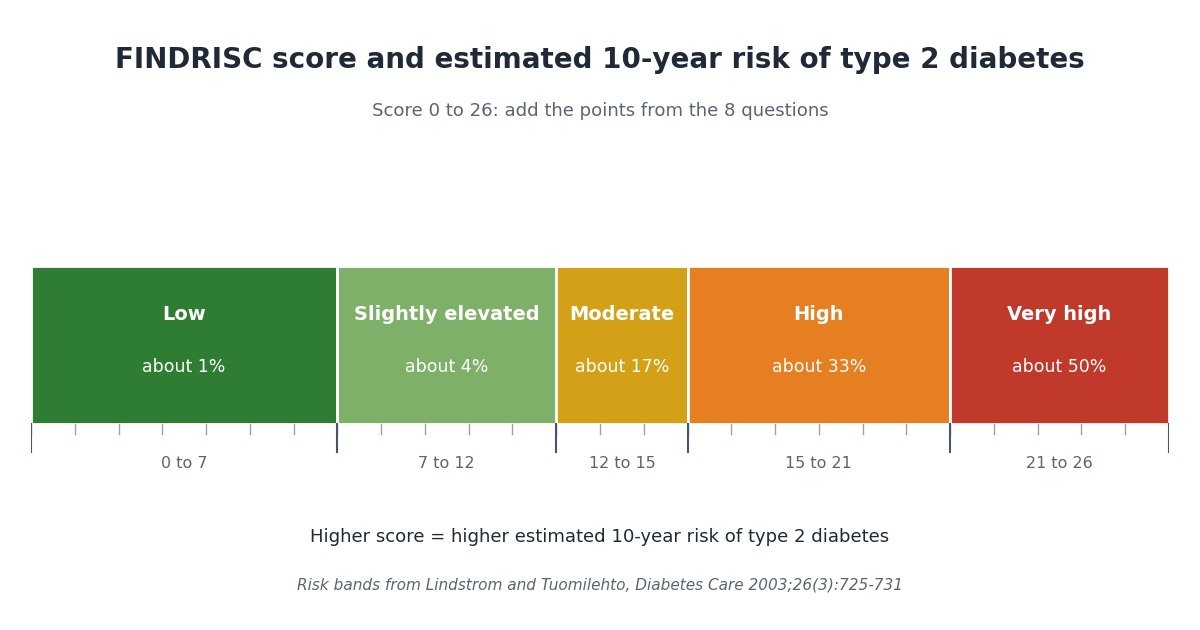
| Score | Risk category | Estimated 10-year risk | What it means |
|---|---|---|---|
| Below 7 | Low | About 1% | About 1 person in 100 with this score develops type 2 diabetes within 10 years. Keep your healthy habits and recheck in a few years. |
| 7-11 | Slightly elevated | About 4% | About 1 person in 25 develops diabetes within 10 years. Small, lasting lifestyle changes now make the biggest difference. |
| 12-14 | Moderate | About 17% | About 1 person in 6 develops diabetes within 10 years. Time for a GP visit and a blood sugar check. |
| 15-20 | High | About 33% | About 1 person in 3 develops diabetes within 10 years. See your GP for testing and ask about a prevention programme. |
| Above 20 | Very high | About 50% | About 1 person in 2 develops diabetes within 10 years. See a clinician promptly; a blood test is needed to rule out diabetes that is already present. |
These percentages describe groups, not individuals. In the original Finnish data, the risk rose steeply across the bands, which is why the top two bands together account for most of the new diabetes cases even though fewer people score that high. Researchers have also found that a score of 15 or above is a practical threshold for selecting people for a confirmatory blood test, since the Finnish follow-up work showed this cut-off efficiently picks out undetected diabetes and abnormal glucose tolerance.
What to do at each FINDRISC risk level
A score is only useful if it leads to action. The advice below follows the standard clinical response to each band and the lifestyle evidence from the Finnish Diabetes Prevention Study, the trial that grew directly out of the FINDRISC research programme.
Low (below 7)
Your estimated risk is about 1% over 10 years. The goal is maintenance: keep moving at least 30 minutes a day, eat vegetables or fruit daily, keep your weight stable, and avoid smoking. Repeating the test every few years is sensible, because age points accumulate over time and weight can creep up unnoticed.
Slightly elevated (7-11)
Your estimated risk is about 4%. This band is the sweet spot for prevention: modest changes now have the largest relative payoff. Aim for daily activity, vegetables or fruit every day, and slow, steady weight loss if you carry extra weight. Mention the result at your next routine GP visit so it goes on your record.
Moderate (12-14)
Your estimated risk is about 17%, roughly 1 in 6. Book a GP appointment for a blood sugar check, either fasting glucose or HbA1c, to see where you stand today. Ask whether a structured lifestyle programme is available in your area, and set one concrete goal to start with, for example a daily 30-minute walk or cutting sugary drinks.
High (15-20)
Your estimated risk is about 33%, roughly 1 in 3. See your GP soon for blood sugar testing, because people in this band benefit most from early detection. The Finnish Diabetes Prevention Study enrolled overweight adults with impaired glucose tolerance, a group much like this band, and gave them individual counselling aimed at losing at least 5% of body weight, cutting total and saturated fat, eating more fibre, and exercising at least 30 minutes a day. After a mean follow-up of 3.2 years, new diabetes cases were 58% lower in the lifestyle group than in the control group. That is the evidence base behind every recommendation on this page: type 2 diabetes can be delayed or prevented, and the effect is large.
Very high (above 20)
Your estimated risk is about 50%, roughly 1 in 2. See a clinician promptly. At this level the score is also doing a second job: Finnish follow-up research found that FINDRISC identifies people who already have undetected type 2 diabetes or abnormal glucose tolerance, so a blood test is needed to rule that out. Do not try to manage this band with lifestyle changes alone before you have been tested. Once tested, a supervised prevention programme and regular follow-up are the standard path.
If you want to understand the blood tests your clinician may order, our HbA1c to average glucose calculator explains what the HbA1c number means, and the HOMA-IR calculator estimates insulin resistance from fasting glucose and insulin. You can also browse all endocrinology calculators.
Limitations of the FINDRISC score
FINDRISC is a well validated screening tool, but it has limits that are worth knowing before you act on a result.
- Population of origin. The score was developed in Finnish adults aged 35 to 64. It has been validated in many other populations, but the waist circumference cut-offs and the exact calibration can fit less well in some ethnic groups, in younger adults, and in the very old.
- Screening, not diagnosis. FINDRISC estimates future risk and flags people who need a blood test. It cannot diagnose diabetes, and it cannot reliably detect diabetes that is already present on its own. A high score needs laboratory confirmation; a low score does not guarantee you will never develop diabetes.
- Not for everyone. The questionnaire is meant for people without diagnosed diabetes. It is not designed for type 1 diabetes, for diabetes already diagnosed, or for use during pregnancy, where gestational diabetes needs its own assessment.
- Self-reported answers. The score is only as good as the answers. Waist circumference is the item most often mismeasured; measuring midway between the lowest rib and the hip bone, after a normal breath out, gives the most reliable value.
- Population averages. The 10-year percentages are averages for each band in the study population. Your personal risk also depends on factors the questionnaire does not ask about, such as smoking, sleep, stress, specific medications and detailed diet.
Key takeaways
- Lower is better.
- No.
- In the original 2003 study the score discriminated well between people who did and did not develop diabetes, with an area under the ROC curve of about 0.85 in development and 0.87 in validation.
- A previous finding of raised blood sugar, for example during a health check, an illness or a pregnancy, is the strongest single item in the questionnaire.
Frequently asked questions
What is a good FINDRISC score?
Lower is better. A FINDRISC score below 7 is classed as low risk, with an estimated 10-year risk of developing type 2 diabetes of about 1%. Scores of 7 to 11 are slightly elevated (about 4%), 12 to 14 moderate (about 17%), 15 to 20 high (about 33%), and above 20 very high (about 50%), based on the original Lindstrom and Tuomilehto study.
Can the FINDRISC test diagnose diabetes?
No. FINDRISC is a screening tool, not a diagnostic test. It estimates the chance of developing type 2 diabetes in the next 10 years and helps identify people who should have a blood test, such as fasting glucose, HbA1c or an oral glucose tolerance test. Only a clinician, using blood test results, can diagnose diabetes.
How accurate is the FINDRISC diabetes risk score?
In the original 2003 study the score discriminated well between people who did and did not develop diabetes, with an area under the ROC curve of about 0.85 in development and 0.87 in validation. It has since been validated in many countries and populations. Like all risk scores it gives a population-based estimate, not a personal prediction.
Why does a history of high blood sugar add 5 points to the FINDRISC score?
A previous finding of raised blood sugar, for example during a health check, an illness or a pregnancy, is the strongest single item in the questionnaire. It suggests the body's glucose regulation is already impaired, which is why the original scoring gives it 5 points, more than any other single question.
How often should I repeat the FINDRISC test?
For most adults with a low score, repeating the test every few years is reasonable. Repeat it sooner if something changes: noticeable weight gain, less physical activity, a new diagnosis of high blood pressure, or a family member developing diabetes. If your score was moderate or higher, follow the testing plan your clinician recommends rather than waiting.
Does FINDRISC work for people outside Finland?
FINDRISC was developed in Finnish adults aged 35 to 64, but it has been tested and validated in many other populations across Europe, Asia, Latin America and North America. The waist circumference cut-offs and overall calibration can fit less well in some ethnic groups, so results outside European populations should be interpreted with a little extra caution and confirmed with local guidance.
References
- Lindstrom J, Tuomilehto J. The diabetes risk score: a practical tool to predict type 2 diabetes risk. Diabetes Care. 2003;26(3):725-731. doi:10.2337/diacare.26.3.725. PubMed record.
- Tuomilehto J, Lindstrom J, Eriksson JG, et al. Prevention of type 2 diabetes mellitus by changes in lifestyle among subjects with impaired glucose tolerance. N Engl J Med. 2001;344(18):1343-1350. (Finnish Diabetes Prevention Study: 58% fewer new diabetes cases with intensive lifestyle intervention over a mean 3.2 years of follow-up.)
- Saaristo T, Peltonen M, Lindstrom J, Saarikoski L, Sundvall J, Eriksson JG, Tuomilehto J. Cross-sectional evaluation of the Finnish Diabetes Risk Score: a tool to identify undetected type 2 diabetes, abnormal glucose tolerance and metabolic syndrome. Diab Vasc Dis Res. 2005;2(2):67-72.
- Endocrine Society
- American Diabetes Association
Medically reviewed by Dr. Taimoor Asghar, Physician and Community Medicine Researcher. Last reviewed: 5 October 2026. Scoring follows Lindstrom J, Tuomilehto J, Diabetes Care 2003;26(3):725-731.