What is a thyroid storm?
A thyroid storm, also called thyrotoxic crisis, is a rare but life-threatening exaggeration of hyperthyroidism. In this state the body is overwhelmed by the effects of excess thyroid hormone, and several organ systems fail at once: body temperature climbs, the heart races and may develop arrhythmias or heart failure, the gut becomes overactive with nausea, vomiting or diarrhoea, and the brain is affected, ranging from agitation and restlessness through delirium to seizures or coma.
Most cases of thyroid storm do not arrive out of nowhere. In their original 1993 paper, Burch and Wartofsky observed that most cases follow a precipitating event or an intercurrent illness in someone with untreated or undertreated hyperthyroidism. Typical triggers include infections, surgery, trauma, childbirth, and abruptly stopping antithyroid medication. The most common underlying thyroid disorder in these patients is Graves disease, the autoimmune cause of hyperthyroidism.
Thyroid storm used to be almost always fatal. In the 1993 paper the authors noted that fatality rates had fallen from the nearly 100 percent reported in Lahey's era to between 20 and 50 percent in more recent series at that time, which they attributed to earlier recognition and the stepwise addition of antithyroid, corticosteroid and antiadrenergic drugs to treatment. Survival is still not guaranteed, which is why rapid recognition matters so much.
One difficulty is that thyroid storm cannot be diagnosed from blood tests alone. A suppressed TSH with raised free T4 or free T3 confirms thyrotoxicosis, but those results look similar in uncomplicated hyperthyroidism. Before 1993, the diagnosis rested on a history of raised thyroid hormones plus worsening thyrotoxic symptoms, which biased the diagnosis. The Burch-Wartofsky point scale was introduced to give clinicians a structured, quantitative way to separate uncomplicated thyrotoxicosis from impending or established thyroid storm.
When is the thyroid storm score Burch-Wartofsky used?
The thyroid storm score Burch-Wartofsky is used at the bedside, usually in an emergency department or intensive care unit, when a patient with known or suspected hyperthyroidism deteriorates. The clinician scores seven clinical features, adds the points, and reads off one of three interpretation bands. Because every item is a bedside observation, the score can be completed in minutes without waiting for laboratory results.
Henry B. Burch and Leonard Wartofsky developed the scale from their clinical observations of patients at major referral centres, correlating clinical findings with patient outcomes such as morbidity and mortality. Their aim was a practical diagnostic aid: a number that helps a clinician decide whether the patient in front of them has uncomplicated thyrotoxicosis, is heading toward thyroid storm, or is already in it.
The scale is best known internationally and is still the most widely used bedside tool for this purpose. Other criteria exist, for example the diagnostic criteria published in the 2016 guidelines for the management of thyroid storm from the Japan Thyroid Association and Japan Endocrine Society, which use a different combination of clinical features. In practice, many clinicians know the Burch-Wartofsky bands and use them as a shared language when handing a patient over to intensive care.
It is important to understand what the score is not. It is not a laboratory test, it is not a treatment protocol, and it does not replace clinical judgment. A patient with a low score can still be seriously ill from something else, and a patient with a high score needs a clinician, not a calculator, to decide the next step.
The seven items and their weights
Each of the seven items captures one organ-system manifestation of thyroid storm, and the points rise with severity. The maximum possible total is 140 points. The table below shows every band and its point value, exactly as implemented in the calculator above.
| Clinical item | Finding | Points |
|---|---|---|
| Thermoregulatory dysfunction (temperature) | Below 37.2 °C (below 99 °F) | 0 |
| 37.2 to 37.7 °C (99.0 to 99.9 °F) | 5 | |
| 37.8 to 38.3 °C (100.0 to 100.9 °F) | 10 | |
| 38.3 to 38.8 °C (101.0 to 101.9 °F) | 15 | |
| 38.9 to 39.4 °C (102.0 to 102.9 °F) | 20 | |
| 39.4 to 39.9 °C (103.0 to 103.9 °F) | 25 | |
| 40.0 °C or higher (104 °F or higher) | 30 | |
| Central nervous system effects | Absent | 0 |
| Agitation | 10 | |
| Delirium, psychosis or extreme lethargy | 20 | |
| Seizure or coma | 30 | |
| Gastrointestinal-hepatic dysfunction | Absent | 0 |
| Moderate: diarrhoea, nausea, vomiting or abdominal pain | 10 | |
| Severe: unexplained jaundice | 20 | |
| Tachycardia (beats per minute) | Below 90 | 0 |
| 90 to 109 | 5 | |
| 110 to 119 | 10 | |
| 120 to 129 | 15 | |
| 130 to 139 | 20 | |
| 140 or higher | 25 | |
| Congestive heart failure | Absent | 0 |
| Mild: pedal oedema | 5 | |
| Moderate: bibasilar rales | 10 | |
| Severe: pulmonary oedema | 15 | |
| Atrial fibrillation | Absent | 0 |
| Present | 10 | |
| Precipitating event | Negative | 0 |
| Positive | 10 |
Why these items carry the weights they do
Temperature and heart rate are the two graded physiological items because they track the core hypermetabolic state: the hotter the patient and the faster the heart, the further the crisis has progressed, with the top bands (40.0 °C or higher, 140 beats per minute or higher) carrying the heaviest weights of 30 and 25 points. The nervous system item is the single most heavily weighted categorical item because progression from agitation to delirium to coma marks the transition from severe thyrotoxicosis toward a true crisis. Gastrointestinal and hepatic signs matter because profuse diarrhoea and vomiting drive dehydration and electrolyte disturbance, while unexplained jaundice signals hepatic dysfunction. Heart failure and atrial fibrillation capture the cardiac decompensation that makes thyroid storm so dangerous, and the precipitating event item reflects the observation that storms are usually triggered, not spontaneous.
A worked example shows how quickly the points add up. A patient with a temperature of 39.6 °C (25 points), agitation (10), diarrhoea (10), a heart rate of 135 (20), pedal oedema (5), atrial fibrillation (10) and a recent infection as precipitant (10) scores 90 points, well into the highest band.
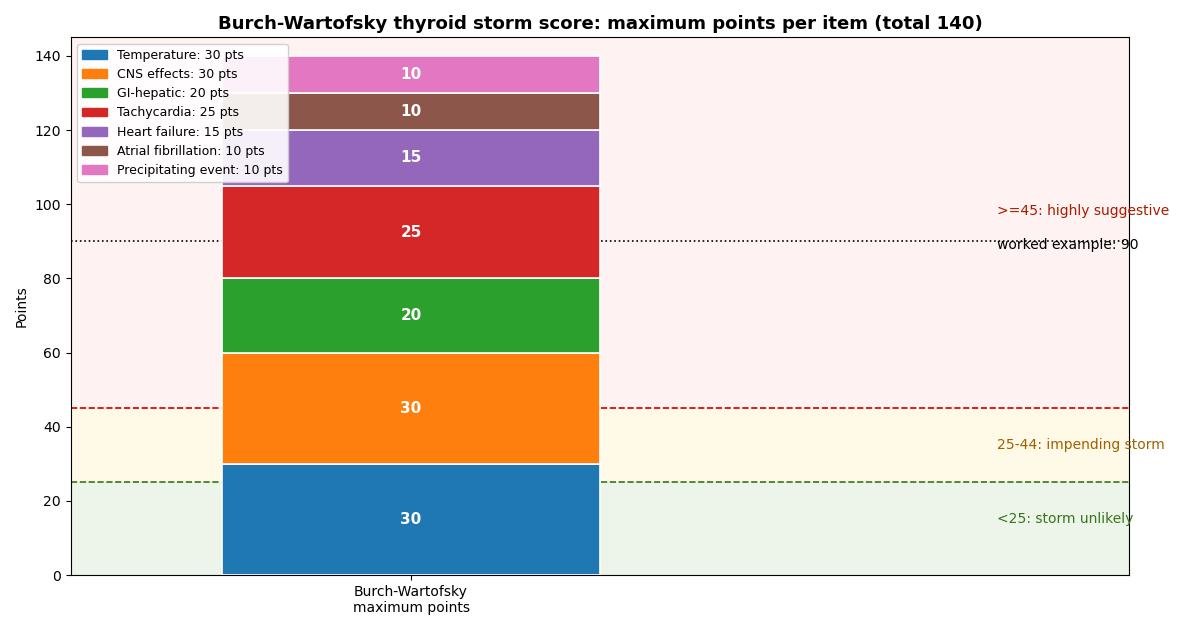
The three interpretation bands and what each means
The total score falls into one of three bands, each with a different clinical meaning and a different level of urgency.
Below 25: thyroid storm unlikely
A score under 25 points suggests the presentation is unlikely to represent thyroid storm. The clinician still needs to explain the patient's thyrotoxicosis and treat its underlying cause, which may mean antithyroid drugs and, depending on the cause, beta blockers for symptom control. The low score is reassuring about storm specifically, but it does not mean the patient is well.
25 to 44: impending thyroid storm
This middle band is a warning. The patient shows enough features of thyroid storm that the diagnosis is approaching, and deterioration can be rapid. Published clinical reviews advise close monitoring, often in an intensive care setting, with medical therapy using thionamides and beta blockers, and consideration of additional measures such as iodine solutions or bile acid sequestrants. The precipitant must be hunted down and treated.
45 or higher: highly suggestive of thyroid storm
A score of 45 or more is highly suggestive of thyroid storm and is treated as an endocrine emergency. Clinical reviews recommend admission to an intensive care unit and aggressive medical therapy: antithyroid drugs, corticosteroids, iodine solutions, bile acid sequestrants and beta blockers, together with supportive care such as cooling measures, fever control with antipyretics (aspirin is avoided), intravenous hydration, and treatment of precipitating factors. Every minute of delay increases risk, which is why the emergency warning on this page is so prominent.
Management of thyroid storm: hospital-only emergency care
Thyroid storm is managed exclusively in hospital, and there is no home treatment. The general principles described in clinical reviews are worth understanding so that patients and families know what to expect, but none of this should ever be attempted outside medical supervision.
- Beta blockers blunt the dangerous adrenergic surge: they slow the racing heart, reduce tremor and agitation, and lower the risk of arrhythmia.
- Thionamides (antithyroid drugs such as carbimazole, methimazole or propylthiouracil) block the thyroid from making new hormone.
- Iodine solutions block the release of already-formed hormone from the gland. They are given after the thionamide has had time to act, because iodine given first can paradoxically fuel more hormone production.
- Corticosteroids reduce the conversion of T4 to the more active T3 in the tissues and cover the possibility of relative adrenal insufficiency during the crisis.
- Supportive care includes cooling blankets and antipyretics for fever (aspirin is avoided because it can displace thyroid hormone from binding proteins), intravenous fluids for dehydration, and correction of electrolyte disturbances.
- Treating the trigger is essential: if an infection precipitated the storm, antibiotics and source control are part of therapy.
The exact drug choices, doses and sequencing are decisions for the treating endocrinology and intensive care team, tailored to the patient. What matters for everyone else is speed: suspected thyroid storm should reach an emergency department without delay.
Limitations of the Burch-Wartofsky score
The scale has real limitations that clinicians keep in mind. Because thyroid storm is rare, there are no large prospective studies validating the score; its performance has been examined in retrospective cohort analyses and multicentre surveys looking at outcomes such as mortality and organ failure. The scale was built from clinical observation rather than from a derivation cohort with statistical modelling, so the weights reflect expert judgment about severity.
Symptoms can also be hard to attribute. Fever may come from the precipitating infection rather than the storm itself, confusion may have another cause, and heart failure may reflect underlying cardiac disease. Published criteria therefore stress clinical judgment in deciding whether a finding is truly part of the thyrotoxic picture. The score also ignores laboratory values entirely, which is a strength at the bedside (no waiting for results) but means it cannot incorporate the biochemical severity of thyrotoxicosis.
Finally, the bands are guides, not walls. A patient scoring 44 is not meaningfully safer than one scoring 45, and management should follow the clinical picture as well as the number. The score structures thinking; it does not replace it.
Key takeaways
- A total of 45 points or more is highly suggestive of thyroid storm, a score of 25 to 44 points suggests impending thyroid storm, and a score below 25 points makes thyroid storm unlikely.
- No.
- Most cases of thyroid storm follow a precipitating event or intercurrent illness in someone with untreated or undertreated hyperthyroidism.
- Thyroid storm is an exaggerated, multi-system response to excess thyroid hormone, and the scale captures its effects on each major system: thermoregulation (fever), the central nervous system (agitation through to coma), the gut and liver, and the cardiovascular system (tachycardia, heart failure, atrial fibrillation).
Frequently asked questions
What score on the Burch-Wartofsky scale indicates thyroid storm?
A total of 45 points or more is highly suggestive of thyroid storm, 25 to 44 points suggests impending thyroid storm, and below 25 points makes thyroid storm unlikely. Any score in the higher bands is a medical emergency needing immediate hospital assessment.
Can thyroid storm be diagnosed with blood tests alone?
No. Blood tests confirm thyrotoxicosis but do not reliably separate thyroid storm from uncomplicated hyperthyroidism. The diagnosis is clinical, based on the severity of organ dysfunction, which is why the point scale exists.
What usually triggers thyroid storm?
Most cases follow a precipitating event or intercurrent illness in someone with untreated or undertreated hyperthyroidism, such as an infection, surgery, trauma, childbirth, or suddenly stopping antithyroid medication. The scale awards 10 points for a positive precipitant history.
Why does the score ask about temperature, heart rate and mental state?
Thyroid storm is a multi-system crisis, and the scale captures each affected system: thermoregulation, the brain, the gut and liver, and the heart and circulation. Points rise with severity, so coma scores 30 while mild agitation scores 10.
What should I do if the score is 45 or higher?
Call your local emergency number immediately and go to an emergency department. Thyroid storm is treated in hospital, usually in intensive care, with beta blockers, thionamides, iodine solutions, corticosteroids and supportive care. Never attempt to manage it at home.
Is the Burch-Wartofsky score validated?
There are no large prospective validation studies because the condition is rare. The scale was derived from clinical observations at major referral centres and has since been assessed in retrospective analyses. It remains the most widely used bedside tool, with clinical judgment as the final arbiter.
Source for the scale: Burch HB, Wartofsky L. Life-threatening thyrotoxicosis. Thyroid storm. Endocrinol Metab Clin North Am. 1993;22(2):263-277. PMID: 8325286. Clinical interpretation bands and management principles are summarised from published reviews of the Burch-Wartofsky score and thyroid storm management.