Calculate your ANC
What is the absolute neutrophil count?
The absolute neutrophil count, usually shortened to ANC, is the number of neutrophil white blood cells in one microliter of blood. Neutrophils are the immune system's first responders: they are the white blood cells that arrive first at a site of bacterial or fungal infection and destroy the invading organisms. The National Cancer Institute's Dictionary of Cancer Terms defines the ANC as a measure of the number of neutrophils in the blood, noting that a low ANC increases the risk of infection. Because neutrophils are produced continuously in the bone marrow and live only a short time in the circulation, the ANC is a sensitive, real time indicator of the body's ability to mount an antibacterial defense. In cancer care it is one of the most closely watched laboratory values, because chemotherapy and some other treatments can suppress the bone marrow and cause the count to fall sharply.
The ANC is not the same as the neutrophil percentage printed on a differential report. A percentage only says what fraction of the white cells are neutrophils; the absolute count says how many of them are actually present. That distinction matters. A person can have a normal neutrophil percentage but a low total white count, which still means too few neutrophils in absolute terms, and that is the situation that raises infection risk.
How the ANC is calculated
The formula is straightforward. Take the total white blood cell count, multiply it by the combined percentage of segmented neutrophils and band neutrophils, and divide by 100:
ANC = WBC × (segmented neutrophils % + band neutrophils %) ÷ 100
The result is expressed in cells per microliter (cells/uL). Most laboratory reports give the total WBC either in units of x10^9 per liter or in cells per microliter, and the two are easy to convert: 1 x10^9/L equals 1000 cells/uL. This calculator accepts both unit styles and converts internally before applying the formula.
Here is a worked example. Suppose a CBC shows a WBC of 5.0 x10^9/L, 60 percent segmented neutrophils, and 5 percent bands. First convert the WBC to cells per microliter: 5.0 × 1000 = 5000 cells/uL. Then apply the formula: 5000 × (60 + 5) ÷ 100 = 5000 × 0.65 = 3250 cells/uL. That is comfortably in the normal range, which starts at 1500 cells/uL.
Reading your CBC report
The three numbers the formula needs come from different lines of a complete blood count with differential. The total white blood cell count is usually the first line under the CBC heading, labeled WBC or WCC. The neutrophil percentages come from the differential, the part of the report that breaks the white cells down by type. Segmented neutrophils may be labeled “segs”, “neutrophils”, “polys” or “segmenters” depending on the laboratory. Bands are the immature form and may appear as “bands”, “band forms”, “stabs” or may not be reported at all, in which case the calculator treats them as zero. Always use the percentages rather than any absolute values from the differential when the calculator asks for them, and always copy the numbers from the same draw date, because a differential from a different day can give a misleading result.
Interpreting the bands
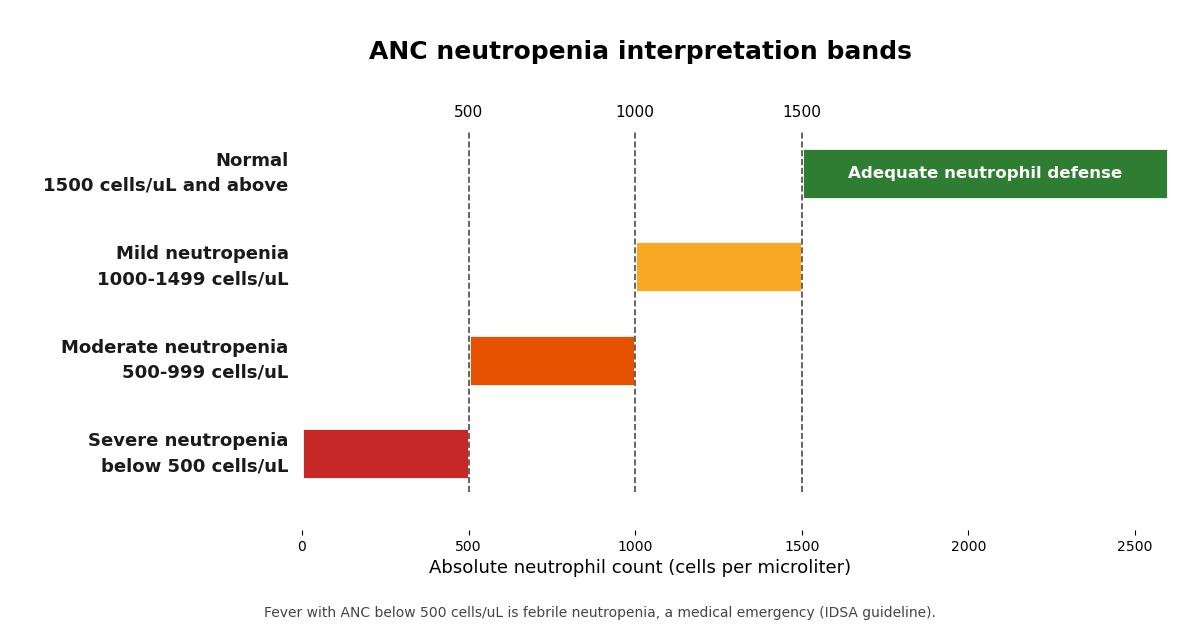
Oncology practice grades neutropenia using the cutoffs published in the National Cancer Institute's Common Terminology Criteria for Adverse Events (CTCAE) version 5.0: Grade 2 spans 1000 to below 1500, Grade 3 spans 500 to below 1000, and Grade 4 is below 500. This calculator maps those grades to plain language bands:
| ANC (cells/uL) | Band | What it means |
|---|---|---|
| ≥ 1500 | Normal | Neutrophil numbers are adequate. Standard infection precautions apply. |
| 1000 to 1499 | Mild neutropenia | Slightly reduced neutrophil reserve. Monitoring is usual; report fever promptly. |
| 500 to 999 | Moderate neutropenia | Infection risk is clearly increased. Neutropenic precautions and close monitoring are typical. |
| < 500 | Severe neutropenia | High infection risk. Fever at this level is febrile neutropenia, a medical emergency needing immediate assessment. |
Reference ranges on individual laboratory reports can differ slightly from these cutoffs, so your own lab's printed range always takes precedence for that specific report.
Why the ANC matters: febrile neutropenia
The ANC earns its importance from one clinical situation above all: febrile neutropenia. The Infectious Diseases Society of America (IDSA), in its 2010 guideline updated in 2011, defines neutropenia as an ANC below 1500 cells/uL, or one expected to fall below 500 within 48 hours. Febrile neutropenia is then defined as a single oral temperature of 38.3℃ (101℉) or higher, or 38.0℃ (100.4℉) or higher sustained for one hour or longer, occurring in a patient with an ANC below 500, or below 1000 with an expected drop to 500 within 48 hours.
The reason fever plus severe neutropenia is treated as an emergency is that neutrophils are the cells that produce the classic signs of infection: pus, local inflammation, and a robust febrile response. When they are nearly absent, an infection can advance with almost no visible warning signs, and only the fever announces it. That is why cancer patients on chemotherapy are instructed to take their temperature at home and to contact their team immediately, at any hour, if it reaches the threshold. Standard management, as described in the IDSA guideline, is prompt clinical assessment and empiric broad spectrum antibiotics, because delay is associated with worse outcomes.
Common causes of a low ANC
Chemotherapy is the most frequent cause in oncology practice. Cytotoxic drugs attack rapidly dividing cells, and neutrophil precursors in the marrow divide rapidly, so the count typically falls after a cycle of treatment, reaches its lowest point (called the nadir) about one to two weeks after the dose depending on the regimen, and then recovers as the marrow repopulates. Other important causes include cancers of the bone marrow such as leukemia, infections (including some viral infections and sepsis), autoimmune conditions in which the body destroys its own neutrophils, nutritional deficiencies (particularly vitamin B12 and folate deficiency), and drugs such as clozapine, carbimazole, sulfasalazine and some antibiotics. Certain people also have a chronically low neutrophil count with no underlying disease, a pattern seen more often in people of African, Middle Eastern or West Indian ancestry, sometimes called benign ethnic neutropenia; the absolute values may be lower than standard reference ranges without any increased infection risk.
What clinicians do about neutropenia
Management depends on the cause and the depth and duration of the drop. For chemotherapy related neutropenia, oncologists may delay the next cycle, reduce doses, or use granulocyte colony stimulating factors (G-CSF) such as filgrastim to shorten the duration of neutropenia in high risk patients, following guidance from the American Society of Clinical Oncology. During periods of severe neutropenia, patients are counseled on neutropenic precautions: careful hand hygiene, avoiding crowds and people with respiratory infections, food safety measures, and prompt reporting of any fever, chills, sore throat, mouth sores or unusual fatigue. These precautions reduce exposure, they do not replace the neutrophils themselves. If a specific drug is the likely cause, the prescribing clinician may stop or substitute it. Growth factor support, antibiotics and dose adjustments are all treatment decisions for the treating team, not for this calculator.
Limitations of this calculator
This tool applies a standard arithmetic formula to the numbers you type in. It cannot detect typing errors, it does not know whether your differential percentages are from the same blood draw as your WBC, and it does not account for laboratory specific reference ranges or for the clinical context that gives a number its meaning: symptoms, medications, treatment history and how the count is trending. A single ANC value is less informative than the trend across several draws, and only your clinician can say whether a value requires action. Use the result as an aid to understanding your report, and bring any questions, especially any fever, directly to your care team.
Key takeaways
- An absolute neutrophil count of 1500 cells per microliter or higher is considered normal in adults.
- ANC equals the total white blood cell count multiplied by the percentage of segmented neutrophils plus the percentage of band neutrophils, divided by 100.
- Severe neutropenia means an absolute neutrophil count below 500 cells per microliter.
- Febrile neutropenia is fever occurring with an absolute neutrophil count below 500 cells per microliter, or below 1000 with an expected fall below 500 within 48 hours.
Frequently asked questions
What is a normal absolute neutrophil count?
An ANC of 1500 cells/uL or higher is considered normal in adults. From 1000 to 1499 is mild neutropenia, 500 to 999 is moderate neutropenia, and below 500 is severe neutropenia. These cutoffs follow the grading used in oncology practice and in the NCI Common Terminology Criteria for Adverse Events.
How is the ANC calculated?
Multiply the total WBC by the sum of the segmented neutrophil and band neutrophil percentages, then divide by 100. For example, a WBC of 5.0 x10^9/L with 60 percent segs and 5 percent bands gives 3250 cells/uL. This page's calculator performs the arithmetic for you in either unit style.
What does severe neutropenia mean?
An ANC below 500 cells/uL means the body's antibacterial defense is severely reduced. Infection risk is high, and any fever during severe neutropenia is treated as a medical emergency because serious infections can progress rapidly when neutrophils are nearly absent.
What is febrile neutropenia?
Fever occurring with an ANC below 500 (or below 1000 with an expected fall to 500 within 48 hours). The IDSA definition is a single oral temperature of 38.3℃ or higher, or 38.0℃ or higher sustained for one hour or more, in a neutropenic patient. It requires immediate medical assessment and empiric antibiotics.
Can this calculator diagnose neutropenia?
No. It is an educational tool that applies the standard formula to numbers you enter. Diagnosis requires a proper laboratory report interpreted by a clinician in the context of your symptoms, medications and full clinical picture.
Why are band neutrophils included?
Bands are immature neutrophils released from the marrow during acute demand, such as an early infection or after growth factor therapy. Adding their percentage to the mature segmented neutrophils gives a more complete measure of the neutrophil response available.
References
- National Cancer Institute. NCI Dictionary of Cancer Terms: absolute neutrophil count. https://www.cancer.gov/publications/dictionaries/cancer-terms/def/absolute-neutrophil-count
- National Cancer Institute. Common Terminology Criteria for Adverse Events (CTCAE), Version 5.0. November 2017. Neutropenia grading: Grade 2, <1500 to 1000; Grade 3, <1000 to 500; Grade 4, <500 cells/mm3.
- Freifeld AG, Bow EJ, Sepkowitz KA, et al. Clinical practice guideline for the use of antimicrobial agents in neutropenic patients with cancer: 2010 update by the Infectious Diseases Society of America. Clin Infect Dis. 2011;52(4):e56-e93.
- Smith TJ, Bohlke K, Lyman GH, et al. Recommendations for the use of WBC growth factors: American Society of Clinical Oncology clinical practice guideline update. J Clin Oncol. 2015;33(28):3199-3212.
- American Society of Hematology
- National Cancer Institute