What is the absolute lymphocyte count?
Lymphocytes are a type of white blood cell and a central part of the adaptive immune system. There are three main kinds: B lymphocytes, T lymphocytes, and natural killer (NK) cells. B cells produce antibodies that tag foreign substances for destruction, T cells kill virus-infected and cancerous cells and help control the immune response, and NK cells respond quickly to infected or abnormal cells. Because they carry immunological memory, lymphocytes are the cells that remember past infections and respond faster the next time the same threat appears.
When a doctor orders a complete blood count (CBC) with differential, the laboratory reports both the total white blood cell count and the breakdown into the different white cell types. The lymphocyte percentage tells you what share of the white cells are lymphocytes, typically somewhere between 20 and 40 percent of the total. The absolute lymphocyte count, or ALC, converts that percentage into a true concentration: the actual number of lymphocytes per unit of blood. It is this absolute number, not the percentage, that clinicians use to decide whether a person's lymphocytes are genuinely low, normal, or high.
For adults, a widely cited healthy range for the absolute lymphocyte count is 1,000 to 4,800 lymphocytes per microliter of blood, which is the same as 1.0 to 4.8 x10^9/L. This range is published in patient-facing references such as Medical News Today and WebMD. Reference ranges do differ between laboratories and instruments, so the range printed on your own lab report always takes precedence. Some laboratory guides use a narrower range, for example the Derbyshire shared care pathology guideline quotes 1.5 to 3.0 x10^9/L for adults. The calculator on this page uses the 1.0 to 4.8 band because it is the most commonly published general adult range, and it flags that other ranges exist.
The ALC formula and how units convert
The arithmetic behind the absolute lymphocyte count is simple multiplication. Take the total white blood cell count, multiply it by the lymphocyte percentage, and divide by 100. Written as a formula:
ALC = WBC x (lymphocyte % / 100)
For example, if the total WBC is 6.0 x10^9/L and the differential shows 30 percent lymphocytes, the absolute lymphocyte count is 6.0 x 30 / 100 = 1.8 x10^9/L. The result lands in the same unit system as the WBC you entered, so no extra conversion step is needed to read it.
Laboratories report white cell counts in two main unit systems, and this is where mistakes creep in. The SI system uses x10^9/L, meaning billions of cells per liter. The conventional system used in the United States uses cells per microliter (cells/uL). The conversion between them is a factor of 1,000: 1 x10^9/L equals 1,000 cells per microliter, because a liter contains one million microliters and one billion divided by one million is one thousand. So an ALC of 1.8 x10^9/L is exactly 1,800 cells per microliter. This calculator accepts the WBC in either system and reports the ALC in both, which removes the conversion step where most manual errors happen.
One detail worth knowing: entering the wrong unit system is the most common source of absurd results. A WBC of 6,000 cells per microliter entered as 6,000 x10^9/L would produce an ALC one thousand times too large. The calculator guards against the most extreme cases by requiring a positive WBC and a percentage between 0 and 100, but it cannot tell which unit system your report uses. Always check the units on your lab slip before you type.
How to use this calculator
Start by selecting the unit system that matches your lab report: x10^9/L or cells per microliter. Then enter the total white blood cell count and the lymphocyte percentage from the differential. Press the calculate button. The result panel shows the absolute lymphocyte count in both unit systems, states whether it falls in the normal band, below it, or above it, and gives a short explanation of what that band means.
The calculator validates every input before it does any arithmetic. A missing WBC, a missing lymphocyte percentage, a WBC that is zero or negative, a percentage below 0 or above 100, or a value that is not a number at all each produce a named error code explaining exactly what is wrong. These checks exist because a differential percentage can never exceed 100, and a zero or negative cell count is biologically impossible, so any such input is a data entry mistake rather than a real result.
What your result means
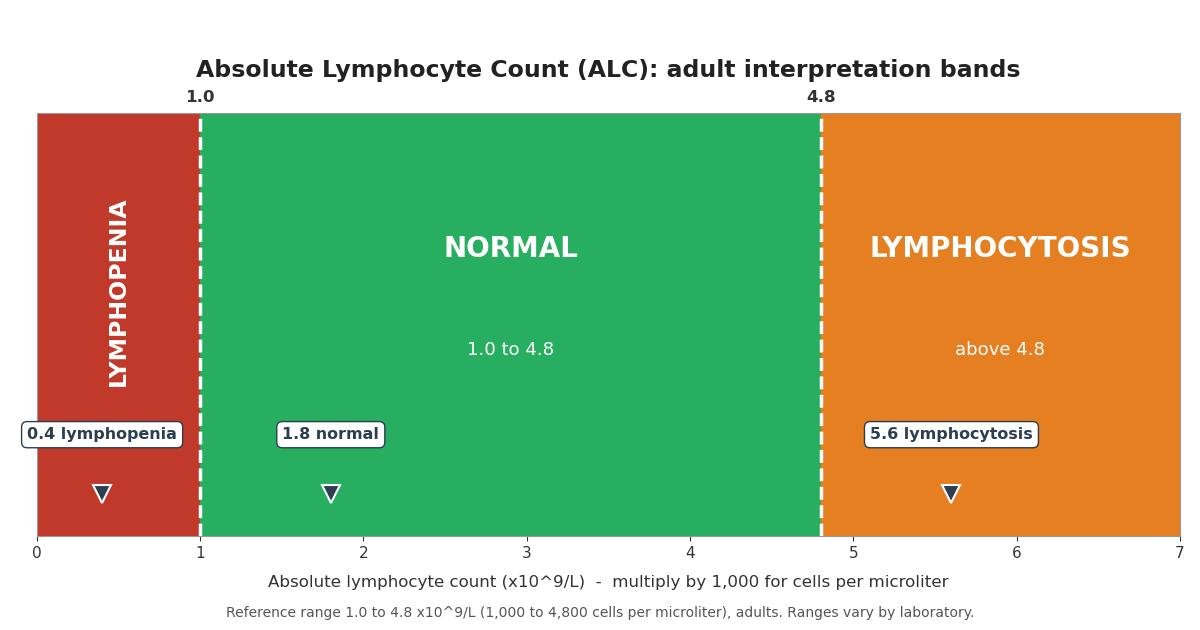
The calculator interprets the ALC against the adult reference band of 1.0 to 4.8 x10^9/L (1,000 to 4,800 cells per microliter), drawn from the published range cited above. Three bands cover every possible result.
Normal: 1.0 to 4.8 x10^9/L (1,000 to 4,800 cells/uL)
A result inside this band means the circulating lymphocyte count is within the commonly published healthy adult range. It is a reassuring finding, but it is only one line of the blood count. A normal ALC does not guarantee that the immune system is fully healthy, because the count says nothing about how well the lymphocytes work, and some diseases cause dysfunctional lymphocytes that are present in normal numbers. Conversely, the count is a single snapshot in time, and values drift up and down with recent infections, stress, and even the time of day the blood was drawn.
Low: below 1.0 x10^9/L (below 1,000 cells/uL) - lymphopenia
An ALC below 1,000 per microliter in an adult is called lymphopenia, also written as lymphocytopenia. This is the standard threshold used in clinical references. A low count means fewer circulating lymphocytes are available to mount immune responses, which can leave a person more vulnerable to infections. Whether that matters depends on how low the count is, how long it stays low, and what is happening in the rest of the blood count. A mildly low value that appears once during or just after an infection is often transient and resolves on its own, while a persistently low count deserves medical attention and usually a repeat test to confirm it.
High: above 4.8 x10^9/L (above 4,800 cells/uL) - lymphocytosis
An ALC above the top of the reference band is called lymphocytosis. In most people this is a reactive response: the immune system is producing extra lymphocytes because it is fighting something, most often a viral infection. It can also persist in smokers and, less commonly, it reflects a bone marrow or lymphoid disorder. As a practical rule of thumb published by WebMD, if lymphocyte counts repeatedly reach 5,000 per microliter or more without an obvious reason, it is time to talk to a doctor and investigate the cause. A single mildly raised value during an infection, on the other hand, is usually not a cause for alarm.
Common causes of a low ALC (lymphopenia)
Lymphopenia arises through a few basic mechanisms: the body produces too few lymphocytes, something destroys them faster than they are replaced, or they become trapped in the lymph nodes or spleen instead of circulating in the blood. Clinical references group the causes accordingly. Acute infections and severe physiological stress can cause a temporary dip that recovers as the illness resolves. Poor nutrition, including zinc deficiency, can suppress production. Medications and treatments that target dividing cells, particularly chemotherapy and radiation therapy, commonly reduce lymphocyte counts. Autoimmune conditions such as lupus can destroy lymphocytes, and HIV directly infects and kills the T cell subset.
It helps to distinguish transient from persistent lymphopenia. Transient lymphopenia follows an acute event and normalizes within days to weeks once the trigger passes. Persistent lymphopenia, meaning the count stays below the threshold on repeat testing, points toward an ongoing process such as an immunodeficiency, a chronic disease, or a treatment effect, and it is the pattern that prompts a fuller workup. Because a single low reading can be a laboratory fluctuation or the tail end of a recent illness, clinicians almost always repeat the blood count before drawing conclusions.
Common causes of a high ALC (lymphocytosis)
The most frequent cause of lymphocytosis is infection, particularly viral infections. Infectious mononucleosis is the classic example and can push the lymphocyte count well above the normal range for weeks. Other infections associated with raised lymphocytes include hepatitis, cytomegalovirus, toxoplasmosis, and syphilis. Acute stress from surgery, trauma, or septic shock can also raise the count briefly, and corticosteroid treatment can cause a short-lived rise. Smokers often carry a mild but persistent lymphocytosis even without any infection, a point noted in hematology guidelines.
When lymphocytosis persists without an infectious explanation, clinicians consider bone marrow and lymphoid disorders. These include lymphomas and chronic leukemias, in which abnormal lymphocytes accumulate in the blood. Chronic lymphocytic leukemia, for instance, is characterized by a sustained elevation of lymphocytes; diagnostic criteria require a monoclonal B-lymphocyte count of at least 5,000 per microliter persisting for at least three months. Autoimmune conditions and thyroid underactivity are also listed among the causes of raised lymphocytes. The key clinical question is always duration and trajectory: a high count that fades as an infection clears is reassuring, while one that climbs or persists on repeat testing needs investigation.
ALC in children
Children are not small adults when it comes to lymphocyte counts. Healthy children carry substantially more circulating lymphocytes than adults do, so the adult bands used by this calculator do not apply to them. Published patient references give a normal range of roughly 3,000 to 9,500 lymphocytes per microliter for children, and laboratory reference intervals are broken down further by age: for example, one hospital laboratory guide lists 4.0 to 10.5 x10^9/L for ages one month to two years and 2.0 to 8.0 x10^9/L for ages two to ten years. A count that would be flagged as lymphocytosis in an adult can be perfectly normal in a toddler.
This matters because misapplying adult ranges to children is one of the most common interpretation errors in primary care. If the blood count belongs to a child, ignore the band labels from this calculator and use the age-specific reference range printed on the laboratory report, or ask the child's doctor. The arithmetic of the calculator is still correct for any age, since the formula does not depend on age, but the interpretation bands are adult-only.
Why the absolute count matters more than the percentage
The lymphocyte percentage is a relative number: it describes the share of white cells that are lymphocytes, but it says nothing about the total. This creates a well-known trap. If the total white cell count is very low, a normal-looking percentage can hide a dangerously low absolute count. For example, a WBC of 2.0 x10^9/L with 40 percent lymphocytes looks fine as a percentage, yet the absolute count is only 0.8 x10^9/L, which is lymphopenia. The percentage was reassuring and the absolute count was not.
The reverse trap exists too. A low percentage does not always mean low lymphocytes: if the total WBC is high because neutrophils have surged during a bacterial infection, the lymphocyte percentage can fall below its usual 20 to 40 percent range while the absolute lymphocyte count remains completely normal. This is why hematologists insist on the absolute count for clinical decisions. The percentage is useful for describing the pattern of the differential, but the absolute number answers the question that matters: how many lymphocytes are actually circulating.
When to talk to your doctor
Most mildly abnormal lymphocyte counts turn out to be transient and harmless, but some patterns warrant a conversation with a clinician. Seek medical advice if the absolute lymphocyte count is repeatedly below 1,000 per microliter or repeatedly at or above 5,000 per microliter without a clear explanation, if an abnormal value persists on repeat testing weeks apart, or if it comes with symptoms such as recurrent or unusual infections, persistent fever, unexplained weight loss, drenching night sweats, or painless swollen lymph nodes. Bring the full blood count report, not just the lymphocyte line, because the pattern across all the cell types is what guides the next steps.
It is also worth discussing the result if you are taking medication known to affect white cells, such as chemotherapy, immunosuppressants, or long-term corticosteroids, or if you have a condition that affects immunity, such as HIV or an autoimmune disease. In those situations the ALC is often used to monitor treatment, and the trend over time matters more than any single value. Never start, stop, or change a medication because of a calculator result; that decision belongs to you and your doctor together.
Limitations of this calculator
This calculator performs arithmetic and compares the result to one published adult reference range. It cannot account for the reference range of your specific laboratory, the age-specific ranges used for children, or the clinical context that determines what a number means. A single blood count is a snapshot, and counts fluctuate with infections, stress, medications, hydration, and laboratory variation. The interpretation bands are educational signposts, not diagnostic thresholds, and they do not replace the judgment of a clinician who can see the whole patient. If a result worries you, the correct next step is a repeat blood count and a discussion with a healthcare professional, not repeated calculation.
Key takeaways
- Multiply the total white blood cell count by the lymphocyte percentage, then divide by 100.
- For adults, a widely cited healthy range is 1,000 to 4,800 lymphocytes per microliter of blood, which is 1.0 to 4.8 x10^9/L.
- An adult ALC below 1,000 per microliter (1.0 x10^9/L) is called lymphopenia or lymphocytopenia.
- An adult ALC above 4,800 per microliter (4.8 x10^9/L) is called lymphocytosis.
Frequently asked questions
How do you calculate absolute lymphocyte count?
Multiply the total white blood cell count by the lymphocyte percentage, then divide by 100. For example, a WBC of 6.0 x10^9/L with 30 percent lymphocytes gives 6.0 x 30 / 100 = 1.8 x10^9/L, which equals 1,800 cells per microliter. The result is reported in the same units as the WBC you entered, and multiplying an x10^9/L value by 1,000 converts it to cells per microliter.
What is a normal absolute lymphocyte count in adults?
For adults, a widely cited healthy range is 1,000 to 4,800 lymphocytes per microliter of blood, or 1.0 to 4.8 x10^9/L, as published by references such as Medical News Today and WebMD. Reference ranges vary between laboratories and instruments, and some guides quote narrower ranges, so always compare your result against the range printed on your own lab report rather than any online calculator alone.
What does a low absolute lymphocyte count mean?
An adult ALC below 1,000 per microliter (1.0 x10^9/L) is called lymphopenia or lymphocytopenia. It can be temporary, for example during or after an acute infection or a period of severe stress, or persistent, for example with HIV, autoimmune disease, chemotherapy, radiation therapy, or poor nutrition. Fewer circulating lymphocytes can mean reduced ability to fight infections. A clinician interprets a low value alongside the full blood count, symptoms, and usually a repeat test before drawing conclusions.
What does a high absolute lymphocyte count mean?
An adult ALC above 4,800 per microliter (4.8 x10^9/L) is called lymphocytosis. The most common causes are viral infections such as infectious mononucleosis, and it can also occur with smoking, acute stress, certain medications such as corticosteroids, and less commonly with blood disorders including lymphomas and chronic leukemias. Published guidance suggests talking to a doctor if counts repeatedly reach 5,000 per microliter or more without an obvious reason.
Is the lymphocyte percentage or the absolute count more important?
The absolute count is the more reliable measure. The percentage only describes the share of white cells that are lymphocytes, so it can mislead in both directions: a normal percentage can hide a low absolute count when the total WBC is low, and a low percentage can occur with a normal absolute count when another white cell type has surged. Doctors base decisions about low or high lymphocytes on the absolute lymphocyte count, using the percentage to describe the pattern of the differential.
Can this calculator diagnose an immune problem?
No. The calculator only performs the arithmetic on the numbers you enter and shows where the result falls against a published adult reference range. It cannot diagnose lymphopenia, lymphocytosis, or any underlying disease, and a single abnormal value often needs repeat testing to confirm. An abnormal result should be discussed with a healthcare professional, who will consider the full blood count, your symptoms, and your medical history.
Medical disclaimer
This calculator is for educational and informational purposes only. It is not medical advice, does not diagnose any condition, and does not replace professional evaluation of a blood count by a qualified clinician. Reference ranges vary between laboratories, and the adult bands used here do not apply to children. If you have concerns about a blood test result, please see a healthcare professional.
Sources
- Medical News Today. Lymphocytes: Levels, ranges, and functions. (Adult healthy range 1,000 to 4,800 lymphocytes per microliter; lymphocytopenia in adults typically below 1,000 per microliter; B, T and NK cell functions.)
- WebMD. Lymphocytes: What's a Normal Count? (Adult range 1,000 to 4,800 per microliter; children 3,000 to 9,500 per microliter; repeatedly 5,000 or more per microliter without a reason warrants talking to a doctor; causes of high lymphocytes.)
- Medical News Today. Chronic lymphocytic leukemia: Lymphocyte counts and ranges. (CLL diagnosis requires at least 5,000 B cells per microliter for a minimum of three months.)
- Derbyshire Shared Care Pathology Guidelines. Lymphocytosis in Adults. (Adult normal range 1.5 to 3.0 x10^9/L; lymphocytosis defined as above 5 x10^9/L; smoking and viral infection as causes.)
- London Health Sciences Centre. Differential Leukocyte Count: Reference Intervals. (Adult lymphocyte count 1.0 to 4.0 x10^9/L; age-specific pediatric intervals.)
- iCliniq. Acquired Lymphocytopenia. (Adult normal range 1,000 to 4,800 per microliter; lymphocytopenia below 1,000 per microliter in adults and below 3,000 in children; lymphocytes about 20 to 40 percent of WBCs.)