What is heparin-induced thrombocytopenia?
Heparin-induced thrombocytopenia (HIT) is an immune-mediated adverse reaction to heparin. After heparin exposure, some patients form antibodies against complexes of platelet factor 4 (PF4) and heparin. These antibodies activate platelets, the platelet count falls, and, paradoxically, the risk of new blood clots rises. HIT is therefore a prothrombotic disorder rather than a bleeding disorder: venous and arterial thrombosis, skin necrosis at heparin injection sites, and acute systemic reactions after an intravenous heparin bolus all belong to its clinical picture.
Because the laboratory tests that confirm HIT take time to return, clinicians need a structured bedside estimate of probability before deciding whether to stop heparin and start an alternative anticoagulant. The 4Ts score is that estimate. It was derived and validated by Lo and colleagues and published in the Journal of Thrombosis and Haemostasis in 2006, and it remains the recommended first step in every major HIT guideline published since.
Why pretest probability comes before laboratory testing
HIT is diagnosed by combining clinical probability with laboratory testing. The usual laboratory pathway starts with a PF4 immunoassay, which is sensitive but can be positive in patients who do not have HIT, and may continue to a functional platelet-activation assay, such as the serotonin-release assay, which is more specific but technically demanding and slow to return. The 4Ts score tells the clinician how to use those tests.
In a systematic review and meta-analysis of the 4Ts score, a low score (0 to 3) had a negative predictive value of 0.998, which means HIT is effectively ruled out and routine laboratory testing is not needed. An intermediate score (4 or 5) had a positive predictive value of only 0.14, and a high score (6 to 8) a positive predictive value of 0.64, so neither confirms the diagnosis, but both mean the possibility of HIT must be taken seriously: heparin must be stopped, a non-heparin anticoagulant must be started, and testing must be ordered without waiting for the result. A guideline summary puts the negative predictive value of a low score at 97% to 99%. The logic is deliberately asymmetric: the score is excellent at ruling HIT out and only modest at ruling it in, which is exactly what a pretest-probability tool should do.
The four Ts, one by one
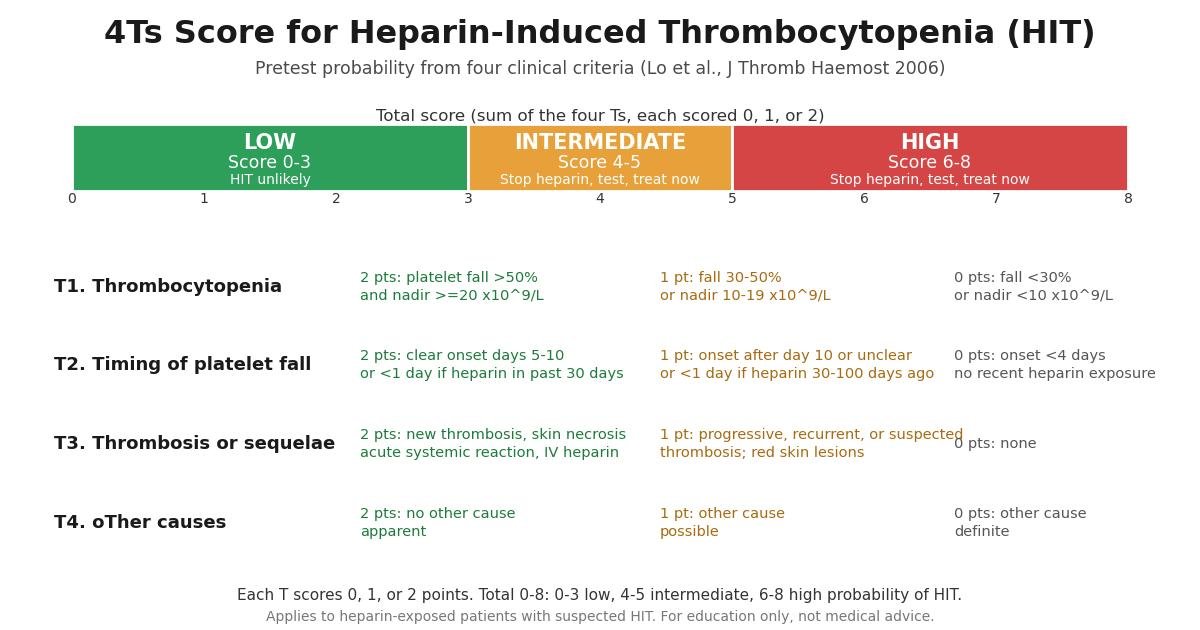
Each of the four Ts is scored 2, 1, or 0 points, and the points are added to give a total from 0 to 8. The sections below walk through each T exactly as Lo and colleagues defined it.
T1: Thrombocytopenia
The first T looks at two numbers: how far the platelet count has fallen from its peak after heparin was started, and the lowest value it reached (the nadir). Two points are awarded when the fall exceeds 50% and the nadir is still at least 20 x10^9/L. One point is awarded when the fall is between 30% and 50%, or when the nadir lies between 10 and 19 x10^9/L. Zero points are awarded when the fall is less than 30%, or when the nadir drops below 10 x10^9/L.
The reasoning is straightforward. A large proportional fall with a nadir that is low but not profoundly low is the classic HIT pattern. A very small fall is not characteristic of HIT at all. And a nadir below 10 x10^9/L, while alarming, points away from HIT and toward other causes of severe thrombocytopenia, because HIT rarely drives the count that low. Note the asymmetry in the top category: it requires both a greater than 50% fall and a nadir of at least 20 x10^9/L, while the lower categories use "or", so a patient qualifies for one point if either the fall or the nadir criterion is met.
T2: Timing of the platelet count fall
The second T is about when the platelet count starts to fall, measured from the day heparin was started. A clear onset between days 5 and 10 scores two points, because that is the time an immune response needs to generate pathogenic antibodies. The same two points are given when the fall begins within one day of heparin exposure in a patient who received heparin within the previous 30 days, because circulating antibodies from the recent exposure can trigger an immediate fall.
One point is given when the timing is consistent with HIT but not clear: for example, when platelet counts are missing from the critical days, when the fall begins after day 10, or when the rapid fall within one day follows heparin exposure 30 to 100 days earlier, by which time antibody levels have partly waned. Zero points are given when the fall begins less than four days after heparin was started in a patient with no recent heparin exposure, because that is too early for a new immune response and suggests a non-immune cause.
T3: Thrombosis or other sequelae
The third T captures the thrombotic complications that make HIT dangerous. Two points are awarded for a new, confirmed thrombosis, for skin necrosis at heparin injection sites, or for an acute systemic reaction, such as chills, fever, or cardiovascular collapse, after an intravenous heparin bolus. One point is awarded for progressive or recurrent thrombosis, for erythematous (red but non-necrotic) skin lesions, or for a suspected thrombosis that has not been proven by imaging. Zero points are awarded when there are no thrombotic signs at all.
This T reflects the central paradox of HIT: the platelet count is falling, yet clots are forming. A patient with a falling platelet count and a new deep vein thrombosis or pulmonary embolism while receiving heparin should therefore score highly here, which is precisely the combination the score is designed to catch.
T4: oTher causes of thrombocytopenia
The fourth T, with its deliberately lower-case "o", asks whether something other than HIT explains the platelet fall. Two points are awarded when no other cause is apparent. One point is awarded when another cause is possible but not established. Zero points are awarded when a definite alternative cause is present.
This T is a reminder that thrombocytopenia in a heparin-treated patient is common and often has nothing to do with HIT. Sepsis, disseminated intravascular coagulation, other drugs, and dilution after major surgery can all lower the platelet count. Scoring this T honestly is what keeps the total down in patients whose platelet fall has an obvious alternative explanation.
Adding up the score: the three probability bands
The four subscores are added to give a total between 0 and 8. A total of 0 to 3 means low probability of HIT. A total of 4 or 5 means intermediate probability. A total of 6 to 8 means high probability. These cut points come from the original Lo study and have been carried unchanged into every major guideline since.
The bands are deliberately wide at the bottom. With a negative predictive value of 0.998, the low band is where the score does its most useful work, identifying the large group of patients in whom HIT can be set aside and heparin continued. The intermediate and high bands are narrower because they mark the smaller group in whom HIT must be actively pursued and empirically treated.
What each result means for management
A low score (0 to 3) means HIT is unlikely. Guidelines recommend against stopping heparin and against starting empiric alternative anticoagulation in these patients. Heparin can be continued if it is otherwise indicated, platelet counts should keep being monitored, and routine HIT laboratory testing is not required.
An intermediate score (4 or 5) or a high score (6 to 8) changes everything. All heparin must be stopped, including heparin flushes and heparin-coated catheters, and a non-heparin anticoagulant at therapeutic intensity must be started while the laboratory work is pending, because waiting for results while heparin continues exposes the patient to new thrombosis. A PF4 immunoassay should be ordered, and if it is positive, a functional platelet-activation assay should follow to confirm the diagnosis. Guideline action lists for intermediate and high scores also advise stopping low-molecular-weight heparin and warfarin products, since these patients need a non-heparin anticoagulant rather than any heparin-based or vitamin K antagonist strategy during the acute phase.
If the clinical picture changes, for example if blood cultures turn positive and reveal sepsis as the cause of the platelet fall, the score should be recalculated, because new information changes the pretest probability. When key information needed for the score is missing, guidelines advise erring toward a higher score rather than a lower one, so that a treatable and dangerous condition is not missed.
Worked example
Consider a patient who started heparin seven days ago. The platelet count has fallen by 60% to a nadir of 45 x10^9/L, a new deep vein thrombosis has been confirmed on ultrasound, and no other cause for the platelet fall is apparent. Thrombocytopenia scores 2 points (fall greater than 50% with nadir at least 20 x10^9/L). Timing scores 2 points (clear onset on day 7). Thrombosis scores 2 points (new confirmed thrombosis). Other causes scores 2 points (none apparent). The total is 8: high probability of HIT. The correct response is to stop all heparin, start a non-heparin anticoagulant, and order a PF4 immunoassay, with a functional assay to follow if the immunoassay is positive.
Limitations of the 4Ts score
The 4Ts score applies to patients who have been exposed to heparin and in whom HIT is suspected. It was not designed for patients who never received heparin, and its timing and thrombosis criteria cannot be meaningfully scored without a heparin exposure history. Its accuracy depends on complete and accurate clinical information: missing platelet counts or an uncertain exposure history make the score less reliable, which is why guidelines advise erring toward a higher score when key details are missing.
The score also has a built-in asymmetry that users must respect. With a positive predictive value of only 0.14, most intermediate scores do not turn out to be HIT, which is why a positive immunoassay should be followed by a functional assay rather than taken as proof on its own. Even a high score, with a positive predictive value of 0.64, leaves more than a third of patients without HIT, so laboratory confirmation still matters. Finally, the score supports clinical judgment but does not replace it: an experienced clinician who spots a pattern the score misses should still act, and the score should be recalculated whenever the clinical picture changes.
Medical disclaimer
This calculator is an educational tool. It estimates the pretest probability of heparin-induced thrombocytopenia and does not diagnose HIT, prescribe treatment, or replace the judgment of a qualified clinician. Management decisions in suspected HIT are high stakes and time sensitive, and they should be made by, or together with, the treating team, ideally with hematology input. If you are a patient or carer reading this page, discuss any concern about HIT with your clinical team promptly rather than acting on a score alone.