Introduction: why a prognostic index was needed for aggressive lymphoma
Aggressive non-Hodgkin lymphoma (NHL) is curable in many patients with combination chemotherapy, yet a substantial minority are not cured and ultimately die of their disease. In the 1980s, clinicians knew that patients with the same diagnosis could have very different outcomes, but the Ann Arbor staging system did not consistently separate patients with different long-term prognoses. Stage alone describes where the disease has spread, not how the patient is likely to fare. To fill that gap, the International Non-Hodgkin's Lymphoma Prognostic Factors Project was launched as a collaboration of 16 institutions and cooperative groups in the United States, Europe, and Canada. The project collected clinical data on 2,031 adults with aggressive NHL treated between 1982 and 1987 with doxorubicin-based combination chemotherapy regimens, then searched for pretreatment characteristics that independently predicted overall survival and relapse-free survival. The result, published by Shipp, Harrington, Anderson and colleagues in the New England Journal of Medicine in 1993, was the International Prognostic Index (IPI). Because every input is available before treatment from a standard history, blood test, and staging workup, the index became one of the most widely used risk tools in hematology, and it remains a mainstay of risk stratification in clinical trials for lymphoma.
How the IPI works: five factors, one point each
The IPI is deliberately simple. Five clinical features emerged as independently significant predictors of survival in the project's step-down regression analyses, and each unfavorable feature scores exactly one point. The five factors are: age greater than 60 years; serum lactate dehydrogenase (LDH) above the normal range; ECOG (also called Zubrod) performance status of 2, 3, or 4; Ann Arbor stage III or IV disease; and more than one extranodal site of disease. Adding the points gives a score from 0 to 5. The score then maps to four risk groups: 0 or 1 points is low risk, 2 points is low-intermediate risk, 3 points is high-intermediate risk, and 4 or 5 points is high risk. The equal weighting means the calculator is easy to use at the bedside and easy to reproduce in research, and it reflects that no single factor dominated the others in the original analysis. The calculator above follows this exact scheme: it checks each of the five inputs against the published cutoffs, sums the points, and reports the risk group together with the outcomes observed in that group in the original cohort.
The five prognostic factors explained
1. Age greater than 60 years
Older patients had worse survival in the original study even after accounting for stage and other features. Age over 60 scores one point. Age matters because it correlates with reduced tolerance of intensive chemotherapy, more comorbid disease, and differences in tumor biology, but the cutoff is a pragmatic one: a patient aged 60 does not score the point, while a patient aged 61 does. The age-adjusted IPI, described below, drops this factor entirely when comparing patients within a single age group.
2. Elevated serum LDH
Lactate dehydrogenase is an enzyme released when cells are damaged or turn over rapidly, so an LDH above the laboratory's normal range acts as a rough marker of tumor burden and aggressiveness. In the project, elevated serum LDH was an independent predictor of both lower complete response rates and shorter survival. It scores one point regardless of how far above normal the value is, because the model uses a simple normal versus elevated split. Laboratories differ in their reference ranges, so the relevant comparison is the value against the upper limit of normal at the patient's own laboratory.
3. ECOG performance status of 2 or higher
Performance status records how much the disease limits daily function. An ECOG score of 0 means fully active, 1 means restricted only in strenuous activity, 2 means ambulatory but unable to work and in bed less than half the day, 3 means in bed more than half the day, and 4 means completely disabled. Scores of 2, 3, or 4 each contribute one point. Poor performance status reflects both the burden of disease and the patient's ability to tolerate full-dose chemotherapy, which is why it independently predicted survival in the regression analyses.
4. Ann Arbor stage III or IV
The Ann Arbor system stages lymphoma by anatomical spread. Stage III means lymph node regions involved on both sides of the diaphragm, and stage IV means disseminated involvement of one or more extralymphatic organs or tissues. Stages III and IV are considered advanced disease and score one point, while limited disease (stages I and II) scores zero. Advanced stage was one of the strongest predictors in the study, consistent with the intuition that more widespread disease is harder to eradicate.
5. More than one extranodal site of disease
Extranodal disease means lymphoma outside the lymph nodes and spleen, for example in the gastrointestinal tract, lung, bone, skin, or other organs. Patients with two or more extranodal sites score one point; patients with zero or one such site score zero. Counting distinct extranodal sites requires complete staging with imaging, and it adds prognostic information beyond the stage itself, because widespread extranodal spread behaves differently from advanced nodal disease alone.
Risk groups and what they meant in the original cohort
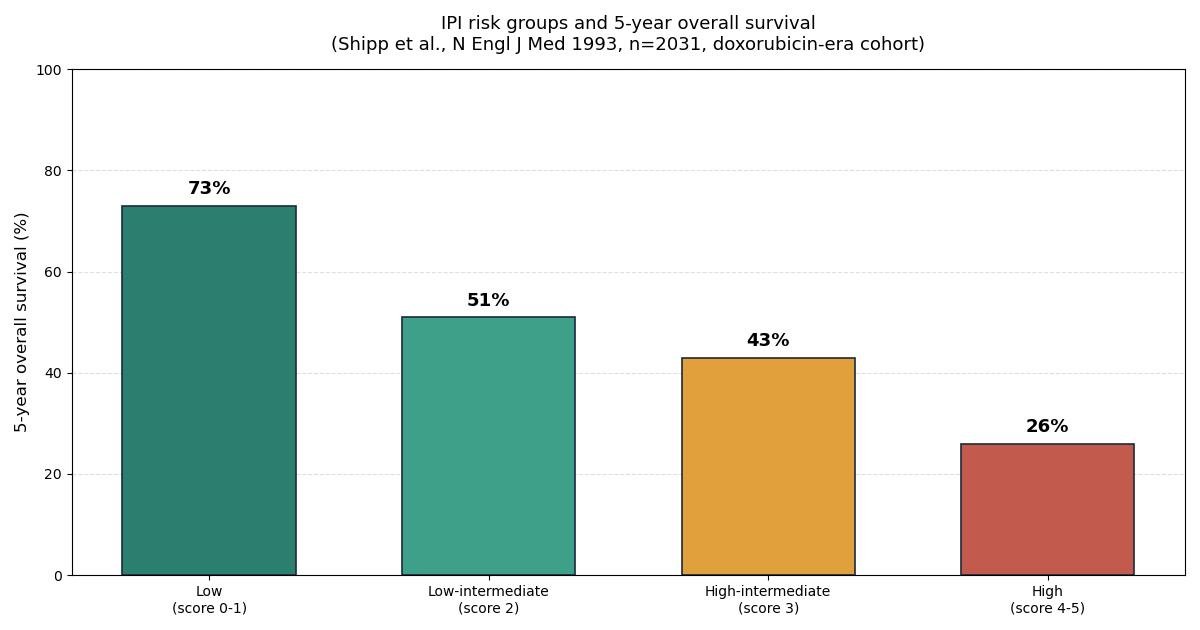
The following table shows the four IPI risk groups and the outcomes reported for them in the 1993 publication. The survival percentages are predicted five-year rates from the derivation cohort of 2,031 patients, all treated with doxorubicin-based regimens in the 1980s.
| Risk group | IPI score | Complete response rate | 5-year relapse-free survival | 5-year overall survival |
|---|---|---|---|---|
| Low | 0 or 1 | 87% | 70% | 73% |
| Low-intermediate | 2 | 67% | 50% | 51% |
| High-intermediate | 3 | 55% | 49% | 43% |
| High | 4 or 5 | 44% | 40% | 26% |
Two patterns in the table deserve attention. First, the gradient is steep and consistent across all three outcome measures: complete response rates fall from 87 to 44 percent and five-year overall survival falls from 73 to 26 percent as the score rises. The paper's authors showed that this gradient came from two sources, because higher-risk patients both achieved complete responses less often and relapsed more often after a complete response. Second, these numbers describe a historical treatment era. Every patient in the cohort received doxorubicin-based combination chemotherapy such as CHOP between 1982 and 1987, years before the monoclonal antibody rituximab was added to standard treatment for B-cell lymphomas. Outcomes for most patients are substantially better today, so these percentages should be read as the original validation of the model, not as a prediction for a patient treated in 2026.
The age-adjusted IPI for patients 60 or younger
The project also built a second model for the 1,274 patients aged 60 or younger, because comparing prognosis within one age group makes the age factor meaningless. The age-adjusted IPI (aaIPI) uses only three factors: tumor stage III or IV, elevated serum LDH, and performance status of 2 or higher. Its risk groups are defined differently: 0 factors is low risk, 1 factor is low-intermediate risk, 2 factors is high-intermediate risk, and 3 factors is high risk. In that younger subgroup, the predicted five-year overall survival rates were 83, 69, 46, and 32 percent respectively, with complete response rates of 92, 78, 57, and 46 percent and five-year relapse-free survival of 86, 66, 53, and 58 percent. The calculator on this page reports the age-adjusted score and group automatically whenever the entered age is 60 or younger, alongside the standard IPI. It is context for clinicians who stratify younger patients in trials and practice.
Limitations and the rituximab era
Every prognostic model carries the fingerprints of the patients and treatments it was built on, and the IPI is no exception. The most important limitation is time: the index was derived before rituximab became standard with anthracycline-based chemotherapy for B-cell lymphomas, and rituximab has substantially improved outcomes across all risk groups. The prognostic value of the five factors persists, but their absolute predictions are outdated, which is why this page presents the survival figures explicitly as the original cohort's outcomes. Later models address the modern era: the revised IPI (R-IPI), derived from patients treated with rituximab plus CHOP, distinguishes three outcome groups with 4-year overall survival ranging from 55 to 94 percent (Sehn et al., Blood 2007), and the National Comprehensive Cancer Network IPI (NCCN-IPI) refines the original factors with more granular age and LDH categories. The IPI was also derived specifically for aggressive NHL, so it should not be applied to indolent lymphomas such as follicular lymphoma (which has its own index, FLIPI), Hodgkin lymphoma, or other cancers. Finally, the index says nothing about molecular subtype, cell of origin, or genetic lesions, all of which influence prognosis in diffuse large B-cell lymphoma today. Treat the IPI as a validated baseline risk estimate, not a complete picture.
Related calculators
Key takeaways
- The International Prognostic Index is a clinical risk model for aggressive non-Hodgkin lymphoma, published by Shipp and colleagues in the New England Journal of Medicine in 1993.
- The IPI was derived from 2,031 adults with aggressive non-Hodgkin lymphoma treated between 1982 and 1987 at 16 institutions in the United States, Europe, and Canada.
- Each of the five factors scores one point: (1) age greater than 60 years; (2) serum lactate dehydrogenase (LDH) above the normal range; (3) ECOG (or Zubrod) performance status of 2, 3, or 4; (4) Ann Arbor stage III or IV disease; and (5) more than one extranodal site of disease, meaning two or more.
- In the original 1993 cohort, the four IPI risk groups had predicted 5-year overall survival of 73 percent (low, 0 to 1 points), 51 percent (low-intermediate, 2 points), 43 percent (high-intermediate, 3 points), and 26 percent (high, 4 to 5 points).
Frequently asked questions
- What is the International Prognostic Index (IPI)?
- The International Prognostic Index is a clinical risk model for aggressive non-Hodgkin lymphoma, published by Shipp and colleagues in the New England Journal of Medicine in 1993. It combines five routinely available pretreatment features (age over 60, elevated serum LDH, ECOG performance status of 2 or higher, Ann Arbor stage III or IV, and more than one extranodal site of disease) into a score from 0 to 5, which places patients into four risk groups: low, low-intermediate, high-intermediate, and high. It remains one of the most widely used prognostic tools in lymphoma practice and clinical trials.
- Which patients was the IPI developed for?
- The IPI was derived from 2,031 adults with aggressive non-Hodgkin lymphoma treated between 1982 and 1987 at 16 institutions in the United States, Europe, and Canada. All patients received doxorubicin-based combination chemotherapy. The index is intended for newly diagnosed aggressive disease, such as diffuse large B-cell lymphoma, before treatment begins. It was not developed for indolent lymphomas, Hodgkin lymphoma, or patients treated with modern targeted regimens, and applying it outside aggressive non-Hodgkin lymphoma is not supported by the original data.
- What are the five risk factors of the IPI?
- Each of the five factors scores one point: (1) age greater than 60 years; (2) serum lactate dehydrogenase (LDH) above the normal range; (3) ECOG (or Zubrod) performance status of 2, 3, or 4; (4) Ann Arbor stage III or IV disease; and (5) more than one extranodal site of disease, meaning two or more. The points are summed for a total score from 0 to 5. Scores of 0 or 1 are low risk, 2 is low-intermediate risk, 3 is high-intermediate risk, and 4 or 5 is high risk.
- What do the IPI risk groups mean?
- In the original 1993 cohort, the four IPI risk groups had predicted 5-year overall survival of 73 percent (low, 0 to 1 points), 51 percent (low-intermediate, 2 points), 43 percent (high-intermediate, 3 points), and 26 percent (high, 4 to 5 points). Complete response rates in the same groups were 87, 67, 55, and 44 percent, and 5-year relapse-free survival was 70, 50, 49, and 40 percent. These figures describe the outcomes of patients treated with doxorubicin-based chemotherapy in the 1980s, before rituximab became standard, and do not predict outcomes under modern treatment.
- What is the age-adjusted IPI (aaIPI)?
- The age-adjusted IPI is a simplified version of the index for patients aged 60 years or younger, because age itself cannot be used as a risk factor within a single age group. It uses only three of the five factors: tumor stage (III or IV), serum LDH (elevated), and performance status (ECOG 2 or higher). In the 1,274 patients aged 60 or younger in the original study, the age-adjusted groups had 5-year overall survival of 83 percent (0 factors), 69 percent (1 factor), 46 percent (2 factors), and 32 percent (3 factors). The calculator on this page also reports the age-adjusted score automatically for patients aged 60 or younger.
- Can the IPI predict my individual outcome or guide treatment?
- No. The IPI describes average outcomes in broad groups of patients treated decades ago and cannot predict any single person's result. It does not diagnose lymphoma, does not recommend treatment, and does not replace a hematologist's judgment, because modern care (including rituximab and other advances) has substantially changed survival figures. Patients should discuss their own prognosis and treatment options with their treating oncologist, who can consider pathology, molecular features, and current evidence alongside the IPI.