What is febrile neutropenia?
Febrile neutropenia is fever in a patient whose neutrophil count has fallen to dangerously low levels. It occurs most often after chemotherapy for cancer, but any treatment that suppresses the bone marrow can cause it. Neutrophils are the white blood cells that form the first line of defence against bacterial infection. When almost none remain in circulation, bacteria can multiply unchecked, and a localised infection can progress to life-threatening sepsis within hours. That speed is what makes febrile neutropenia a medical emergency in every oncology setting.
The clinical picture is often deceptively quiet. A patient with almost no neutrophils cannot mount the usual inflammatory response, so there may be little redness, swelling, or pus even when a serious infection is present. Fever can be the only warning sign, and it demands the same urgent response every time: immediate assessment, blood cultures, and prompt broad-spectrum antibiotics. Every major guideline treats the first hour as critical, because delays in antibiotics are consistently associated with worse outcomes. No risk score changes that starting point. The role of a risk index begins after the emergency response is under way, when the clinical team must decide where the patient should be treated.
Why risk stratification matters
For decades the standard management of febrile neutropenia was uniform: every patient was admitted to hospital and given intravenous antibiotics until the fever settled and the neutrophil count recovered. That approach is undeniably safe, but it is also heavy. Hospital stays are expensive, they expose vulnerable patients to resistant hospital organisms, they disrupt work and family life, and they consume beds and nursing time that could serve patients who need them more. At the same time, some episodes of febrile neutropenia are genuinely dangerous and demand the full weight of inpatient care: patients who arrive hypotensive, breathless, confused, or with failing kidneys need intensive monitoring and intravenous therapy without compromise.
The clinical challenge is telling these two groups apart reliably at the bedside, on the day of presentation. Clinician intuition alone is inconsistent, and admitting everyone is neither affordable nor kind to patients who would do just as well, or better, at home. An evidence-based risk index solves this by combining a small number of bedside observations into a reproducible score, so that low-risk patients can be identified with confidence and offered a safe alternative, usually outpatient care with oral antibiotics and structured follow-up, while high-risk patients receive the intensive inpatient management they need. The MASCC risk index has become the most widely used tool for this exact decision worldwide.
The MASCC risk index
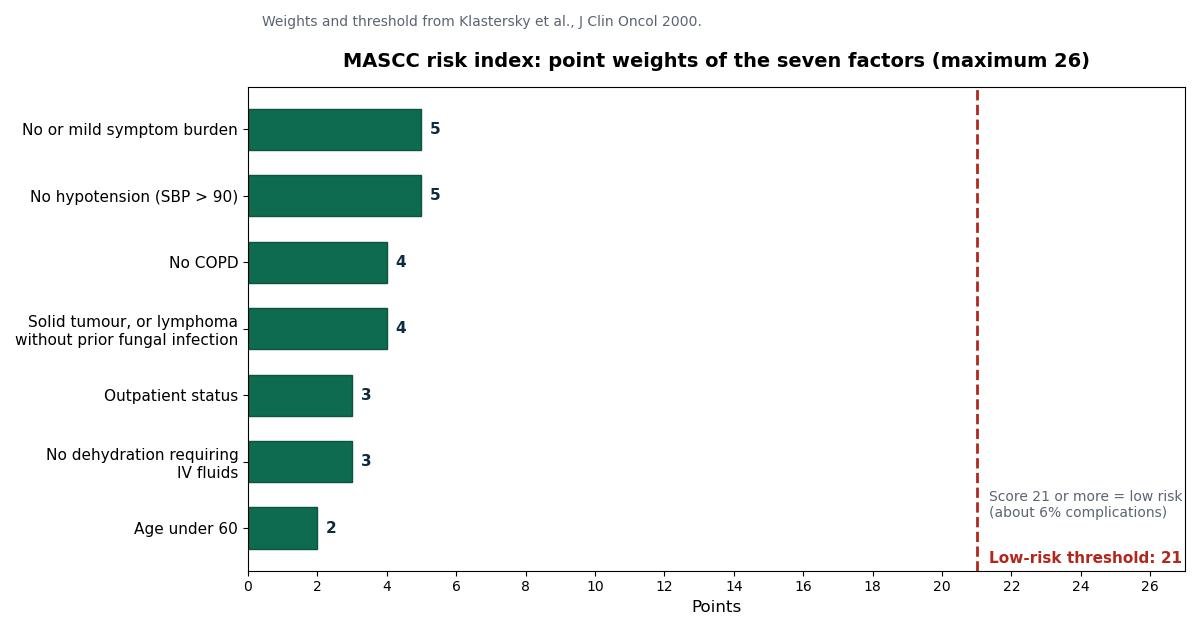
The index was developed by the Multinational Association for Supportive Care in Cancer and published by Klastersky and colleagues in the Journal of Clinical Oncology in 2000. The researchers set out to build a practical scoring system that could identify, at the time of presentation, which adults with febrile neutropenia were unlikely to develop serious complications. The resulting model combines seven clinical characteristics, each assigned a weight reflecting how strongly it predicts a benign course when present. The weights are simply added together, giving a total that can range from 0 to a maximum of 26 points.
A threshold of 21 points separates the two risk groups. Patients scoring 21 or more are classified as low risk, and those scoring below 21 as high risk. In the derivation data reported by Klastersky and colleagues, this cut-off separated the outcomes sharply: serious complications developed in only about 6 percent of episodes scoring 21 or higher, compared with about 39 percent of episodes scoring below 21. That gap is the clinical justification for the score. A tool that can find a large subgroup whose observed complication rate is around one in seventeen, against a background rate near two in five, gives clinicians a solid evidence base for choosing less intensive management in the right patients.
The model was deliberately designed for the bedside. Every factor is available from the history, examination, and vital signs at presentation, with no need to wait for laboratory results. Subsequent studies in many countries have tested the score in different health systems and patient populations, and it has held up well enough to be endorsed by international guidelines as the standard risk-stratification instrument for febrile neutropenia.
The seven factors, explained
Each factor is scored at presentation, and the weights are fixed by the original publication:
1. Burden of illness: 5, 3, or 0 points
The clinician's overall assessment of how ill the patient appears. No or mild symptoms score 5 points, moderate symptoms score 3, and severe symptoms, or a moribund patient, score 0. This is the single most heavily weighted item in the model, which reflects a simple clinical truth: a patient who looks well at presentation is far more likely to have an uncomplicated course than one who looks severely ill, even before any test result is back.
2. No hypotension: 5 points
A systolic blood pressure above 90 mmHg scores 5 points; a systolic pressure of 90 or below scores 0. Low blood pressure suggests the infection is already driving circulatory failure, which is one of the pathways to serious complications. Note the exact boundary used by the model: a systolic pressure of exactly 90 does not earn the points, because the criterion is strictly above 90.
3. No chronic obstructive pulmonary disease: 4 points
Absence of COPD scores 4 points. Patients with chronic lung disease have limited respiratory reserve and tolerate infections, and their complications, poorly. A respiratory infection that a healthy-lunged patient would weather can tip a COPD patient into respiratory failure, so the model penalises its presence.
4. Solid tumour, or lymphoma without previous fungal infection: 4 points
This item carries a nuance worth understanding. A solid tumour scores 4 points, as does lymphoma when the patient has no previous fungal infection. Lymphoma with a previous fungal infection scores 0. The logic is that a prior invasive fungal infection marks a patient already proven vulnerable to serious opportunistic infection, while haematological cancers other than uncomplicated lymphoma generally carry a more complicated course than solid tumours. This calculator implements the item exactly as published: solid tumour always scores the 4 points, lymphoma scores them only when there is no history of fungal infection, and other cancer types score 0.
5. Outpatient status: 3 points
Fever developing while the patient is an outpatient scores 3 points; fever developing during a hospital stay scores 0. Community-onset fever tends to be caught earlier and in more stable patients, while fever arising in someone already hospitalised more often reflects a complicated clinical situation.
6. No dehydration requiring intravenous fluids: 3 points
Absence of dehydration severe enough to need IV fluids scores 3 points. Needing intravenous rehydration signals volume depletion and a sicker patient, often one who has been unwell for longer or is losing fluid through vomiting or diarrhoea, both of which complicate febrile neutropenia.
7. Age under 60 years: 2 points
Patients younger than 60 score 2 points; those 60 or older score 0. Younger patients generally have greater physiological reserve to withstand infection and its treatment. Like the blood pressure item, the boundary is exact: age 60 does not earn the points.
Interpreting your result
A total of 21 or more points out of 26 is low risk. In the derivation data of Klastersky and colleagues, serious complications developed in only about 6 percent of episodes in this group. A total below 21 points is high risk, with serious complications observed in about 39 percent of episodes. The complications counted in the original study included hypotension, respiratory failure, renal failure, admission to intensive care, and death, so the high-risk figure represents genuinely severe outcomes, not minor setbacks.
What follows from each result is a disposition decision, not a treatment decision. A low-risk score supports considering outpatient management with oral antibiotics and close, structured follow-up, provided the patient is otherwise stable and the clinical team is satisfied the arrangements are safe. A high-risk score points toward inpatient care with intravenous antibiotics and close monitoring. In both groups, the emergency response is identical: immediate assessment and prompt empiric antibiotics. Even a low-risk result is not a guarantee of a benign course, which is why the score is always applied by a qualified clinician who can weigh it against the full clinical picture.
What the guidelines say
The Infectious Diseases Society of America addressed risk stratification directly in its 2010 update of the febrile neutropenia guideline, published in Clinical Infectious Diseases in 2011. The guideline endorsed the MASCC score as the risk-stratification instrument and concluded that carefully selected low-risk patients can be managed as outpatients with oral antibiotic regimens and structured follow-up, rather than being admitted for intravenous therapy by default.
The same guideline stresses the conditions that make outpatient care safe. The patient must be clinically stable, with no organ dysfunction or other reason requiring admission; must be able to tolerate oral medication; and must have reliable follow-up, typically with reassessment within a day or so of starting treatment. The decision always rests with the treating clinician, who must also consider local antimicrobial resistance patterns and the patient's social circumstances. This is the framework in which the MASCC score operates: a validated input to a clinical decision, never an automatic triage rule, and never a reason to delay the first dose of antibiotics.
Limitations of the MASCC score
No risk model is perfect, and the MASCC index should be used with its limitations in mind. It was derived from patients treated around the turn of the millennium, and antimicrobial resistance patterns, chemotherapy regimens, and supportive care have all evolved since. The burden-of-illness item is a subjective clinical judgment, so two clinicians can legitimately score the same patient differently. The model does not capture the expected depth or duration of neutropenia, the severity of mucositis, or local epidemiological factors that a treating team would weigh. It was developed for adults with cancer who develop fever during neutropenia; it is not a general sepsis score and was not designed for patients without neutropenia. Finally, the score is a snapshot at presentation: a patient who deteriorates after scoring needs reassessment regardless of the number. Used within these boundaries, and always alongside clinical judgment and local protocols, it remains the best-validated bedside tool for this decision.
Reference: Klastersky J, Paesmans M, Rubenstein EB, et al. The Multinational Association for Supportive Care in Cancer risk index: a multinational scoring system for identifying low-risk febrile neutropenic cancer patients. J Clin Oncol. 2000;18(16):3038-3051.
Key takeaways
- The MASCC (Multinational Association for Supportive Care in Cancer) risk index identifies which patients with febrile neutropenia are at low versus high risk of serious complications.
- A total of 21 or more points out of a maximum of 26 is classified as low risk.
- A total below 21 points is classified as high risk.
- The seven weighted factors are: burden of illness (no or mild symptoms 5 points, moderate 3, severe or moribund 0), no hypotension with systolic blood pressure above 90 mmHg (5 points), no chronic obstructive pulmonary disease (4 points), solid tumour or lymphoma without previous fungal infection (4 points), outpatient status (3 points), no dehydration requiring intravenous fluids (3 points), and age under 60 years (2 points), for a maximum of 26 points.
Frequently asked questions
What is the MASCC score used for?
The MASCC (Multinational Association for Supportive Care in Cancer) risk index identifies which patients with febrile neutropenia are at low versus high risk of serious complications. Published by Klastersky and colleagues in the Journal of Clinical Oncology in 2000, it supports decisions about where a patient can be safely treated, for example as an outpatient versus in hospital. It is a decision-support tool and never a substitute for clinical judgment.
What MASCC score counts as low risk?
A total of 21 or more points out of a maximum of 26 is classified as low risk. In the original derivation data, serious complications developed in about 6 percent of episodes scoring 21 or higher.
What does a MASCC score below 21 mean?
A total below 21 points is classified as high risk. In the derivation data of Klastersky et al., serious complications developed in about 39 percent of episodes scoring below 21, so these patients are generally managed as inpatients with intravenous antibiotics and close monitoring.
Which factors does the MASCC score include?
The seven weighted factors are: burden of illness (no or mild symptoms 5 points, moderate 3, severe or moribund 0), no hypotension with systolic blood pressure above 90 mmHg (5 points), no chronic obstructive pulmonary disease (4 points), solid tumour or lymphoma without previous fungal infection (4 points), outpatient status (3 points), no dehydration requiring intravenous fluids (3 points), and age under 60 years (2 points), for a maximum of 26 points.
If my MASCC score is low risk, can antibiotics be skipped?
No. Febrile neutropenia is always a medical emergency and prompt empiric broad-spectrum antibiotics remain mandatory for every patient, regardless of score. The MASCC index guides where care can safely happen, for example outpatient versus inpatient, not whether treatment starts.
Does the MASCC score replace a doctor's judgment?
No. The score was designed to support, not replace, clinical judgment. It is calculated at presentation from the clinical assessment and must be weighed alongside the full picture, organ function, local antimicrobial guidance, and the reliability of follow-up. A low-risk result does not guarantee a benign course.
This calculator is an educational tool only and is not medical advice. It reproduces the MASCC risk index from Klastersky et al., J Clin Oncol 2000, for study and clinical decision support by qualified professionals. Febrile neutropenia is a medical emergency: anyone who develops fever during chemotherapy-related neutropenia needs immediate medical attention and prompt empiric antibiotics, regardless of any score. The index supports disposition decisions and never replaces clinical judgment, full patient assessment, or local protocols. If you are a patient or carer, do not use this score to decide whether to seek care: seek emergency care immediately.