The PESI score explained
What the PESI score is
The Pulmonary Embolism Severity Index (PESI) is a clinical prediction rule that estimates the risk of death within 30 days in patients with confirmed pulmonary embolism (PE). It combines 11 routinely available clinical variables into a single point total, which is then grouped into one of five risk classes. The score was derived and validated by Aujesky and colleagues in a cohort of 15,531 patients with PE treated at 186 hospitals, and the results were published in 2005.
The most important thing to understand about PESI is what it does not do. It is a prognostic tool, not a diagnostic tool. It cannot tell you whether a patient has a pulmonary embolism; that diagnosis must already be established, usually by CT pulmonary angiography or a ventilation perfusion scan. PESI answers a different question: now that PE is confirmed, how likely is this patient to die in the next 30 days, and is hospital admission necessary, or could the patient be treated safely at home? That question matters because PE ranges from a small clot in a stable patient to a life threatening emergency, and treating every patient as high risk wastes hospital resources while treating a high risk patient as an outpatient can be dangerous.
How the score was developed
The original study used a derivation cohort of 10,354 discharged patients with PE to build the prediction rule. The rule was then tested in two separate populations: an internal validation cohort of 5,177 patients from the same hospitals, and an external validation cohort drawn from a different health system. This three stage design (derivation, internal validation, external validation) is the reason clinicians trust the score more than a rule tested only on the patients used to create it.
Candidate predictors were screened using logistic regression, a statistical method that identifies which variables are independently associated with the outcome after accounting for the others. The final model kept 11 variables: two demographic characteristics (age and male sex), three comorbid illnesses (cancer, heart failure, and chronic lung disease), and six clinical findings measured at presentation (pulse rate, systolic blood pressure, respiratory rate, body temperature, mental status, and arterial oxygen saturation). Points were assigned in proportion to each variable's regression coefficient, which is why the weights differ so much: altered mental status contributes 60 points while heart failure contributes only 10.
The score's discriminatory power, its ability to distinguish patients who died within 30 days from those who survived, was measured as the area under the receiver operating characteristic curve. It was 0.78 in the derivation cohort, 0.77 in the internal validation cohort, and 0.79 in the external validation cohort, showing consistent performance across populations. Overall 30-day mortality was 9.2 percent in the derivation sample and 9.5 percent in the internal validation sample. The external validation sample had a lower overall mortality of 2.7 percent, which the authors attributed to a lower prevalence of comorbid illnesses in that population.
The 11 variables and their points
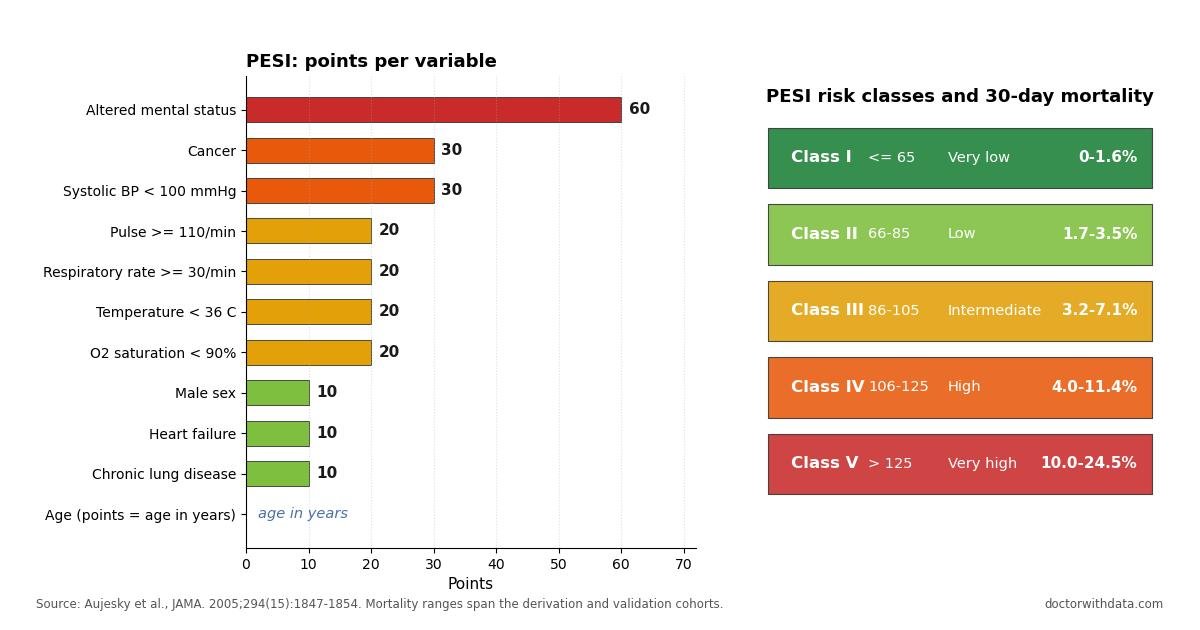
Every patient starts with points equal to their age in years, so age is the single largest contributor for most patients. The remaining ten variables add fixed points when present:
| Variable | Criterion | Points |
|---|---|---|
| Age | Points equal age in years | Age in years |
| Male sex | Male | +10 |
| Cancer | Active cancer or history of cancer | +30 |
| Heart failure | History of heart failure | +10 |
| Chronic lung disease | History of chronic lung disease | +10 |
| Pulse rate | 110 beats per minute or higher | +20 |
| Systolic blood pressure | Below 100 mmHg | +30 |
| Respiratory rate | 30 breaths per minute or higher | +20 |
| Body temperature | Below 36 degrees C | +20 |
| Altered mental status | Disorientation, lethargy, stupor, or coma | +60 |
| Arterial oxygen saturation | Below 90 percent, with or without supplemental oxygen | +20 |
A few details deserve emphasis. The oxygen saturation criterion applies whether or not the patient is receiving supplemental oxygen, so a saturation below 90 percent on oxygen still scores. Altered mental status was defined in the original study as disorientation, lethargy, stupor, or coma, and at 60 points it is by far the heaviest single variable: a patient with altered mental status reaches at least class III on that finding alone if they are over 26 years old, and usually class IV or V. The vital sign cutoffs are strict inequalities or inclusive thresholds exactly as published: pulse 110 or higher, systolic pressure strictly below 100, respiratory rate 30 or higher, temperature strictly below 36, saturation strictly below 90.
Worked example
Consider a 68-year-old man with a history of cancer who presents with a pulse of 118 beats per minute, systolic blood pressure of 95 mmHg, respiratory rate of 32 per minute, temperature of 36.5 degrees C, normal mental status, and oxygen saturation of 93 percent on room air. He has no heart failure and no chronic lung disease. The points add up as follows: 68 for age, 10 for male sex, 30 for cancer, 20 for pulse of 110 or higher, 30 for systolic pressure below 100, and 20 for respiratory rate of 30 or higher, giving a total of 178. Temperature of 36.5 does not score (it is not below 36), saturation of 93 does not score, and the absent findings add nothing. A total of 178 places him in class V, very high risk, with an estimated 30-day mortality of 10.0 to 24.5 percent. Contrast this with a 40-year-old woman with no comorbidities, normal vital signs, and normal oxygenation: her score is simply her age, 40, which is class I, very low risk, with 30-day mortality of 0 to 1.6 percent.
Risk classes and 30-day mortality
The total score maps to five risk classes. The mortality ranges below span the derivation, internal validation, and external validation cohorts of the original study:
| Risk class | Score range | Risk level | 30-day mortality |
|---|---|---|---|
| Class I | 65 or less | Very low | 0-1.6% |
| Class II | 66 to 85 | Low | 1.7-3.5% |
| Class III | 86 to 105 | Intermediate | 3.2-7.1% |
| Class IV | 106 to 125 | High | 4.0-11.4% |
| Class V | More than 125 | Very high | 10.0-24.5% |
The steep rise across classes is the score's main message: mortality climbs from under 2 percent in class I to as high as roughly 1 in 4 in class V. The ranges, rather than single figures, reflect real variation between the study cohorts, and they remind the user that the score gives a risk stratum, not a precise individual probability.
What the result means for patient care
Classes I and II are considered low risk, and identifying these patients is the score's most important clinical use. Historically, nearly all patients with acute PE were admitted to hospital. The PESI score made it possible to select low risk patients for outpatient management. This approach was tested directly in a randomized non-inferiority trial that allocated 344 patients with low risk PE (PESI classes I and II) to outpatient versus inpatient treatment. Ninety-day mortality was 0.6 percent in both groups, supporting the safety of outpatient care with low molecular weight heparin for carefully selected low risk patients. In practice, the disposition decision still requires clinical judgment: bleeding risk, the patient's social support, the ability to return promptly for care, and comorbidities not captured by the score all matter.
Class III represents intermediate risk; these patients are generally admitted for observation and anticoagulation. Classes IV and V carry high and very high short term mortality and warrant inpatient care with close monitoring. In patients with hemodynamic instability, guidelines recommend considering reperfusion therapy, and the PESI class helps frame how aggressive monitoring should be, even though the decision for thrombolysis or embolectomy rests on hemodynamics and imaging rather than the score alone. Across all classes, PESI supports but never replaces clinical judgment, and it should be used alongside assessment of right ventricular function on imaging and cardiac biomarkers where guidelines call for them.
PESI and the simplified sPESI
Clinicians sometimes confuse the original PESI with the simplified PESI, known as sPESI. This is a separate, shorter tool published in 2010, designed to be easier to remember and calculate at the bedside. It uses six variables, each worth exactly one point: age over 80 years, history of cancer, chronic cardiopulmonary disease, pulse 110 beats per minute or higher, systolic blood pressure below 100 mmHg, and oxygen saturation below 90 percent. A score of 0 identifies low risk patients, while a score of 1 or more identifies higher risk patients. Validation studies found its prognostic performance similar to the original score. This calculator implements only the original 11-variable PESI; sPESI is mentioned here so users do not mix the two instruments or their cutoffs.
Limitations of the PESI score
Like every prediction rule, PESI has boundaries that users should respect. It was derived and validated in adult patients with confirmed PE, so it should not be applied to children, and data in pregnancy are limited. In the external validation cohort, patients with cognitive impairment had been excluded from the underlying study, so altered mental status was assumed to be normal for those patients; the score's performance in patients with genuine neurological impairment is therefore less certain than in the derivation population.
The outcome the score predicts is death from any cause within 30 days, not death specifically caused by the embolism, and it does not predict recurrent venous thromboembolism or bleeding on anticoagulation. The score also ignores information that modern guidelines consider important for intermediate risk patients, including right ventricular dysfunction on echocardiography or CT and elevated cardiac biomarkers such as troponin. A final caveat concerns age: because points equal age in years, an otherwise healthy 90-year-old scores at least 90 (class III) before any other variable is considered. The score remains valid in older patients, but the number should always be interpreted in full clinical context rather than as an automatic admission order.
How to use this calculator
Enter all 11 values above and press "Calculate PESI score". Every field is required; the calculator will flag any missing, invalid, or out of range entry. The result shows the total score, the risk class, the corresponding 30-day mortality range, and a breakdown of how many points each variable contributed, so you can see exactly what is driving the risk. Because this page is educational, always discuss the result with the treating clinician before making any care decision. Pulmonary embolism is a medical emergency: sudden breathlessness, chest pain, or coughing blood requires urgent medical attention, not an online calculator.