PLASMIC Score Calculator
Enter the seven PLASMIC criteria from the raw laboratory values and clinical history, and get the 0 to 7 total with the low, intermediate, or high risk band for severe ADAMTS13 deficiency.
In short: Enter the seven PLASMIC criteria from the raw laboratory values and clinical history, and get the 0 to 7 total with the low, intermediate, or high risk band for severe ADAMTS13 deficiency. Use the calculator above, then read the guide below to interpret your result and its limitations.
Why TTP needs a pretest probability tool
Thrombotic thrombocytopenic purpura (TTP) is a medical emergency. It is caused by a severe deficiency of ADAMTS13, the enzyme that cleaves von Willebrand factor, and an ADAMTS13 activity below 10% is considered pathognomonic of TTP. The deficiency is most commonly immune mediated, driven by autoantibodies against ADAMTS13. Because untreated TTP deteriorates fast, treatment cannot wait for certainty, yet certainty is slow to arrive: ADAMTS13 activity testing is usually only available at reference laboratories and can take many hours to days to return.
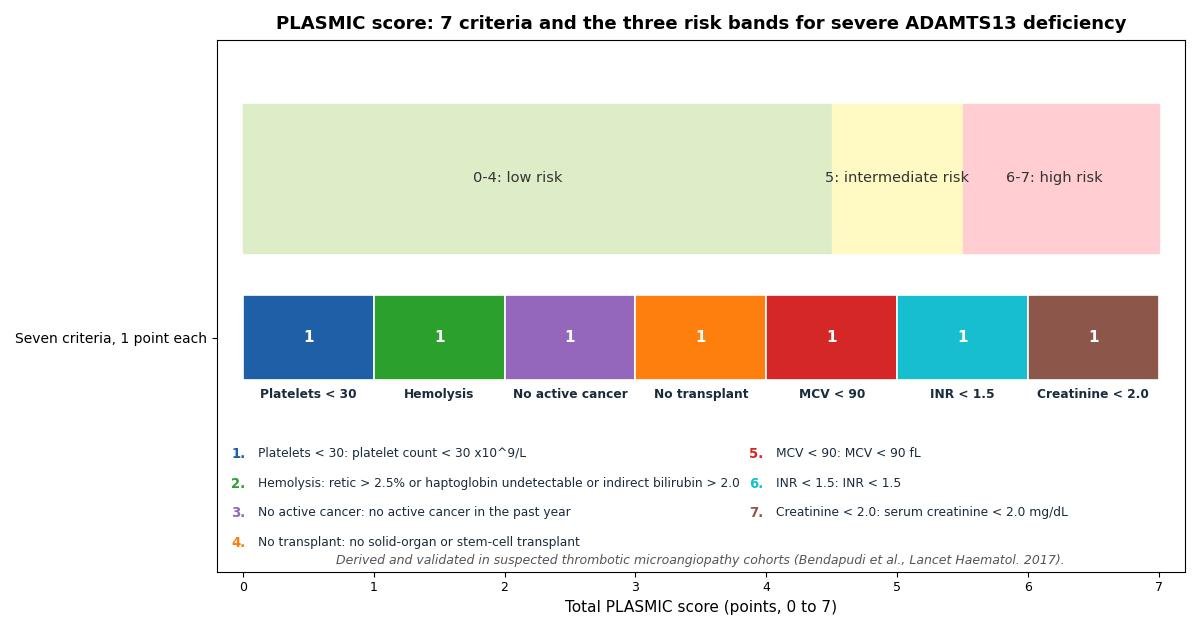
The PLASMIC score was created to fill exactly that gap. Published by Bendapudi and colleagues in 2017, it stratifies the pretest probability of severe ADAMTS13 deficiency in adults presenting with a suspected thrombotic microangiopathy, so that clinicians can decide who needs urgent plasma exchange while the laboratory result is still pending. The score was derived from 214 consecutive patients in the multicentre Harvard TMA Research Collaborative registry enrolled between 2004 and 2012, and then validated in separate cohorts. The name is a mnemonic for its seven components: platelet count, combined haemolysis variable, absence of active cancer, absence of stem-cell or solid-organ transplant, MCV, INR, and creatinine. Each fulfilled criterion contributes 1 point, giving a total from 0 to 7.
An interesting detail from the derivation work is that the published cut-offs are rounded versions of the thresholds found by multivariate regression. The regression identified platelet count below about 29 x10^9/L, creatinine below about 1.8 mg/dL, INR below about 1.3, and MCV below about 86.5 fL as the best discriminators; the authors rounded these to the memorable 30, 2.0, 1.5, and 90 used in the final score. Two further variables, the absence of active cancer and the absence of transplant, were added not because of the regression but because they were absent in every patient with severe ADAMTS13 deficiency in the derivation cohort, giving them a very high negative predictive value.
The seven criteria, one point each
The score uses seven binary criteria. Note the inversion traps: only the first two criteria award a point for an abnormal finding. Criteria 3 through 7 award their point when the finding is absent or below the cut-off, which is where most scoring mistakes happen.
| Number | Criterion (1 point if true) | How this calculator reads it |
|---|---|---|
| 1 | Platelet count below 30 x10^9/L | Enter the platelet count; the point is awarded only for a strict less-than. |
| 2 | Haemolysis present: reticulocyte count above 2.5%, undetectable haptoglobin, or indirect bilirubin above 2.0 mg/dL | Enter all three; any single one being true qualifies for the point. |
| 3 | No active cancer in the past year | Select No to earn the point; a history of active cancer loses it. |
| 4 | No history of solid-organ or haematopoietic stem-cell transplant | Select No to earn the point; a transplant history loses it. |
| 5 | MCV below 90 fL | Enter the MCV; values at or above 90 earn nothing. |
| 6 | INR below 1.5 | Enter the INR; values at or above 1.5 earn nothing. |
| 7 | Serum creatinine below 2.0 mg/dL | Enter the creatinine; values at or above 2.0 earn nothing. |
The haemolysis criterion deserves a second look because it is really three tests in one. A patient qualifies if the reticulocyte count exceeds 2.5%, or the haptoglobin is undetectable, or the indirect bilirubin exceeds 2.0 mg/dL. Meeting two or three of these still yields only 1 point, since the criterion is a single combined variable. The thresholds are strict inequalities throughout the score: a platelet count of exactly 30, an MCV of exactly 90, an INR of exactly 1.5, or a creatinine of exactly 2.0 does not earn the point.
How to use this calculator
Enter the raw laboratory values and the two yes-or-no history items, then press Calculate score. The calculator derives all seven criteria internally, so you never need to work out which findings count and which do not. For haptoglobin, choose whether it was undetectable or detectable on the laboratory report. For the cancer and transplant items, answer honestly: selecting Yes removes a point, which is the intended behaviour of the score, not a penalty to be avoided.
Two practical points matter for real use. First, use laboratory values drawn before any plasma exchange or plasma infusion, because replacement plasma changes the platelet count and ADAMTS13 measurements; guideline pathways likewise require the ADAMTS13 sample to be drawn before plasma exchange or any blood product is given. Second, double-check the units before entering values, particularly for indirect bilirubin and creatinine, which must be in mg/dL. The calculator flags values outside plausible physiological ranges so that a unit slip is caught rather than silently scored.
Risk bands and what they mean
The total maps to three risk bands: 0 to 4 is low risk, 5 is intermediate risk, and 6 to 7 is high risk of severe ADAMTS13 deficiency. These bands come directly from the 2017 derivation and validation study.
| Total score | Risk band | What it means |
|---|---|---|
| 0 to 4 | Low risk | Low pretest probability of severe ADAMTS13 deficiency. |
| 5 | Intermediate risk | Intermediate pretest probability; a clinical-judgement zone. |
| 6 to 7 | High risk | High pretest probability of severe ADAMTS13 deficiency. |
In the derivation cohort, none of the 84 patients scoring 0 to 4 had severe ADAMTS13 deficiency, while 81% of those scoring 6 or 7 did. Patients who were ultimately diagnosed with TTP had a median score of 7. The score also separated TTP from look-alike microangiopathies: patients whose microangiopathy was traced to rheumatologic disorders had a median score of 5, those with drug-associated microangiopathy had a median score of 4, and those with disseminated intravascular coagulation had a median score of 4. In external validation, a small minority of low-risk patients, 2 of 47, turned out to have severe deficiency, which is why a low score reduces probability without eliminating it entirely.
What each risk band should trigger
The score exists to drive action while ADAMTS13 results are pending, and the action differs by band. For high-risk patients, the ISTH guideline for TTP recommends starting therapeutic plasma exchange and corticosteroids without waiting for the ADAMTS13 result. The plasma sample for ADAMTS13 activity and inhibitor testing must be drawn before plasma exchange or any blood product is given, so the result remains interpretable. Because most acute events with ADAMTS13 activity below 10% are immune mediated (over 95% in the guideline's summary), early immunosuppression with corticosteroids is part of the initial strategy, and the guideline also suggests considering early caplacizumab, a von Willebrand factor directed therapy, before results return. Patients are usually transferred urgently to a facility that can perform plasma exchange, ideally under a clinician experienced in TTP. One more rule from the same guidance: platelet transfusion is avoided in suspected TTP unless there is life-threatening bleeding, because added platelets may feed the microvascular thrombosis.
For intermediate-risk patients there is no single mandated path, which is precisely why the band exists. Many clinicians begin plasma exchange while awaiting results when the rest of the presentation fits TTP, and hold off when a strong alternative diagnosis is evident. For low-risk patients the emphasis shifts to the alternatives: other thrombotic microangiopathies, disseminated intravascular coagulation, and secondary causes. Plasma exchange is generally not started empirically on a low score alone, but ADAMTS13 testing is still sent, because the rare exceptions are real.
Why the criteria look the way they do
Every criterion in the score is a small piece of differential diagnosis. The list of conditions that mimic TTP is long: Shiga toxin associated haemolytic uraemic syndrome, atypical haemolytic uraemic syndrome, disseminated intravascular coagulation, rheumatologic microangiopathies, drug-associated microangiopathy, cancer-associated and transplant-associated microangiopathy, and severe vitamin B12 deficiency. The score was shown to discriminate TTP from a broad range of these subtypes, including those with the most similar presentations, such as typical and atypical haemolytic uraemic syndrome.
The thresholds encode that reasoning. A creatinine below 2.0 mg/dL earns a point because marked renal failure points away from TTP and toward the haemolytic uraemic syndromes, in which creatinine runs much higher. An INR below 1.5 earns a point because a prolonged INR suggests consumptive coagulopathy, which favours disseminated intravascular coagulation over TTP. An MCV below 90 fL earns a point because macrocytosis raises the possibility of B12 deficiency, another TTP mimic. And the absence of active cancer or transplant earns points because those secondary microangiopathies essentially never show severe ADAMTS13 deficiency. The platelet and haemolysis criteria capture the core of any thrombotic microangiopathy: profound thrombocytopenia with microangiopathic haemolytic anaemia.
Limitations and the French score alternative
The PLASMIC score was derived and validated in cohorts of patients with suspected thrombotic microangiopathy, and that is the population in which it should be used. Applying it to unselected thrombocytopenia, or to patients without evidence of microangiopathic haemolysis, stretches it beyond its evidence base. Even within its intended population it is a probability tool, not a diagnosis: severe ADAMTS13 deficiency is confirmed by the activity assay, and treatment decisions are revisited once that result returns.
The score is also only as good as its inputs. All seven criteria should come from the same clinical moment, before plasma therapy, and the history items depend on accurate records of cancer and transplant. Missing or estimated values should not be quietly substituted; if a value is unknown, the honest answer is to obtain it rather than to guess.
An alternative worth knowing is the French score, described by Coppo and colleagues in 2010, which uses just three components: the platelet count, the creatinine, and the antinuclear antibody result. It is simpler and remains in use, particularly where the full PLASMIC inputs are unavailable. In practice the two scores serve the same purpose: a rapid, bedside estimate of the probability of severe ADAMTS13 deficiency that lets treatment start before the reference laboratory reports.
Key takeaways
- The PLASMIC score estimates the pretest probability of severe ADAMTS13 deficiency in adults with suspected thrombotic microangiopathy, while the ADAMTS13 result is still pending.
- A total of 0 to 4 is low risk, 5 is intermediate risk, and 6 to 7 is high risk of severe ADAMTS13 deficiency.
- Five of the seven criteria are scored in reverse: the point is earned when active cancer is absent, transplant history is absent, or the MCV, INR, or creatinine is below its cut-off.
- Haemolysis is a single combined criterion worth 1 point.
Frequently asked questions
What is the PLASMIC score used for?
The PLASMIC score estimates the pretest probability of severe ADAMTS13 deficiency in adults with suspected thrombotic microangiopathy, while the ADAMTS13 result is still pending. It helps clinicians decide who needs urgent plasma exchange for possible TTP and who can safely be worked up for alternative diagnoses first. It was derived and validated by Bendapudi and colleagues and published in 2017.
What do the PLASMIC risk bands mean?
A total of 0 to 4 is low risk, 5 is intermediate risk, and 6 to 7 is high risk of severe ADAMTS13 deficiency. In the derivation cohort, none of the 84 low-risk patients had severe deficiency, while 81% of those scoring 6 or 7 did. High-risk patients should generally start plasma exchange and corticosteroids without waiting for the ADAMTS13 result.
Why do some criteria award a point for a normal or absent finding?
Five of the seven criteria are scored in reverse: the point is earned when active cancer is absent, transplant history is absent, or the MCV, INR, or creatinine is below its cut-off. These findings point away from TTP toward mimics such as cancer-associated microangiopathy, haemolytic uraemic syndromes, or disseminated intravascular coagulation, so their absence raises the probability of severe ADAMTS13 deficiency.
How is haemolysis scored in the PLASMIC score?
Haemolysis is a single combined criterion worth 1 point. It is met if any one of three findings is present: a reticulocyte count above 2.5%, an undetectable haptoglobin, or an indirect bilirubin above 2.0 mg/dL. Meeting more than one of these still yields only 1 point.
Can a high PLASMIC score diagnose TTP on its own?
No. The score stratifies probability; the diagnosis of TTP rests on demonstrating severe ADAMTS13 deficiency, defined as activity below 10%. A high score justifies urgent empiric treatment, but the ADAMTS13 sample must still be drawn and the result used to confirm or revise the plan.
What should happen while waiting for the ADAMTS13 result?
For high clinical suspicion, which includes a high PLASMIC score, ISTH guidance recommends drawing the ADAMTS13 sample first and then starting therapeutic plasma exchange plus corticosteroids without waiting for the result. Early caplacizumab may be considered, and platelet transfusion is avoided unless bleeding is life threatening. Low-risk patients are generally worked up for alternative diagnoses while the test is pending.
References
- Bendapudi PK, Hurwitz S, Fry A, et al. Derivation and external validation of the PLASMIC score for rapid assessment of adults with thrombotic microangiopathies: a cohort study. Lancet Haematol. 2017;4(4):e157-e164.
- Zheng XL, Vesely SK, Cataland SR, et al. ISTH guidelines for the diagnosis and management of thrombotic thrombocytopenic purpura. J Thromb Haemost. 2020;18(10):2486-2496.
- Rock GA, Shumak KH, Buskard NA, et al. Comparison of plasma exchange with plasma infusion in the treatment of thrombotic thrombocytopenic purpura. N Engl J Med. 1991;325(6):393-397.
- Coppo P, Schwarzinger M, Buffet M, et al. Predictive features of severe acquired ADAMTS13 deficiency in idiopathic thrombotic microangiopathies: the French TMA Reference Center score. PLoS One. 2010;5(4):e10208.
- Bendapudi PK, Upadhyay V, Williams S, et al. Derivation and prospective validation of a predictive score for the rapid diagnosis of thrombotic thrombocytopenic purpura: the PLASMIC score. Blood. 2014;124(21):231.
- Scully M, Cataland SR, Peyvandi F, et al. Caplacizumab treatment for acquired thrombotic thrombocytopenic purpura. N Engl J Med. 2019;380(4):335-346.
- American Society of Hematology
- National Cancer Institute