Calculate your RPI
What are reticulocytes?
Reticulocytes are immature red blood cells, the final stage before a fully mature red cell. When a developing red cell leaves the bone marrow, it has already ejected its nucleus but still contains a mesh of residual ribosomal RNA, the "reticulum" that gives these cells their name. That leftover RNA can be stained in the laboratory with special supravital dyes such as new methylene blue, which is how both manual and automated counters recognize and count them. A healthy adult's blood normally contains only a small proportion of reticulocytes, typically around 0.5 to 1.5 percent of all red cells, because the bone marrow constantly replaces the red cells that reach the end of their roughly 120-day lifespan. In absolute terms the reference range is often quoted as roughly 25 to 75 x10^9/L, but the exact range printed on your own laboratory report always takes precedence over any textbook figure.
The reticulocyte count is the most direct window a clinician has into what the bone marrow is doing right now. Unlike hemoglobin or hematocrit, which describe the red cell mass accumulated over the previous three to four months, the reticulocyte count reflects production over the last day or two. That makes it one of the first numbers to move when the marrow ramps up output, for example after blood loss, or when it restarts after treatment begins for a nutritional deficiency. Hematology teaching has long used the reticulocyte count as the opening question in the workup of anemia: is the marrow responding, or is it not?
Why the raw reticulocyte percentage misleads in anemia
The reticulocyte percentage is a ratio: the number of reticulocytes divided by the total number of red cells, multiplied by 100. In a person with anemia, the denominator of that ratio has shrunk. If the marrow produces exactly the same number of reticulocytes as before, but the total red cell count has fallen, the percentage automatically rises, and it can look as though the marrow is working hard when it is doing nothing extra. A raw value of 3 percent in a patient whose red cell mass is half of normal represents roughly the same daily production as 1.5 percent in a healthy person, which is nothing to celebrate.
This is the trap the reticulocyte production index was designed to avoid. A raw reticulocyte count that looks "high normal" or even elevated can mask a marrow that is failing to respond, while a seemingly unimpressive number can actually represent a vigorous response once the depth of the anemia is taken into account. Every interpretation of the reticulocyte count in an anemic patient therefore needs two corrections: one for the reduced red cell mass, and one for the prolonged time reticulocytes spend in the circulation when anemia is severe. The RPI performs both, in sequence, and what comes out is a fair estimate of how many times normal the marrow's production rate actually is.
Correction one: adjusting for the red cell mass
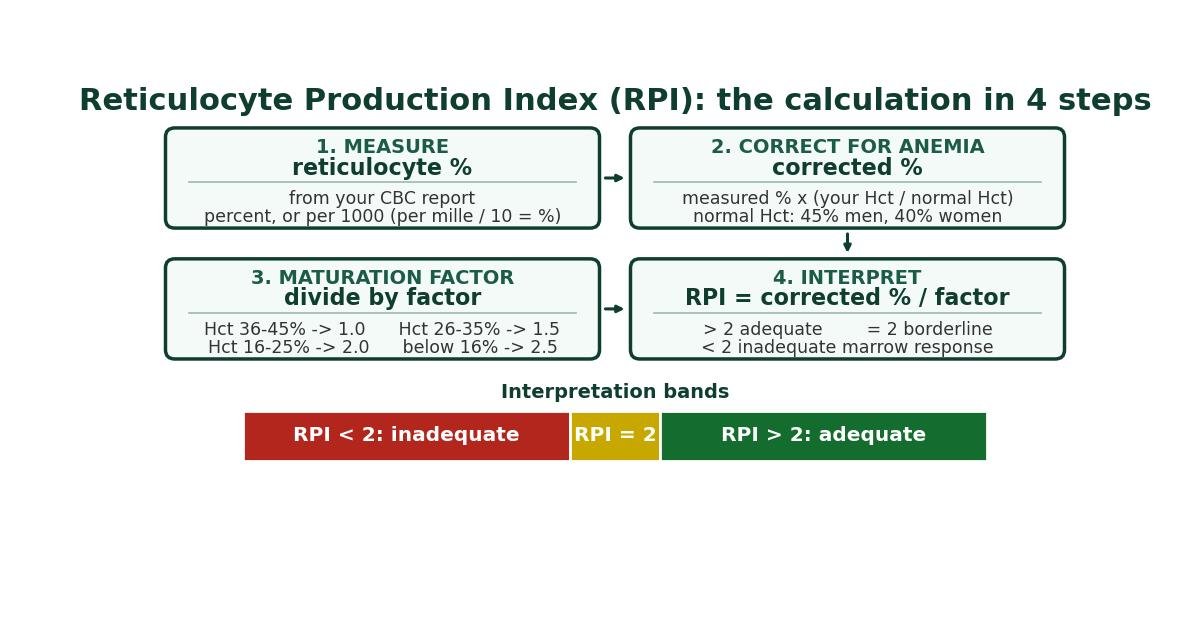
The first correction produces the "corrected reticulocyte percentage," sometimes called the corrected reticulocyte count. It asks a simple question: what would this reticulocyte percentage look like if the patient's red cell mass were normal? The formula is:
Corrected reticulocyte % = measured reticulocyte % × (patient's hematocrit ÷ normal hematocrit)
Hematocrit, the fraction of blood volume occupied by red cells, is used as the measure of red cell mass. The normal hematocrit in this standard convention is 45 percent for men and 40 percent for women, which is why this calculator asks for your sex.
Here is the first half of a worked example. A man has a measured reticulocyte count of 4 percent and a hematocrit of 25 percent. His corrected reticulocyte percentage is 4 × (25 ÷ 45) = 4 × 0.556 = 2.22 percent. In other words, once the anemia is accounted for, his "4 percent" is equivalent to 2.22 percent in a person with a normal red cell mass, a much less impressive figure. If we ran the same numbers for a woman, the correction would use the female normal hematocrit of 40 percent: 4 × (25 ÷ 40) = 2.50 percent, because a normal female red cell mass is smaller, so the same anemia represents a slightly larger production shortfall.
Correction two: the maturation-time factor
There is a second, less obvious distortion. Reticulocytes do not mature instantly: after release from the marrow, they circulate for roughly one day before becoming fully mature red cells. But when anemia is severe, the kidneys release more erythropoietin (EPO), the hormone that drives red cell production, and the marrow responds by releasing reticulocytes early, while they are still relatively immature. These "shift" reticulocytes then take longer to finish maturing in the bloodstream, up to two and a half days instead of one.
That matters because the reticulocyte count is a snapshot. If each reticulocyte lingers two and a half times longer in the blood, the snapshot counts each day's production two and a half times over, and the corrected percentage still overstates the true production rate. The maturation factor fixes this by dividing the corrected percentage by a factor chosen from the patient's hematocrit band:
| Patient hematocrit | Maturation factor |
|---|---|
| 36 to 45% | 1.0 |
| 26 to 35% | 1.5 |
| 16 to 25% | 2.0 |
| Below 16% | 2.5 |
The bands come from standard hematology teaching, most closely associated with the approach of Hillman and Finch, and they are physiological conventions rather than cutoffs from a validation trial (more on that under limitations). Where the hematocrit is above 45 percent, the calculator uses a factor of 1.0, because maturation is not prolonged outside the anemic range the table covers.
Now we can finish the worked example. Our man's corrected reticulocyte percentage of 2.22 percent is divided by the factor for his hematocrit band of 16 to 25 percent, which is 2.0. His reticulocyte production index is therefore 2.22 ÷ 2.0 = 1.11. The raw "4 percent" has become an RPI of 1.11, and as the next section explains, anything below 2 means the marrow is not responding adequately.
Reading the result: what an RPI above or below 2 means
An RPI above 2 indicates an adequate, "hyperproliferative" marrow response: the bone marrow is producing red cells at more than twice the normal rate in an effort to correct the anemia. That pattern points away from marrow failure and toward causes in which the marrow is healthy but red cells are being lost or destroyed faster than usual: acute or ongoing blood loss, for example gastrointestinal bleeding or heavy menstrual bleeding, and hemolysis, the premature destruction of red cells, as seen in autoimmune hemolytic anemia, sickle cell disease, thalassemia, hereditary spherocytosis, or glucose-6-phosphate dehydrogenase (G6PD) deficiency during a crisis. A high RPI is also seen when a previously deficient marrow is recovering, for instance several days after iron or vitamin B12 treatment begins.
An RPI below 2 indicates an inadequate, "hypoproliferative" marrow response: despite the anemia, the marrow is not stepping up production. The differential diagnosis then shifts from loss to production problems: iron deficiency, vitamin B12 or folate deficiency, anemia of chronic disease (also called anemia of inflammation), marrow failure such as aplastic anemia, marrow infiltration by malignancy or fibrosis, kidney failure with reduced EPO production, hypothyroidism, and the suppressive effects of chemotherapy, certain drugs, or heavy alcohol use.
An RPI of exactly 2 is borderline. It sits precisely on the teaching threshold, so the clinical context, the trend of the reticulocyte count, and repeat testing decide which side it belongs to. The threshold of 2 is itself a teaching convention from Hillman and Finch rather than a number derived from a diagnostic-accuracy study, so borderline results deserve particular caution.
Two practical cautions apply to every interpretation. First, after sudden blood loss the reticulocyte response takes three to five days to reach its peak, so an RPI drawn in the first day or two after an acute bleed can be misleadingly low even though the marrow is about to respond. Second, the RPI judges the marrow's effort, not the cause of the anemia: even a reassuringly high RPI leaves the underlying cause to be found and treated, because ongoing bleeding or hemolysis will continue to destroy or remove the red cells the marrow is working so hard to make.
Reticulocyte units: percent, per mille, and absolute counts
Laboratories do not all report reticulocytes the same way. Most print a percentage, but some report the count "per 1000 red cells," also called per mille. To convert per mille to percent, divide by 10: 80 per mille equals 8 percent, and 12 per mille equals 1.2 percent. This calculator offers both input styles and converts per-mille entries to percent before doing anything else, so choose the toggle that matches your report.
Some reports instead give an absolute reticulocyte count, usually in units of x10^9 per liter, which already sidesteps the denominator problem of the percentage because it counts cells rather than a fraction. The absolute count can be derived from the percentage if you know the red blood cell count: absolute reticulocytes = reticulocyte percentage ÷ 100 × red blood cell count. Hematologists sometimes apply a parallel correction to the absolute count, but the percentage-based RPI remains the standard teaching calculation and the one expected in examinations and clinical documentation.
Limitations of the RPI
A word of honesty about what this number is. The RPI is a piece of textbook hematology teaching, most closely associated with the approach of Hillman and Finch, rather than a score validated in a single original research study with measured sensitivity and specificity. The maturation-factor bands and the threshold of 2 are physiological conventions refined by decades of clinical experience, not outputs of a validation trial. That does not make them useless, but it means they should be read with the same judgment you would apply to any bedside calculation, and never as a diagnosis on their own.
Timing and treatment can distort the result. A recent red blood cell transfusion raises the hematocrit and dilutes the patient's own reticulocytes with donor cells, which contain almost none, producing a falsely low RPI; the calculation is unreliable until the transfused cells have been cleared. Erythropoietin therapy changes the assumptions behind the maturation factor. Automated counters can misclassify nucleated red blood cells, Howell-Jolly bodies, malaria parasites, or giant platelets as reticulocytes, inflating the raw count and with it the RPI. Very high or very low mean cell volumes and hemoglobin disorders can bend the textbook assumptions about normal red cell mass on which the first correction rests.
The RPI is only meaningful in the presence of anemia: with a normal hematocrit it collapses to roughly the corrected reticulocyte percentage and adds no information, which is why the calculation starts from an anemic patient's numbers. Finally, like every calculator on this site, the RPI does not diagnose anything. It grades the marrow's effort so that you and your clinician can ask sharper questions about the cause, and the cause always needs its own workup.
Key takeaways
- An RPI above 2 is considered an adequate marrow response to anemia, an RPI below 2 an inadequate one, and exactly 2 is borderline.
- Divide by 10.
- The first correction uses a normal hematocrit of 45 percent for men and 40 percent for women, the standard convention in hematology teaching.
- No.
Frequently asked questions
What is a good reticulocyte production index?
An RPI above 2 is considered an adequate marrow response to anemia, an RPI below 2 an inadequate one, and exactly 2 is borderline. These thresholds come from standard hematology teaching (Hillman and Finch) rather than a single validation study, so borderline results deserve careful clinical correlation.
How do I convert reticulocytes "per 1000" to percent?
Divide by 10. A count of 80 per 1000 equals 8 percent, and 12 per 1000 equals 1.2 percent. This calculator has a per-mille toggle that matches your report style and converts the entry automatically before applying the corrections.
Why does the calculator ask for my sex?
The hematocrit correction uses a normal hematocrit of 45 percent for men and 40 percent for women, the standard convention in hematology teaching. Choosing the correct option keeps the corrected reticulocyte percentage accurate for your red cell mass.
Can the RPI tell me why I am anemic?
No. The RPI only tells you whether your bone marrow is mounting an adequate response to the anemia. Finding the cause, whether blood loss, hemolysis, iron deficiency, or something else, requires further tests interpreted by a clinician.
I recently had a blood transfusion. Can I still use the RPI?
It is best to wait. Transfused donor red cells contain almost no reticulocytes and they raise your hematocrit, so the calculation will underestimate your own marrow's response. Ask your clinician when the result becomes meaningful again.
Does an adequate RPI mean my anemia is nothing to worry about?
No. An RPI above 2 means the marrow is responding, but the anemia itself still has a cause that must be found and treated, such as bleeding or hemolysis. Always discuss the result with your clinician rather than treating the number as reassurance on its own.
References
- Hillman RS, Finch CA. Red Cell Manual. 7th ed. Philadelphia, PA: F.A. Davis; 1996. The classic source of the RPI method and the maturation-factor bands.
- Means RT Jr. Approach to the anemias. In: Goldman L, Schafer AI, eds. Goldman-Cecil Medicine. Elsevier. The standard clinical framework: classify anemia first by whether marrow production is adequate.
- Kaushansky K, Lichtman MA, Prchal JT, et al, eds. Williams Hematology. 10th ed. New York, NY: McGraw Hill; 2021. Chapters on the evaluation of anemia and reticulocyte kinetics.
- StatPearls. Reticulocyte Count. Treasure Island, FL: StatPearls Publishing. Available from the NCBI Bookshelf. Overview of reticulocyte physiology, reference ranges, and clinical uses.
- American Association for Clinical Chemistry. Reticulocyte Count. Lab Tests Online. Patient and clinician reference for reticulocyte testing and interpretation.
- American Society of Hematology
- National Cancer Institute