What is the Alvarado score?
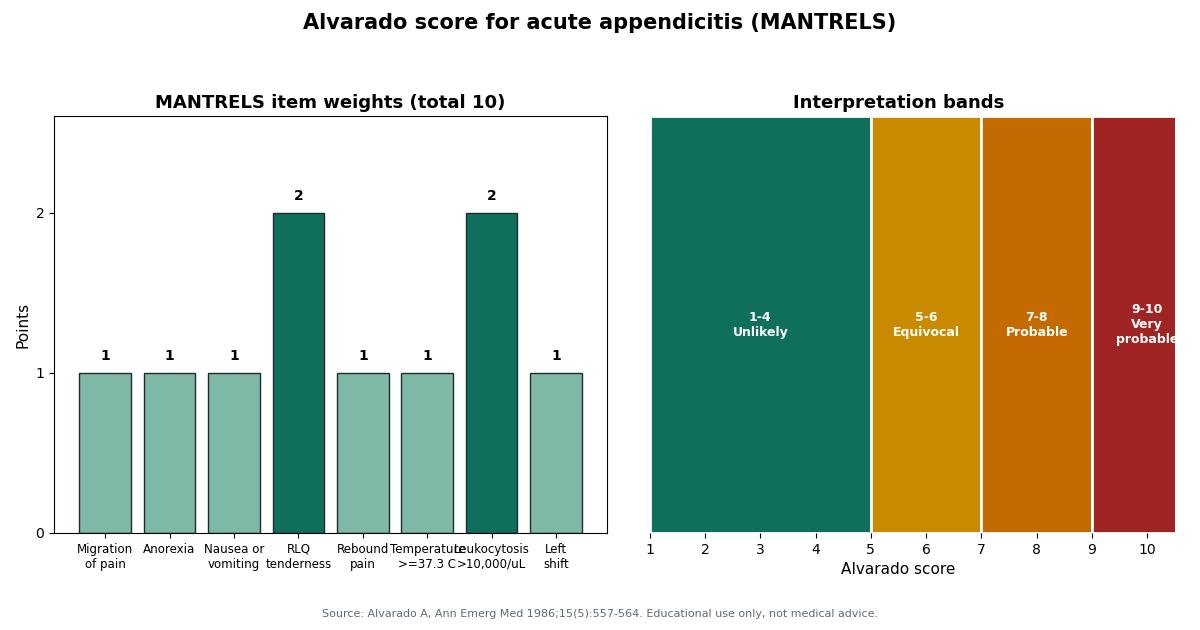
The Alvarado score is a clinical scoring system for the early diagnosis of acute appendicitis, published by Alfredo Alvarado in the Annals of Emergency Medicine in 1986. It was developed from a prospective study of patients presenting with suspected acute appendicitis at a single hospital, in which clinical features were analyzed to see which ones distinguished patients who truly had appendicitis from those who did not. The result was a simple checklist of eight items, weighted by their diagnostic value and summed into a single number out of 10. The items are remembered by the mnemonic MANTRELS: Migration of pain, Anorexia, Nausea or vomiting, Tenderness in the right lower quadrant, Rebound pain, Elevation of temperature, Leukocytosis, and Shift of white blood cells to the left.
The score exists because appendicitis is one of the most common surgical emergencies and one of the most error-prone diagnoses in emergency care. The appendix can declare itself plainly or hide behind vague symptoms, and the stakes on both sides are high. Operate on too many patients and you produce negative appendectomies: operations in which the appendix turns out to be normal, exposing patients to surgical risk for no benefit. Wait too long on a patient who does have appendicitis and the appendix can perforate, turning a straightforward operation into a much longer, more dangerous illness with abscesses, peritonitis and extended hospital stays. Alvarado's paper was written to help clinicians act earlier and more consistently, by turning an unstructured clinical impression into a structured, reproducible assessment that could be scored at the bedside and used to decide who should go home, who should be watched, and who should be seen by a surgeon.
That structured approach is what this calculator implements. It walks through the same eight items in the same way the original paper describes them, applies the published weights, and places the total in the original four interpretation bands. It is a faithful implementation of a 1986 clinical score, not a modern diagnostic test: it supports clinical judgment but does not replace it, and the sections below explain where it fits in today's practice alongside ultrasound and CT imaging.
Why clinical scores for appendicitis matter
Every clinician who evaluates abdominal pain faces the same dilemma that Alvarado described: the diagnosis of appendicitis is easy to make in retrospect and hard to make in the first hour. A patient arrives with abdominal pain that could be a dozen things. If it is appendicitis and the appendix is removed promptly, the illness is usually over in days. If it is appendicitis and treatment is delayed until perforation, the patient faces a far worse course. But operating on every patient with abdominal pain would mean removing many normal appendixes, each operation carrying its own risks of anesthesia, infection and adhesion formation. A clinical score does not remove this uncertainty, but it organizes it. By scoring the same features in every patient, it reduces the variation between clinicians and makes the decision explicit: this patient scores 3 and can go home, that patient scores 8 and needs a surgical consult now.
The Alvarado score was the first widely adopted tool of this kind, and it shaped how emergency clinicians think about appendicitis. Its value today is partly as a teaching and triage aid: it forces a complete examination and history, it records the findings in a standardized way, and it gives junior clinicians a framework that matches the senior clinician's instinct. Used honestly, it also protects patients, because a low score reminds the clinician that observation is reasonable and a high score reminds the clinician that delay is dangerous.
The eight MANTRELS items, explained
The eight items fall naturally into three groups, and the mnemonic itself encodes the grouping. The first three letters, MAN, are symptoms: things the patient reports. The next three, TRE, are signs: things the clinician finds on examination. The last two, LS, are laboratory findings: things the blood count shows. Symptoms contribute 3 points, signs contribute 4 points, and laboratory findings contribute 3 points, which reflects Alvarado's finding that the examination findings, especially right lower quadrant tenderness, carried more diagnostic weight than any single symptom or lab value.
Migration of pain to the right lower quadrant (1 point). The classic appendicitis story begins with poorly localized pain around the navel, which then migrates to the right lower quadrant as the inflamed appendix irritates the parietal peritoneum. This migration reflects the disease's natural history: early visceral pain from the midgut is vague and central, while later somatic pain from the irritated peritoneum is sharp and localized. A patient who describes exactly this sequence earns the point; pain that began in the right lower quadrant without a migratory phase, or pain that stays diffuse, does not.
Anorexia (1 point). Loss of appetite is one of the most consistent early features of appendicitis, and Alvarado found it worth including precisely because it is so common in true cases. Its diagnostic logic is negative: a patient with right lower quadrant pain who has been eating normally, and especially one who is hungry, is less likely to have appendicitis. The question to ask is simple and direct: have you felt like eating since the pain began?
Nausea or vomiting (1 point). Nausea with or without vomiting often follows the onset of pain in appendicitis. Alvarado counts either symptom, and you do not need both. The typical sequence is pain first, then nausea, then vomiting once or twice; profuse vomiting from the start is more characteristic of other conditions such as gastroenteritis or bowel obstruction. Like anorexia, this item is a soft symptom that gains meaning in combination with the rest.
Tenderness in the right lower quadrant (2 points). This is the heaviest-weighted single item and the cornerstone of the physical examination. Tenderness on deep palpation of the right lower quadrant, classically at McBurney's point, two-thirds of the way from the navel to the front of the hip bone, reflects the inflamed appendix lying beneath the abdominal wall. In Alvarado's analysis this sign carried twice the weight of any symptom, which is why it is the only examination item worth 2 points alongside the lab item leukocytosis. Guarding and the patient flinching or pulling away strengthen the finding, though guarding itself is not a separate item.
Rebound pain (1 point). Rebound tenderness is pain that worsens when pressure on the abdomen is suddenly released rather than when it is applied. It indicates irritation of the parietal peritoneum and is a sign that the inflammation has reached the lining of the abdominal cavity. It is elicited by pressing slowly and releasing quickly, and it is often more dramatic and more distressing to the patient than direct tenderness. Its presence adds a point and suggests a more advanced inflammatory process.
Elevation of temperature to at least 37.3 C (1 point). A low-grade fever is the expected systemic response to the inflamed appendix. Alvarado set the threshold at 37.3 C, which is about 99.1 F, and the point is awarded only at or above this cutoff: a temperature of 37.2 C does not score. High fever is unusual in early uncomplicated appendicitis and should prompt consideration of perforation or an alternative diagnosis. The threshold is deliberately low, because the item is meant to capture the mild systemic response that accompanies most true cases.
Leukocytosis above 10,000 per microliter (2 points). A raised white blood cell count is the laboratory signature of the body's response to infection, and in Alvarado's analysis it was important enough to earn 2 points, matching the weight of right lower quadrant tenderness. The cutoff is strict: above 10,000 per microliter counts, exactly 10,000 does not. A markedly high count in the tens of thousands suggests a more severe or complicated process, but the score does not award extra points beyond the cutoff; it is a yes or no item like all the others.
Shift of white blood cells to the left (1 point). A left shift means an increased proportion of immature neutrophils, called bands, on the differential count, reflecting the bone marrow releasing young cells to fight the infection. It is a sign that the leukocytosis is an acute infectious response rather than a chronic or non-infectious elevation. Of the eight items this is the one most dependent on laboratory reporting detail, which is why a modified version of the score drops it.
| Mnemonic | Item | Points |
|---|---|---|
| M | Migration of pain to the right lower quadrant | 1 |
| A | Anorexia | 1 |
| N | Nausea or vomiting | 1 |
| T | Tenderness in the right lower quadrant | 2 |
| R | Rebound pain | 1 |
| E | Elevation of temperature to at least 37.3 C | 1 |
| L | Leukocytosis above 10,000 per microliter | 2 |
| S | Shift of white blood cells to the left | 1 |
How this calculator applies the scoring rules
The calculator above follows the original algorithm exactly. For each of the five clinical items, migration, anorexia, nausea or vomiting, tenderness, and rebound, you answer yes or no; a yes adds the item's published weight and a no adds nothing. The temperature item is answered by entering the measured temperature: the calculator awards the point when the temperature is at least 37.3 C. If you enter the temperature in Fahrenheit, it converts it first, rounding to one decimal place, so 99.1 F converts to 37.3 C and scores the point while 99.0 F does not. The leukocytosis item is answered by entering the white blood cell count: the 2 points are awarded only when the count is strictly above 10,000 per microliter, so 10,000 exactly does not score. You can enter the count either as cells per microliter or in units of 10^9 per liter, and the calculator converts the latter by multiplying by 1000. The left shift item is a yes or no answer based on the differential count. Every item must be answered; the calculator reports a named error if any item is missing or if a number is invalid.
The maximum is 10 points, and it is reached only when every item is present, including both 2-point items. A patient with maximal right lower quadrant tenderness and a white cell count of 12,000 already has 4 points from the two heaviest items, which shows why those two findings dominate the score. But the score is designed so that no single finding decides the case: even with both 2-point items, 4 more points from symptoms, signs and the remaining labs are needed to reach the probable range.
Interpreting your score: the four bands
Alvarado's original scheme divides the 0 to 10 scale into four bands, each linked to a management suggestion. The bands are the heart of the score, because they convert a number into a plan.
Scores 1 to 4: appendicitis unlikely. At these scores the clinical picture does not support appendicitis, and Alvarado's scheme suggests discharge with observation. The patient is typically sent home with clear instructions to return if symptoms worsen, migrate, or are accompanied by fever or vomiting. A score in this band does not prove the appendix is normal, but it places the patient at low enough risk that watchful waiting is reasonable.
Scores 5 to 6: equivocal. This is the gray zone where the clinical findings are suggestive but not convincing. Alvarado's scheme suggests admission and observation: the patient is kept in hospital or under close review, examined again after a period of hours, and the score can be repeated as the picture evolves. In modern practice this band is the classic indication for imaging, usually an ultrasound first and then a CT scan if the ultrasound is inconclusive, because imaging resolves the uncertainty that the score cannot.
Scores 7 to 8: probable appendicitis. At these scores the diagnosis is likely and Alvarado's scheme suggests surgical consultation. The surgeon reassesses the patient, and in the original era this band often led directly to the operating room. Today a surgeon will usually still confirm with imaging before operating, but the consultation is urgent rather than elective.
Scores 9 to 10: very probable appendicitis. At these scores nearly every feature of the disease is present, and Alvarado's scheme suggests proceeding to surgery. Even here, most modern surgeons obtain imaging unless the picture is overwhelmingly clear, because a score is a probability and imaging provides anatomy. The practical message of this band is speed: this patient should not be left waiting.
A score of 0, with no items present, is not in Alvarado's original band description, which starts at 1, but it falls naturally at the lowest end of the unlikely range. The calculator reports it as appendicitis unlikely, which is the only sensible reading of a completely negative assessment.
The modified Alvarado score
A widely used variant, the modified Alvarado score, drops the left shift item and scores the remaining seven items out of 9. The reason is practical: the left shift depends on the differential count being reported promptly and in detail, which is not always available when the decision must be made. With the other seven items, which need only a history, an examination and a single total white cell count, the score can be completed at the bedside. On the modified scale, a score of 7 or more is the usual high-risk cutoff, corresponding roughly to the probable and very probable bands of the original. Studies comparing the two versions have generally found similar performance, which is unsurprising: the left shift contributes only 1 point and overlaps substantially with the leukocytosis item, since both reflect the same infectious response. This calculator implements the original 10-point score, because that is the version Alvarado published; if you are using a setting that omits the left shift, apply the modified 9-point scale with the 7-point cutoff instead.
The Alvarado score in the age of imaging
When Alvarado published in 1986, ultrasound and CT were not routine tools for suspected appendicitis; the diagnosis rested on history, examination and the white cell count, and surgeons accepted a substantial negative appendectomy rate as the price of avoiding perforations. Imaging has since transformed the field. Ultrasound, with no radiation, and CT, with high accuracy, now let clinicians see the appendix directly, measure its diameter, and identify complications such as perforation or abscess. Guidelines and practice today place imaging at the center of the diagnostic pathway, particularly for equivocal cases.
The Alvarado score still has a role, but it is a different role from 1986. First, it remains a structured initial assessment: working through the eight items guarantees a complete history and examination and produces a record that can be communicated clearly between clinicians. Second, it helps with triage and resource use: a score of 2 suggests observation rather than an urgent scan, while a score of 6 makes the case for imaging. Third, it remains valuable where imaging is unavailable or delayed, which includes many settings worldwide and some out-of-hours situations even in well-equipped hospitals. The honest framing is that the score is a decision aid from the pre-imaging era that has found a second life as a triage and teaching tool inside the imaging era. It structures the clinical assessment; imaging settles the anatomy.
Special populations: where the score performs less well
Alvarado derived the score from a general hospital population of patients with suspected appendicitis, and its performance is weakest at the edges of that population. Three groups deserve specific caution.
Children. Young children often cannot describe the migration of pain, may not report anorexia or nausea clearly, and frequently present with atypical or diffuse symptoms. Their examination can be unreliable when they are frightened or in pain, and a complete white cell count with differential may be hard to obtain. For these reasons the Alvarado score is less accurate in children, and pediatric clinicians use dedicated tools and a lower threshold for imaging and observation.
Older adults. In elderly patients the classic features are often blunted: fever may be absent, tenderness may be muted, and the white cell count may not rise as expected, all of which push the score down even when appendicitis is present. At the same time, older patients perforate earlier and tolerate complications worse, so a falsely low score is particularly dangerous. A low Alvarado score should never reassure the clinician unduly in an older patient with right lower quadrant pain.
Pregnant patients. Pregnancy displaces the appendix upward as the uterus grows, so tenderness may appear far from the right lower quadrant, undermining the two examination items. The leukocytosis of normal pregnancy can exceed the 10,000 threshold on its own, which inflates the laboratory item. And the choice of imaging is constrained by the desire to avoid radiation, which changes the downstream pathway. The score can still be computed, but it must be interpreted with these caveats and alongside obstetric and surgical input.
Strengths and limitations
The score's strengths explain its forty-year survival in the literature. It is simple: eight items, one page, no equipment beyond a thermometer and a blood count. It is reproducible: two clinicians scoring the same patient usually arrive at the same number, which is more than can be said for unstructured impressions. It is transparent: every point can be traced to a specific finding, so a score of 7 can be unpacked into exactly which features drove it. And it is well studied: few clinical scores have been validated as often across as many settings, so its behavior at each band is well understood.
The limitations are real and should shape how the result is used. The score is only as good as the examination: vague answers to the yes or no items produce a vague score, and the items themselves, especially rebound tenderness, depend on examiner technique. It performs poorly in the special populations described above. It was derived before imaging and before modern appreciation of conditions that mimic appendicitis, such as mesenteric adenitis or ovarian pathology, which the score does not address. It gives a probability, not a diagnosis: a score of 8 can still be wrong, and a score of 3 can still be appendicitis in an atypical patient. Finally, the management suggestions from 1986, admit and observe, or proceed to surgery, describe the decision logic of that era; today they should be read as indications for the level of urgency, with imaging confirming the anatomy before the operating room in most cases. Used with these caveats, as a structured starting point rather than a verdict, the Alvarado score remains one of the most useful bedside tools in the evaluation of suspected appendicitis.
Key takeaways
- The Alvarado score is an 8-item clinical scoring system for acute appendicitis, published by Alfredo Alvarado in the Annals of Emergency Medicine in 1986.
- MANTRELS stands for the eight Alvarado items: M, migration of pain to the right lower quadrant (1 point); A, anorexia (1 point); N, nausea or vomiting (1 point); T, tenderness in the right lower quadrant (2 points); R, rebound pain (1 point); E, elevation of temperature to at least 37.3 C (1 point); L, leukocytosis above 10,000 per microliter (2 points); S, shift of white blood cells to the left (1 point).
- Alvarado's original scheme uses four bands.
- The modified Alvarado score drops the left shift item, leaving 7 items with a maximum of 9 points.
Frequently asked questions
What is the Alvarado score for appendicitis?
The Alvarado score is an 8-item clinical scoring system for acute appendicitis, published by Alfredo Alvarado in the Annals of Emergency Medicine in 1986. The items are remembered by the mnemonic MANTRELS: Migration of pain to the right lower quadrant, Anorexia, Nausea or vomiting, Tenderness in the right lower quadrant, Rebound pain, Elevation of temperature to at least 37.3 C, Leukocytosis above 10,000 per microliter, and Shift of white blood cells to the left. The total is out of 10 points.
What does the MANTRELS mnemonic stand for?
MANTRELS stands for the eight Alvarado items: M, migration of pain to the right lower quadrant (1 point); A, anorexia (1 point); N, nausea or vomiting (1 point); T, tenderness in the right lower quadrant (2 points); R, rebound pain (1 point); E, elevation of temperature to at least 37.3 C (1 point); L, leukocytosis above 10,000 per microliter (2 points); S, shift of white blood cells to the left (1 point). Symptoms contribute 3 points, signs 4 points, and laboratory findings 3 points.
How do you interpret an Alvarado score?
Alvarado's original scheme uses four bands. Scores of 1 to 4 mean appendicitis is unlikely, with a suggestion of discharge or observation. Scores of 5 to 6 are equivocal, with a suggestion of admission and observation. Scores of 7 to 8 mean appendicitis is probable, with a suggestion of surgical consultation. Scores of 9 to 10 mean appendicitis is very probable, with a suggestion of proceeding to surgery. Modern practice usually adds imaging, especially ultrasound or CT, for equivocal scores.
What is the modified Alvarado score?
The modified Alvarado score drops the left shift item, leaving 7 items with a maximum of 9 points. A score of 7 or more on the modified scale is the usual high-risk cutoff. The modification exists because the left shift result is not always available or reported promptly, while the other seven items can be assessed at the bedside with one blood count.
Is the Alvarado score reliable in children, older adults, and pregnancy?
The score performs less well in children, older adults, and pregnant patients than in the general adult population it was derived from. Children often present atypically and cannot always describe migrating pain. Older adults may have blunted symptoms with less fever and less tenderness, yet they carry a higher risk of perforation. In pregnancy, anatomic displacement of the appendix and the leukocytosis of pregnancy reduce the score's accuracy. Dedicated assessments and imaging play a larger role in these groups.
Can the Alvarado score replace ultrasound or CT imaging?
No. The score was developed in 1986, before ultrasound and CT were routine for suspected appendicitis, and it has not replaced imaging. In current practice the score is best used as a structured initial assessment and triage aid: low scores support observation, high scores support early surgical involvement, and equivocal scores of 5 to 6 are the classic indication for imaging. It is an educational and decision-support tool, not a diagnostic test, and it never overrides clinical judgment.
Medical disclaimer
This calculator is for educational and informational purposes only. It is not medical advice, it does not diagnose appendicitis or any other condition, and it does not replace professional clinical judgment. A suspected case of appendicitis is a medical emergency: seek immediate care from a qualified clinician. If you have abdominal pain or concerns about your health, please see a healthcare professional promptly.
Sources
- Alvarado A. A practical score for the early diagnosis of acute appendicitis. Ann Emerg Med. 1986;15(5):557-564. (Source of the 8-item, 10-point score, the item weights, the temperature threshold of 37.3 C, the leukocytosis threshold of above 10,000 per microliter, and the four interpretation bands with their management scheme.)