What is the Child-Pugh score?
The Child-Pugh score is a five-item clinical scoring system used to assess prognosis in cirrhosis and to estimate the operative risk of patients with liver disease. It is also known by its full name, the Child-Turcotte-Pugh score, which records the two stages of its development. The score was first published in 1964 by Charles Child and Jeremiah Turcotte, who designed it to predict the risk of surgery in patients with portal hypertension undergoing shunt operations for bleeding oesophageal varices (Child CG, Turcotte JG, Surgery 1964;55:318-327). Their original version used five items: total bilirubin, serum albumin, ascites, hepatic encephalopathy, and nutritional status.
In 1973, Pugh and colleagues reported their experience with transection of the oesophagus for bleeding varices and proposed the modification that gave the score its current form (Pugh RNH et al., Br J Surg 1973;60(8):648-652). They replaced nutritional status, which is difficult to assess reproducibly, with the prothrombin time, an objective laboratory measure. They also formalised the three classes, A, B and C, that remain in use today. Since then the score has become the standard bedside measure of liver functional reserve: it appears in surgical risk assessment, in trial stratification, and in everyday hepatology as the quickest way to communicate how compensated or decompensated a patient with cirrhosis is.
The five parameters, explained
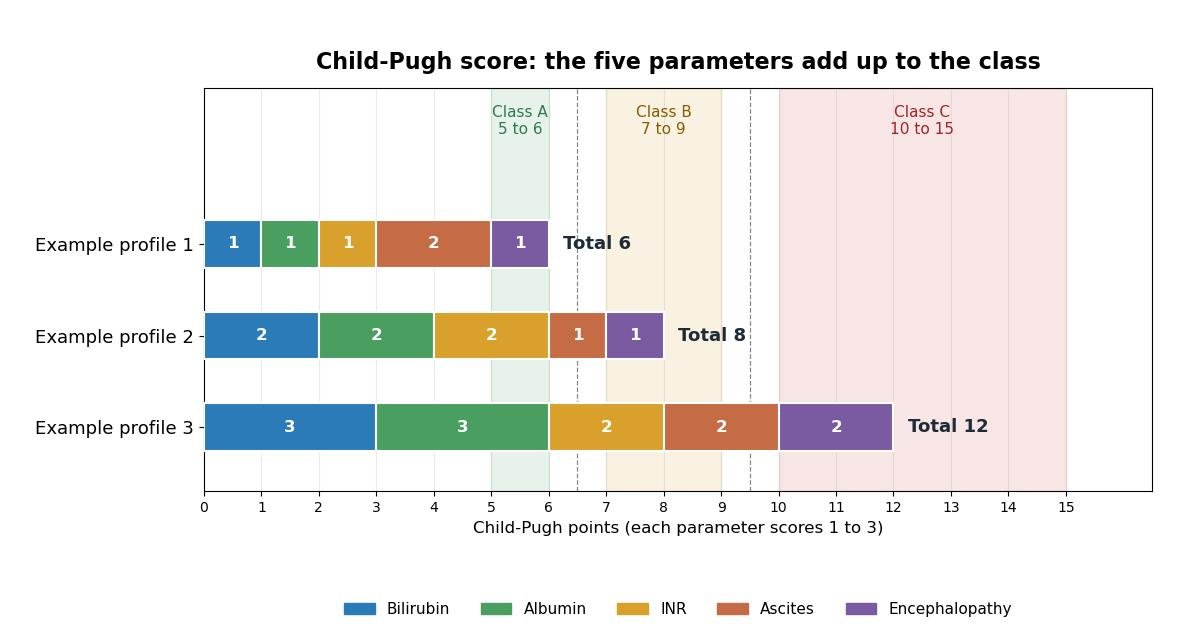
Each of the five parameters reflects a different facet of failing liver function, and each contributes 1, 2 or 3 points. The total therefore ranges from 5 to 15. Three of the items are laboratory values and two are bedside clinical findings, which is exactly what makes the score both practical and, as discussed below, partly subjective.
Total bilirubin: excretory function
Bilirubin is the pigment produced when old red blood cells are broken down. A healthy liver takes it up, conjugates it and excretes it into bile; when hepatocytes fail or bile flow is obstructed, bilirubin accumulates in the blood. In the Child-Pugh score, a total bilirubin below 2 mg/dL scores 1 point, 2 to 3 mg/dL scores 2 points, and above 3 mg/dL scores 3 points. Laboratories in many countries report bilirubin in micromoles per litre rather than mg/dL. This calculator accepts either unit and converts using the standard factor of 1 mg/dL = 17.1 umol/L, so a value of 34.2 umol/L is treated as exactly 2.0 mg/dL and scores 2 points. The cutoff at exactly 2 and exactly 3 mg/dL belongs to the 2-point band in the published scheme.
Serum albumin: synthetic function
Albumin is the main protein manufactured by the liver, and a falling albumin is one of the earliest laboratory signs that synthetic function is failing. A value above 3.5 g/dL scores 1 point, 2.8 to 3.5 g/dL scores 2 points, and below 2.8 g/dL scores 3 points. Albumin can be misleading in either direction: it rises slowly and falls slowly, so it reflects chronic function rather than acute change, and it can be artificially raised by albumin infusions or lowered by poor nutrition and chronic illness unrelated to the liver. The score takes the number at face value, which is one reason clinical judgment must accompany it.
INR or prothrombin time prolongation: clotting function
The liver synthesises most clotting factors, so a failing liver prolongs the time blood takes to clot. Pugh's 1973 modification used the prothrombin time prolongation in seconds beyond the control value: below 4 seconds scores 1 point, 4 to 6 seconds scores 2 points, and above 6 seconds scores 3 points. The modern laboratory equivalent is the INR, standardised from the same measurement: below 1.7 scores 1 point, 1.7 to 2.3 scores 2 points, and above 2.3 scores 3 points. Either entry is valid in this calculator, and when both are provided the INR is used. Two caveats matter in practice. First, the prolongation is the seconds beyond the control, not the raw prothrombin time. Second, warfarin and other anticoagulants raise the INR for reasons that have nothing to do with the liver, so an INR on anticoagulation should not be used to score this item.
Ascites: portal hypertension and sodium retention
Ascites, the accumulation of fluid in the peritoneal cavity, signals portal hypertension and the kidney's response to a failing circulation. Absent ascites scores 1 point, slight ascites scores 2 points, and moderate to severe ascites scores 3 points. Slight ascites may be visible only on ultrasound or as a subtle fluid wave; moderate to severe ascites is obvious on examination, may be tense, and may require therapeutic paracentesis. Because ascites responds to diuretics and salt restriction, the score ideally reflects the patient's state on treatment, and two examiners can reasonably disagree on whether ascites is slight or moderate, which is the best-known weakness of the score.
Hepatic encephalopathy: brain dysfunction
When the liver can no longer clear gut-derived toxins such as ammonia, brain function deteriorates, producing hepatic encephalopathy. No encephalopathy scores 1 point, grade 1 to 2 scores 2 points, and grade 3 to 4 scores 3 points, using the standard West Haven grading. Grade 1 is a trivial lack of awareness with euphoria or anxiety and a shortened attention span; grade 2 brings lethargy, disorientation to time and obvious personality change; grade 3 is somnolence to semi-stupor with confusion and disorientation; grade 4 is coma. Like ascites, grading encephalopathy depends on bedside assessment, and it can fluctuate with precipitants such as infection, bleeding or constipation, so the score captures a moment in time.
How the points add up: classes A, B and C
The five item scores are simply added. The minimum is 5 (all items 1 point) and the maximum is 15 (all items 3 points). The total falls into one of three classes that Pugh's group formalised:
| Parameter | 1 point | 2 points | 3 points |
|---|---|---|---|
| Total bilirubin | < 2 mg/dL | 2 to 3 mg/dL | > 3 mg/dL |
| Serum albumin | > 3.5 g/dL | 2.8 to 3.5 g/dL | < 2.8 g/dL |
| INR | < 1.7 | 1.7 to 2.3 | > 2.3 |
| PT prolongation (alternative) | < 4 s | 4 to 6 s | > 6 s |
| Ascites | None | Slight | Moderate to severe |
| Encephalopathy | None | Grade 1 to 2 | Grade 3 to 4 |
| Class | Total points | Meaning | Classic 1-year survival | Classic elective-surgery mortality |
|---|---|---|---|---|
| A | 5 to 6 | Well-compensated disease | Around 100% | Around 10% |
| B | 7 to 9 | Significant functional compromise | Around 80% | Around 30% |
| C | 10 to 15 | Decompensated disease | Around 45% | Around 80% |
The outcome figures in the table are the classic numbers from the early surgical cohorts of the Child-Pugh literature, widely reproduced in surgical and hepatology references: roughly 10%, 30% and 80% mortality for elective surgery in classes A, B and C, with 1-year survivals around 100%, 80% and 45%. An important caveat accompanies them: they come from an era of older perioperative care, and modern anaesthesia, critical care and surgical technique have improved on them substantially. They remain the standard counselling figures because they stratify risk so clearly, but they are population figures from historical cohorts, not personal predictions for any individual patient today.
Child-Pugh versus MELD
The score most often discussed alongside Child-Pugh is MELD, the Model for End-Stage Liver Disease. The two answer different questions. Child-Pugh combines three laboratory values with two bedside clinical findings into a coarse 15-point scale; it is a clinical instrument, designed for surgical-risk assessment and bedside prognosis, and it can be scored at the bedside without a computer. MELD uses only objective laboratory values (bilirubin, INR and creatinine, with sodium added in the MELD-Na version) on a continuous scale; it was designed to predict short-term mortality and is the score used to prioritise patients on the liver transplant waiting list. In current practice the two are used together rather than as rivals: MELD drives allocation because it is fully objective and finely graded, while Child-Pugh remains the bedside language for describing how compensated a patient is, for operative-risk counselling, and for stratifying patients in trials. A patient can be Child-Pugh class B with a MELD that still places them low on a transplant list, or vice versa, which is exactly why clinicians keep both in view.
Strengths and limitations
The score's strengths explain its longevity. It is simple enough to compute mentally, it uses data available in any clinic, it has been validated across six decades of hepatology, and it stratifies both prognosis and operative risk with remarkable consistency. Its limitations are equally well known and worth stating plainly.
- Two items are subjective. Ascites and encephalopathy depend on bedside judgment, and inter-observer agreement is imperfect. Diuretics, paracentesis and treatment of precipitants can move a patient between bands without any change in underlying liver function.
- The 1 to 3 bins create ceiling and floor effects. A bilirubin of 3.1 mg/dL and a bilirubin of 30 mg/dL both score 3 points, and a bilirubin of 1.9 and 0.4 both score 1 point. The score cannot distinguish within a band, so two patients in the same class can have very different physiology.
- Correlated variables are counted twice. Albumin, ascites and to some extent encephalopathy all reflect aspects of portal hypertension and synthetic failure, so the score double-counts related pathophysiology rather than measuring five independent axes.
- Kidney function is missing. Creatinine is one of the strongest prognostic factors in cirrhosis, particularly when hepatorenal physiology develops, yet it plays no part in Child-Pugh. This is a major reason MELD outperforms it for short-term mortality prediction.
- The INR item is easily distorted. Anticoagulants such as warfarin, vitamin K deficiency and laboratory variation raise the INR for non-hepatic reasons; the item should reflect liver synthetic failure, not anticoagulation.
- It is a snapshot. Cirrhosis is dynamic, and acute-on-chronic liver failure can move a patient from class A to class C within days. A single score never replaces serial assessment.
None of these limitations invalidates the score. They simply define where it belongs: a fast, standardised bedside summary of hepatic reserve, interpreted by a clinician who knows what the numbers leave out.
Key takeaways
- The Child-Pugh score is used to assess prognosis in cirrhosis.
- The five parameters are total bilirubin (less than 2 mg/dL scores 1, 2 to 3 scores 2, above 3 scores 3), serum albumin (above 3.5 g/dL scores 1, 2.8 to 3.5 scores 2, below 2.8 scores 3), INR (below 1.7 scores 1, 1.7 to 2.3 scores 2, above 2.3 scores 3) or prothrombin time prolongation (below 4 seconds scores 1, 4 to 6 scores 2, above 6 scores 3), ascites (none 1, slight 2, moderate to severe 3), and hepatic encephalopathy (none 1, grade 1 to 2 scores 2, grade 3 to 4 scores 3).
- Each of the five parameters scores 1, 2 or 3 points, and the points are added for a total between 5 and 15.
- The classic figures from the early surgical cohorts are 1-year survival around 100% for class A, around 80% for class B, and around 45% for class C, with elective-surgery mortality around 10% for class A, 30% for class B, and 80% for class C.
Frequently asked questions
What is the Child-Pugh score used for?
The Child-Pugh score is used to assess prognosis in cirrhosis. It was originally designed to estimate the surgical risk of patients with portal hypertension undergoing surgery for bleeding varices, and it is now widely used for bedside prognosis, stratification in clinical trials, and assessment of operative risk in patients with liver disease. For transplant listing priority it is used alongside the MELD score, which is the objective score that drives organ allocation.
What are the five parameters of the Child-Pugh score?
The five parameters are total bilirubin (less than 2 mg/dL scores 1, 2 to 3 scores 2, above 3 scores 3), serum albumin (above 3.5 g/dL scores 1, 2.8 to 3.5 scores 2, below 2.8 scores 3), INR (below 1.7 scores 1, 1.7 to 2.3 scores 2, above 2.3 scores 3) or prothrombin time prolongation (below 4 seconds scores 1, 4 to 6 scores 2, above 6 scores 3), ascites (none 1, slight 2, moderate to severe 3), and hepatic encephalopathy (none 1, grade 1 to 2 scores 2, grade 3 to 4 scores 3).
How is the Child-Pugh score calculated, and what do classes A, B and C mean?
Each of the five parameters scores 1, 2 or 3 points, and the points are added for a total between 5 and 15. A total of 5 to 6 is class A (well-compensated disease), 7 to 9 is class B (significant functional compromise), and 10 to 15 is class C (decompensated disease). Higher classes carry worse prognosis and higher operative risk.
What survival figures are associated with each Child-Pugh class?
The classic figures from the early surgical cohorts are 1-year survival around 100% for class A, around 80% for class B, and around 45% for class C, with elective-surgery mortality around 10% for class A, 30% for class B, and 80% for class C. Modern perioperative care has improved on these figures. They remain useful for counselling about risk, but they are population figures, not personal predictions.
Should I enter the INR or the prothrombin time prolongation?
Either is acceptable because both measure the same coagulation item. The 1973 modification used the prothrombin time prolongation in seconds beyond the control value, which is what modern laboratories standardised into the INR. Most laboratories today report the INR, so it is the usual choice. This calculator accepts either; if both are entered, the INR is used. Note that the prolongation is the seconds beyond the control, not the raw prothrombin time.
How does the Child-Pugh score differ from the MELD score?
The Child-Pugh score combines three laboratory values with two bedside clinical findings (ascites and encephalopathy) into a coarse 15-point scale, and it is mainly used for surgical-risk assessment and bedside prognosis. MELD uses only objective laboratory values (bilirubin, INR, creatinine, and sodium in MELD-Na) on a continuous scale and is the score used to prioritise patients on the liver transplant waiting list. In practice the two are used together: MELD for allocation, Child-Pugh for clinical judgment.
Medical disclaimer
This calculator is for educational and informational purposes only. It is not medical advice, it does not diagnose cirrhosis or any other condition, and it does not replace professional clinical judgment. Cirrhosis and its complications, including bleeding varices, ascites and hepatic encephalopathy, are serious medical conditions: if you have liver disease or concerns about your health, please see a qualified healthcare professional promptly.
Sources
- Child CG, Turcotte JG. Surgery and portal hypertension. Surgery. 1964;55:318-327. (The original five-item score for estimating surgical risk in portal hypertension; nutritional status was the fifth item.)
- Pugh RNH, Murray-Lyon IM, Dawson JL, Pietroni MC, Williams R. Transection of the oesophagus for bleeding oesophageal varices. Br J Surg. 1973;60(8):648-652. (Replaced nutritional status with prothrombin time; source of the A/B/C classes and the 1 to 3 point cutoffs used by this calculator.)
- The class-associated outcome figures quoted (elective-surgery mortality around 10%, 30% and 80%, and 1-year survival around 100%, 80% and 45% for classes A, B and C) are the classic figures from the early surgical cohorts of the Child-Pugh literature, widely reproduced in surgical and hepatology references. Modern perioperative care has improved on them.
- Bilirubin unit conversion uses the standard factor 1 mg/dL = 17.1 umol/L.