Why early prediction matters in acute pancreatitis
Acute pancreatitis is a common cause of emergency hospital admission, and most patients recover with supportive care over a few days. A minority, however, develop a dangerous illness with organ failure, infected pancreatic necrosis, and prolonged intensive care stays. The clinical problem is that these two trajectories look similar at the door. A patient with mild edematous pancreatitis and a patient who will be in the intensive care unit within two days can both present with upper abdominal pain, vomiting, and a raised lipase. Telling them apart early is one of the most consequential judgments in gastroenterology, because the decisions that change outcomes, where the patient is admitted, how intensively they are monitored, how aggressively fluids and nutrition are managed, and how quickly complications are sought, are all made in the first hours.
That is the gap the BISAP score was designed to fill. Before 2008, the established prognostic tools had a structural weakness for this exact decision. The Ranson criteria, published in 1974, require 48 hours to complete, which means the full score arrives after the early management window has already closed. The APACHE-II score, borrowed from intensive care, uses a dozen physiological variables and is cumbersome to compute at the bedside in an emergency department. Clinicians needed something simpler: a score that could be finished within the first day, from data already collected on admission, that would identify the patients at increased risk of dying so that monitoring and resources could be matched to risk from the start.
BISAP answers that need. It uses five items, each worth one point, all available within the first 24 hours: the blood urea nitrogen level, the mental status, the systemic inflammatory response as captured by the SIRS criteria, the age, and the presence of pleural effusion. No item requires a specialized test, a calculator for predicted values, or a second day of observation. In the validation study, the score stratified patients into groups whose observed mortality ranged from under 1% to 22.5%, a more than twenty-fold spread, using nothing more than routine admission data. That is why it earned its name: it is a bedside index, meant to be computed where the patient is, when the decision is being made.
What the BISAP score is
BISAP stands for the Bedside Index of Severity in Acute Pancreatitis. It was published by Bechien Wu and colleagues in Gut in 2008, in a paper titled "The early prediction of mortality in acute pancreatitis: a large population-based study." The authors analyzed administrative and clinical data from 17,992 cases of acute pancreatitis to derive the score, using classification and regression tree analysis to find the variables that most efficiently separated patients who died from those who survived. They then validated the resulting 5-point score in a separate cohort of 18,256 cases, a combined study population of more than 36,000 patients, making it one of the largest prognostic studies in pancreatitis ever conducted.
The five variables that survived the analysis, each contributing one point, are remembered by the initials in the name: BUN above 25 mg/dL; Impaired mental status; SIRS present; Age above 60 years; and Pleural effusion. All five are assessed within the first 24 hours of presentation. In the derivation cohort the score achieved an area under the ROC curve of 0.83 for predicting in-hospital mortality, and in the validation cohort it achieved 0.82, essentially identical to the far more complex APACHE-II score at 0.83. The paper's conclusion was direct: BISAP is a simple and accurate method for the early identification of patients at increased risk of in-hospital mortality.
Two properties of the score deserve emphasis. First, every item is binary. There are no sliding scales, no weighted sub-scores, and no predicted-value tables. A patient either meets a criterion or does not, and the total is a whole number from 0 to 5. Second, the score predicts mortality, not the severity categories of the revised Atlanta classification. This distinction matters and is explained in detail below, because the score is sometimes described loosely as a severity score when its validated outcome is specifically death during the admission.
The five BISAP items, explained
BUN above 25 mg/dL (1 point). Blood urea nitrogen was the single most efficient splitting variable in the original classification tree, which means it carried more prognostic information than any other single measurement. The physiology is straightforward. In acute pancreatitis, aggressive fluid resuscitation is the main early therapy, and patients who are volume depleted or who develop early renal hypoperfusion show a rising BUN. A high BUN therefore reflects both the severity of the systemic insult and the adequacy of the early fluid response. The cutoff is strict: above 25 mg/dL scores the point, and exactly 25 does not. Note that many laboratories report BUN in mmol/L, in which case 9.0 mmol/L converts to 25.2 mg/dL and scores, while 8.9 mmol/L converts to 24.9 mg/dL and does not. The calculator above performs this conversion automatically.
Impaired mental status (1 point). This item is scored as present when the patient shows disorientation, lethargy, somnolence, stupor, or coma within the first 24 hours. Altered mental status in acute pancreatitis reflects the systemic nature of the illness: the inflammatory cascade affects the brain through a combination of hypoperfusion, hypoxia, electrolyte disturbance, and circulating inflammatory mediators. It is one of the quietest items in the score, because a drowsy patient can be overlooked when the attention is on the abdomen, yet it was one of the five strongest mortality predictors in a study of tens of thousands of cases. Any degree of impairment beyond normal alertness counts.
SIRS present (1 point). The systemic inflammatory response syndrome is assessed with the four classic criteria: body temperature below 36 C or above 38 C; heart rate above 90 beats per minute; respiratory rate above 20 breaths per minute, or arterial carbon dioxide below 32 mmHg; and white blood cell count below 4,000 or above 12,000 per microliter, or more than 10% immature band forms. SIRS is considered present when two or more of the four criteria are met. In the BISAP score, SIRS present contributes exactly one point, regardless of whether two, three, or four criteria are met. This reflects the score's bedside philosophy: what matters is whether the systemic inflammatory response has declared itself, not its exact depth. SIRS is nearly universal in severe pancreatitis, and its absence is one of the strongest reassuring findings in a patient with a low score.
Age above 60 years (1 point). Age is the one item that is fixed at presentation and carries no information about the current attack, yet it was a powerful discriminator. Older patients tolerate systemic inflammation less well, have less physiological reserve when organ dysfunction begins, and carry more comorbid disease that complicates the course. The cutoff is strict: above 60 years scores the point, and age 60 exactly does not. Like the BUN item, this is a deliberate binary line drawn from the data rather than a physiological threshold, and the calculator applies it exactly as published.
Pleural effusion present (1 point). Pleural effusion, usually assessed on the admission chest radiograph, reflects the systemic capillary leak of the inflammatory response and, more specifically, the transdiaphragmatic spread of pancreatic inflammation. Left-sided effusions are the classic finding in pancreatitis. An effusion visible within the first 24 hours indicates that the disease process is already producing systemic effects beyond the pancreas itself. In the original analysis it helped separate intermediate-risk patients into higher and lower groups, which is why it survived the tree analysis alongside the heavier variables.
| Initial | Item | Criterion |
|---|---|---|
| B | BUN | Above 25 mg/dL (about 8.9 mmol/L) |
| I | Impaired mental status | Disorientation, lethargy, somnolence, stupor, or coma |
| S | SIRS present | 2 or more of the 4 SIRS criteria |
| A | Age | Above 60 years |
| P | Pleural effusion | Present on imaging within 24 hours |
The observed mortality table
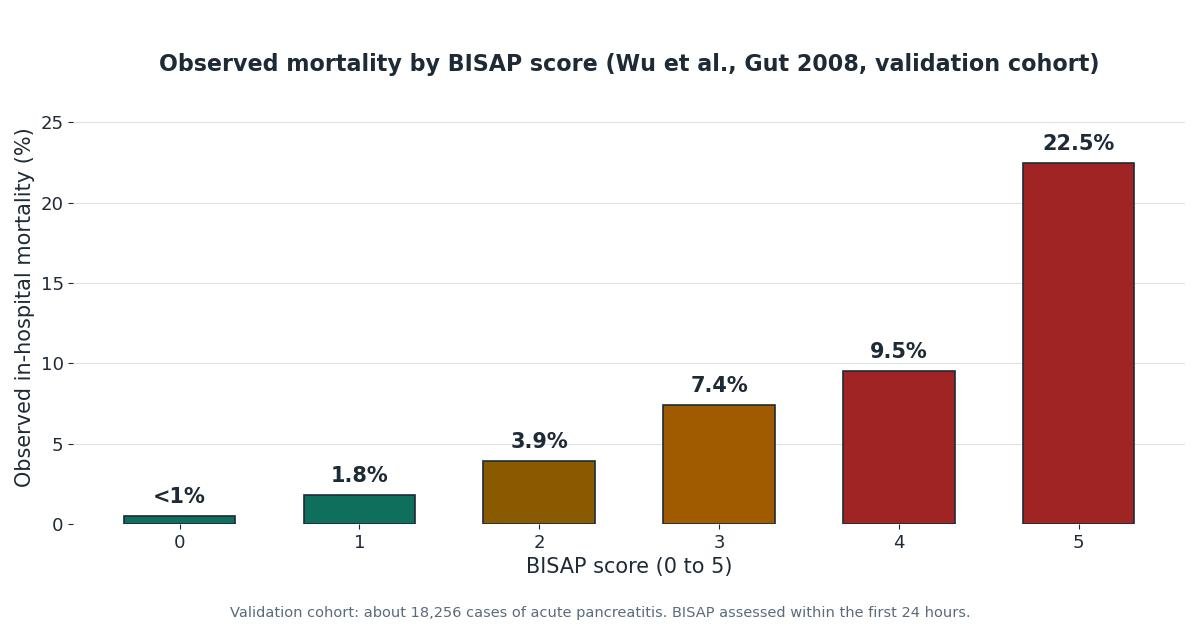
The score's clinical value comes from the mortality gradient across its six levels. In the validation cohort of about 18,256 cases, with 213 deaths overall (1.2%), the observed in-hospital mortality was: 0 points, under 1%; 1 point, 1.8%; 2 points, 3.9%; 3 points, 7.4%; 4 points, 9.5%; and 5 points, 22.5%. The trend was statistically significant, with mortality rising at every step. Two features of this table are worth noting. First, the absolute risk at 0 points is genuinely low: fewer than 1 in 100 such patients died, which gives real reassurance when combined with clinical judgment. Second, the jump from 4 to 5 points is dramatic: more than doubling from 9.5% to 22.5%, which means a patient with all five items present is in a different risk category from everyone else.
These figures are observed rates in the study population, and they should be understood as what they are. They describe what happened to thousands of patients with each score in a large American administrative dataset in the mid-2000s. They do not predict the fate of an individual patient, and they do not account for differences in case mix, care quality, or treatment era. Their use is comparative and triage-oriented: they tell the clinician that a score of 4 carries roughly five times the observed mortality of a score of 1, and that this difference is large enough to justify different levels of monitoring.
BISAP compared with Ranson and Glasgow-Imrie
The Ranson criteria, published in 1974, were the first widely used prognostic system for acute pancreatitis and remain the historical reference. They use 11 items: five assessed on admission (age over 55, white cell count over 16,000, glucose over 200 mg/dL, AST over 250 IU/L, LDH over 350 IU/L) and six assessed at 48 hours (hematocrit fall, BUN rise, calcium fall, PaO2 fall, base deficit, fluid sequestration). A score of 3 or more predicts a severe course. The structural problem is timing: the full score cannot be computed until 48 hours after admission, which is after the period when the most important triage decisions are made. BISAP was explicitly designed to answer the question Ranson leaves open for two days.
The Glasgow-Imrie criteria, published in 1975, use 8 items assessed within 48 hours (age over 55, white cell count over 15,000, glucose, urea, PaO2, calcium, albumin, LDH, AST), with 3 or more indicating severe disease. They share Ranson's 48-hour horizon and add a longer item list. BISAP's advantages over both are speed and simplicity: 5 items instead of 8 or 11, a 24-hour window instead of 48, and no arterial blood gas requirement beyond what the SIRS criteria already allow. In the Wu study, BISAP's discriminative accuracy for mortality (AUC 0.82 in validation) matched APACHE-II (0.83), the most complex of the available systems. That comparison is the score's strongest credential: it achieved the accuracy of a 12-variable intensive care score with five bedside items.
None of this makes the older scores useless. Ranson's criteria remain a useful framework for understanding the pathophysiology of a severe attack, and APACHE-II remains valuable in the intensive care unit where its variables are already being measured. But for the emergency department and the early ward phase, where the question is who needs close watching tonight, BISAP's 24-hour simplicity is a genuine advance.
What BISAP predicts and what it does not
BISAP was derived and validated against one outcome: in-hospital mortality. This needs to be stated plainly, because the score is often called a severity index and its name invites confusion with the revised Atlanta classification of acute pancreatitis. The revised Atlanta system defines severity by persistent organ failure lasting more than 48 hours and by local or systemic complications: mild, moderately severe, and severe disease. That is a different outcome from death, measured on a different timescale, with different clinical implications. A patient can have moderately severe pancreatitis by Atlanta criteria and survive, and a patient with a high BISAP score is at increased risk of dying whether or not the Atlanta criteria are met.
In practice the two overlap substantially: patients with high BISAP scores are more likely to develop persistent organ failure and therefore to be classified as severe. But the score should not be used as a substitute for the Atlanta definitions, and a BISAP result should never be recorded as the Atlanta severity. The honest framing is that BISAP is an early mortality-risk stratification tool. It answers the triage question, how worried should we be about this patient dying, within the first day. It does not answer the classification question, which Atlanta category does this patient fall into, because that question can only be answered after 48 hours of observation.
Limitations
BISAP has the limitations of the data it came from. It was derived from administrative records, and the diagnosis of pancreatitis depended on hospital coding rather than uniformly applied diagnostic criteria. Some included cases may not have met strict diagnostic standards, and the item measurements were whatever the hospitals recorded in routine care rather than protocolized research measurements. The mortality rates reflect American hospital care in the mid-2000s and may not transfer exactly to other settings, populations, or eras.
The score is also deliberately coarse. Five binary items cannot capture the continuous reality of a disease: a BUN of 26 and a BUN of 120 score identically, and a patient meeting all four SIRS criteria scores the same SIRS point as one meeting two. This coarseness is the price of bedside simplicity, and it is usually worth paying, but it means the score should not override a clinician's sense that a particular patient is sicker than their number suggests. Finally, BISAP says nothing about etiology. It does not distinguish gallstone pancreatitis from alcohol-related or other causes, and it does not guide the specific decisions that depend on etiology, such as the timing of cholecystectomy or the evaluation for biliary obstruction. It is a mortality-risk tool, not a complete management guide.
Key takeaways
- The BISAP score, the Bedside Index of Severity in Acute Pancreatitis, is a 5-point mortality prediction score published by Wu BU and colleagues in Gut in 2008.
- The five BISAP items are: blood urea nitrogen (BUN) above 25 mg/dL; impaired mental status, such as disorientation, lethargy, somnolence, stupor, or coma; systemic inflammatory response syndrome (SIRS) present, meaning two or more SIRS criteria; age above 60 years; and pleural effusion present.
- SIRS is present when at least two of the four standard SIRS criteria are met: body temperature below 36 C or above 38 C; heart rate above 90 beats per minute; respiratory rate above 20 breaths per minute or PaCO2 below 32 mmHg; and white blood cell count below 4,000 or above 12,000 per microliter, or more than 10% immature (band) forms.
- The observed in-hospital mortality rates in the Wu 2008 validation cohort of about 18,256 cases were: 0 points, under 1%; 1 point, 1.8%; 2 points, 3.9%; 3 points, 7.4%; 4 points, 9.5%; and 5 points, 22.5%.
Frequently asked questions
What is the BISAP score for acute pancreatitis?
The BISAP score, the Bedside Index of Severity in Acute Pancreatitis, is a 5-point mortality prediction score published by Wu BU and colleagues in Gut in 2008. It was derived from about 17,992 cases of acute pancreatitis and validated in about 18,256 further cases. Each of five items assessed within the first 24 hours contributes 1 point: BUN above 25 mg/dL, impaired mental status, SIRS present, age above 60 years, and pleural effusion. Observed in-hospital mortality rose from under 1% at 0 points to 22.5% at 5 points in the validation cohort.
What are the five BISAP criteria?
The five BISAP items are: blood urea nitrogen (BUN) above 25 mg/dL; impaired mental status, such as disorientation, lethargy, somnolence, stupor, or coma; systemic inflammatory response syndrome (SIRS) present, meaning two or more SIRS criteria; age above 60 years; and pleural effusion present. Each counts as 1 point, and all are assessed within the first 24 hours of presentation. The name BISAP is formed from the initials: BUN, Impaired mental status, SIRS, Age, and Pleural effusion.
How is SIRS determined for the BISAP score?
SIRS is present when at least two of the four standard SIRS criteria are met: body temperature below 36 C or above 38 C; heart rate above 90 beats per minute; respiratory rate above 20 breaths per minute or PaCO2 below 32 mmHg; and white blood cell count below 4,000 or above 12,000 per microliter, or more than 10% immature (band) forms. In the BISAP score, SIRS present counts as a single point: it does not matter which two or more of the four criteria are met, and having three or four criteria does not add extra points.
What does each BISAP score mean for mortality?
The observed in-hospital mortality rates in the Wu 2008 validation cohort of about 18,256 cases were: 0 points, under 1%; 1 point, 1.8%; 2 points, 3.9%; 3 points, 7.4%; 4 points, 9.5%; and 5 points, 22.5%. Mortality rose significantly with each additional point. These are observed rates in that study population, not predictions for an individual patient, and the score is a decision-support aid, not a substitute for clinical judgment.
How does BISAP differ from the Ranson criteria?
The Ranson criteria use 11 items, five assessed on admission and six after 48 hours, so the full score is not available until two days into the illness. BISAP uses only 5 items and is complete within the first 24 hours, which is the window when triage and monitoring decisions are made. BISAP also uses simpler bedside data: a BUN level, mental status, vital signs and white cell count for SIRS, age, and a chest radiograph for pleural effusion. Both predict mortality, but BISAP is designed for earlier use at the bedside.
Can the BISAP score predict severe pancreatitis under the revised Atlanta classification?
No, not directly. The BISAP score was derived and validated to predict in-hospital mortality, not the severity categories of the revised Atlanta classification, which define severity by persistent organ failure (more than 48 hours) and local or systemic complications. A high BISAP score identifies a patient at higher risk of death, which often overlaps with severe disease, but the two are different outcomes measured in different ways. BISAP is best understood as an early mortality-risk stratification tool for triage and monitoring decisions.
Medical disclaimer
This calculator is an educational tool that implements the BISAP score exactly as published in Wu BU et al., Gut 2008. It is not medical advice, and it is not a substitute for professional clinical judgment. The BISAP score supports early triage and monitoring decisions for patients with acute pancreatitis; it does not diagnose, treat, or predict the outcome of any individual patient. All inputs should be assessed by a qualified clinician, and any concern about acute pancreatitis requires prompt professional medical evaluation.
Sources
- Wu BU, Johannes RS, Sun X, Tabak Y, Conwell DL, Banks PA. The early prediction of mortality in acute pancreatitis: a large population-based study. Gut. 2008;57(12):1698-1703. doi:10.1136/gut.2008.152702
- Ranson JH, Rifkind KM, Roses DF, Fink SD, Eng K, Spencer FC. Prognostic signs and the role of operative management in acute pancreatitis. Surg Gynecol Obstet. 1974;139(1):69-81.
- Blamey SL, Imrie CW, O'Neill J, Gilmour WH, Carter DC. Prognostic factors in acute pancreatitis. Gut. 1984;25(12):1340-1346.