Glasgow-Blatchford Bleeding Score Calculator
In short: Free Glasgow-Blatchford Bleeding Score calculator: estimate the risk of needing hospital intervention after an upper gastrointestinal bleed, using the validated Blatchford et al. (Lancet 2000) prediction rule. Use the calculator above, then read the guide below to interpret your result and its limitations.
This calculator computes the Glasgow-Blatchford Bleeding Score, a validated prediction rule from Blatchford et al. (Lancet 2000) that stratifies patients with suspected upper gastrointestinal bleeding. Enter vital signs, bedside findings, and blood results below to get the score, its component breakdown, and the recommended disposition. A score of 0 signals very low risk; any score of 1 or higher means hospital admission with urgent endoscopy.
Calculate the score
What the Glasgow-Blatchford score measures
Upper gastrointestinal bleeding, bleeding from the esophagus, stomach, or duodenum, is one of the most common gastroenterological emergencies. When a patient arrives with vomiting of blood, black tarry stools (melena), or a sudden drop in hemoglobin, the immediate clinical question is not only what is bleeding but how dangerous the bleed is. Some patients will stop bleeding on their own and never need a transfusion or an endoscopic procedure. Others will need urgent resuscitation, blood transfusion, therapeutic endoscopy, or even surgery. Telling these two groups apart at the door is difficult, because early vital signs can look reassuring even when significant blood has already been lost.
The Glasgow-Blatchford Bleeding Score was developed to answer exactly this question. Published by Blatchford, Murray, and Blatchford in The Lancet in 2000 (DOI: 10.1016/S0140-6736(00)02114-5), it is a prediction rule derived from prospective data on patients presenting with acute upper gastrointestinal bleeding at two hospitals in Glasgow, Scotland. Using multivariable statistical modelling, the authors identified the combination of clinical and laboratory features that best predicted the need for hospital-based treatment, and converted those features into a simple point score.
The outcome the score predicts is usually called a composite of intervention or adverse outcome: the need for blood transfusion, endoscopic or surgical treatment to control bleeding, or death. This matters because it frames the score as a triage instrument rather than a diagnostic one. It does not tell you where the bleeding is coming from or what lesion is responsible. It tells you how likely the patient is to need the hospital, which is precisely the decision facing the emergency clinician at first contact.
A defining strength of the score is that every component is available at initial presentation. It needs a blood pressure cuff, a pulse check, a brief history and examination, and two routine blood tests: blood urea nitrogen and hemoglobin. Nothing in the score requires an endoscopy, which means it can be completed before any procedure, unlike scores that depend on endoscopic findings. This is why guidelines in several countries recommend it as the first risk-stratification step for suspected upper gastrointestinal bleeding.
When and where the score should be used
The Glasgow-Blatchford score applies to adults presenting with suspected acute upper gastrointestinal bleeding: hematemesis (vomiting blood), melena, or a clinical picture strongly suggesting blood loss from the upper gut. It is most useful in the emergency department or acute assessment unit, where it supports three linked decisions: whether the patient can be considered for outpatient management, how urgently endoscopy should be arranged, and how intensive the monitoring should be while waiting.
The score is not a substitute for resuscitation. A patient with obvious hemodynamic instability, ongoing large-volume hematemesis, or a collapsing blood pressure needs immediate emergency care, fluids, transfusion as indicated, and senior involvement, regardless of what any calculator says. The score refines decision-making for the large middle ground of patients who are not obviously crashing but whose bleed could still turn out to be significant.
It should not be used for suspected lower gastrointestinal bleeding, such as bright red rectal bleeding with a normal upper tract picture, because the physiology the score relies on (particularly the blood urea response to digested blood in the upper gut) does not apply in the same way. It is also not validated in children, and its performance can vary across populations with different background rates of liver disease, anticoagulant use, and variceal bleeding, so local protocols and clinical judgment remain essential.
How the points are assigned
The score is a sum of points from eight clinical and laboratory items. Blood urea nitrogen contributes the most, up to 6 points, reflecting how strongly a high urea marks significant upper gastrointestinal blood loss. Hemoglobin also contributes up to 6 points, with separate bands for men and women because normal hemoglobin ranges differ by sex. Systolic blood pressure contributes up to 3 points. A pulse of 100 beats per minute or higher adds 1 point, melena on examination adds 1 point, and syncope, hepatic disease, and cardiac failure each add 2 points. In this implementation, male sex adds 1 point, consistent with the build specification for this calculator page. The maximum possible score is therefore 24 for men and 23 for women.
Blood urea is entered in mg/dL. The original paper reported urea in mmol/L, and the conversion is approximately 2.8 mg/dL per 1 mmol/L, which is how the mg/dL bands used here (18.2, 22.4, 28.0, and 70.0) were obtained. If your laboratory reports urea in mmol/L, multiply by 2.8 before entering the value.
| Variable | Value | Points |
|---|---|---|
| Blood urea nitrogen (mg/dL) | Below 18.2 | 0 |
| 18.2 to below 22.4 | 2 | |
| 22.4 to below 28.0 | 3 | |
| 28.0 to 70.0 | 4 | |
| Above 70.0 | 6 | |
| Hemoglobin, men (g/dL) | 13.0 or above | 0 |
| 12.0 to below 13.0 | 1 | |
| 10.0 to below 12.0 | 3 | |
| Below 10.0 | 6 | |
| Hemoglobin, women (g/dL) | 12.0 or above | 0 |
| 10.0 to below 12.0 | 1 | |
| Below 10.0 | 6 | |
| Systolic blood pressure (mmHg) | 110 or above | 0 |
| 100 to 109 | 1 | |
| 90 to 99 | 2 | |
| Below 90 | 3 | |
| Pulse 100/min or higher | Yes | 1 |
| Melena on examination | Yes | 1 |
| Syncope | Yes | 2 |
| Hepatic disease | Yes | 2 |
| Cardiac failure | Yes | 2 |
| Male sex | Yes | 1 |
Interpreting the result
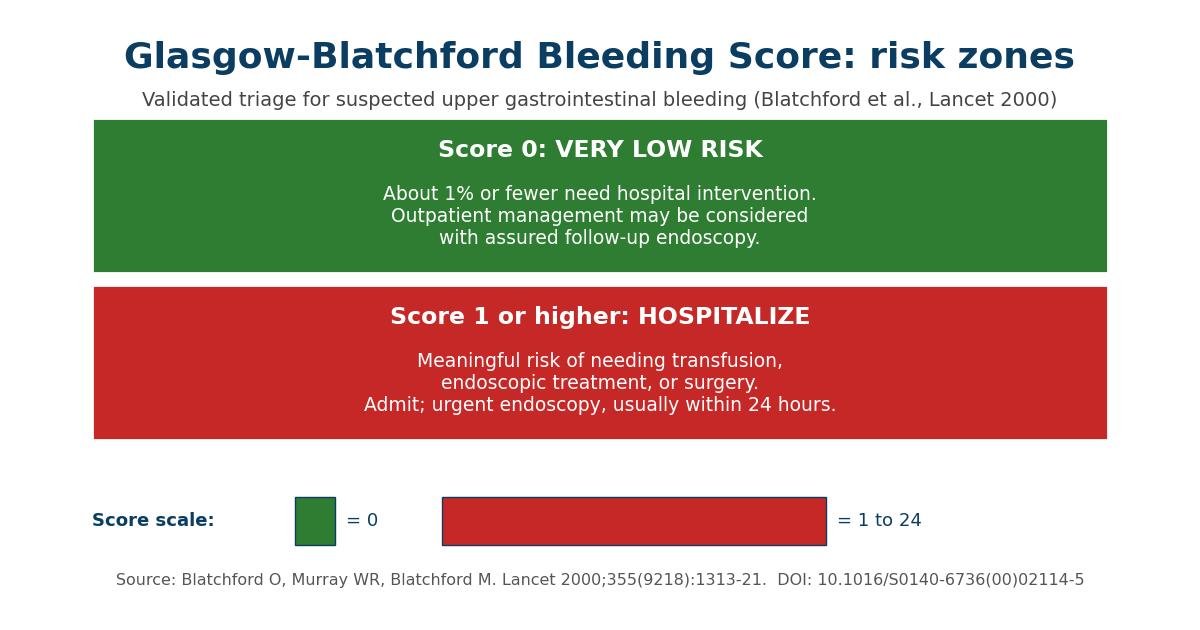
The single most important cut point in the Glasgow-Blatchford score is between 0 and 1. A score of 0 defines a very-low-risk group: in validation work, about 1% or fewer of these patients needed transfusion, endoscopic therapy, or surgery. This is the only group for whom outpatient management can be considered, and even then only when the clinical assessment agrees with the number, the patient is truly stable, and a definite plan for timely outpatient endoscopy and follow-up is in place. A score of 0 does not mean no bleeding happened; it means the predicted need for hospital intervention is very low.
Any score of 1 or higher means hospital admission. That threshold is deliberately sensitive: it captures essentially all patients who will go on to need intervention, at the cost of admitting some who ultimately would have been fine. Once admitted, management follows standard upper gastrointestinal bleeding care: monitoring, resuscitation as needed, review of anticoagulant and antiplatelet medicines, and early upper endoscopy, generally within 24 hours of presentation, to identify and treat the bleeding source. Patients with higher scores deserve closer monitoring and earlier senior and endoscopy input, because the likelihood of transfusion and therapeutic endoscopy rises with the score.
To make the result transparent, this calculator shows a breakdown of where every point came from. If a score surprises you, check the inputs first: a mis-entered urea or hemoglobin value, a blood pressure recorded after fluids rather than on arrival, or a forgotten history of liver disease can all move the total by several points. Scores should always be interpreted alongside the patient in front of you, not in isolation.
Evidence behind the score
The score comes from Blatchford O, Murray WR, Blatchford M, "Prediction of need for treatment of upper gastrointestinal haemorrhage by clinical and laboratory features", published in The Lancet, volume 355, issue 9218, pages 1313 to 1321, in the year 2000 (DOI: 10.1016/S0140-6736(00)02114-5). The authors collected prospective data on consecutive patients presenting with acute upper gastrointestinal bleeding and used logistic regression to build a model predicting the need for treatment, then simplified it into the point score. They validated it in a separate patient sample, which is an important marker of reliability: many prediction rules are never tested outside the data they were built on.
Since 2000, the score has been validated in many countries and clinical settings, and it has consistently shown very high sensitivity for identifying patients who need intervention, which is exactly what a triage test must do. Its main clinical achievement has been to define the score-0 group: before this rule, nearly all patients with suspected upper gastrointestinal bleeding were admitted, but the score gave clinicians an evidence-based way to identify the small minority who could safely be managed without admission. Major guidelines on upper gastrointestinal bleeding now recommend pre-endoscopy risk stratification, and the Glasgow-Blatchford score is the most widely recommended instrument for that purpose.
Comparisons with the Rockall score, the other classic upper gastrointestinal bleeding score, have generally found the Glasgow-Blatchford score more sensitive for predicting the need for intervention, while the Rockall score, which incorporates endoscopic findings and age and comorbidity in more detail, performs well for predicting mortality and rebleeding after endoscopy. They answer different questions at different moments, which is why many clinicians use both in sequence.
Limitations to keep in mind
No prediction rule is perfect, and the Glasgow-Blatchford score has recognized limits. First, it was derived in emergency presentations of suspected upper gastrointestinal bleeding, so applying it to other populations, such as inpatients who bleed during a hospital stay for another reason, stretches beyond its evidence base. Second, the score depends on laboratory results, which means it cannot be completed until blood tests return; in practice this is usually fast, but it is not an instant bedside-only score. Third, some inputs require judgment: "hepatic disease" and "cardiac failure" mean known, clinically significant disease, not borderline or suspected diagnoses, and different clinicians may classify edge cases differently.
Fourth, the score predicts the need for intervention, not the diagnosis. A high score does not distinguish a bleeding ulcer from varices or a Mallory-Weiss tear, and management of the underlying cause still needs endoscopy and clinical assessment. Fifth, anticoagulant and antiplatelet use, common in this patient population, is not a direct component of the score, although its consequences show up indirectly through hemoglobin and vital signs. Finally, thresholds derived decades ago may behave slightly differently as populations, medicines, and endoscopy practice change, which is why the score supports, but never replaces, clinical judgment.
How to use this calculator
Select the patient's sex, because the hemoglobin bands differ for men and women. Enter the blood urea nitrogen in mg/dL (multiply a mmol/L value by 2.8 first), the hemoglobin in g/dL, the systolic blood pressure in mmHg, and the pulse in beats per minute, all from the initial presentation if possible, since values after resuscitation can mask the true severity. Tick melena if black tarry stool was found on examination or reported as the presenting feature, syncope if the patient fainted or nearly fainted around the time of bleeding, and the comorbidity boxes for known hepatic disease or cardiac failure. Press Calculate to see the total score, the point breakdown, and the recommended disposition. You can adjust any value and recalculate to explore how each variable moves the total, which is also a useful teaching exercise for trainees learning the score.
Key takeaways
- The Glasgow-Blatchford Bleeding Score (GBS) is a validated clinical prediction rule that estimates the risk that a patient presenting with upper gastrointestinal bleeding will need hospital-based intervention, such as blood transfusion, endoscopic treatment, or surgery.
- A score of 0 identifies patients at very low risk.
- A score of 1 or higher means the patient should be admitted to hospital for observation and monitoring.
- The score uses blood urea nitrogen (BUN), hemoglobin (with sex-specific bands), systolic blood pressure, pulse rate, plus melena, syncope, hepatic disease, and cardiac failure.
Frequently asked questions
What is the Glasgow-Blatchford Bleeding Score used for?
The Glasgow-Blatchford Bleeding Score (GBS) is a validated clinical prediction rule that estimates the risk that a patient presenting with upper gastrointestinal bleeding will need hospital-based intervention, such as blood transfusion, endoscopic treatment, or surgery. It was designed to be calculated at first presentation, using only vital signs, bedside findings, and routine blood results, so clinicians can decide who needs urgent hospital care and who is at such low risk that outpatient management can be considered.
What does a Glasgow-Blatchford score of 0 mean?
A score of 0 identifies patients at very low risk. In validation studies, about 1% or fewer of patients scoring 0 needed transfusion, endoscopic treatment, or surgery. Guidelines therefore allow selected score-0 patients to be managed as outpatients with timely follow-up endoscopy, provided the clinical picture matches the numbers and a reliable follow-up plan exists. A score of 0 never overrides signs of instability or clinician concern.
What should be done for a Glasgow-Blatchford score of 1 or higher?
A score of 1 or higher means the patient should be admitted to hospital for observation and monitoring. Because even low positive scores carry a meaningful risk of needing intervention, guidelines recommend prompt resuscitation, correction of coagulopathy where present, and early (urgent) upper endoscopy, usually within 24 hours, to find and treat the bleeding source. Higher scores signal greater urgency and a higher likelihood of transfusion or therapeutic endoscopy.
Which variables does the score use, and why blood urea and hemoglobin?
The score uses blood urea nitrogen (BUN), hemoglobin (with sex-specific bands), systolic blood pressure, pulse rate, plus melena, syncope, hepatic disease, and cardiac failure. BUN rises when blood proteins are digested in the upper gut, so a high BUN with a falling hemoglobin suggests significant upper gastrointestinal blood loss. Low hemoglobin, low blood pressure, and a fast pulse all reflect the physiological impact of bleeding, while syncope, melena, and comorbid liver or heart disease mark patients more likely to deteriorate.
How does the Glasgow-Blatchford score differ from the Rockall score?
The key difference is timing. The Glasgow-Blatchford score uses only information available at first presentation (vital signs, examination, and basic blood tests), so it supports the initial decision to admit or consider outpatient care. The Rockall score also predicts mortality and rebleeding, but its full version requires endoscopic findings, which are only known after the procedure. In practice the two scores complement each other: Blatchford at the door, Rockall after endoscopy.
Can the Glasgow-Blatchford score be used for lower gastrointestinal bleeding?
No, it should not. The score was derived and validated specifically in patients with suspected upper gastrointestinal bleeding, and its components (especially blood urea and melena) reflect upper-gut blood loss physiology. It is also not validated in children. For lower gastrointestinal bleeding or pediatric patients, different assessment tools and local protocols apply, and any gastrointestinal bleeding with hemodynamic instability needs emergency evaluation regardless of any score.