Calculate your FIB-4
Why non-invasive fibrosis staging matters
The liver responds to chronic injury the same way skin responds to a cut: it lays down scar tissue. In the liver this scar tissue is called fibrosis, and when the injury goes on for years, from fatty liver disease, chronic viral hepatitis, or long-term heavy alcohol use, the scarring can progress through well-defined stages. Pathologists grade this on scales such as Metavir, which runs from F0 (no fibrosis) to F4 (cirrhosis), and Ishak, which runs from 0 to 6. The turning point that clinicians care about most is advanced fibrosis, roughly Ishak stages 4 to 6 or Metavir F3 to F4, because it is the stage at which the risk of serious complications, including cirrhosis, portal hypertension, liver failure and liver cancer, begins to climb steeply.
Knowing the stage changes management. A patient with simple fatty liver and no significant fibrosis mainly needs lifestyle measures and periodic monitoring, while a patient with advanced fibrosis needs surveillance for liver cancer and varices, vaccination review, medication adjustment, and often a referral to a liver specialist. This matters at population scale: non-alcoholic fatty liver disease, now usually called metabolic dysfunction-associated steatotic liver disease, is estimated to affect roughly one in four adults worldwide (Younossi et al., Hepatology 2016), which means clinicians need a practical way to sort the large number of people with abnormal liver tests or fatty liver on ultrasound into those who can be safely watched and those who need prompt specialist care.
For decades the reference method for staging was liver biopsy: a needle sample of liver tissue examined under the microscope. Biopsy is accurate in experienced hands, but it is invasive, with a small but real risk of bleeding and other complications, and it samples only a tiny fraction of an organ in which fibrosis is often unevenly distributed, so sampling error is a genuine problem. It is also expensive, uncomfortable, and difficult to repeat often. Because of these drawbacks, hepatology has spent the last twenty years developing non-invasive alternatives: simple blood-based scores, proprietary panels, and imaging techniques such as elastography. The FIB-4 index is the simplest and most widely validated of the blood-based scores, requiring only four values that are already present on a routine blood count and liver panel.
What the FIB-4 index is and where it came from
The FIB-4 index was developed by Sterling and colleagues and published in Hepatology in 2006. The original purpose was a practical one: the authors studied adults with HIV and hepatitis C coinfection and wanted a simple index, built from ordinary laboratory values, that could predict significant fibrosis without a biopsy. Using data from their cohort, they combined four variables, age, AST, ALT and platelet count, into a single formula and showed that it could separate patients with advanced fibrosis (Ishak stages 4 to 6) from those without it with clinically useful accuracy.
What made FIB-4 unusual, and why it is still in daily use twenty years later, is that it escaped its original niche. Researchers soon tested it in hepatitis C alone, in hepatitis B, in alcohol-related liver disease, and above all in non-alcoholic fatty liver disease, where the need for a cheap triage test is greatest. In study after study it held up as a reliable first-line tool: not perfect, but good enough to rule out advanced fibrosis in a large share of patients and to flag those who need further testing. Major liver societies now incorporate it into care pathways for NAFLD, typically as the first step before elastography or referral. Its appeal has never changed: no new blood draw, no proprietary kit, no special equipment, just arithmetic on numbers the patient already has.
The formula, explained piece by piece
The FIB-4 formula is:
Each of the four components earns its place for a physiological reason. Age sits in the numerator because fibrosis is the product of time: the longer an injurious process has been running, the more scar has accumulated, and in the original Sterling cohort older age was independently associated with advanced fibrosis. AST also sits in the numerator: it is an enzyme released from injured liver cells, and as fibrosis advances the AST level tends to rise and, characteristically, to exceed ALT, the well-known AST-to-ALT reversal seen in cirrhosis. Putting AST on top therefore pushes the score upward as liver injury and scarring worsen.
The denominator works in the opposite direction. The platelet count falls as fibrosis advances, for two reasons that reinforce each other. First, progressive scarring raises pressure in the portal vein, the spleen enlarges, and the enlarged spleen traps and destroys platelets. Second, the scarred liver produces less thrombopoietin, the hormone that tells the bone marrow to make platelets. A falling platelet count therefore signals advancing disease, and because it sits in the denominator, it drives the FIB-4 score upward, exactly as intended.
The square root of ALT is the subtlest term. ALT is the more liver-specific of the two transaminases and a sensitive marker of current inflammation. Taking its square root, rather than the raw value, dampens its influence: it keeps the score from being dominated by a transient inflammatory flare while still letting genuine chronic injury contribute. In effect, the formula compares the age-and-AST signal of accumulated injury against a platelet term that reflects the structural consequences of fibrosis, with ALT acting as a moderating factor.
A worked example makes the arithmetic concrete. Take a 50-year-old with AST 40 U/L, ALT 36 U/L and a platelet count of 200 x10^9/L. The numerator is 50 x 40 = 2000. The square root of 36 is 6, so the denominator is 200 x 6 = 1200. The FIB-4 is 2000 / 1200 = 1.67, which falls in the indeterminate band described below. Notice how ordinary these laboratory values are: none of them looks alarming on its own, which is precisely why a combined index is useful.
Interpreting your result: the three bands
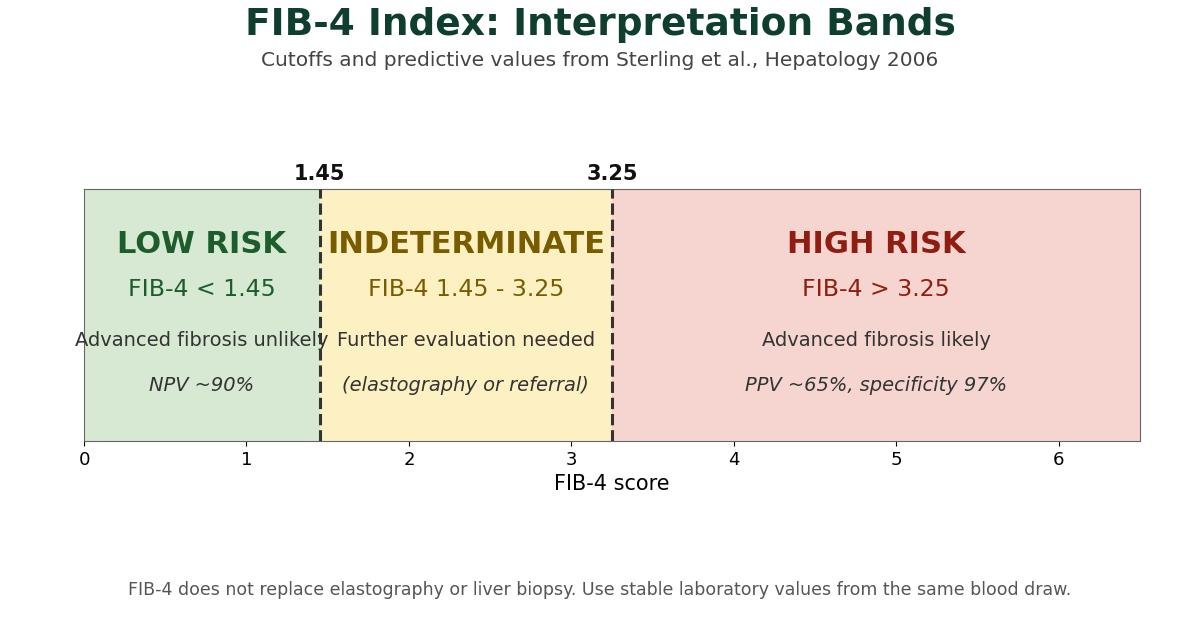
Sterling and colleagues derived two cutoffs from their validation cohort, 1.45 and 3.25, creating three bands. These are the cutoffs this calculator uses:
| FIB-4 score | Band | Meaning | Published performance (original cohort) |
|---|---|---|---|
| Below 1.45 | Low risk | Advanced fibrosis unlikely; routine monitoring usually sufficient | Negative predictive value about 90% |
| 1.45 to 3.25 | Indeterminate | Cannot classify; further evaluation needed | Neither cutoff applies; elastography or referral advised |
| Above 3.25 | High risk | Advanced fibrosis likely; specialist evaluation needed | Positive predictive value about 65%; specificity 97% |
The low-risk cutoff is the workhorse of the score. A negative predictive value of about 90 percent means that in the original cohort, roughly nine out of ten people scoring below 1.45 truly did not have advanced fibrosis (Ishak stages 4 to 6). That is the property clinicians exploit: a low FIB-4 lets them reassure the patient and continue routine monitoring without a biopsy or an urgent referral. The high-risk cutoff works the other way: a score above 3.25 had a positive predictive value of about 65 percent, meaning about two in three such patients did have advanced fibrosis, and a specificity of 97 percent, meaning false alarms were uncommon.
Two cautions belong with these numbers. First, they are the figures from the original 2006 cohort, and predictive values always depend on how common advanced fibrosis is in the population being tested: in a low-risk primary care population the negative predictive value is even better, while in a liver clinic the positive predictive value shifts. Second, the middle band is not a failure of the test but a designed feature: no single cutoff can classify everyone, and the indeterminate zone honestly identifies the patients for whom a blood score is not enough.
If you are 65 or older: the adjusted cutoff
There is one systematic quirk in the formula worth knowing about: age sits in the numerator, so the score drifts upward as people get older even when the liver is unchanged. Researchers noticed that this makes the standard 1.45 cutoff too strict for older adults, pushing many into the indeterminate band who turn out not to have advanced fibrosis. McPherson and colleagues addressed this in a 2017 study in The American Journal of Gastroenterology and proposed an age-adjusted low-risk cutoff: for adults aged 65 and above, use 2.0 instead of 1.45 to rule out advanced fibrosis, while keeping the 3.25 high-risk cutoff unchanged.
This calculator reports the standard 1.45 and 3.25 cutoffs for everyone, because those remain the validated defaults, but if you enter an age of 65 or older it shows an additional note explaining the 2.0 alternative. A 70-year-old scoring 1.8, for example, is indeterminate by the standard cutoffs but would be considered low risk under the age-adjusted proposal. The note is context for your discussion with your clinician, not a second diagnosis: the adjusted cutoff is a later proposal layered on top of the original validation, and your doctor decides which threshold guides your care.
FIB-4 versus APRI, elastography and biopsy
FIB-4 is not the only non-invasive option, and it helps to know where it sits in the lineup. Its closest relative is APRI, the AST-to-platelet ratio index (Wai et al., Hepatology 2003), calculated as (AST divided by the upper limit of normal, divided by the platelet count) multiplied by 100. APRI is even simpler, using only two variables, and it was designed for hepatitis C. In head-to-head comparisons, particularly in fatty liver disease, FIB-4 has generally performed at least as well and often better, which is why many current NAFLD pathways start with FIB-4 rather than APRI. Neither score requires anything beyond routine labs.
Transient elastography, best known by the FibroScan brand name, is the next step up the accuracy ladder. A probe placed on the skin sends a shear wave through the liver and measures how fast it travels; stiffer, more fibrotic tissue transmits the wave faster. Elastography is more accurate than any blood score for grading fibrosis and is the usual test ordered for patients whose FIB-4 lands in the indeterminate band. Its limitations are practical: it needs the device, a trained operator, and a clinic visit, and results can be distorted by obesity, a narrow rib space, or a recent meal.
Liver biopsy remains the reference standard against which everything else is judged, and it is still required when the non-invasive workup is inconclusive or when another diagnosis needs tissue confirmation. The modern approach is therefore a stepwise one: FIB-4 first as the cheap, everywhere-available triage test, elastography for the indeterminate and high-risk groups, and biopsy reserved for cases where the question cannot be answered any other way. One rule from the task brief is worth repeating plainly: FIB-4 does not replace elastography or biopsy for indeterminate results. An indeterminate score is a referral, not a shrug.
Limitations you should know
Every component of the formula can mislead in the wrong clinical setting. Acute hepatitis, a disease flare, or a recent bout of heavy drinking sharply inflates AST and ALT, and because AST sits in the numerator the score can surge into the high-risk band even though no new fibrosis has formed. For this reason the score should only be calculated from stable, routine laboratory values, never during an acute illness or flare. Similarly, a low platelet count from causes unrelated to liver disease, such as heavy alcohol use itself, certain medications, or hematologic disorders, will inflate the score through the denominator and produce a falsely alarming result.
The age term cuts both ways: in young adults the score can underestimate risk because the numerator is small, while in the elderly it overestimates, which is exactly the problem the 2.0 adjusted cutoff tries to fix. FIB-4 says nothing about fat in the liver, so it cannot distinguish simple steatosis from steatohepatitis; it answers only the fibrosis question. Finally, like all predictive values, its performance shifts with the population: a score validated in specialty cohorts behaves differently when applied to unselected primary care patients, which is why the published 90 percent negative predictive value and 65 percent positive predictive value should be read as the original cohort's results rather than universal guarantees.
How to use this calculator
Collect the four values from a single set of blood tests: your age at the time of the draw, AST and ALT from the liver panel, and the platelet count from the complete blood count. Using values from the same blood draw matters, because the formula is meant to capture one moment in time. Enter AST and ALT in U/L and the platelet count in x10^9/L; if your report gives platelets in K/uL or x10^3/uL, the number is identical, so enter it as printed. Avoid calculating the score from results drawn during an acute illness, a known hepatitis flare, or shortly after starting a drug known to injure the liver, and wait until your clinician confirms the values reflect your stable state. Bring the result, along with the actual laboratory printout, to your appointment: the number is most useful when your clinician interprets it alongside your history, examination, imaging, and any prior scores, so that a trend over time can be judged rather than a single snapshot.
Key takeaways
- A FIB-4 below 1.45 is the published low-risk cutoff.
- An indeterminate result means FIB-4 alone cannot classify your risk, so the next step is further evaluation, typically transient elastography (such as FibroScan) or a hepatology referral.
- No, you should wait.
- No special preparation is required.
Frequently asked questions
What FIB-4 score rules out advanced liver fibrosis?
A FIB-4 below 1.45 is the published low-risk cutoff. In the original validation cohort of Sterling et al. (Hepatology 2006), a score below 1.45 had a negative predictive value of about 90 percent for excluding advanced fibrosis (Ishak stages 4 to 6). For adults aged 65 or older, some guidance suggests using 2.0 as the low-risk cutoff instead (McPherson et al., 2017).
What should I do if my FIB-4 is in the indeterminate range of 1.45 to 3.25?
An indeterminate result means FIB-4 alone cannot classify your risk, so the next step is further evaluation, typically transient elastography (such as FibroScan) or a hepatology referral. FIB-4 does not replace elastography or liver biopsy for indeterminate results. Discuss the finding with your clinician rather than ignoring it or treating it as a diagnosis.
Can I use FIB-4 during a hepatitis flare or acute liver injury?
No, you should wait. Acute hepatitis and flares sharply inflate AST and ALT, which drives the FIB-4 score up even when no additional fibrosis has formed. For a meaningful result, use laboratory values from a stable period and have your clinician confirm the timing.
Do I need to fast before the blood tests used in FIB-4?
No special preparation is required. FIB-4 uses a routine complete blood count (for the platelet count) and a standard liver panel (for AST and ALT), which are drawn as part of ordinary care. All four values should come from blood drawn at the same visit so they reflect the same moment in time.
Does a high FIB-4 mean I have cirrhosis?
No. A score above 3.25 indicates a high risk of advanced fibrosis, with a positive predictive value of about 65 percent in the original cohort, but it is not a diagnosis of cirrhosis. Confirmation with elastography, imaging, or biopsy, interpreted by a clinician, is still required before any diagnosis is made.
How often should the FIB-4 be repeated?
There is no single mandated interval; it depends on your liver condition and your clinician's monitoring plan. In chronic liver disease such as NAFLD, clinicians commonly reassess non-invasive fibrosis markers when routine follow-up blood work is redrawn, so that trends over time can be tracked alongside the latest clinical picture.
References
- Sterling RK, Luterer E, Stravitz RT, et al. Development of a simple noninvasive index to predict significant fibrosis in patients with HIV/HCV coinfection. Hepatology. 2006;44(5):1317-1325. (Source of the FIB-4 formula and the 1.45 / 3.25 cutoffs, with a negative predictive value of about 90% below 1.45 and a positive predictive value of about 65% with 97% specificity above 3.25 for Ishak stages 4-6.)
- McPherson S, Hardy T, Dufour JF, et al. Age as a confounding factor for the accurate non-invasive diagnosis of advanced NAFLD fibrosis. Am J Gastroenterol. 2017;112(5):740-751. (Proposal of the age-adjusted low-risk cutoff of 2.0 for adults aged 65 and above.)
- Younossi ZM, Koenig AB, Abdelatif D, et al. Global epidemiology of nonalcoholic fatty liver disease: meta-analytic assessment of prevalence, incidence, and outcomes. Hepatology. 2016;64(1):73-84. (Global NAFLD prevalence estimate of roughly one in four adults.)
- Wai CT, Greenson JK, Fontana RJ, et al. A simple noninvasive index can predict both significant fibrosis and cirrhosis in patients with chronic hepatitis C. Hepatology. 2003;38(2):518-526. (Source of the APRI formula used for comparison.)
- American Association for the Study of Liver Diseases
- American College of Gastroenterology