What is the MELD-Na score?
The Model for End-Stage Liver Disease with sodium, usually shortened to MELD-Na, is an objective score that grades the severity of chronic liver disease in adults. It is built from four routine laboratory values: total bilirubin, the international normalised ratio (INR), serum creatinine, and serum sodium. Because every input is a measured number rather than a clinical impression, two clinicians scoring the same patient will arrive at the same result, which made the historical score reproducible. It is not the current United States transplant-allocation formula.
The score ranges from 6 to 40. A higher number means more severe disease and a higher probability of death within the next 90 days without transplantation. Transplant programmes use it to rank waiting-list candidates: when a donor liver becomes available, it is generally offered to the compatible candidate with the highest score, because that person faces the greatest short-term risk. The score therefore serves two purposes at once. It gives patients and families a realistic sense of prognosis, and it gives allocation systems a fair, transparent rule for distributing a scarce resource.
It is important to understand what the score does not do. It does not diagnose liver disease, it does not measure quality of life, and it does not predict how a patient will feel next month. It is a population-derived statistical model, so an individual patient can always do better or worse than the score suggests. Clinicians use it alongside the physical examination, imaging, the trend of laboratory values over time, and complications such as ascites, variceal bleeding and hepatic encephalopathy.
From MELD to MELD-Na: a short history
The story begins in 2000, when Malinchoc and colleagues published the original MELD model in Hepatology. They had set out to predict survival after transjugular intrahepatic portosystemic shunt (TIPS), a procedure that relieves portal hypertension but can precipitate liver failure. Their model combined bilirubin, INR and creatinine with the cause of the liver disease. A year later, Kamath and colleagues at the Mayo Clinic showed that the same three laboratory values, without the disease-etiology term, predicted survival across a much broader population of patients with chronic liver disease. Then Wiesner and colleagues demonstrated in 2003 that this simplified MELD score accurately predicted three-month mortality among patients on the liver transplant waiting list. On the strength of that evidence, the United Network for Organ Sharing (UNOS) adopted MELD for organ allocation in February 2002, replacing a older system based on waiting time and subjective clinical categories.
Clinicians soon noticed a pattern that the original MELD formula did not capture. Patients with low serum sodium, a condition called hyponatraemia, died at higher rates than their MELD score alone predicted. Low sodium in cirrhosis is not a coincidence: it reflects the same failing circulation that drives ascites and kidney injury, and several studies identified it as an independent predictor of waiting-list mortality. In 2008, Kim and colleagues published the definitive analysis in Hepatology (volume 47, issue 5, pages 1594-1602, DOI 10.1002/hep.22297). Working with United States waiting-list data, they derived the sodium-adjusted formula used on this page and showed that it predicted mortality more accurately than MELD alone. Their analysis estimated that allocating organs by MELD-Na could have prevented roughly 7 percent of waiting-list deaths in the study population, a finding that eventually led to the adoption of MELD-Na for allocation.
The formula, step by step
The calculation happens in two stages. First the standard MELD score is computed:
Bilirubin and creatinine are entered in mg/dL. Before the logarithms are taken, three adjustments are applied. Any laboratory value below 1.0 is raised to 1.0, because the natural logarithm of a fraction would be negative and would otherwise distort the score. Creatinine is capped at 4.0 mg/dL, so extreme kidney injury cannot push the score beyond its validated range; if the patient is receiving dialysis, creatinine is set to 4.0 mg/dL outright, since dialysis artificially lowers the measured value. The result is rounded to the nearest whole number and capped at 40.
Next, the sodium adjustment of Kim et al. is applied:
Sodium is entered in mEq/L, which is numerically identical to mmol/L. The formula only gives credit for low sodium: the value is clamped to a minimum of 125 and a maximum of 137. A sodium of 137 or higher leaves the score unchanged, so MELD-Na equals MELD. A sodium of 125 or lower is treated as exactly 125, so the adjustment has a defined floor. The final MELD-Na value is rounded to the nearest whole number and also capped at 40.
Notice the interaction term, 0.033 x MELD x (137 - Na). It means the sodium adjustment shrinks as the MELD score itself rises. A patient with a low MELD score gains substantial points from hyponatraemia, while a patient whose MELD is already near 40 gains almost nothing, which matches the clinical observation that sodium adds the most information when the other values are not yet extreme.
How to use this calculator
Gather the four most recent laboratory results: total bilirubin, INR, serum creatinine and serum sodium. If your laboratory reports bilirubin or creatinine in SI units (micromoles per litre), convert them first by dividing bilirubin by 17.1 and creatinine by 88.4. Enter the values in the form above, tick the dialysis box only if the patient is currently receiving dialysis, and press the calculate button. The tool will show the MELD score, the MELD-Na score and the corresponding risk band. If a field is left empty or contains an invalid value, the calculator will name the problem instead of guessing, because a silently wrong score in this setting could mislead a real decision.
All calculation happens inside your browser. No data is sent to any server, stored, or shared, so the tool is safe to use with real patient values on a private device.
Interpreting your result
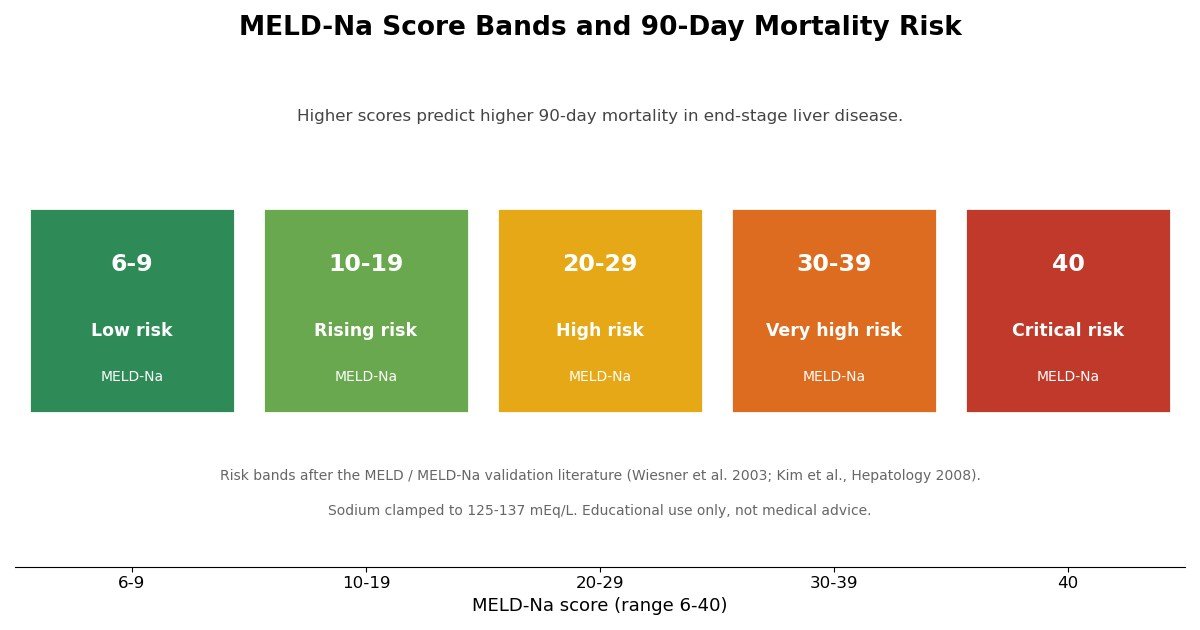
The MELD-Na literature commonly describes the following 90-day risk bands: scores of 6 to 9 indicate low short-term risk, 10 to 19 rising risk, 20 to 29 high risk, 30 to 39 very high risk, and 40 critical risk. These bands are qualitative summaries of the mortality curve reported in the MELD and MELD-Na validation studies of Wiesner et al. and Kim et al. A score in the single digits is reassuring in the short term but still warrants regular follow-up, because liver disease can progress. A score in the twenties or higher should prompt a conversation with a hepatologist about transplant evaluation if that has not already happened.
Two scores computed from the same blood draw can differ. If sodium is normal, MELD and MELD-Na are identical. If sodium is low, MELD-Na will be the higher of the two, sometimes by several points, which can meaningfully change waiting-list priority. Always check which version of the score a clinic or transplant centre is quoting before comparing numbers across visits or institutions.
Why sodium matters in cirrhosis
Hyponatraemia is one of the most frequent complications of advanced cirrhosis, and understanding why it happens explains why it earned a place in the score. Portal hypertension causes widespread dilation of the splanchnic blood vessels, which reduces the effective circulating blood volume even though total body water is increased. The body interprets this as dehydration and releases antidiuretic hormone, which instructs the kidneys to retain free water. The retained water dilutes the sodium in the blood. This is called dilutional hyponatraemia, and it is a marker of just how profoundly the circulation has been disrupted.
The same haemodynamic disturbance drives the other feared complications of cirrhosis. Reduced effective blood volume activates the renin-angiotensin system and the sympathetic nervous system, constricting the renal arteries and setting the stage for hepatorenal physiology. Fluid leaks into the abdomen as ascites. The brain, exposed to both low sodium and the toxins of liver failure, becomes more vulnerable to hepatic encephalopathy. A low sodium value therefore summarises a whole syndrome of decompensation in a single number, which is exactly why Kim and colleagues found that it added prognostic information beyond bilirubin, INR and creatinine alone.
It is worth noting that sodium can be lowered by factors outside the liver disease itself, such as diuretic therapy, excessive water intake or intravenous hypotonic fluids. Clinicians interpret the sodium value in context rather than treating it as a pure liver signal, another reason the score supports but never replaces clinical judgment.
Limitations you should know
No model fits every patient, and MELD-Na has well-documented weaknesses. Creatinine is a product of muscle metabolism, so patients with low muscle mass, including many women and older adults, can have deceptively low creatinine values that understate their kidney dysfunction and therefore their score. INR can be raised by anticoagulant drugs such as warfarin, which inflates the score for reasons unrelated to liver function. Sodium, as noted above, responds to diuretics and fluid management. Laboratory methods also differ between hospitals, so a score computed from one laboratory's assays may not be exactly comparable with another's.
The score was derived in adults with chronic liver disease, so it should not be applied to children, for whom the PELD score is used, or to acute liver failure, where the tempo of illness is entirely different. In 2021, Kim and colleagues published MELD 3.0, a revised model that adds serum albumin and female sex and updates the coefficients; the United States organ allocation system adopted MELD 3.0 in 2023. The calculator on this page implements the widely used MELD-Na version from 2008, which remains the reference in most textbooks and in many countries. If your centre uses MELD 3.0, ask them to confirm which formula your quoted score follows.
When clinicians use MELD-Na
Beyond transplant waiting lists, clinicians reach for the score in several situations. Before TIPS placement or abdominal surgery in a patient with cirrhosis, the score helps estimate perioperative risk and informs the consent discussion. In the intensive care unit it contributes to triage and goals-of-care conversations when a patient with decompensated cirrhosis deteriorates. Hepatologists track it over time as an objective trend line: a score climbing from 12 to 22 over six months tells a clearer story than any single symptom. Researchers use it to stratify patients in clinical trials so that treatment groups are comparable in disease severity.
In every one of these settings the score is a starting point for judgment, not a verdict. A patient with a score of 14 and refractory ascites may be sicker than the number suggests, while a patient with a score of 24 driven by a reversible insult such as an infection may improve dramatically once the trigger is treated. The number earns its keep by making the severity explicit and comparable; the clinician earns theirs by interpreting it.