NAFLD Fibrosis Score (NFS) Calculator
In short: Free NAFLD Fibrosis Score (NFS) calculator. Estimate the probability of advanced liver fibrosis in NAFLD using age, BMI, diabetes status, AST/ALT ratio, platelets and albumin. Use the calculator above, then read the guide below to interpret your result and its limitations.
The NAFLD Fibrosis Score (NFS) estimates the probability of advanced liver fibrosis (stage F3 to F4) in adults with non-alcoholic fatty liver disease, using six routine clinical variables: age, body mass index, diabetes status, the AST to ALT ratio, platelet count, and serum albumin. Enter your values below to calculate your score instantly.
Reference: Angulo P, Hui JM, Marchesini G, et al. The NAFLD fibrosis score: a noninvasive system that identifies liver fibrosis in patients with NAFLD. Hepatology. 2007;45(4):846-854. doi: 10.1002/hep.21496
What Is the NAFLD Fibrosis Score?
Non-alcoholic fatty liver disease (NAFLD) is now the most common chronic liver condition in the world, affecting roughly one in four adults globally. The disease ranges from simple fat accumulation in the liver (steatosis), which is usually harmless, to non-alcoholic steatohepatitis (NASH), where inflammation and cell injury drive progressive scarring. The single strongest predictor of liver-related death in these patients is not the amount of fat or even the inflammation, but the stage of fibrosis: the extent to which healthy liver tissue has been replaced by scar tissue. Bridging fibrosis (stage F3) and cirrhosis (stage F4) carry a markedly higher risk of liver failure, portal hypertension and hepatocellular carcinoma, while stages F0 to F2 can often be managed safely without specialist care.
The problem facing clinicians is that fibrosis stage cannot be felt, seen on a routine ultrasound or inferred from a single blood test. Liver biopsy is the traditional reference standard, but it is invasive, expensive and samples only a tiny fraction of the organ, so it cannot be offered to the hundreds of millions of people living with NAFLD. The NAFLD Fibrosis Score was created to fill this gap. Developed by Angulo and colleagues and published in Hepatology in 2007, it was derived from 480 patients with biopsy-proven NAFLD and validated in a separate group of 253 patients. Six variables that are already collected in routine care are combined into one number that separates patients into low, indeterminate and high probability of advanced fibrosis. In the validation cohort the score achieved an area under the receiver operating characteristic curve of 0.88, with a negative predictive value of 93 percent at the low cutoff and a positive predictive value of 90 percent at the high cutoff.
The NFS Formula and What Each Variable Means
The NAFLD Fibrosis Score is calculated as follows:
NFS = -1.675 + 0.037 x age (years) + 0.094 x BMI (kg/m²) + 1.13 x (impaired fasting glucose or diabetes: yes = 1, no = 0) + 0.99 x (AST/ALT ratio) - 0.013 x platelet count (x10⁸/L) - 0.66 x albumin (g/dL)
Each term reflects a known biological driver of fibrosis risk. Age and body mass index capture the two strongest epidemiological risk factors: fibrosis prevalence rises with age, and obesity drives the insulin resistance at the heart of NAFLD. The diabetes term (which also counts impaired fasting glucose) adds more than a full point to the score, reflecting how central disordered glucose metabolism is to progressive disease. The AST to ALT ratio flips in advanced fibrosis: while ALT typically exceeds AST in simple steatosis, AST rises above ALT as scarring progresses, so a ratio above 1.0 pushes the score upward. Platelet count falls as portal hypertension develops and the enlarged spleen sequesters platelets, which is why a low platelet count raises the score. Finally, albumin is made by the liver, so a declining albumin signals failing synthetic function and increases the score.
How to Use This Calculator
Enter your age in years. For body mass index you have two options: let the calculator compute it from your height and weight, using either metric units (centimetres and kilograms) or imperial units (inches and pounds), or enter a known BMI value directly. Select whether you have impaired fasting glucose or diabetes, then enter your most recent AST and ALT values in units per litre, your platelet count in billions per litre (x10⁸/L, the standard unit on most laboratory reports), and your serum albumin in grams per decilitre. All seven inputs are required for a valid result. The calculator first checks that every field contains a plausible number and then applies the published formula exactly as described in the original paper, rounding the displayed score to two decimal places. A colour-coded scale bar shows where your result sits relative to the two published cutoffs.
Interpreting Your Result
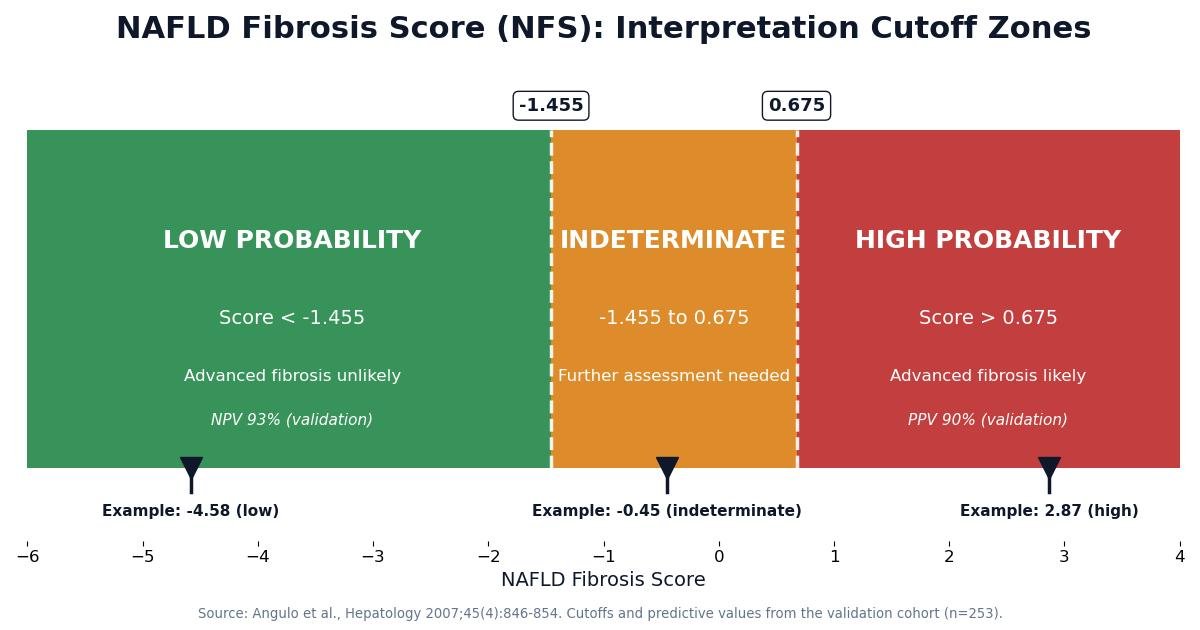
The original publication defines two cutoffs, creating three interpretation bands:
| Score | Band | Meaning |
|---|---|---|
| Below -1.455 | Low probability | Advanced fibrosis unlikely. In the validation cohort, 93 of every 100 patients scoring here had no advanced fibrosis on biopsy. |
| -1.455 to 0.675 | Indeterminate | The score cannot reliably rule fibrosis in or out. Further assessment, such as liver stiffness measurement, is appropriate. |
| Above 0.675 | High probability | Advanced fibrosis likely. In the validation cohort, 90 of every 100 patients scoring here had advanced fibrosis on biopsy. |
The band edges are inclusive: a score of exactly -1.455 or exactly 0.675 falls in the indeterminate band, consistent with the original paper. Note that the score estimates the probability of advanced fibrosis (stages F3 and F4), not the presence of fatty liver itself. A low score in someone with confirmed NAFLD is reassuring about fibrosis but does not mean the liver disease has resolved; lifestyle measures and metabolic risk management remain essential. Conversely, a high score is not a diagnosis of cirrhosis. It is a strong signal that specialist evaluation is warranted, and confirmation with imaging-based elastography or biopsy usually follows.
Accuracy and Evidence Behind the Score
The NFS is one of the most extensively validated non-invasive fibrosis scores in hepatology. Beyond the original derivation (AUROC 0.85) and validation (AUROC 0.88) cohorts reported by Angulo et al., the score has been tested in independent populations across North America, Europe and Asia, in cohorts with and without diabetes, and in severely obese patients undergoing bariatric surgery evaluation. Meta-analyses pooling these studies have consistently found summary AUROCs in the region of 0.80 to 0.85 for detecting advanced fibrosis, confirming that the score retains good discrimination outside the population in which it was developed. Its greatest strength is the low cutoff: with a negative predictive value around 93 percent, it reliably identifies the large group of NAFLD patients who do not have advanced fibrosis and can be managed in primary care.
That said, accuracy depends on context. Predictive values shift with disease prevalence, so in a low-risk primary care population a high score is less likely to reflect true advanced fibrosis than in a specialist liver clinic. The score also performs less well at the extremes of age: in patients over 65 the original cutoffs lose specificity, and several groups have proposed age-adjusted thresholds. These nuances do not invalidate the score, but they are why guidelines present it as a triage instrument rather than a standalone diagnosis.
NFS Compared With the FIB-4 Index
The FIB-4 index is the other widely used non-invasive fibrosis score, and many clinicians calculate both. FIB-4 uses only four variables (age, AST, ALT and platelet count) and was originally derived in patients with hepatitis C and HIV co-infection before being validated in NAFLD. Because it omits BMI, albumin and diabetes status, it is simpler but may miss risk carried by metabolic factors. Head-to-head comparisons in NAFLD cohorts have generally found similar overall accuracy, with the NFS sometimes performing slightly better in populations with high rates of obesity or diabetes, exactly the patients in whom those extra variables add information. In practice the two scores are complementary: the inputs are the same routine blood tests, so calculating both costs nothing, and agreement between them increases confidence in the result while disagreement pushes toward elastography.
Limitations to Keep in Mind
First, the score was developed and validated in adults with NAFLD, and it should not be applied to other liver diseases such as alcohol-related liver disease or viral hepatitis without recognising that the cutoffs were not calibrated for them. Second, the indeterminate band is wide: roughly one in four to one in three patients falls into it, and for these patients the score offers no actionable answer. Third, acute illness can distort the inputs. A transient spike in transaminases from an unrelated cause, or a low platelet count from a haematological condition, will move the score without reflecting true fibrosis. Fourth, the score has not been validated in children or adolescents. Fifth, as noted above, performance declines in older adults when the original cutoffs are used. Finally, the score is a snapshot. Fibrosis evolves over years, so a single low score does not grant permanent reassurance; guidelines suggest repeating non-invasive assessment periodically, particularly if metabolic risk factors worsen.
What Happens After the Score
A low score generally supports continued management in primary care: annual review of liver enzymes and metabolic risk factors, reinforcement of weight management, and treatment of diabetes, dyslipidaemia and hypertension. An indeterminate score usually triggers the next non-invasive step, most commonly vibration-controlled transient elastography (often known by the brand name FibroScan), which measures liver stiffness directly and pairs well with blood-based scores. A high score warrants prompt referral to a hepatologist or gastroenterologist. The specialist will confirm the finding, screen for complications of advanced fibrosis such as oesophageal varices and hepatocellular carcinoma, and review medications and alcohol intake for reversible contributors.
Whatever the score, the foundation of NAFLD care is the same. A sustained weight loss of 7 to 10 percent of body weight through a balanced diet and regular exercise can reduce liver fat, improve inflammation and even regress fibrosis in some patients. Tight control of blood sugar, cholesterol and blood pressure protects both the liver and the cardiovascular system, which remains the leading cause of death in people with NAFLD. Alcohol should be minimised or avoided entirely, since it accelerates fibrosis progression. A high NFS is therefore best understood not as a verdict but as a call to act: the earlier advanced fibrosis is recognised, the more can be done to slow or halt its course.
Frequently Asked Questions
What is the NAFLD fibrosis score used for?
The NAFLD Fibrosis Score (NFS) is a validated, non-invasive scoring system that estimates the probability of advanced liver fibrosis (stage F3 bridging fibrosis or stage F4 cirrhosis) in adults with non-alcoholic fatty liver disease (NAFLD). It combines six routine variables, age, body mass index, impaired fasting glucose or diabetes status, the AST to ALT ratio, platelet count and serum albumin, into a single score. It was developed by Angulo and colleagues and published in Hepatology in 2007. Clinicians use it to decide which patients need closer monitoring, specialist referral or further assessment such as elastography, and which patients can be safely managed in primary care, avoiding a liver biopsy in many cases.
What do the NAFLD fibrosis score cutoff values mean?
The original publication defines two cutoffs that create three bands. A score below -1.455 indicates a low probability of advanced fibrosis, and at this cutoff the score had a negative predictive value of 93 percent in the validation cohort, meaning 93 of every 100 people scoring below the cutoff did not have advanced fibrosis on biopsy. A score above 0.675 indicates a high probability of advanced fibrosis, with a positive predictive value of 90 percent in the validation cohort. Scores from -1.455 to 0.675 fall in an indeterminate zone where the score cannot reliably rule fibrosis in or out, and further evaluation, such as transient elastography or specialist assessment, is appropriate.
How accurate is the NAFLD fibrosis score?
In the original Angulo et al. 2007 study of 733 patients with biopsy-proven NAFLD, the score achieved an area under the receiver operating characteristic curve (AUROC) of 0.85 in the derivation group of 480 patients and 0.88 in the validation group of 253 patients. An AUROC of 0.88 indicates good discrimination between patients with and without advanced fibrosis. The low cutoff (-1.455) had a sensitivity of 90 percent and the high cutoff (0.675) a specificity of 97 percent in the validation cohort. Independent studies in diverse populations have confirmed similar performance, although accuracy can vary with disease prevalence and specific populations such as severely obese or diabetic cohorts.
Can the NAFLD fibrosis score replace a liver biopsy?
For many patients, yes, at least for the initial staging decision. Liver biopsy remains the reference standard for diagnosing and staging NAFLD, but it is invasive, costly and carries small risks of bleeding and sampling error. The NFS correctly classifies the majority of patients into low-risk or high-risk categories, in which the decision is clear: reassure and monitor, or refer and treat aggressively. Because roughly a quarter to a third of patients land in the indeterminate band, the score cannot replace biopsy or elastography in everyone. Current clinical guidelines therefore position the NFS and similar non-invasive scores as the first triage step, reserving biopsy for indeterminate or discordant cases.
What is the difference between the NFS and the FIB-4 index?
Both are non-invasive fibrosis scores for chronic liver disease, but they were derived differently and use different inputs. The NAFLD Fibrosis Score was developed specifically in patients with NAFLD and uses six variables including BMI, albumin and diabetes status, while the FIB-4 index was originally derived for hepatitis C and HIV co-infected patients and uses only age, AST, ALT and platelet count. In NAFLD populations both scores perform comparably, with the NFS sometimes showing a slight edge in cohorts with high obesity or diabetes prevalence because those risk factors are built into the formula. In practice many clinics calculate both, since the inputs are identical routine tests, and treat agreement between the scores as reassuring.
What should I do if my NAFLD fibrosis score is high?
A score above 0.675 suggests a high probability of advanced fibrosis, so the next step is to discuss the result with your clinician rather than treating the number as a diagnosis. Your doctor will usually confirm the finding with additional tests such as liver stiffness measurement by transient elastography (FibroScan), review for reversible causes of liver injury and assess complications. Regardless of the score, the cornerstone of NAFLD management is sustained weight loss of 7 to 10 percent of body weight through diet and exercise, tight control of diabetes, cholesterol and blood pressure, and avoidance of alcohol. These measures can improve liver histology even when fibrosis is present, so a high score is a call to act, not a verdict.
Key takeaways
- The NAFLD Fibrosis Score (NFS) is a validated, non-invasive scoring system that estimates the probability of advanced liver fibrosis (stage F3 bridging fibrosis or stage F4 cirrhosis) in adults with non-alcoholic fatty liver disease (NAFLD).
- The original publication defines two cutoffs that create three bands.
- In the original Angulo et al.
- For many patients, yes, at least for the initial staging decision.
References and further reading
Medically reviewed by Dr. Taimoor Asghar, Physician and Community Medicine Researcher. Last reviewed: 5 October 2026. Reference: Angulo P, Hui JM, Marchesini G, et al. The NAFLD fibrosis score: a noninvasive system that identifies liver fibrosis in patients with NAFLD. Hepatology. 2007;45(4):846-854. doi: 10.1002/hep.21496