Shock Index Calculator
Heart rate divided by systolic blood pressure, with cautious interpretation bands and an optional modified shock index.
In short: Heart rate divided by systolic blood pressure, with cautious interpretation bands and an optional modified shock index. Use the calculator above, then read the guide below to interpret your result and its limitations.
Calculate shock index
Required. Must be a positive number.
Required. Must be a positive number.
Optional. When provided, the calculator also shows modified shock index (heart rate divided by mean arterial pressure).
What shock index captures
Shock index captures a simple physiological truth: a rising heart rate and a falling blood pressure often appear together in the early stages of circulatory failure, and their combination is more alarming than either sign on its own. When the heart pumps less blood with each beat, for example during blood loss or severe infection, the body compensates by beating faster so that total output stays adequate for a while. Heart rate divided by systolic blood pressure turns that compensation into a single number. A healthy resting adult with a heart rate of 70 beats per minute and a systolic pressure of 120 mmHg has a shock index of 0.58, comfortably inside the normal range. If bleeding continues, the heart rate may climb to 110 while the systolic pressure drifts down to 95, giving 1.16, a value that flags concern. The index therefore does not measure a new vital sign. It repackages two familiar ones so that their joint movement becomes visible earlier than either would suggest alone. That is the whole appeal of the measure: it is fast, free, and available from the first set of observations in the field or at the bedside.
Because it is a ratio, shock index stays fairly stable when both numbers move in the same direction, which is what happens during healthy exertion, and it rises when they diverge in the wrong way. This property is why clinicians find it useful as an early warning signal. A patient can still have a normal blood pressure while the body is already working hard to keep it there, and the rising ratio can hint at that hidden effort before the pressure itself falls. Early emergency department research by Birkhahn RH and colleagues examined shock index in the evaluation of acute blood loss, and later cohort work extended the idea into trauma and sepsis care. Throughout this page, keep the honest framing in mind: the interpretation bands below are heuristics reported across cohort studies, not a validated diagnostic test, and the index is a risk flag rather than a diagnosis.
How the calculation works
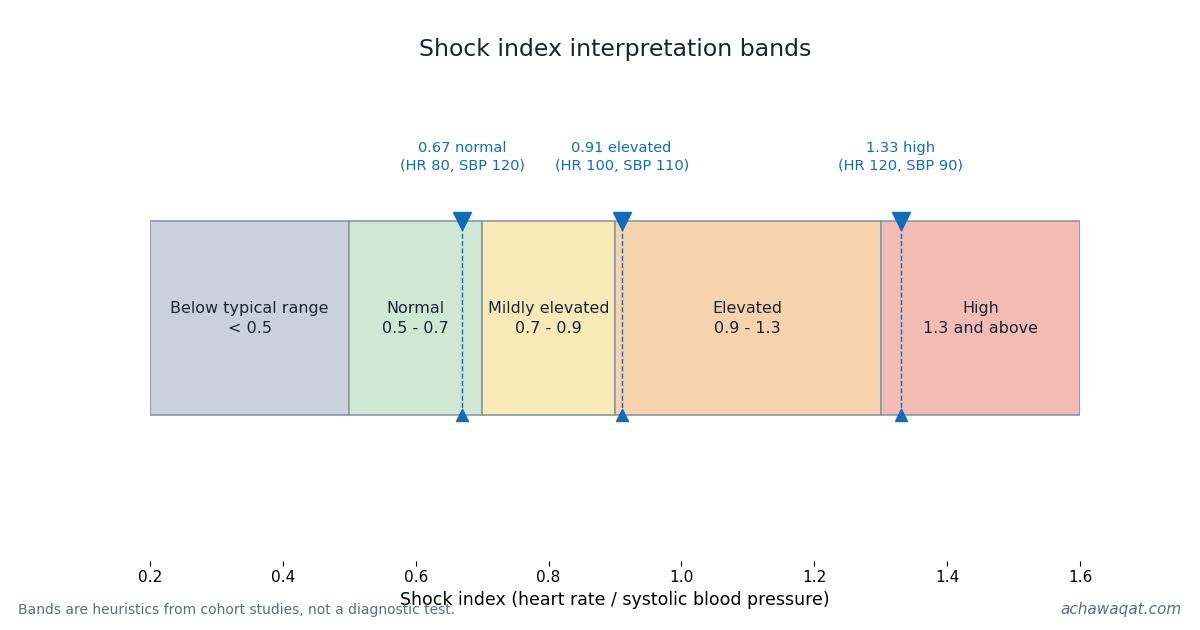
The formula is straightforward: shock index equals heart rate in beats per minute divided by systolic blood pressure in millimetres of mercury. With a heart rate of 100 and a systolic pressure of 110, the calculation is 100 divided by 110, which is 0.909, rounded to two decimal places as 0.91. This calculator rounds every result to two decimals and bases the band classification on that rounded value. The boundary rule matters at the edges, so it is stated plainly: 0.90 and above is classed as elevated, 1.30 and above is classed as high, and 0.70 is the upper end of the normal range, so a value of 0.90 falls into the elevated band rather than mildly elevated. When a diastolic pressure is provided, the calculator also shows the modified shock index, which is heart rate divided by mean arterial pressure, with mean arterial pressure calculated as systolic pressure plus twice the diastolic pressure, all divided by three. For example, with a systolic of 110 and a diastolic of 70, the mean arterial pressure is 83.33 mmHg and the modified shock index for a heart rate of 100 is 1.20. If either required input is missing or zero or negative, the calculator refuses to produce a number and reports a named error instead, because a ratio built on invalid inputs would be worse than no number at all.
Interpreting your result: the bands
The bands used by this calculator are the ones most commonly reported in the literature, presented here with deliberately cautious wording. A value from 0.5 to 0.7 sits in the normal resting range for adults. A value just above 0.7 up to 0.9 is mildly elevated: nothing to act on alone, but a reason to monitor the patient and repeat the observations. A value of 0.9 or above is elevated: multiple studies have reported an association between values in this range and increased mortality and transfusion need in trauma and sepsis cohorts, so it warrants clinical assessment rather than watchful waiting. A value of 1.3 or above is high, and significant haemodynamic compromise is likely, which calls for prompt senior review and a search for the cause. Values below 0.5 fall outside the typical resting range and are uncommon; they are usually an arithmetic curiosity in someone with a slow heart rate and a robust pressure, but they still deserve interpretation in context. Two reminders belong beside every band. First, these are population-level heuristics, and individual patients can deteriorate at values the bands call normal. Second, the evidence language is association, not prediction: studies report that elevated values are associated with worse outcomes, which is not the same as saying the index predicts any one person's fate.
Why shock index is used in trauma triage
In trauma care, the earliest minutes matter and the earliest signs of blood loss can be subtle. A patient who has lost a meaningful amount of blood may still show a systolic pressure in the normal range because the sympathetic nervous system is driving the heart harder to compensate. Shock index was taken up in prehospital and emergency department triage precisely because it can flag that compensation: the heart rate climbs while the pressure holds, and the ratio moves before the pressure falls. Several cohort studies in trauma populations have reported that higher shock index values are associated with greater transfusion requirements and higher mortality, and early emergency department research by Birkhahn RH and colleagues examined the index in the context of acute blood loss. Triage teams use it as one input among many, alongside mechanism of injury, the patient's appearance, and other observations. A mildly elevated value in a trauma patient typically prompts closer monitoring and repeat vital signs, while an elevated or high value supports activating a more urgent response, such as preparing blood products or involving senior clinicians early. None of this makes the index a decision rule on its own; it is a nudge toward looking harder, and looking harder is what triage is for.
Why shock index is used in sepsis assessment
Sepsis, the body's dysregulated response to infection, also produces the classic combination of a fast heart rate and a falling blood pressure as the circulation begins to fail. Emergency clinicians assessing a possibly septic patient already weigh tachycardia and hypotension heavily, and shock index offers a compact way to keep both in view at once. Cohort work in sepsis has examined whether elevated values are associated with worse outcomes, including higher mortality, and some emergency departments have folded the index into their screening workflows as an additional flag for patients who might need earlier fluids, earlier antibiotics, or earlier senior review. The same cautions apply as in trauma. Fever alone raises the heart rate, so a septic patient may have an elevated index partly from the temperature rather than from circulatory collapse, and an elderly patient on rate-slowing medication may have a falsely reassuring value. In sepsis assessment the index works best as a screening aid sitting beside lactate measurement, clinical examination, and structured scores, each catching something the others miss.
The advantage over single vital signs
A single vital sign can mislead in two directions. A systolic pressure of 105 mmHg looks borderline on its own, but paired with a heart rate of 130 it gives a shock index of 1.24, firmly elevated and clearly concerning. Conversely, a heart rate of 110 looks fast, but paired with a systolic pressure of 150 it gives 0.73, only mildly elevated and perhaps explained by pain or anxiety. The ratio adds context that each number lacks alone. This matters most in compensated shock, the phase where the body is still keeping the blood pressure up through effort. During that phase the pressure can read as normal while the heart rate tells a different story, and clinicians who track only the pressure may feel reassured too early. The index does not replace clinical judgement; it directs attention. When the ratio drifts upward across repeated measurements, something is changing even if no single number has crossed a red line yet, and that trend can be the earliest objective hint that the patient needs escalation.
Modified shock index: adding diastolic pressure
Standard shock index uses only the systolic pressure, which is the peak pressure during each heartbeat. Modified shock index goes one step further by using mean arterial pressure, the average pressure across the cardiac cycle, which is closer to the pressure actually driving blood through the organs. The formula is heart rate divided by mean arterial pressure, with mean arterial pressure calculated as the systolic pressure plus twice the diastolic pressure, divided by three. Because the diastolic component reflects vascular tone, the modified version can behave differently when the circulation is failing in ways that affect the diastolic pressure more than the systolic. Researchers have examined modified shock index in emergency and critical care cohorts as a possible alternative or complement to the standard index, and this calculator shows it as a secondary value whenever a diastolic pressure is entered. There is no separate set of universally agreed bands for the modified index, so interpret it in the same spirit: higher values relative to the person's baseline deserve attention, and the number is a flag for assessment, not a diagnosis.
Things that can skew the reading
Several common situations move shock index up or down without any circulatory failure, and knowing them prevents both false alarms and false reassurance. Beta blockers and some calcium channel blockers blunt the heart-rate response, so a patient in genuine trouble can present with a reassuringly normal index; this is one of the most important confounders in older patients with heart disease. At the other extreme, pain, anxiety, and fever all raise the heart rate, pushing the index upward in people whose circulation is perfectly adequate. Trained endurance athletes often have low resting heart rates, sometimes below 50, which can drag the index below the typical range at rest without any pathology. Dehydration from heat or exertion can raise the heart rate while the pressure is maintained, nudging the index into mildly elevated territory in an otherwise well person. Pregnancy changes the baseline too, with a higher resting heart rate that shifts the expected range. The practical lesson is consistent: interpret the number with knowledge of the person's medicines, fitness, pain, temperature, and pregnancy status, and when in doubt, repeat the measurements and look at the trend rather than a single snapshot.
Children: the age-adjusted shock index
This calculator and its bands are intended for adults. In children, normal heart rate and blood pressure change markedly with age, so a single set of cutoffs cannot work: a value that is normal for a teenager could be expected physiology in a toddler. Researchers have therefore proposed the shock index, paediatric age-adjusted, usually abbreviated SIPA, which compares a child's shock index against cutoffs specific to their age group. The concept is the same, a ratio that flags the joint movement of heart rate and pressure, but the reference values are age matched. Parents and carers should not apply the adult bands on this page to children; paediatric assessment follows different thresholds and, as always, a worried carer should seek medical advice promptly rather than relying on a calculated number.
Limitations: what this number cannot do
The most important limitation is also the simplest: shock index is a risk flag, never a diagnosis of shock. Shock is a clinical state defined by inadequate tissue perfusion, and it is diagnosed at the bedside from the whole picture, including mental status, skin perfusion, urine output, and laboratory markers, not from a single ratio. Related to this, normal vital signs and a normal shock index do not rule out shock; early or compensated shock can hide behind reassuring numbers, and some forms of shock do not follow the classic fast-heart-rate, low-pressure pattern at all. The bands are heuristics drawn from cohort studies with all the limits that implies: different populations, different measurement conditions, and cutoffs that shift between studies. The index is also blind to context it cannot see, including the medicines, pain, anxiety, and fitness effects described above. Used well, it is a cheap, instant, and genuinely useful prompt to look more carefully. Used badly, as a rule-out test or a substitute for examination, it can mislead. Treat every result on this page as the start of a clinical thought, not the end of one.
Key takeaways
- Shock index is heart rate divided by systolic blood pressure (HR/SBP).
- A commonly reported normal resting range is 0.5 to 0.7 in adults.
- Multiple studies have reported that a shock index above 0.9 is associated with increased mortality and greater transfusion need in trauma and sepsis cohorts, but association is not prediction and it is not a diagnosis of shock.
- Modified shock index is heart rate divided by mean arterial pressure (HR/MAP), where MAP is calculated as (systolic + 2 x diastolic) divided by 3.
Frequently asked questions
What is shock index?
Shock index is heart rate divided by systolic blood pressure (HR/SBP). It combines two vital signs into a single number so that tachycardia (a fast heart rate) and hypotension (low blood pressure) appearing together become easier to spot. It is used as a risk flag in trauma triage and sepsis assessment, not as a diagnosis of shock. The idea is that the ratio can reveal the body's compensation, a climbing heart rate holding up a threatened pressure, before either vital sign alone looks alarming. Early emergency department research by Birkhahn RH and colleagues examined the index in the evaluation of acute blood loss, and later cohort studies extended it into trauma and sepsis care. Because it needs only a pulse and a blood pressure cuff, it is available in the field, at triage, and at the bedside within seconds.
What is a normal shock index?
A commonly reported normal resting range is 0.5 to 0.7 in adults. Values just above 0.7 up to 0.9 are often described as mildly elevated and worth rechecking, values of 0.9 and above as elevated and warranting clinical assessment, and values of 1.3 and above as high, suggesting significant haemodynamic compromise. These bands are heuristics from cohort studies, not a validated diagnostic test. This calculator applies inclusive boundaries so there is no ambiguity at the edges: 0.90 and above is classed as elevated, 1.30 and above as high, and 0.70 is the top of the normal range. Values below 0.5 are uncommon and usually reflect a slow heart rate with a robust pressure, but they still deserve interpretation in context rather than being dismissed.
What does a shock index above 0.9 mean?
Multiple studies have reported that a shock index above 0.9 is associated with increased mortality and greater transfusion need in trauma and sepsis cohorts. That association is meaningful, but it is not prediction and it is certainly not a diagnosis of shock. In practical terms, a value above 0.9 warrants clinical assessment: recheck the vital signs, look at the whole patient rather than the number, and consider whether there is a source of bleeding, an infection, or another cause of circulatory compromise. It is a reason to escalate attention, involve senior clinicians where appropriate, and repeat the measurements to see whether the trend is rising, stable, or settling. What it is not is a trigger for any specific treatment on its own; treatment follows the cause, and the cause is found by examination and investigation.
What is modified shock index?
Modified shock index is heart rate divided by mean arterial pressure (HR/MAP). Mean arterial pressure is the average pressure across the cardiac cycle and is calculated as the systolic pressure plus twice the diastolic pressure, all divided by three. Because it incorporates the diastolic pressure, it reflects vascular tone and the average driving pressure for organ perfusion more closely than the systolic peak alone. Researchers have examined the modified index in emergency and critical care cohorts as an alternative or complement to the standard shock index. This calculator shows it as a secondary value whenever you enter a diastolic pressure alongside the required heart rate and systolic pressure. There is no separate set of universally agreed bands for it, so read it in the same spirit as the standard index: a flag for assessment, not a diagnosis.
Can medicines or pain affect shock index?
Yes, and this is one of the main reasons the index must be read in context. Beta blockers and some calcium channel blockers blunt the heart-rate rise that shock index depends on, so the value can look falsely reassuring in a patient who is genuinely deteriorating. Pain, anxiety, and fever raise the heart rate without any circulatory problem, pushing the value up and creating false alarms. Trained athletes often have low resting heart rates that drag the value down at baseline. Dehydration, pregnancy, and recent exertion all shift the expected numbers too. None of these make the index useless; they make context essential. A good habit is to note the confounders alongside the number, repeat the measurements, and watch the trend, because a rising ratio in the same patient over time is harder to explain away than a single value.
Does a normal shock index rule out shock?
No. A normal shock index does not rule out shock, and this is the single most dangerous misunderstanding of the measure. Early or compensated shock can exist behind normal-looking vital signs, some forms of shock do not follow the classic fast-heart-rate and low-pressure pattern, and medicines such as beta blockers can mask the tachycardia the ratio relies on. Shock is diagnosed from the full clinical picture, including mental status, skin perfusion, urine output, and laboratory markers, never from one number. The index earns its place as an early warning flag that prompts closer assessment, and it should be used alongside examination, repeated observations, and the clinician's judgement. If you are worried about a patient, or about yourself, do not let a reassuring number delay seeking care.