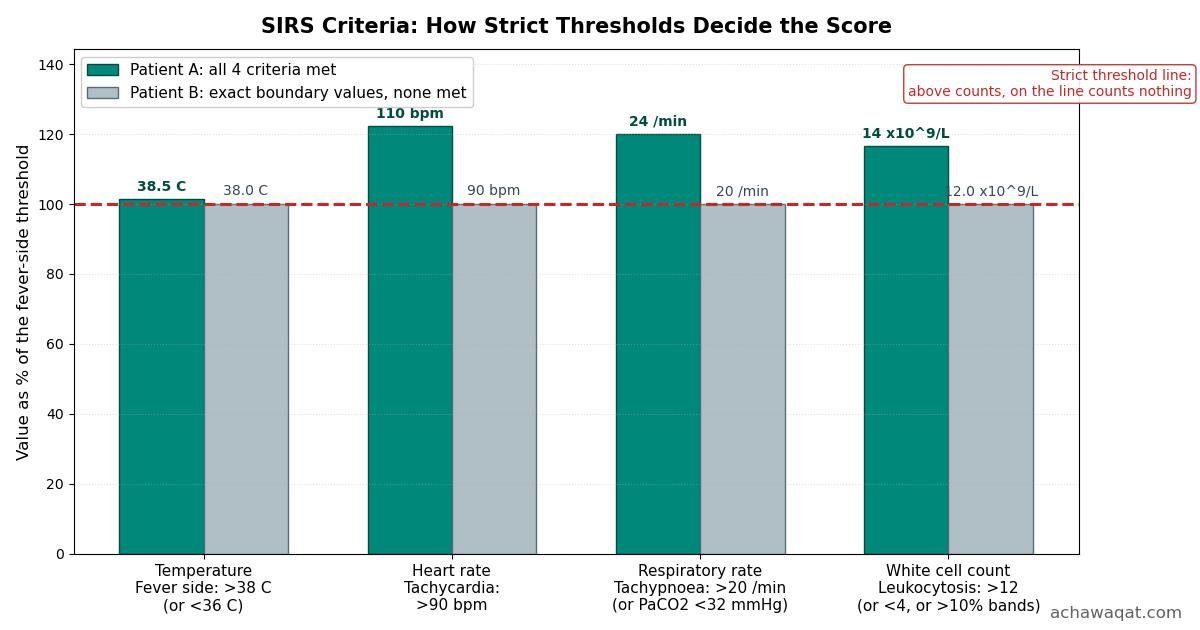
What SIRS is: the four criteria
The systemic inflammatory response syndrome, universally known as SIRS, is a clinical construct that describes the body's generalised response to a serious insult, whether infectious or not. It was defined in 1992 by a consensus conference of the American College of Chest Physicians and the Society of Critical Care Medicine (Bone RC et al., Chest 1992;101(6):1644-55), which set out four criteria that together capture the systemic, whole-body character of severe inflammation. A patient meets the SIRS definition when two or more of the four criteria are present, giving a score that ranges from 0 to 4.
The four criteria are deliberately simple, because they were designed to be recognisable at the bedside from vital signs and a routine blood count. First, body temperature above 38 C (fever) or below 36 C (hypothermia). Second, heart rate above 90 beats per minute. Third, respiratory rate above 20 breaths per minute, or a PaCO2 below 32 mmHg on an arterial blood gas, which reflects the same hyperventilation through a different measurement. Fourth, a white blood cell count above 12 x109/L or below 4 x10⁹/L, or more than 10% immature band neutrophils in the differential count. Each criterion contributes one point, and the threshold of two or more points is what separates SIRS from its absence.
It is worth dwelling on the idea of a score built from yes-or-no questions, because this design choice shapes everything about how SIRS behaves. Each variable is continuous in biology: temperature rises gradually, heart rate creeps upward, white cells drift up or down. The 1992 definition draws a line across each continuum and assigns a point to one side of it. That makes the score fast to compute and easy to communicate, but it also means a patient with a temperature of 37.9 C and a heart rate of 89 scores 0 on those two criteria, while a patient at 38.1 C and 91 scores 2, even though their physiology is nearly identical. The strict boundary behaviour is not a flaw in this calculator; it is the definition itself, and any calculator that smoothed it out would be computing something other than SIRS.
The infection and sepsis continuum where SIRS was born
To understand why SIRS exists, it helps to picture the framework the 1992 conference proposed. They described a continuum that begins with infection, meaning microorganisms invading normally sterile tissue and provoking a host response. When that response becomes systemic, with the four criteria above, the patient has SIRS in response to infection, which the conference called sepsis. Worsening organ dysfunction on top of that was termed severe sepsis, and sepsis-induced hypotension that persists despite fluid resuscitation was termed septic shock. In this scheme, SIRS was the gateway concept: the visible, measurable systemic response that marked the passage from localised infection to a whole-body event.
This continuum was enormously influential. For more than two decades it organised how clinicians thought, how trials enrolled patients, and how hospitals built their sepsis screening pathways. Under it, SIRS was not merely a score but a step in a story: infection leading to systemic inflammation, leading to organ failure, leading to shock. The calculator above computes the SIRS step of that story, and nothing more. Whether the inflammation it detects is caused by infection, and whether organ dysfunction is developing, are separate questions answered by separate evidence.
It is precisely this story that later came under revision, as described below. The 1992 continuum is still useful for teaching, because it shows how the field first organised the problem, but it is no longer the framework by which sepsis is defined. Knowing the history matters because it explains why SIRS is still everywhere in clinical language while no longer playing its original starring role.
Why each variable matters
Each of the four criteria reflects a recognisable piece of the inflammatory physiology, which is why they have survived decades of scrutiny even as the score built from them has been repositioned.
Temperature is the most intuitive. Fever is the classic systemic sign of inflammation, driven by pyrogenic cytokines such as interleukin-1 and interleukin-6 acting on the hypothalamus to raise the thermoregulatory set point. Hypothermia, the low-temperature end of the criterion, is less familiar but more ominous: it tends to appear in severe sepsis, in the elderly, and in overwhelming infection where the host response is failing rather than overactive. Including both directions in one criterion acknowledges that danger lies at both extremes of the temperature range.
Heart rate rises with inflammation for several converging reasons. Fever itself increases metabolic rate and oxygen demand, sympathetic activation drives the heart faster, circulating cytokines have direct effects on cardiac pacing, and the vasodilation of early sepsis forces a compensatory tachycardia to maintain blood pressure. A heart rate above 90 is therefore a crude but honest signal that the cardiovascular system is working harder than resting physiology requires.
The respiratory criterion captures the lungs' participation in the systemic response. Tachypnoea can reflect compensation for metabolic acidosis, direct effects of inflammatory mediators on the respiratory centres, developing lung injury, or simply the increased ventilatory demand of fever and tachycardia. The PaCO2 alternative measures the same phenomenon from the blood gas side: hyperventilation blows off carbon dioxide, so a PaCO2 below 32 mmHg indicates that the patient is ventilating beyond metabolic need, even if the counted respiratory rate looks normal because the breaths are deep rather than rapid. Either measurement satisfies the criterion, because either demonstrates the respiratory component of the systemic response.
The white cell criterion reflects the immune system's mobilisation. Leukocytosis, a count above 12 x109/L, is the familiar response: the marrow releases stored neutrophils and ramps up production. Leukopenia, a count below 4 x10⁹/L, is the less familiar but more worrying pattern, seen when consumption and margination of white cells outpace production, or when the marrow is suppressed. The band count adds a qualitative dimension: more than 10% immature band neutrophils, the so-called left shift, shows that the marrow is releasing cells before they are fully mature, a sign of acute demand that can appear even when the total count is still normal. That is why a patient with a normal total white count but 11% bands still earns the point.
Strict thresholds: why exactly 38.0 counts nothing
The 1992 definition states its thresholds as strict inequalities, and this calculator enforces them literally. Temperature must be above 38.0 C or below 36.0 C: a reading of exactly 38.0 or exactly 36.0 contributes zero points. Heart rate must exceed 90: exactly 90 contributes zero. Respiratory rate must exceed 20, with the PaCO2 below 32 mmHg as the alternative path: exactly 20 with a normal PaCO2 contributes zero. White cells must exceed 12 or fall below 4 x10⁹/L, and bands must exceed 10%: exactly 12.0, exactly 4.0, or exactly 10% bands each contribute zero.
This strictness is worth understanding rather than resenting. A continuous biological variable has to be cut somewhere to make a yes-or-no criterion, and wherever the cut falls, patients will cluster near it. The strict inequality is simply the convention the definition chose, and consistency with the definition matters more than any argument about which side of 38.0 a particular patient belongs on. In practice, few clinical decisions should hinge on a single decimal place: a temperature of 37.9 C in a patient who otherwise looks septic should prompt the same workup as 38.1 C, because the criterion is a screening convention, not a biological law. The calculator reports the score the definition produces; the clinician interprets it in context.
The unit conversions built into this calculator respect the same strictness. A temperature entered in Fahrenheit is converted to Celsius before comparison, so 101.5 F, which equals approximately 38.6 C, satisfies the fever criterion, while 100.4 F, which equals exactly 38.0 C, does not. A white count entered as cells per microlitre is divided by 1000 to give x109/L, so 12,000 cells per microlitre equals 12.0 x10⁹/L and, by the strict rule, does not count, whereas 12,100 does. These are the cases where unit handling visibly changes the score, and the calculator handles them explicitly.
A worked example
Consider a patient with a temperature of 38.5 C, a heart rate of 110, a respiratory rate of 24, and a white cell count of 14 x109/L. Temperature 38.5 exceeds 38, so the first criterion is met. Heart rate 110 exceeds 90, so the second is met. Respiratory rate 24 exceeds 20, so the third is met. White cells 14 exceed 12, so the fourth is met. The score is 4 of 4, and the SIRS definition is satisfied. Contrast this with a patient at temperature 38.0 C, heart rate 90, respiratory rate 20 with a normal PaCO2, and white cells 12.0 x10⁹/L: every value sits exactly on its boundary, every criterion scores zero, and the total is 0. The two patients differ by small margins in each variable, yet the score differs by four points, which illustrates both the utility and the artificiality of threshold-based scoring.
History: from the 1992 consensus to Sepsis-3
The 1992 ACCP/SCCM consensus gave intensive care its first shared language for sepsis, and for over two decades SIRS was the gateway concept in that language. A revision effort in 2001, published by the International Sepsis Definitions Conference, reviewed the evidence and kept the SIRS criteria essentially intact, concluding that while the criteria were imperfect, no clearly better bedside alternative had emerged. Through the 2000s, SIRS-based screening spread into emergency departments and wards, and sepsis bundles and protocols were commonly triggered by meeting two SIRS criteria in the presence of suspected infection.
The turning point came in 2016 with the Third International Consensus Definitions for Sepsis and Septic Shock, known as Sepsis-3 (Singer M et al., JAMA 2016;315(8):801-10). The task force redefined sepsis as life-threatening organ dysfunction caused by a dysregulated host response to infection, operationalised as an increase in the Sequential Organ Failure Assessment (SOFA) score of 2 or more points in the setting of suspected infection. Crucially, the task force retired SIRS as the sepsis-defining framework outside the intensive care unit, replacing it for screening with the quick SOFA (qSOFA) score.
The reasons given were about the balance of sensitivity and specificity. SIRS is exquisitely sensitive: the criteria are so easily met that they capture nearly every septic patient, which is exactly what a screening concept should do. But they are poorly specific: fever, tachycardia, tachypnoea and leukocytosis are generic responses to almost any significant physiological stress, so large numbers of patients meet SIRS criteria without infection and without organ dysfunction. A definition of sepsis built on SIRS therefore labelled many non-septic patients as septic while adding little information about who was actually in danger. Sepsis-3 moved the defining feature from inflammation to organ dysfunction, on the argument that organ dysfunction is what makes sepsis life-threatening and what distinguishes it from uncomplicated infection.
SIRS did not disappear. It remains in clinical use as a sensitive early-warning and screening concept, it continues to appear in research literature and in some diagnostic and triage pathways, and many clinicians still think in SIRS terms at the bedside because the criteria are fast and require no laboratory organ-function panel. What changed is its formal role: SIRS no longer defines sepsis, and a positive SIRS score is no longer, by itself, a sepsis diagnosis. Understanding both halves of this story, the enduring clinical usefulness and the formal retirement, is essential to using the score responsibly.
SIRS vs qSOFA vs SOFA
Because the three scores are constantly mentioned together, and constantly confused, a direct comparison helps.
| Score | Purpose | Variables | Positive threshold |
|---|---|---|---|
| SIRS | Screens for systemic inflammation | Temperature, heart rate, respiratory rate or PaCO2, white cell count or bands | 2 or more of 4 |
| qSOFA | Bedside screening for sepsis risk outside the ICU | Respiratory rate 22 or more, systolic blood pressure 100 mmHg or less, altered mentation | 2 or more of 3 |
| SOFA | Quantifies organ dysfunction | Six systems: respiratory, coagulation, liver, cardiovascular, central nervous system, renal (0 to 24 points) | Increase of 2 or more points with suspected infection defines sepsis under Sepsis-3 |
In plain terms: SIRS asks whether the body is mounting a systemic inflammatory response, qSOFA asks whether a patient outside the ICU looks sick enough to warrant urgent assessment for sepsis, and SOFA asks how badly the organs are failing. SIRS is the most sensitive and least specific of the three; qSOFA is simpler and more specific but less sensitive, which is why it works as a prompt rather than a rule-out tool; SOFA is the most informative but requires laboratory values across six organ systems. They answer different questions, and the modern approach uses them in sequence: SIRS or clinical suspicion raises the question, qSOFA flags risk at the bedside, and SOFA with clinical assessment answers it.
Limitations: sensitive but non-specific
The central limitation of SIRS is the one Sepsis-3 acted on: it detects inflammation, not infection, and inflammation has many causes. A long list of non-infectious conditions routinely produces two or more SIRS criteria. Vigorous exercise raises heart rate, respiratory rate and temperature. Anxiety and pain drive tachycardia and tachypnoea. Trauma, burns, major surgery and pancreatitis provoke full systemic inflammatory responses that are indistinguishable from septic SIRS by the criteria alone. Medications contribute too: beta agonists raise heart rate, and corticosteroids can raise white cell counts. Pregnancy shifts several variables toward SIRS thresholds. In all of these settings the score is doing its job, it is reporting genuine systemic inflammation, while saying nothing about whether infection is present.
The score can also miss genuinely septic patients. Older adults and immunocompromised patients may mount blunted responses and never reach two criteria despite serious infection. Patients on beta blockers may be unable to become tachycardic. Hypothermia instead of fever is already accounted for in the criterion, but the blunted response in the frail elderly remains a recognised blind spot. This is why the calculator's result for a score below 2 explicitly states that infection and sepsis are not excluded: a negative SIRS never rules out sepsis.
There are measurement limitations as well. Temperature varies by site and technique: a peripheral reading underestimates core temperature, and antipyretics mask fever. Respiratory rate is the most poorly measured vital sign in routine practice, often estimated rather than counted. White cell counts lag behind clinical changes by hours. None of this invalidates the criteria, but it means the score is only as good as the measurements fed into it, and single-point measurements should be rechecked when they drive important decisions.
A positive SIRS is not a sepsis diagnosis
This point deserves its own section because it is the single most common misunderstanding. SIRS describes a pattern of vital signs and a blood count; sepsis, under the current definition, is organ dysfunction caused by infection. The bridge between them requires two additional pieces of evidence that the SIRS score cannot supply: a suspected or documented infection, and evidence of organ dysfunction or at least a clinical assessment suggesting the patient is deteriorating.
In practice, a SIRS score of 2 or more with a suspected infection should trigger the standard sepsis workup: cultures before antibiotics where that does not delay treatment, lactate measurement, assessment of organ function, source control, and timely antimicrobials and fluids per local protocol. But the same score in a patient with an obvious non-infectious cause, such as a recent grand mal seizure, an acute pancreatitis presentation, or the immediate postoperative period, points toward that cause instead. The score is the start of the diagnostic process, a prompt to look harder, and never its conclusion. Anyone who is not a clinician and finds a SIRS score of 2 or more in themselves or a relative should seek urgent medical assessment rather than interpreting the number: the score cannot distinguish the many benign causes of its criteria from the dangerous ones.
How to use this calculator
Enter the four required values: temperature (with the Celsius or Fahrenheit toggle), heart rate, respiratory rate, and white blood cell count (with the x109/L or cells per microlitre toggle). The two optional fields refine the score: PaCO2 from an arterial blood gas can satisfy the respiratory criterion when the respiratory rate is 20 or below, and the band neutrophil percentage can satisfy the white cell criterion when the total count is normal. The calculator converts units before applying the thresholds, enforces the strict inequalities exactly as the 1992 definition states them, and rejects missing, non-positive or implausible inputs with named error codes so that data problems are visible rather than silently scored.
The result shows the score out of 4, whether the SIRS definition is met, and a criterion-by-criterion breakdown explaining which thresholds were crossed. Use the breakdown, not just the headline number: knowing that the score came from temperature and heart rate rather than from white cells and respiratory rate can change what the clinician looks for next. For deploy-day spot checks, the boundary behaviour is the critical test: exact boundary values (38.0 C, heart rate 90, respiratory rate 20, white cells 12.0 or 4.0, bands 10%) must each contribute zero points.
A clinician tool, not home triage
The SIRS criteria were designed for clinicians assessing patients with suspected serious illness, and this calculator belongs in that setting. It requires measurements, a blood count and clinical context that have meaning only within an assessment, and its result is a screening signal that must be combined with the examination, the history, cultures, lactate and organ-function assessment. It cannot be used meaningfully as a home triage test: the same score of 2 can arise from a panic attack, a marathon, or early septic shock, and only clinical assessment distinguishes them.
For clinicians, SIRS remains a useful fast screen precisely because it is sensitive: it is hard for a seriously inflamed patient to hide from all four criteria. Use it to raise the question early, then answer the question with the tools Sepsis-3 provides: assess for infection, measure lactate, apply qSOFA at the bedside and SOFA where laboratory values are available, and follow local sepsis pathways. That sequence, screen sensitively with SIRS, then define and stratify with the modern framework, is how a 1992 definition continues to earn its place in 21st-century practice.