What fractional excretion of urea measures
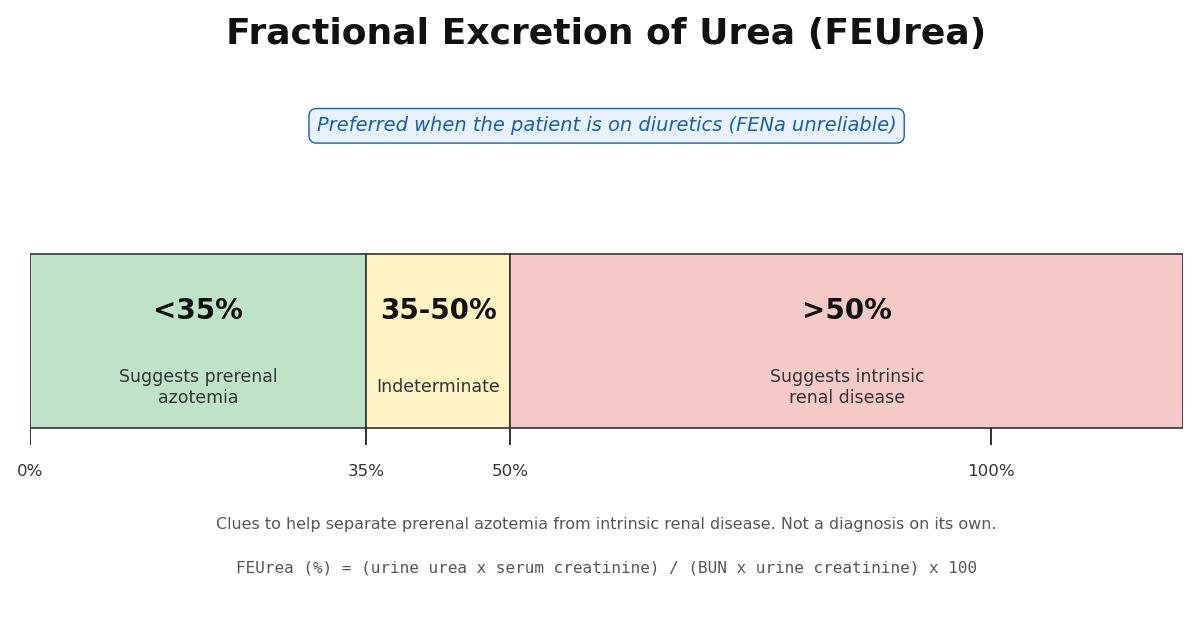
The fractional excretion of urea, usually shortened to FEUrea, is the percentage of the urea filtered by the glomeruli that ends up excreted in the urine. It answers a simple question: of all the urea the kidneys filtered today, what share did the tubules send back into the blood, and what share did they let go? The formula is:
All four values are measured in mg/dL, which is why the units cancel and leave a clean percentage. Serum creatinine in the numerator and urine creatinine in the denominator play the role of a reference marker: creatinine is filtered freely and handled by the tubules in a fairly predictable way, so comparing urea handling against creatinine handling tells you how aggressively the tubules are reclaiming urea. When the tubules reabsorb a lot of urea, the number comes out low. When the tubules are damaged and let urea slip through, the number comes out high.
Clinicians reach for this test in acute kidney injury, when the serum creatinine is rising and the question is whether the kidneys are simply underperfused (prerenal azotemia) or whether the tubules themselves are injured (intrinsic renal disease, most often acute tubular necrosis). The distinction matters because the treatments point in opposite directions: prerenal problems are managed by restoring perfusion, while intrinsic injury is managed by removing the cause and supporting the kidneys while they recover. FEUrea is one clue among several, and it is never a diagnosis on its own, but it is a particularly valuable clue in one common situation: the patient who is already taking diuretics.
Why urea handling differs from sodium handling
To understand why FEUrea exists at all, it helps to compare it with its better known cousin, the fractional excretion of sodium (FENa). Both tests use the same trick: divide the clearance of one solute by the clearance of creatinine, and multiply by 100. The difference is the solute being tracked. Sodium is reclaimed mainly in the proximal tubule, the thick ascending limb of the loop of Henle, the distal tubule, and the collecting duct, through a set of dedicated transporters that the kidney adjusts minute by minute in response to volume and blood pressure signals. Urea is handled differently. About half of filtered urea is reabsorbed in the proximal tubule along with water, and a large part of the remainder is recycled through the inner medulla by urea transporters in the collecting duct, building the medullary concentration gradient that lets the kidney concentrate urine.
The practical consequence is that urea reabsorption tracks water reabsorption and the kidney's concentrating effort much more closely than sodium reabsorption does. In a volume depleted patient whose kidneys are working properly, antidiuretic hormone is high, water is being reclaimed vigorously, and urea is dragged back into the blood along with that water. Fractional excretion of urea therefore falls, often below 35 percent, because the healthy tubule is doing exactly what it should: conserving water and, incidentally, urea. In acute tubular necrosis, the damaged tubules lose this concentrating ability. Water reabsorption fails, urea reabsorption fails with it, and a large fraction of the filtered urea spills into the urine, pushing FEUrea above 50 percent. This is the physiological logic that makes the two interpretation bands meaningful.
Why FEUrea still works when the patient is on diuretics
The fractional excretion of sodium is the classic test for separating prerenal from intrinsic kidney injury, and it works beautifully, until the patient takes a diuretic. Then it breaks. Loop diuretics such as furosemide block the sodium potassium chloride cotransporter in the thick ascending limb of Henle. That is their entire job: force sodium to stay in the tubule so water follows it out. A patient on a loop diuretic is therefore excreting extra sodium by design, and their FENa rises whether or not their kidneys are underperfused. Thiazide diuretics block sodium reabsorption in the distal tubule with a similar, if milder, effect. In both cases FENa can look high, falsely pointing toward intrinsic disease, in a patient whose real problem is simply low perfusion plus a drug that wastes sodium.
Urea escapes most of this interference. Loop and thiazide diuretics act on sodium transporters, not on the urea transporters that govern urea recycling in the medulla. The kidney's handling of urea is therefore far less disturbed by these drugs. This is the central reason FEUrea is the preferred test in patients on diuretics: the concentrating mechanism it probes is largely left alone by the medication, so the result still reflects tubular function rather than the drug's pharmacology. A prerenal patient on furosemide will typically still show a low FEUrea, below 35 percent, because their intact tubules are still reclaiming water and urea aggressively. A patient with tubular injury will typically still show a high FEUrea, above 50 percent, because the damaged tubule cannot reclaim urea regardless of the diuretic. The landmark study by Carvounis and colleagues, published in Kidney International in 2002, examined exactly this question and established FEUrea as the more reliable discriminator when diuretics are in play.
Urine urea versus urine urea nitrogen: the 2.14 conversion
One of the most common sources of confusion with this test is the laboratory report itself. Some laboratories report urine urea, meaning the concentration of the whole urea molecule in mg/dL. Others report urine urea nitrogen, abbreviated UUN, which measures only the nitrogen atoms contained in that urea. The urea molecule has the formula CO(NH2)2, and nitrogen accounts for a fixed share of its mass. The ratio of the full molecular weight to the nitrogen weight is approximately 2.14, so the conversion is:
For example, a UUN of 280 mg/dL corresponds to a urine urea of 280 x 2.14 = 599.2 mg/dL. The formula for FEUrea requires the full urea value, so if your lab reports UUN, you must convert first. This calculator handles that for you: choose "Urine urea nitrogen, UUN" in the selector above and enter the lab value as reported, and the 2.14 factor is applied before the calculation. Choose "Urine urea" if your lab already reported the full urea value, and the number is used as entered. Mixing the two up, for instance entering a UUN value as if it were urine urea, would underestimate the numerator by more than half and produce a falsely low result, so it is worth checking the units line on your report before you calculate.
Note that BUN, the blood urea nitrogen, is always a nitrogen based measurement, and it stays in the denominator exactly as reported. The conversion applies only to the urine value, never to BUN.
Worked example
Consider a patient with acute kidney injury who takes a daily loop diuretic. The laboratory results are: urine urea 600 mg/dL, serum BUN 40 mg/dL, urine creatinine 60 mg/dL, and serum creatinine 1.5 mg/dL. Applying the formula step by step:
The result, 37.5 percent, falls in the 35 to 50 percent band, which is indeterminate. In a diuretic treated patient this is a genuinely useful piece of information even though it does not settle the question: it tells the clinician that urea handling is neither avidly conserved nor frankly wasted, and that the decision must rest on the rest of the clinical picture, such as the medication history, the response to a fluid challenge, the urine microscopy, and the trend of the creatinine. A lower urine urea, say 300 mg/dL with the same other values, would give (300 x 1.5) / (40 x 60) x 100 = 18.75 percent, below 35 percent and suggestive of a prerenal cause. A higher urine urea of 900 mg/dL with BUN 30 mg/dL, urine creatinine 50 mg/dL, and serum creatinine 2.0 mg/dL would give (900 x 2.0) / (30 x 50) x 100 = 120 percent, above 50 percent and suggestive of intrinsic renal disease.
Interpreting your result
The standard teaching bands are straightforward, but they must be read as clues, not as verdicts:
| FEUrea | Interpretation |
|---|---|
| Below 35% | Suggests prerenal azotemia: the tubules are intact and reclaiming urea avidly, which points toward low perfusion or volume depletion. |
| 35% to 50% | Indeterminate: the result does not clearly favor either category, and the diagnosis must come from other findings. |
| Above 50% | Suggests intrinsic renal disease: the tubules are failing to reclaim urea, which points toward tubular injury. |
Values exactly on the boundaries, 35.0 percent and 50.0 percent, are treated as indeterminate, because a single decimal point should never be the difference between two management paths. Remember that FEUrea above 100 percent is entirely possible: it simply means more urea is excreted than was filtered, which happens when the tubules secrete urea or when reabsorption fails completely. The percentage is a ratio, not a share of a fixed pie, so do not treat values over 100 as errors.
Limitations: what can distort FEUrea
FEUrea is a physiological test, and anything that changes urea production or BUN independently of tubular function can distort it. Three confounders deserve special attention because they are common. First, a high protein intake or a protein load raises urea production, which raises BUN and the filtered urea load without any change in tubular function. Second, gastrointestinal bleeding has the same effect through a different route: blood in the gut is digested and absorbed as protein, and the resulting urea load raises BUN. Third, corticosteroids increase protein breakdown throughout the body, again raising urea production and BUN. In all three situations the denominator of the formula is pushed upward by production rather than by excretion, and the result can mislead.
Beyond these, remember that the interpretation bands are teaching tools, not diagnostic cutoffs validated for every population. They were developed and studied in adults with acute kidney injury, and they perform as rough guides, not as precise instruments. Early or partial tubular injury can produce intermediate values. Concurrent conditions, such as liver disease that reduces urea production or very low protein intake that does the same, shift the baseline. And like every fractional excretion test, FEUrea assumes that creatinine handling is stable and representative, which is itself an approximation.
The correct way to use this calculator is as one input to a clinical assessment that includes the history, especially the diuretic and medication history, the physical examination for volume status, the urine sediment, the trend of serum creatinine, and the response to treatment. A low FEUrea in a patient who improves with fluids supports a prerenal diagnosis. A high FEUrea in a patient with muddy brown casts on microscopy supports tubular injury. The number guides thinking; the patient makes the diagnosis.
Reference
Carvounis CP, Helderman JH, Kwon HM, et al. Significance of the fractional excretion of urea in the differential diagnosis of acute renal failure. Kidney Int. 2002;62(6):2223-2229. doi:10.1046/j.1523-1755.2002.00683.x