What the free water deficit estimates
The free water deficit is an estimate of the volume of pure, solute-free water that a person would need to retain in order to bring their current serum sodium concentration down to 140 mEq/L, assuming the total amount of body solute stays the same. In plain terms, it converts a laboratory value (a high sodium concentration) into a volume (litres of missing water) that a clinician can plan around.
The calculator uses the standard textbook formula:
Here TBW is total body water in litres, and serum sodium is measured in mEq/L.
The formula comes from a simple conservation idea. The total quantity of sodium dissolved in the body water does not change while water alone is added or removed, so:
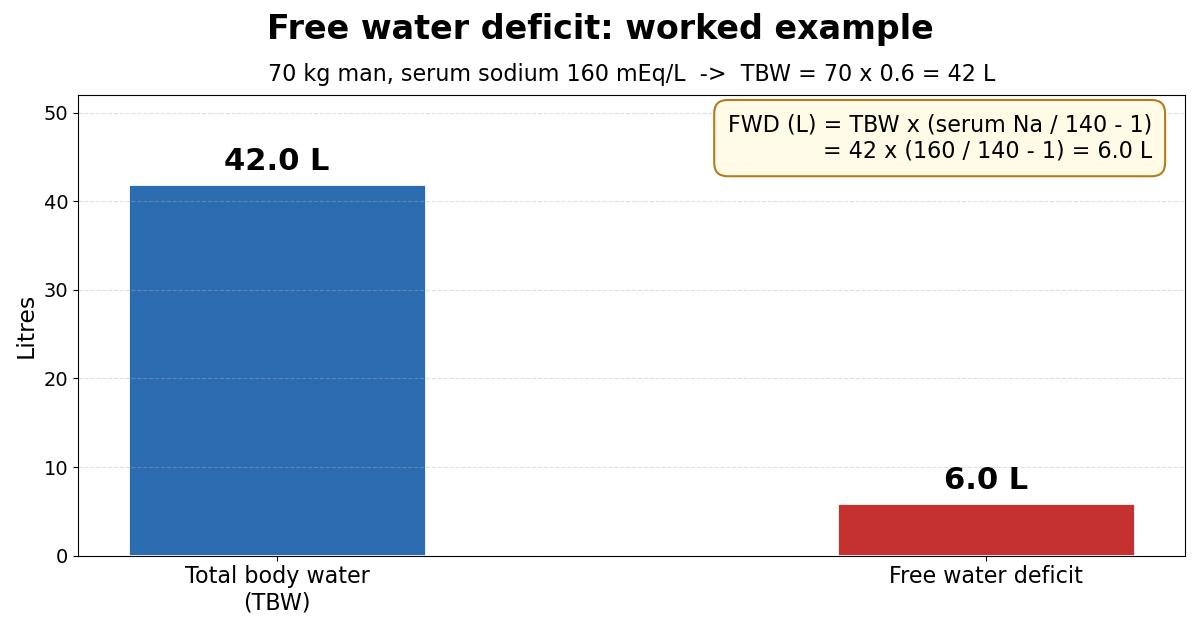
Rearranging this equation produces the deficit formula. For example, a 70 kg man with a serum sodium of 160 mEq/L has an estimated total body water of 42 litres (the next section explains why), so his deficit is 42 x (160 / 140 - 1) = 6.0 litres. In this simplified model, retaining 6 litres of pure water would dilute his sodium to 140 mEq/L.
It is equally important to understand what this number is not. It is a planning estimate, not a prescription for how much fluid to give. The choice of fluid, the rate at which it is given, and how often the sodium is rechecked all depend on the clinical situation: the cause of the hypernatremia, how quickly it developed, and what other conditions the patient has. The deficit answers one narrow question: how far is this patient from water balance, measured in litres. Everything after that is a clinical decision.
How total body water is estimated
Every free water deficit figure rests on an estimate of total body water (TBW), because the deficit is TBW multiplied by the sodium term. A larger estimated TBW gives a larger deficit for the same sodium value, so the TBW assumption deserves attention.
This calculator estimates TBW from body weight with a simple multiplication:
The water fractions used here are widely taught estimates:
| Group | Water fraction |
|---|---|
| Men under 65 years | 0.60 |
| Men aged 65 years and older | 0.50 |
| Women under 65 years | 0.50 |
| Women aged 65 years and older | 0.45 |
A 70 kg man under 65 therefore has an estimated TBW of 70 x 0.6 = 42 litres, while a 60 kg woman under 65 has an estimated TBW of 60 x 0.5 = 30 litres.
These fractions are population averages, and the calculator states this plainly because it matters. Two people of the same weight, sex, and age can carry quite different amounts of body water depending on muscle mass, body fat, hydration status, and illness. Because the deficit scales linearly with TBW, any error in TBW carries straight through the calculation: if TBW is overestimated by one-tenth, the deficit is overestimated by one-tenth as well. Treat the result as an approximation that is refined as the patient is reassessed, not as an exact volume to be administered.
Why women and older adults have lower water fractions
Body water is held mainly in lean tissue. Muscle and the internal organs are rich in water, while adipose (fat) tissue contains relatively little. Body composition therefore decides what fraction of body weight is water.
Women, on average, carry a higher proportion of body fat and a lower proportion of muscle than men of the same weight, which is why the estimated fraction steps down from 0.60 to 0.50. Ageing adds a second shift in the same direction: muscle mass tends to decline with age while fat mass tends to rise, so older adults of either sex carry less water per kilogram than younger adults. That is why the calculator uses 0.50 rather than 0.60 for men aged 65 and over, and 0.45 rather than 0.50 for women aged 65 and over.
These remain averages applied to individuals, and individuals vary. A very muscular older woman may carry more water per kilogram than 0.45 assumes; a younger man with little muscle may carry less than 0.60. In clinical practice the fractions are a reasonable starting point, and the patient's response to treatment together with repeated laboratory measurements is what confirms or corrects them.
What hypernatremia is and what causes it
Hypernatremia means the concentration of sodium in the blood is high. It almost always reflects a shortage of water relative to sodium rather than an absolute overload of sodium in the body: the same amount of dissolved solute in less water produces a higher concentration. That is exactly why a water deficit formula is the right tool for estimating its size.
The causes fall into three broad patterns. The first is pure water loss, or water intake that fails to keep up with loss. Thirst may be impaired, or the person may be unable to reach water: this pattern is seen in infants, in older adults, and in anyone with altered consciousness or critical illness. The kidneys may also waste water, as in diabetes insipidus, where they cannot concentrate the urine. Fever, heat exposure, and burns raise insensible losses through the skin and lungs.
The second pattern is the loss of fluid that is more dilute than the blood: water leaves faster than salt. Examples include the osmotic diuresis caused by very high blood sugar, diarrhoea, and heavy sweating.
The third and least common pattern is true sodium gain: administration of hypertonic saline, large sodium bicarbonate loads, or ingestion of excess salt.
Identifying which pattern applies matters because it shapes treatment. Replacing water corrects a water deficit; a sodium load may call for a different strategy. The history, the concentration of the urine, and the clinical setting usually point the way, and sorting this out is the work of the treating clinician, not the calculator.
Why the speed of correction matters
This is the most safety-critical part of hypernatremia management, and the reason the safety notice sits directly beside the calculator. When a high sodium concentration has been present for more than a day or two, brain cells defend their volume by manufacturing small organic molecules, often called idiogenic osmoles, that hold water inside the cell and keep it from shrinking. This adaptation protects the brain while the sodium is high, but it creates a hazard on the way down: if the serum sodium is lowered quickly, water rushes into the now solute-rich brain cells, and the brain swells. Cerebral edema can cause seizures, coma, and death.
Standard teaching is therefore to correct chronic hypernatremia no faster than about 8 to 10 mEq/L per 24 hours. A slower correction gives brain cells time to dispose of the extra osmoles as the sodium falls, and the sodium is rechecked at intervals to confirm the rate is staying within the safe range.
Hypernatremia that appeared over hours and is already causing symptoms such as confusion or seizures is a different situation and an emergency. The brain has not had time to adapt in the same way, so management is urgent and follows a different protocol, usually in an intensive care setting with a specialist directing a faster initial correction under close monitoring. The 8 to 10 mEq/L per day guidance applies to chronic hypernatremia, not to acute symptomatic hypernatremia, and any correction plan belongs under clinician supervision.
What this calculator does not include
The formula is a snapshot taken at a single moment, and several real-world factors sit outside it. It does not account for insensible water losses from the skin and lungs, which continue around the clock whether or not anyone is measuring them. It does not account for ongoing losses from urine, stool, vomiting, drains, or sweating that may still be active while the patient is being treated. It does not adjust the sodium value for very high blood glucose, something clinicians sometimes correct for before interpreting the number. And it takes the entered weight at face value, even though swelling (edema) or severe dehydration can make body weight a shaky stand-in for lean body water.
The practical consequence is straightforward: the deficit should be recalculated each time new laboratory values arrive, and the running plan should be adjusted for the fluids the patient has already received and the losses that are still occurring. A single calculated number is the starting point of a monitored process, not a finish line. It tells the team where the patient stands; repeated measurements tell the team where the patient is heading.
What to do after you have a result
A free water deficit number is most useful in the hands of the clinician caring for the patient. If you computed it for yourself or a family member, bring the result together with the inputs you used and the trend of recent sodium values to the treating team, and do not act on it alone. Correction is typically carried out with hypotonic fluids chosen by the clinician, the sodium is rechecked at planned intervals, the rate of fall is kept within the safe range described above, and the underlying cause, whether poor intake, diabetes insipidus, ongoing losses, or sodium gain, is identified and treated alongside the number.
Do not attempt to correct hypernatremia at home by drinking or infusing large volumes of water. Unguided correction can be as dangerous as the condition itself, and large rapid shifts in sodium are exactly what the safety guidance is designed to prevent. Worsening confusion, seizures, extreme thirst with an inability to keep fluids down, or reduced consciousness are reasons to seek emergency care immediately.
Key takeaways
- It estimates the volume of pure, solute-free water missing from the body relative to a serum sodium of 140 mEq/L.
- Because the estimated fraction of body weight that is water differs by sex and age.
- The deficit formula is derived for hypernatremia, a high sodium concentration.
- Standard teaching is no faster than about 8 to 10 mEq/L per 24 hours for chronic hypernatremia, to avoid cerebral edema as adapted brain cells re-equilibrate.
Frequently asked questions
What exactly does the free water deficit tell me?
It estimates the volume of pure, solute-free water missing from the body relative to a serum sodium of 140 mEq/L. It is a planning figure that helps a clinician judge the size of the water shortfall; it is not a prescription for how much fluid to give or how fast to give it.
Why does the calculator ask for sex and age group?
Because the estimated fraction of body weight that is water differs by sex and age. The calculator uses 0.6 for men under 65, 0.5 for men aged 65 and over and for women under 65, and 0.45 for women aged 65 and over. These are population averages reflecting differences in muscle and fat composition.
Why does the calculator refuse sodium values of 145 or lower?
The deficit formula is derived for hypernatremia, a high sodium concentration. At 145 mEq/L or below there is no excess sodium concentration for the formula to dilute, so computing a deficit would be meaningless. A low or normal sodium needs a different clinical assessment.
How fast should hypernatremia be corrected?
Standard teaching is no faster than about 8 to 10 mEq/L per 24 hours for chronic hypernatremia, to avoid cerebral edema as adapted brain cells re-equilibrate. Acute hypernatremia with symptoms is managed differently and urgently, in a monitored setting under specialist care.
Does the calculated deficit include ongoing fluid losses?
No. The formula is a snapshot: it ignores insensible losses from skin and lungs and any ongoing losses from urine, stool, vomiting, or sweating. Recalculate when new laboratory values arrive, and adjust for fluids given and losses in the meantime.
Can I use this calculator to guide treatment at home?
No. Hypernatremia correction needs clinician supervision, a chosen fluid, a controlled rate, and repeated sodium checks. Bring the result to the treating team and do not attempt correction on your own.
Formula source: Adrogue HJ, Madias NE. Hypernatremia. N Engl J Med. 2000;342:1493-1499. doi:10.1056/NEJM200005183422006.