KDIGO Acute Kidney Injury Staging Calculator
In short: Free KDIGO acute kidney injury staging calculator: stage AKI from creatinine rise or urine output. Educational tool, not medical advice. Use the calculator above, then read the guide below to interpret your result and its limitations.
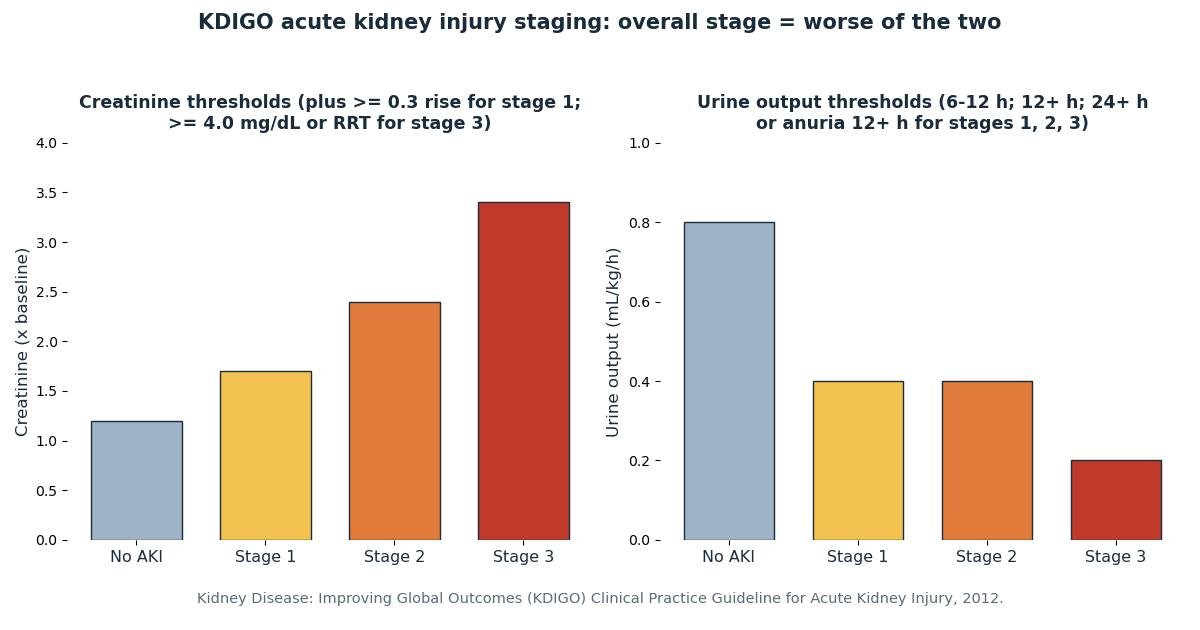
Stage acute kidney injury from serum creatinine, urine output, or both, using the KDIGO 2012 criteria. The overall stage is the worse of the creatinine stage and the urine output stage.
The calculator
Result
Not yet calculated
Enter creatinine values, with or without urine output
Why AKI needs standard staging
Acute kidney injury is common and dangerous: it complicates roughly 1 in 5 hospital admissions and carries a markedly increased risk of death, longer stays, and progression to chronic kidney disease. But for decades, every study defined it differently, some using absolute creatinine rises, others using percentage changes, others using urine output alone. Results could not be compared, and clinicians had no shared language for severity. The KDIGO guideline of 2012 harmonised the two main predecessors, the RIFLE criteria and the AKIN criteria, into one staging system. Today, KDIGO stages are the standard endpoint in AKI research and the standard vocabulary on ward rounds: saying "stage 2 AKI" means the same thing in every hospital that uses the guideline. Because the criteria are simple and use data every inpatient already generates, the system works in settings from intensive care units to resource-limited wards without any special equipment or testing.
The creatinine criteria
| Stage | Creatinine criterion |
|---|---|
| 1 | 1.5 to 1.9 times baseline, or a rise of at least 0.3 mg/dL (26.5 micromol/L) |
| 2 | 2.0 to 2.9 times baseline |
| 3 | 3.0 times baseline, or a rise to 4.0 mg/dL (353.6 micromol/L) or more, or starting renal replacement therapy |
The small absolute rise of 0.3 mg/dL matters because it catches injury early, before the ratio criterion is met, particularly in patients whose baseline creatinine is low. A rise from 0.6 to 0.9 mg/dL is a 50 percent increase in relative terms and represents real injury, but it would not reach 1.5 times baseline; the absolute threshold catches it. Conversely, in chronic kidney disease with a high baseline, small absolute wobbles are common, and the ratio criterion does the work. The two rules complement each other, and meeting either one is enough for the stage.
The urine output criteria
| Stage | Urine output criterion |
|---|---|
| 1 | Below 0.5 mL/kg/h for 6 to 12 hours |
| 2 | Below 0.5 mL/kg/h for 12 hours or more |
| 3 | Below 0.3 mL/kg/h for 24 hours or more, or anuria for 12 hours or more |
Urine output is the early warning system. Creatinine lags behind real-time kidney function by many hours because it must accumulate in the blood, and its level is distorted by muscle mass, fluid resuscitation, and diet. Oliguria often declares itself while the creatinine is still normal. This is why the guideline insists on both: studies consistently show that patients who meet only the urine output criteria still have worse outcomes than those who meet neither, and ignoring oliguria misses a large fraction of AKI.
Taking the worse of the two
The overall KDIGO stage is the higher of the creatinine stage and the urine output stage. A patient with a stage 1 creatinine rise but stage 2 oliguria has stage 2 AKI. This rule reflects the evidence that each criterion independently predicts outcomes; the worse one best captures the severity of the injury. In practice, this means both need monitoring: a patient whose creatinine looks reassuring but who has made almost no urine for eight hours is not reassuring at all.
The baseline problem
Every creatinine criterion is relative to a baseline, and the baseline is often the hardest number to get right. The ideal is a stable outpatient creatinine from the months before the illness. When none exists, options include the lowest inpatient value so far, which risks missing AKI already present on admission, or back-estimating from an assumed normal glomerular filtration rate, which risks mislabelling chronic kidney disease as acute injury. Whichever is chosen, it should be documented explicitly, because the stage is only as valid as the baseline behind it. This calculator uses whatever baseline you enter and shows the ratio, so the assumption stays visible.
How staging changes management
Staging earns its place by changing what the team does. Stage 1 is the moment for low-cost, high-yield interventions: review every medication for nephrotoxicity, hold non-essential contrast studies, optimise perfusion and volume status, and monitor both creatinine and urine output closely. Progression from stage 1 to stage 2 is the signal to escalate: involve nephrology early, look harder for the cause, and start planning for what stage 3 would require. Stage 3 triggers the full toolkit, including preparation for renal replacement therapy and a goals-of-care conversation where appropriate. The evidence consistently shows that earlier recognition and a structured response bundle reduce progression and mortality, which is exactly what standardised staging makes possible in everyday clinical practice. Without the stage label, mild creatinine bumps get filed away and nobody notices until the patient is in trouble.
What staging does not decide
The KDIGO stage describes the severity of kidney injury; it does not prescribe treatment. Decisions about fluids, nephrotoxins, and renal replacement therapy depend on the cause of the injury, the trajectory, complications such as hyperkalaemia or acidosis, fluid balance, and the patient's overall goals of care. Two patients with stage 2 AKI can need completely different management. The stage standardises description so that those decisions, and the research behind them, rest on a common language rather than on local habit.
What are the KDIGO stages of acute kidney injury?
The KDIGO guideline defines three stages. Stage 1: creatinine 1.5 to 1.9 times baseline or a rise of at least 0.3 mg/dL, or urine output below 0.5 mL/kg/h for 6 to 12 hours. Stage 2: creatinine 2.0 to 2.9 times baseline, or urine output below 0.5 mL/kg/h for 12 hours or more. Stage 3: creatinine 3.0 times baseline or a rise to 4.0 mg/dL or more, or starting renal replacement therapy, or urine output below 0.3 mL/kg/h for 24 hours or more, or anuria for 12 hours or more. The stage is the worse of the creatinine and urine output criteria.
How do you convert creatinine between mg/dL and micromol/L?
Multiply mg/dL by 88.4 to get micromol/L. The key KDIGO thresholds convert as follows: a 0.3 mg/dL rise equals 26.5 micromol/L, and 4.0 mg/dL equals 353.6 micromol/L. This calculator accepts either unit and converts internally.
What counts as the baseline creatinine?
The baseline is the patient's usual creatinine before the acute illness, ideally a stable outpatient value from the previous months. If none exists, KDIGO suggests using the lowest creatinine during the admission or estimating it, but every approach has error: using the admission value can miss AKI that is already present, and estimating from assumed normal kidney function can misclassify chronic kidney disease as acute injury. The baseline chosen should be documented.
Why does urine output matter as well as creatinine?
Creatinine rises slowly: it can take a day or more to reflect a fall in kidney function, and it is affected by muscle mass, fluid balance, and diet. Oliguria often appears hours earlier, so the urine output criteria catch AKI sooner. Studies show that patients meeting only the urine output criteria still have worse outcomes, which is why KDIGO keeps both and stages by whichever is worse.
Where do the KDIGO criteria come from?
The criteria come from the Kidney Disease: Improving Global Outcomes (KDIGO) Clinical Practice Guideline for Acute Kidney Injury, published in 2012. KDIGO harmonised the earlier RIFLE and AKIN systems into a single staging scheme, which has since become the international standard for defining and staging AKI in research and practice.
Does a higher KDIGO stage mean dialysis is needed?
No. The stage describes severity, not treatment. Dialysis decisions depend on complications such as refractory fluid overload, severe acidosis, dangerous potassium levels, uraemic symptoms, and the overall trajectory, not the stage number alone. Many stage 3 patients recover without renal replacement therapy, and some stage 1 or 2 patients need it for complications. This calculator cannot advise on treatment.
Key takeaways
- The KDIGO guideline defines three stages.
- Multiply mg/dL by 88.4 to get micromol/L.
- The baseline is the patient's usual creatinine before the acute illness, ideally a stable outpatient value from the previous months.
- Creatinine rises slowly: it can take a day or more to reflect a fall in kidney function, and it is affected by muscle mass, fluid balance, and diet.
References and further reading
Medical disclaimer
This calculator is an educational aid only. It does not diagnose acute kidney injury and does not advise on fluids, medications, or renal replacement therapy. AKI staging must be interpreted by a qualified clinician in the context of the full clinical picture, including the cause of injury, trajectory, and complications. If you are concerned about kidney function, seek medical advice promptly.