MDRD GFR Calculator
Estimate glomerular filtration rate (eGFR) with the 4-variable MDRD equation from serum creatinine, age, sex and race, and see the chronic kidney disease stage (G1 to G5). For educational use only.
In short: Estimate glomerular filtration rate (eGFR) with the 4-variable MDRD equation from serum creatinine, age, sex and race, and see the chronic kidney disease stage (G1 to G5). For educational use only. Use the calculator above, then read the guide below to interpret your result and its limitations.
A note on the race coefficient, stated plainly. The original 1999 MDRD equation multiplies the result by 1.212 for Black patients. Since 2021, nephrology has moved to race-free estimating equations: the NKF-ASN task force recommends the 2021 CKD-EPI creatinine equation, which estimates GFR without any race variable, for routine clinical use. This calculator keeps the original MDRD form for educational and historical comparison. For clinical purposes, use our CKD-EPI 2021 eGFR calculator (race-free).
The calculator
Enter the four values below, then press the button. Age must be between 18 and 120. Serum creatinine can be entered in mg/dL (0.2 to 20) or in umol/L (18 to 1770); the calculator converts umol/L by dividing by 88.4.
Allowed range: 0.2 to 20 mg/dL, or 18 to 1770 umol/L. Values outside this range are rejected because the equation is not validated there.
These are the two categories the 1999 equation was built with. Newer race-free equations do not need this input at all; see the note above.
What eGFR means and why kidneys are measured through creatinine
Glomerular filtration rate, GFR, is the volume of blood the kidneys filter through the glomeruli each minute. It is the single most widely used measure of how well the kidneys are doing their job, and in clinical practice a falling GFR is usually the first signal of chronic kidney disease. Measuring true GFR directly requires injecting a marker such as inulin or iohexol and tracking how fast it disappears from the blood, which is impractical outside research settings. Instead, clinicians use serum creatinine, a waste product of normal muscle metabolism that healthy kidneys clear at a fairly steady rate. When filtration falls, creatinine accumulates in the blood, so a higher serum creatinine generally means a lower GFR.
Creatinine on its own is a blunt instrument. A creatinine of 1.0 mg/dL can mean perfectly normal kidneys in a young muscular man and reduced function in a frail older woman, because creatinine generation depends on muscle mass, and muscle mass depends on age and sex. Estimating equations such as MDRD were built to translate the raw creatinine number into an estimate of GFR that adjusts for age and sex, so that the result is comparable across people. The result, eGFR, is reported in mL/min/1.73 m2, meaning millilitres per minute standardized to a body surface area of 1.73 square metres, the convention that lets kidney function be compared between people of different sizes.
The MDRD equation, piece by piece
The 4-variable MDRD equation was developed from the Modification of Diet in Renal Disease study and published by Levey AS and colleagues in the Annals of Internal Medicine in 1999. The full form used here is:
eGFR = 175 x Scr-1.154 x Age-0.203 x 0.742 (if female) x 1.212 (if Black)
Scr is serum creatinine in mg/dL. The result is in mL/min/1.73 m2.
Each term has a job. Serum creatinine carries an exponent of minus 1.154, so eGFR falls steeply as creatinine rises, and the relationship is curved rather than straight: a change from 1.0 to 2.0 mg/dL reduces eGFR far more than a change from 4.0 to 5.0 mg/dL. This curved relationship matches how kidneys actually behave, because creatinine accumulates exponentially as filtration fails. Age carries an exponent of minus 0.203, so for the same creatinine, an older person gets a lower eGFR than a younger one, reflecting the steady loss of kidney function with ageing and the lower muscle mass of older adults. The 0.742 multiplier for women corrects for the lower average muscle mass, and hence lower creatinine generation, in women. The 1.212 multiplier for Black patients reflects the higher average creatinine generation observed in that group in the original study population.
The constant 175 is the version re-expressed in 2006 (Levey AS et al., Annals of Internal Medicine) for creatinine assays traceable to the isotope dilution mass spectrometry (IDMS) reference standard, which is what modern laboratories use. An older version of the equation used 186 with non-standardized creatinine assays; with today's standardized assays, 175 is the correct constant, and it is the one this calculator uses. If your laboratory report gives creatinine in umol/L, the calculator divides by 88.4, the standard conversion factor, since 1 mg/dL of creatinine equals 88.4 umol/L. For example, 88.4 umol/L converts to exactly 1.0 mg/dL and gives exactly the same eGFR.
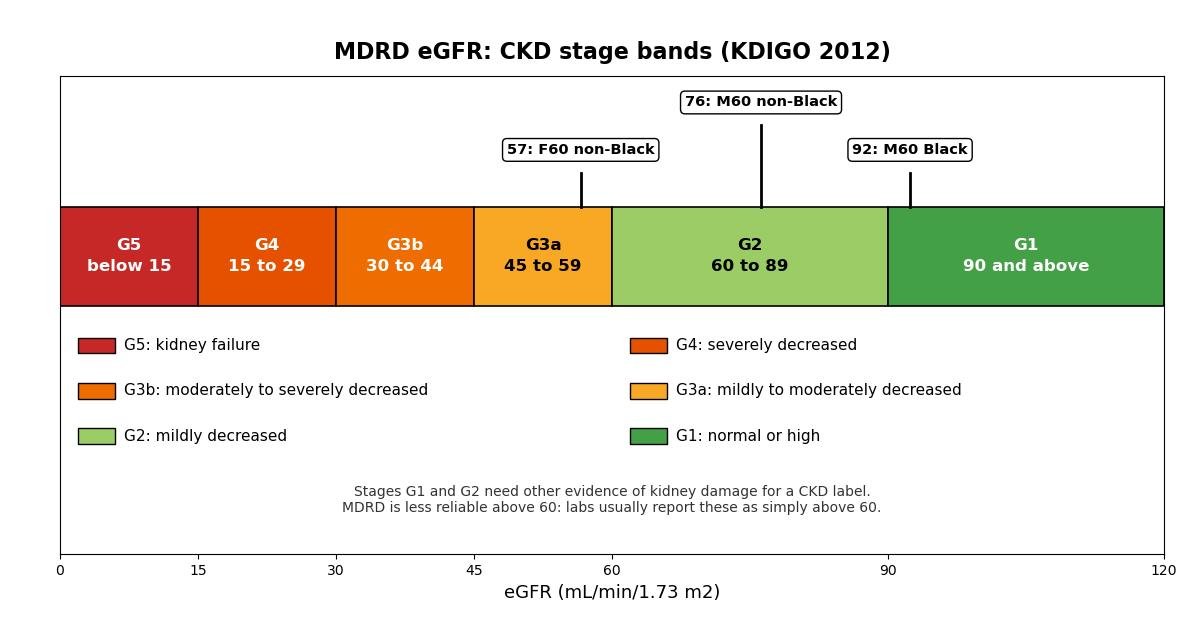
A worked example shows the arithmetic. Take a 60 year old man, creatinine 1.0 mg/dL, non-Black. The equation gives 175 x 1.0^-1.154 x 60^-0.203, which equals 76.2 mL/min/1.73 m2. The same woman gives 76.2 x 0.742 = 56.6. The same man if Black gives 76.2 x 1.212 = 92.4. These three numbers already tell the story of the equation: one creatinine value, three different estimates, driven entirely by the demographic terms.
CKD stages G1 to G5
The KDIGO 2012 clinical practice guideline (Kidney Disease: Improving Global Outcomes, published in Kidney International Supplements, 2013) classifies chronic kidney disease into six G stages based on GFR. The cut-offs are:
| Stage | eGFR (mL/min/1.73 m2) | Description |
|---|---|---|
| G1 | 90 or above | Normal or high |
| G2 | 60 to 89 | Mildly decreased |
| G3a | 45 to 59 | Mildly to moderately decreased |
| G3b | 30 to 44 | Moderately to severely decreased |
| G4 | 15 to 29 | Severely decreased |
| G5 | Below 15 | Kidney failure |
A crucial qualification sits underneath this table, and it is the most misunderstood part of kidney staging. An eGFR in the G1 or G2 range does not by itself mean chronic kidney disease. Under KDIGO, the label CKD requires either an eGFR below 60, or, when eGFR is 60 or above, additional evidence of kidney damage, such as albumin in the urine (albuminuria), an abnormal urine sediment, abnormal findings on kidney imaging, or a biopsy finding, present for at least 3 months. A healthy adult with an eGFR of 76 and no markers of kidney damage simply has mildly decreased GFR for their age, not chronic kidney disease. The calculator states this on every result in the G1 or G2 range.
The boundaries matter because they drive real decisions. The 60 line separates stage G2 from G3a and is the threshold at which KDIGO allows a CKD label from GFR alone. The 30 line separates G3b from G4 and marks the point where preparation for kidney replacement therapy begins to enter planning. The 15 line separates G4 from G5, kidney failure, where dialysis or transplantation becomes a live question. These cut-offs come from KDIGO, not from the MDRD equation itself: MDRD estimates the number, KDIGO interprets it.
The race coefficient, stated plainly
The 1.212 multiplier for Black patients is the most debated part of the MDRD equation, and it deserves a clear statement rather than a quiet footnote. In the 1999 MDRD study population, Black participants had higher serum creatinine at any given measured GFR, consistent with higher average creatinine generation, so the equation needed the multiplier to fit the data. Applied to an individual, this means two people with the same creatinine, age and sex get different eGFRs depending on race alone, a 60 year old man with creatinine 1.0 mg/dL gets 76 if classified non-Black and 92 if classified Black, as shown in the worked example above.
Criticism of this approach has grown for two reasons. First, race is a social category, not a biological one, and using it as a proxy for muscle mass misclassifies many individuals. Second, the multiplier systematically raises eGFR in Black patients, which can delay referral to nephrology, delay transplant listing, and affect drug dosing decisions in ways that disadvantage the very group it was meant to calibrate. In 2021, the National Kidney Foundation and American Society of Nephrology (NKF-ASN) task force on reassessing the inclusion of race in diagnosing kidney diseases recommended that all US laboratories adopt race-free estimating equations, and the new 2021 CKD-EPI creatinine equation (Inker LA et al., New England Journal of Medicine, 2021) estimates GFR without any race variable at all.
This page keeps the original MDRD equation exactly as published, race coefficient included, because the point of this calculator is educational: to show what the historical equation does and how it behaves. For actual clinical use, the race-free CKD-EPI 2021 equation is the current standard, and Doctor With Data provides it as a separate calculator: CKD-EPI 2021 eGFR calculator (race-free).
What to do with the result
A result of 60 or above, with no other sign of kidney disease, is generally reassuring, but it is not the end of the story. GFR declines with age, so mildly decreased values in older adults can be normal ageing; your doctor interprets the number against your age, your medical history, and, most importantly, your urine albumin test and blood pressure. If the result is below 60, or if there are markers of kidney damage at any eGFR, the usual next step is repeat testing: CKD is defined by persistence over at least 3 months, so a single low number on one blood test is a prompt for follow-up, not a diagnosis. Common reversible contributors that a doctor will check include dehydration, recent illness, urinary obstruction, and medications that affect creatinine or kidney function, such as NSAIDs, certain antibiotics, and some blood pressure drugs.
A result below 30 deserves prompt medical attention rather than watchful waiting: this is the range where nephrology referral, medication review, and planning for the future enter the picture. A result below 15 indicates kidney failure and needs urgent specialist care. Whatever the number, bring the actual creatinine value and the laboratory's own eGFR, if reported, to your appointment: laboratories report eGFR with their own equation and assay calibration, and your doctor will want to see the trend over time, which matters more than any single estimate.
Limitations: when not to rely on MDRD
The MDRD equation is an estimate, and its accuracy has known boundaries. It is least reliable at higher GFR values: above 60 mL/min/1.73 m2 the equation systematically underestimates true GFR, which is why many laboratories report results above 60 as simply "greater than 60" rather than giving an exact number. The calculator does show the computed number above 60, because the educational purpose is to show what the equation produces, but in clinical practice a value of, say, 92 from MDRD should be read as "above 60, imprecise", not as a precise measurement. The 2021 CKD-EPI equation is more accurate in this range.
The equation was developed in adults with chronic kidney disease and should not be used where creatinine is not at a steady state. In acute kidney injury, creatinine is still rising or falling, so any equation based on a single value misleads. It is not validated in pregnancy, in children, in amputees, or in people with very high or very low muscle mass, such as bodybuilders or the severely malnourished, because the creatinine-to-GFR relationship breaks down at the extremes. Creatinine itself can be nudged by diet (a large cooked-meat meal), creatine supplements, and some drugs, so a single borderline value deserves a repeat test under normal conditions.
Finally, the calculator enforces the equation's validated input ranges for a reason. Age is restricted to 18 to 120, and creatinine to 0.2 to 20 mg/dL (18 to 1770 umol/L). Values outside these ranges are rejected rather than extrapolated, because the equation was never tested there and the curved mathematics can produce misleading numbers far outside the data it was built on. These are guardrails, not clinical judgements: if your real value falls outside them, that is itself a reason to involve a clinician.
Related kidney assessments
The MDRD equation is the historical workhorse, but it is no longer the recommended first choice. For the current race-free standard, use the CKD-EPI 2021 eGFR calculator, which estimates GFR from the same creatinine and age inputs without any race variable and is more accurate above 60 mL/min/1.73 m2. Comparing the two calculators side by side for the same person is itself instructive: it shows exactly how much the race coefficient and the newer mathematics change the number, and why nephrology moved on.
Key takeaways
- The MDRD (Modification of Diet in Renal Disease) equation estimates glomerular filtration rate from serum creatinine, age, sex, and race.
- eGFR is grouped into KDIGO chronic kidney disease stages: G1 is 90 or above (normal or high), G2 is 60 to 89 (mildly decreased), G3a is 45 to 59, G3b is 30 to 44, G4 is 15 to 29 (severely decreased), and G5 is below 15 (kidney failure).
- The original 1999 MDRD equation includes a race coefficient: the result is multiplied by 1.212 for Black patients, because the study population showed higher creatinine generation on average in that group.
- Both equations estimate GFR from serum creatinine and age, but the 2021 CKD-EPI equation (Inker LA et al., New England Journal of Medicine, 2021) contains no race coefficient and is more accurate at higher GFR values, above 60 mL/min/1.73 m2, where the MDRD equation is known to be less reliable.
Frequently asked questions
What is the MDRD GFR equation?
The MDRD (Modification of Diet in Renal Disease) equation estimates glomerular filtration rate from serum creatinine, age, sex, and race. The 4-variable version, published by Levey AS and colleagues in the Annals of Internal Medicine in 1999, is: eGFR = 175 x (serum creatinine in mg/dL) to the power of minus 1.154, times age to the power of minus 0.203, times 0.742 if female, times 1.212 if Black. The result is reported in mL/min/1.73 m2, standardized to a standard body surface area. The constant 175 is the version re-expressed in 2006 for IDMS-traceable creatinine assays, which is what modern laboratories use.
What does my eGFR number mean?
eGFR is grouped into KDIGO chronic kidney disease stages: G1 is 90 or above (normal or high), G2 is 60 to 89 (mildly decreased), G3a is 45 to 59, G3b is 30 to 44, G4 is 15 to 29 (severely decreased), and G5 is below 15 (kidney failure). Importantly, stages G1 and G2 only count as chronic kidney disease when there is other evidence of kidney damage, such as albumin in the urine, an abnormal urine sediment, abnormal imaging, or a biopsy finding. Without such evidence, a G1 or G2 value is not a CKD diagnosis.
Why does the MDRD equation ask about race?
The original 1999 MDRD equation includes a race coefficient: the result is multiplied by 1.212 for Black patients, because the study population showed higher creatinine generation on average in that group. Since 2021, the medical community has moved away from race-based equations: the NKF-ASN task force recommended routine clinical use of race-free estimating equations, and the 2021 CKD-EPI equation estimates GFR without any race variable. This calculator keeps the original MDRD form for educational and historical comparison; for clinical use, the race-free CKD-EPI 2021 equation is the current standard.
What is the difference between MDRD and the 2021 CKD-EPI equation?
Both equations estimate GFR from serum creatinine and age, but the 2021 CKD-EPI equation (Inker LA et al., New England Journal of Medicine, 2021) contains no race coefficient and is more accurate at higher GFR values, above 60 mL/min/1.73 m2, where the MDRD equation is known to be less reliable. The NKF-ASN task force recommended the race-free 2021 CKD-EPI equation for routine clinical use in 2021. Doctor With Data offers a CKD-EPI 2021 eGFR calculator as well.
Can I enter creatinine in umol/L instead of mg/dL?
Yes. Select the umol/L unit next to the creatinine field and the calculator converts your value by dividing by 88.4, the standard conversion factor (1 mg/dL of creatinine equals 88.4 umol/L). For example, 88.4 umol/L converts to exactly 1.0 mg/dL and gives the same eGFR as entering 1.0 mg/dL directly.
Can the MDRD result diagnose chronic kidney disease?
No. The MDRD calculator estimates kidney function; it does not diagnose chronic kidney disease. A CKD diagnosis requires the abnormality to persist for at least 3 months, and for eGFR values of 60 or above it also requires evidence of kidney damage, such as albuminuria. A single creatinine measurement can be affected by dehydration, medication, diet, or laboratory variation. Any concerning result should be discussed with a doctor, who will arrange repeat testing and further assessment.
References
- Levey AS, Bosch JP, Lewis JB, Greene T, Rogers N, Roth D; Modification of Diet in Renal Disease Study Group. A more accurate method to estimate glomerular filtration rate from serum creatinine: a new prediction equation. Annals of Internal Medicine. 1999;130(6):461-470. doi: 10.7326/0003-4819-130-6-199903160-00002. The original publication of the 4-variable MDRD equation.
- Levey AS, Coresh J, Greene T, Stevens LA, Zhang YL, Hendriksen S, Kusek JW, Van Lente F; Chronic Kidney Disease Epidemiology Collaboration. Using standardized serum creatinine values in the Modification of Diet in Renal Disease Study equation for estimating glomerular filtration rate. Annals of Internal Medicine. 2006;145(4):247-254. The IDMS-traceable re-expression that gives the constant 175 used in this calculator.
- Kidney Disease: Improving Global Outcomes (KDIGO) CKD Work Group. KDIGO 2012 Clinical Practice Guideline for the Evaluation and Management of Chronic Kidney Disease. Kidney International Supplements. 2013;3:1-150. The source of the G1 to G5 stage cut-offs and the rule that G1 and G2 need evidence of kidney damage for a CKD label.
- Inker LA, Eneanya ND, Coresh J, et al. New creatinine- and cystatin C-based equations to estimate GFR without race. New England Journal of Medicine. 2021;385:1737-1749. doi: 10.1056/NEJMoa2102953. The race-free 2021 CKD-EPI equation now recommended for routine clinical use.
- KDIGO Clinical Practice Guidelines
- National Kidney Foundation
Medical disclaimer
This MDRD GFR calculator is for informational and educational purposes only. It is not a medical diagnosis, not a substitute for professional clinical assessment, and must not delay care. Kidney function should be assessed by a qualified health professional using repeat measurements, urine testing, and the full clinical picture. For clinical use, current guidance recommends race-free estimating equations such as the 2021 CKD-EPI equation rather than the original MDRD equation. If you are worried about your kidneys, or your result is below 60 or falling, see your doctor promptly.