What this calculator does
Hyponatremia, a serum sodium below 135 mEq/L, is one of the most common electrolyte disturbances in hospitalized patients, and correcting it is one of the most safety-critical calculations in inpatient medicine. Correcting too slowly leaves the patient symptomatic; correcting too quickly can cause osmotic demyelination syndrome, a devastating and often irreversible neurologic injury. This calculator plans the correction with four linked numbers: the sodium deficit, the Adrogue-Madias prediction of how much one litre of the chosen infusate will raise the serum sodium, the infusate volume needed to reach a chosen target, and the predicted hourly and 24-hour rise at a given infusion rate. A hard safety gate then refuses to endorse any plan whose projected 24-hour rise exceeds the guideline limit for the patient's clinical context.
The maths comes from two well-established sources. The Adrogue-Madias equation was published by Horacio J. Adrogue and Nicolaos E. Madias in the New England Journal of Medicine in 2000 (N Engl J Med 2000;342:1581-9) and remains the standard bedside tool for predicting the serum sodium response to intravenous fluids. The correction-rate limits follow the 2024 US hyponatremia guidance and the long-standing US expert-panel recommendations (Verbalis JG et al., Am J Med 2013;126(10 Suppl 1):S1-42): 8 to 10 mEq/L per 24 hours for chronic hyponatremia, 8 mEq/L per 24 hours or less for high-risk patients, a rapid initial partial correction of 4 to 6 mEq/L in the first hours for acute severe symptomatic hyponatremia, and a ceiling of 18 mEq/L in any 48-hour period.
Why the rate of correction matters so much
To understand the limits, it helps to know what hyponatremia does to the brain. When serum sodium falls slowly over more than 48 hours, brain cells adapt by extruding intracellular solutes, which protects them from swelling. That adaptation is the reason chronic hyponatremia often causes only vague symptoms: headache, nausea, confusion, unsteadiness. But the adaptation takes time to reverse. If the extracellular osmolality is then raised rapidly, water is pulled out of the adapted brain cells so quickly that they shrink, and the myelin sheaths around brainstem neurons are destroyed. This is osmotic demyelination syndrome, formerly called central pontine myelinolysis.
Osmotic demyelination typically declares itself 2 to 4 days after the overcorrection, with dysarthria, dysphagia, quadriparesis, altered consciousness and sometimes a locked-in state, and much of the damage is permanent. The syndrome occurs most frequently when chronic hyponatremia is corrected by more than 10 mEq/L within the first 24 hours, or by more than 18 mEq/L within 48 hours. Those observed injury thresholds are exactly what the guidance limits back away from: the 8 to 10 mEq/L per 24-hour ceiling, with 8 mEq/L per 24 hours for patients carrying additional risk.
The patients who most need the stricter 8 mEq/L limit are those in whom the brain's adaptation is deepest or its resilience lowest: a chronic course of hyponatremia, malnutrition, alcohol use disorder, hypokalemia, advanced liver disease, and very severe hyponatremia with a baseline sodium of 105 mEq/L or below. These are the risk factors named consistently across the US guidance and the clinical guidelines of other countries.
Acute symptomatic hyponatremia is the mirror image. When sodium falls within hours, the brain has not adapted, so cerebral edema and herniation are the danger, not demyelination. Severe symptoms such as seizures or coma demand rapid partial correction: 4 to 6 mEq/L in the first hours, often given as repeated small boluses of hypertonic saline in intensive care, because that amount reverses most symptoms and larger rises offer no additional therapeutic benefit. Once the symptoms improve, the rate must be slowed to the chronic limits. The MSD Manual guidance expresses the same idea as a pace rule: no faster than 0.5 mEq/L per hour, except during the first few hours of treatment of severe hyponatremia, where up to 2 mEq/L per hour is accepted.
The equations, step by step
Total body water: the stated assumption
Every calculation starts with total body water (TBW), because the sodium distributes through it. This calculator uses the standard anthropometric fractions: body weight in kilograms multiplied by 0.60 for men and 0.50 for women, with an age adjustment of 0.50 for men and 0.45 for women at age 65 and above, reflecting the lower water content of the aging body. These are the same fractions used in the worked Adrogue-Madias case examples in the medical literature. So a 70 kg man has an estimated TBW of 42 litres; a 60 kg woman has 30 litres. The assumption is approximate and is stated openly, because dehydration, edema, obesity and critical illness all move the true value. The calculator shows the TBW it used so it can be challenged.
The sodium deficit
The sodium deficit is the simplest of the equations: TBW in litres multiplied by the gap between the target and current serum sodium. It answers how many milliequivalents of sodium the extracellular fluid is short of the target. For a 70 kg man (TBW 42 L) with a serum sodium of 120 mEq/L and a target of 126 mEq/L, the deficit is 42 multiplied by 6, or 252 mEq. The deficit is a planning aid, not a dosing prescription: it is delivered gradually, within the rate limits, not as a bolus.
The Adrogue-Madias equation
The Adrogue-Madias equation predicts the change in serum sodium per litre of a chosen infusate: the infusate sodium plus the infusate potassium, minus the serum sodium, all divided by the TBW plus 1. The logic is a closed-system mass balance: add one litre containing a known amount of cations to the existing sodium pool, and the concentration moves toward the infusate's concentration by exactly that fraction. The "plus 1" in the denominator accounts for the added litre. Potassium enters the numerator because potassium taken up by cells displaces sodium into the extracellular fluid, raising the measured serum sodium.
Using the same 70 kg man with a serum sodium of 120 mEq/L and 3% sodium chloride at 513 mEq/L with no potassium: (513 minus 120) divided by (42 plus 1) equals 393 divided by 43, or about 9.14 mEq/L per litre. The identical example with 0.9% sodium chloride at 154 mEq/L gives (154 minus 120) divided by 43, or 0.79 mEq/L per litre. That eleven-fold difference is why the choice of infusate dominates every correction plan.
The required volume, from mass balance
Rearranging the same closed-system balance gives the infusate volume needed to reach the target: TBW multiplied by the target-minus-current gap, divided by the infusate sodium minus the target. For the 70 kg man, targeting 126 mEq/L with 3% saline: 42 multiplied by 6, divided by (513 minus 126), or 252 divided by 387, which is about 0.65 litres. If the infusate sodium is at or below the target, the equation has no solution: no amount of that fluid can ever reach the target, and the calculator says so rather than producing a nonsense number.
The predicted hourly and 24-hour rise
Multiplying the per-litre prediction by the infusion rate gives the expected hourly rise, and multiplying by 24 gives the projected 24-hour rise. At 20 mL per hour of 3% saline in the 70 kg example, the hourly rise is 9.14 multiplied by 0.02, or 0.18 mEq/L per hour, and the 24-hour projection is 4.39 mEq/L, comfortably under the high-risk limit of 8. At 50 mL per hour, the projection is 10.97 mEq/L per 24 hours, which breaches the chronic limit of 10 and is refused by the safety gate. These projections assume the patient remains a closed system with no oral intake, urine output or other fluid losses; real patients do not, which is why measured sodium must be checked frequently and the plan adjusted.
The safety gate and the correction limits
The defining feature of this calculator is the hard gate. When an infusion rate is entered, the projected 24-hour rise is compared against the limit for the selected clinical context: 10 mEq/L for chronic hyponatremia without high-risk features, 8 mEq/L for high-risk chronic hyponatremia, and 6 mEq/L for the initial rapid phase of acute severe symptomatic hyponatremia. A projection above the limit is refused outright with a red flag: the tool will not endorse the plan. A projection between 80 and 100 percent of the limit is allowed but flagged with an explicit caution, because real-world variables (a water diuresis as the underlying cause resolves, unmeasured intake) can push the actual rise above the projection.
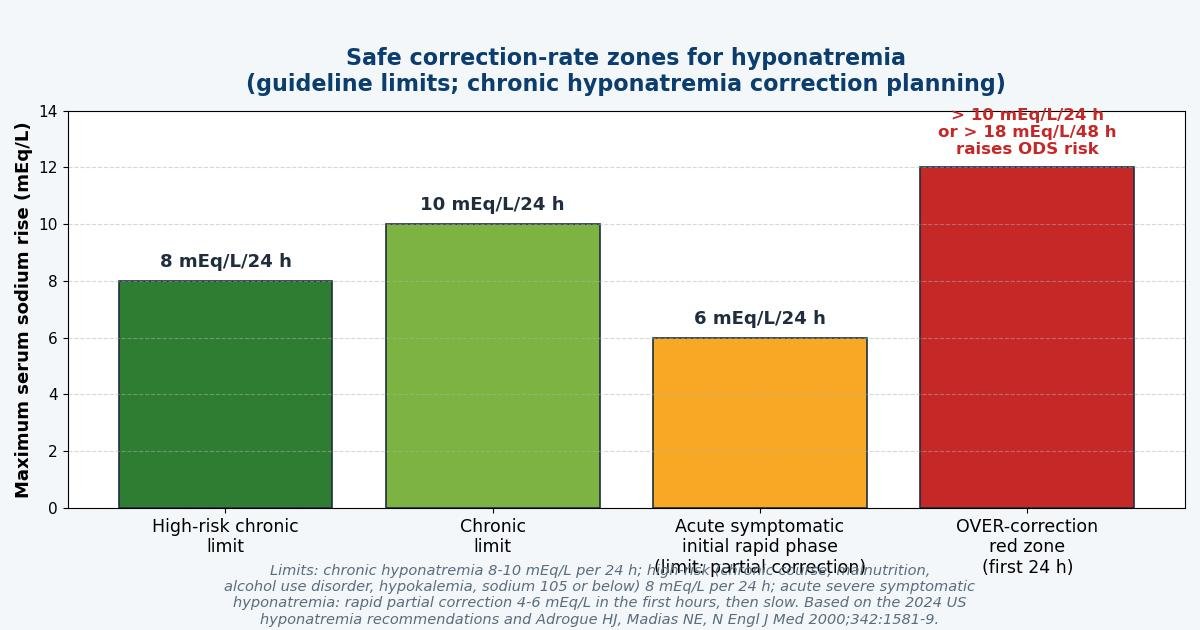
Two further limits are worth stating explicitly. The 48-hour ceiling of 18 mEq/L applies even when each individual day looked safe: a rise of 9 on day one plus 9 on day two stays within the daily limits but touches the 48-hour ceiling. And for patients on the borderline between acute and chronic, the conservative choice is to use the chronic limits unless the time course is certain, because the brain injury from overcorrection is the less reversible harm.
Overcorrection does happen despite planning, most often when a water diuresis begins as the cause of hyponatremia resolves (for example after volume repletion turns off the ADH stimulus). The rescue described in the guidance is to slow or stop the hypertonic infusion and, under specialist supervision, to re-lower the serum sodium with desmopressin (DDAVP) together with hypotonic fluid such as D5W, so that the final 24-hour rise lands back within the planned limit. This is a clinical decision made by the treating team, ideally with nephrology input; it is described here only so readers recognize the concept when they meet it, not as instructions.
How to use this calculator
Work through the four sections of the form in order. Weight, sex, current sodium, target sodium and clinical context are required; age, infusate potassium and the infusion rate are optional refinements.
- Patient: enter the weight in kilograms and select the sex. Optionally enter the age; at 65 or above the calculator applies the elderly water fractions (0.50 for men, 0.45 for women). Without an age it uses 0.60 for men and 0.50 for women.
- Sodium values: enter the current serum sodium and the target serum sodium in mEq/L. The target must be higher than the current value. Note that the target is a planning waypoint, not necessarily normality: for severe chronic hyponatremia the first day's target is often set only a few points above the current value, respecting the 24-hour limit.
- Infusate: choose a preset (0.9% sodium chloride at 154 mEq/L, or 3% sodium chloride at 513 mEq/L) or enter a custom infusate sodium. Optionally add the infusate potassium concentration; it is included in the Adrogue-Madias numerator.
- Infusion plan and clinical context: enter the infusion rate in mL per hour if you want the predicted hourly and 24-hour rise, and select the clinical context that matches the patient. The gate checks the projection against the limit for that context.
Press "Calculate correction plan". The result panel shows the safety badge first (safe, caution zone, or refused), then the estimated total body water, the sodium deficit, the Adrogue-Madias per-litre prediction, the volume of infusate needed to reach the target, the predicted rises, the estimated hours to target, and the applicable 24-hour limit. If the infusate cannot mathematically reach the target, the panel says so explicitly instead of printing a volume.
A worked example: why 0.9% saline is slow
Consider a 60 kg woman with a serum sodium of 115 mEq/L, a target of 125 mEq/L, and 0.9% sodium chloride. Her TBW is 30 litres. The per-litre prediction is (154 minus 115) divided by 31, or about 1.26 mEq/L. The required volume is 30 multiplied by 10, divided by (154 minus 125), or 300 divided by 29: about 10.3 litres. At 100 mL per hour, the predicted hourly rise is 0.126 mEq/L and the 24-hour projection is 3.02 mEq/L, safely within limits but showing why isotonic saline alone is a slow tool for severe hyponatremia: more than ten litres would be needed, which many patients cannot tolerate. This is the arithmetic reason hypertonic saline is preferred when the sodium must move and the daily limit is the binding constraint.
The same patient on 3% saline at 513 mEq/L gives a per-litre prediction of (513 minus 115) divided by 31, or about 12.84 mEq/L, and a required volume of 30 multiplied by 10, divided by (513 minus 125), or 300 divided by 388: about 0.77 litres. At 20 mL per hour the 24-hour projection is 6.17 mEq/L, within the high-risk limit of 8; at 30 mL per hour it is 9.25 mEq/L, which the gate allows for standard chronic hyponatremia but refuses for high-risk patients. Small rate changes matter enormously with hypertonic saline, which is why these patients are managed with frequent sodium checks and, often, an infusion pump in a monitored setting.
Limitations
Like every bedside formula, this calculator simplifies reality, and the simplifications must be understood before the numbers are used.
First, the Adrogue-Madias equation treats the patient as a closed system: no intake, no urine output, no insensible losses, no change in the underlying cause. Real patients are open systems, and the actual sodium movement can differ substantially from the prediction. A water diuresis during correction is the classic way plans overshoot: as the stimulus to ADH resolves, the kidneys excrete free water and the sodium climbs faster than any infusate equation predicted. Frequent sodium measurement, intake and output monitoring, and readiness to slow the infusion are non-negotiable.
Second, the total body water fractions are population averages. Obesity, edema, dehydration, critical illness, pregnancy and extreme age all shift the true TBW, and with it every number that follows. The calculator displays its TBW so the estimate can be sanity-checked against the clinical picture.
Third, the equation is validated for predicting the sodium response to infusates, but the guideline limits are guardrails against population-level injury, not personalized safety guarantees. A rise of 9 mEq/L in 24 hours that stays under the chronic limit can still injure a vulnerable patient; the limits minimize the risk, they do not eliminate it.
Fourth, the acute-symptomatic pathway in this tool covers only the initial rapid partial phase. The decision to give hypertonic saline boluses, the dosing, and the intensive care monitoring that surrounds them are clinical decisions that belong to the treating team and cannot be delegated to a calculator.
Finally, this page plans sodium correction; it does not diagnose the cause of hyponatremia, which determines much of the treatment (hypovolemic, euvolemic and hypervolemic hyponatremia are managed differently). The cause must be established and treated in parallel with any correction plan.
Key takeaways
- The Adrogue-Madias formula, published by Horacio J.
- Current US guidance limits correction of chronic hyponatremia to 8 to 10 mEq/L per 24 hours, with a stricter cap of 8 mEq/L per 24 hours for high-risk patients: those with a chronic course, malnutrition, alcohol use disorder, hypokalemia, or a baseline sodium of 105 mEq/L or below.
- Acute severe symptomatic hyponatremia (seizures, coma, or other severe neurologic symptoms) is a medical emergency managed in intensive care.
- Osmotic demyelination syndrome is a devastating neurologic complication caused by correcting chronic hyponatremia too quickly.
Frequently asked questions
What is the Adrogue-Madias formula?
The Adrogue-Madias formula, published by Horacio J. Adrogue and Nicolaos E. Madias in the New England Journal of Medicine in 2000, predicts the change in serum sodium per litre of infusate: (infusate sodium plus infusate potassium minus serum sodium) divided by (total body water plus 1). It treats the patient as a closed distribution space and is the standard bedside tool for planning hyponatremia correction.
How fast may serum sodium be corrected in chronic hyponatremia?
Current US guidance limits correction of chronic hyponatremia to 8 to 10 mEq/L per 24 hours, with a stricter cap of 8 mEq/L per 24 hours for high-risk patients: those with a chronic course, malnutrition, alcohol use disorder, hypokalemia, or a baseline sodium of 105 mEq/L or below. A further cap is 18 mEq/L in any 48-hour period. Faster correction in these patients raises the risk of osmotic demyelination syndrome.
How is acute severe symptomatic hyponatremia treated differently?
Acute severe symptomatic hyponatremia (seizures, coma, or other severe neurologic symptoms) is a medical emergency managed in intensive care. Guidance supports a more rapid initial partial correction of 4 to 6 mEq/L in the first hours, often with repeated boluses of hypertonic saline, because that amount reverses most symptoms and larger rises offer no added benefit. After the partial correction, the rate must slow to the chronic limits.
What is osmotic demyelination syndrome?
Osmotic demyelination syndrome is a devastating neurologic complication caused by correcting chronic hyponatremia too quickly. Rapid rises in extracellular osmolality shrink brain cells that have adapted to low sodium, causing demyelination in the pons and other areas. Symptoms such as dysarthria, dysphagia, quadriparesis and altered consciousness typically appear 2 to 4 days after overcorrection and are often irreversible, which is why the daily correction limits exist.
Why does the calculator refuse some plans?
The calculator includes a hard safety gate: if the projected 24-hour rise in serum sodium exceeds the guideline limit for the selected clinical context (10 mEq/L for chronic, 8 mEq/L for high-risk chronic, or 6 mEq/L for the acute initial phase), it refuses to endorse the plan and flags it in red. This reflects the 2024 US hyponatremia guidance limits that guard against osmotic demyelination syndrome.
What should be done if serum sodium is corrected too quickly?
Overcorrection is managed by slowing or stopping the hypertonic infusion and, under specialist supervision, strategies such as desmopressin (DDAVP) with hypotonic fluid (D5W) can be used to re-lower serum sodium back toward the planned limit. Frequent sodium monitoring is essential during correction so overcorrection is caught early. Any rescue manoeuvre is a clinical decision made by the treating team, ideally with nephrology input, and is described here only as background information.
References and further reading
Medically reviewed by Dr. Taimoor Asghar, Physician and Community Medicine Researcher. References: Adrogue HJ, Madias NE. Hyponatremia. N Engl J Med. 2000;342:1581-1589. DOI: 10.1056/NEJM200005253422107; Verbalis JG, Goldsmith SR, Greenberg A, et al. Diagnosis, Evaluation, and Treatment of Hyponatremia: Expert Panel Recommendations. Am J Med. 2013;126(10 Suppl 1):S1-42.