What is the urea reduction ratio?
Urea is a waste product of protein metabolism. Healthy kidneys clear it continuously; in end-stage kidney disease, haemodialysis does the clearing in discrete sessions, typically three times a week. The urea reduction ratio (URR) is the simplest measure of how much urea one of those sessions removed. It compares the blood urea nitrogen (BUN) drawn immediately before dialysis with the BUN drawn at the end of the same session, and expresses the fall as a percentage.
The formula has no complications at all: URR = (pre-dialysis BUN minus post-dialysis BUN) divided by pre-dialysis BUN, multiplied by 100. That is the entire mathematics of the URR, which is why it survives as the most widely used bedside adequacy measure in dialysis units: it needs exactly two blood values, no machine parameters, and no body-size data.
A worked example makes it concrete. Suppose a patient starts dialysis with a BUN of 80 mg/dL and finishes the session at 20 mg/dL. Subtract: 80 minus 20 equals 60. Divide by the starting value: 60 divided by 80 equals 0.75. Multiply by 100: the URR is 75%. That session removed three quarters of the urea present at the start, and it exceeds the guideline target described below.
One useful property follows directly from the arithmetic: because the URR is a ratio, the units cancel. As long as the pre and post values use the same unit, the answer is identical whether BUN is reported in mg/dL (the common unit in the United States) or in mmol/L (common elsewhere). To convert BUN from mg/dL to mmol/L, multiply by 0.357; to go back, multiply by 2.8. The calculator above accepts either unit, so there is no need to convert by hand.
The pre-dialysis sample should be drawn immediately before the session starts, and the post-dialysis sample at the end of the same session, using the slow-flow technique described later on this page. Both samples must come from the same session; comparing a pre-dialysis value with a post value from a different day produces a meaningless number.
How to use this calculator
Enter the two BUN values and press "Calculate URR". The result panel shows the URR to one decimal place, a status badge against the KDOQI 2015 thresholds (meets target, meets minimum, or below minimum), and a plain-language interpretation with suggested next steps when the number is low. Below the URR, the panel also shows the post-to-pre BUN ratio and an estimated single-pool Kt/V.
The spKt/V estimate comes in two flavours. The basic estimate uses the standard logarithmic relationship between URR and Kt/V and needs no extra data. If you also enter the session length in hours, the ultrafiltration volume removed in litres, and the post-dialysis weight in kilograms, the calculator adds a Daugirdas second-generation style estimate that adjusts for urea generation during the session and for fluid removal. Both are clearly labelled as estimates: they are handy for teaching and for a quick sense check, but they are not substitutes for formal urea kinetic modelling when prescribing or verifying a dialysis dose.
The form validates your entries before calculating. If the post-dialysis BUN is not lower than the pre-dialysis value, the calculator stops with a named error rather than printing a zero or negative percentage, because swapped or erroneous values are a common real-world mistake. Blank fields are flagged as required for the two BUN values; the session-length fields are optional and can be left empty.
The KDOQI 2015 adequacy targets
Dialysis adequacy targets come from the National Kidney Foundation Kidney Disease Outcomes Quality Initiative guideline: "KDOQI Clinical Practice Guideline for Hemodialysis Adequacy: 2015 Update", published in the American Journal of Kidney Diseases, volume 66, issue 5, pages 884 to 930 (2015). For conventional haemodialysis three times weekly with treatment times under 5 hours, the guideline recommends a minimum adequate URR of more than 65% and a target dose of more than 70%.
The same guideline frames the dose in the companion metric, single-pool Kt/V: minimum delivered spKt/V of 1.2 per session, with a target of 1.4. The two thresholds travel together deliberately, because a URR of about 65% corresponds to a Daugirdas spKt/V of about 1.2, as shown in the relationship section below. Facilities are expected to target the higher number so that most delivered sessions land above the minimum despite the session-to-session variation that is inevitable in real dialysis units.
These targets apply to conventional thrice-weekly in-centre haemodialysis. They do not translate directly to peritoneal dialysis or continuous renal replacement therapy, where BUN stays roughly constant over days and the URR is therefore essentially zero despite large amounts of delivered clearance. Frequent, extended, or nocturnal haemodialysis schedules are assessed with different metrics, such as standard Kt/V, because the URR with simplified equations underestimates the dose when urea generation during a long slow session becomes important.
The targets also carry an evidence base. A large 10-year cohort study of maintenance haemodialysis patients in Taiwan (2615 incident patients) found that both a single-pool Kt/V above 1.2 and a URR above 65% were associated with lower all-cause mortality compared with values below those thresholds, and that the two measures had comparable prognostic value for mortality. Meeting the minimum is therefore not bureaucratic box-ticking; it tracks with survival.
Reading the URR scale
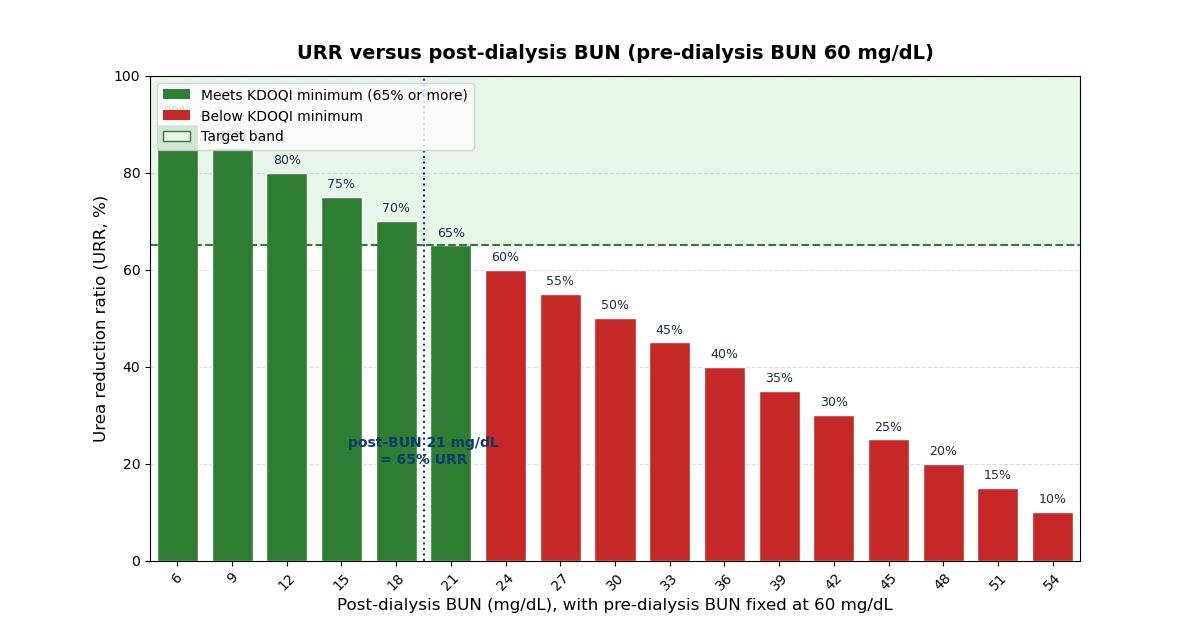
The chart below shows how the URR changes across post-dialysis BUN values when the pre-dialysis BUN is fixed at 60 mg/dL. The green band marks the KDOQI 2015 minimum target of 65% or more. Notice how steep the fall is: each extra 3 mg/dL left in the blood at the end of the session costs about 5 percentage points of URR, which is why the sampling technique for the post BUN matters so much.
| URR | KDOQI 2015 interpretation (3x/week haemodialysis) | What it means in practice |
|---|---|---|
| 70% or more | Meets the target dose | The guideline target dose is being delivered for this session. |
| 65% to below 70% | Meets the minimum adequate dose | Adequate for this session, but below the target dose; aim for the target so that routine variation stays above the minimum. |
| Below 65% | Below the minimum adequate dose | Review the dialysis prescription, session length, vascular access function, blood flow rates, and the blood sampling technique. |
URR and Kt/V: two views of the same clearance
Kt/V is the other major adequacy metric. It expresses the dialyser urea clearance (K) multiplied by treatment time (t), divided by the patient's urea distribution volume (V), which is roughly total body water. Its advantage over the URR is normalisation: dividing by V makes the dose comparable between a 50 kg patient and a 110 kg patient, whereas the raw URR says nothing about body size. That is why Kt/V is the preferred metric for prescribing and troubleshooting, while the URR remains the quickest bedside check.
The two numbers are linked by single-pool urea kinetics. Under fixed-volume assumptions the relationship is simply spKt/V = minus the natural logarithm of (1 minus URR/100), with URR as a fraction. Plug in a URR of 65%: 1 minus 0.65 equals 0.35, and minus ln(0.35) equals about 1.05. In practice, ultrafiltration during the session removes urea-laden fluid and adds to the delivered dose, so the widely used Daugirdas second-generation equation adds corrections for urea generation during treatment and for the ultrafiltration volume: spKt/V = -ln(R - 0.008 times t) + (4 - 3.5 times R) times (UF / W), where R is the post-to-pre BUN ratio, t is the session length in hours, UF is the ultrafiltration volume in litres, and W is the post-dialysis weight in kilograms (Daugirdas JT, Journal of the American Society of Nephrology, 1993). With typical ultrafiltration, a URR of 65% lands at a Daugirdas spKt/V of about 1.2, which is exactly the KDOQI minimum. The calculator's two spKt/V estimates implement precisely these two equations, which is why the estimated basic value at 65% URR reads about 1.05 while the Daugirdas-style value with normal ultrafiltration reads about 1.2.
A word of caution about the word "estimated": these are algebraic approximations of single-pool kinetics. Formal urea kinetic modelling, which the guideline regards as the best measure of delivered dose, also allows comparison of the expected versus delivered dose, estimation of the urea generation rate, and detection of prescription delivery problems such as access recirculation or under-delivery by the machine. The estimates on this page are excellent for understanding the relationship and for teaching; they are not a substitute for modelling when the dose is in doubt.
One more relationship is worth knowing. The equilibrated Kt/V (eKt/V), which corrects for urea rebound after the session, is typically about 0.2 Kt/V units lower than the single-pool value, with the exact difference depending on the dialysis rate. The rebound exists because urea keeps moving out of poorly perfused tissues (skin, muscle, bone) into the blood for 30 to 60 minutes after dialysis ends, raising the BUN measured late. A single-pool value that just meets the minimum can therefore equilibrate below it, which is one reason guidelines set the prescription target above the minimum.
Blood sampling: the detail that changes the number
The URR is only as honest as its two blood samples, and the post-dialysis sample is the fragile one. Two artefacts can corrupt it, both acting in the same direction: they make the post BUN look lower than the true equilibrated value, which inflates the URR and hides under-dialysis.
The first is access recirculation. If the post sample is drawn at full blood pump speed, dialysed blood returning through the venous needle can be sucked straight back into the arterial needle and sampled before it has mixed with the body's blood pool. The defence is the slow-flow technique: stop the dialysate flow, slow the blood pump to 50-100 mL/min, wait about 15 seconds, then draw the sample. This clears the recirculated blood from the access and the sample reflects the systemic circulation.
The second is cardiopulmonary and urea rebound. Even with perfect sampling, the BUN measured in the first minute or two after dialysis is the lowest it will ever be, because urea is still equilibrating between body compartments. Cardiopulmonary recirculation clears within 2 to 3 minutes of slowing the pump; the slower tissue rebound completes within 30 to 60 minutes. Sampling later avoids the artefactual low, but waiting 30 minutes is impractical in routine care, which is why the slow-flow sample is the accepted compromise and why the eKt/V correction exists.
Practical discipline follows from this. The pre and post samples must be collected at the same treatment session, and if the session was not typical for the patient, the post sample should not be used for adequacy at all. Sessions cut short, sessions with excessive pressure alarms or repeated interruptions, and sessions where the prescribed blood flow rate or treatment duration could not be achieved are all reasons to skip the URR that day and recollect at the next typical session. An atypical session's URR answers a question nobody asked.
Limitations
The URR's simplicity is also its blind spot: it sees only two BUN values and ignores everything that happened between them. Ultrafiltration volume, urea generation during the session, and residual kidney function all influence the true delivered dose without moving the URR, and when any of them is large the URR and Kt/V can disagree.
Mathematical modelling has shown how far the disagreement can go. Under the variable-volume single-pool model, a URR below 0.65 can coexist with a total Kt/V above 1.2, particularly when residual renal function contributes; when residual clearance is substantial, the URR can sit below the minimum while the total dose is more than adequate. The reverse discrepancy, a reassuring URR above 0.65 with a Kt/V below 1.2, is rarer and occurs mainly when residual function is negligible. The practical lesson is that the URR should be read alongside Kt/V (including residual clearance where relevant), access flow studies, recirculation checks, and the clinical picture, exactly as the guideline intends, rather than as a standalone verdict.
There are settings where the URR is not just limited but meaningless. In peritoneal dialysis and continuous renal replacement therapy, urea is cleared continuously and the BUN stays roughly constant after the initial treatment of uraemia, so the URR is essentially zero no matter how much clearance is delivered. In long slow overnight haemodialysis, simplified equations underestimate the dose because urea generation during the long session becomes significant; formal kinetic modelling is recommended there.
Finally, every URR is a snapshot of one session. Dialysis dose varies from session to session with treatment time, blood flows, access function, and ultrafiltration goals, so adequacy is judged on the pattern across sessions, not on a single number. And the URR measures small-solute clearance only; it says nothing about middle-molecule clearance, volume control, mineral metabolism, anaemia, or nutrition, all of which matter for the patient's outcomes. It is one instrument on the panel, not the panel itself.
Key takeaways
- The urea reduction ratio (URR) measures the fractional fall in blood urea nitrogen (BUN) across one hemodialysis session: URR = (pre-dialysis BUN minus post-dialysis BUN) divided by pre-dialysis BUN, multiplied by 100.
- The National Kidney Foundation KDOQI 2015 guideline for hemodialysis adequacy recommends a minimum adequate URR of more than 65% and a target dose of more than 70% for patients dialysed three times weekly with treatment times under 5 hours.
- Subtract the post-dialysis BUN from the pre-dialysis BUN, divide by the pre-dialysis BUN, and multiply by 100.
- URR and single-pool Kt/V are two views of the same urea clearance.
Frequently asked questions
What is the urea reduction ratio?
The urea reduction ratio (URR) measures the fractional fall in blood urea nitrogen (BUN) across one haemodialysis session: URR = (pre-dialysis BUN minus post-dialysis BUN) divided by pre-dialysis BUN, multiplied by 100. It is the simplest bedside measure of how much urea a dialysis session removed.
What URR should dialysis achieve?
The National Kidney Foundation KDOQI 2015 guideline for haemodialysis adequacy recommends a minimum adequate URR of more than 65% and a target dose of more than 70% for patients dialysed three times weekly with treatment times under 5 hours. The same guideline sets a minimum delivered single-pool Kt/V of 1.2 with a target of 1.4.
How is URR calculated? Give an example.
Subtract the post-dialysis BUN from the pre-dialysis BUN, divide by the pre-dialysis BUN, and multiply by 100. For example, with a pre-dialysis BUN of 80 mg/dL and a post-dialysis BUN of 20 mg/dL: (80 - 20) / 80 x 100 = 75%. Because URR is a ratio, the units cancel, so mg/dL and mmol/L give the same answer as long as both values use the same unit.
How is URR related to Kt/V?
URR and single-pool Kt/V are two views of the same urea clearance. The basic logarithmic relationship is spKt/V = -ln(1 - URR/100): a URR of 65% corresponds to a basic spKt/V of about 1.05, and about 1.2 when ultrafiltration is taken into account with the Daugirdas equation, which is why the two thresholds (URR 65% and spKt/V 1.2) travel together. The estimates on this page are approximations, not substitutes for formal urea kinetic modelling.
Why does the post-dialysis blood sample need special handling?
The post-dialysis sample must be drawn with the dialysate flow stopped and the blood pump slowed to 50-100 mL/min for about 15 seconds before sampling (the slow-flow technique). This avoids contamination by recirculated blood from the access, which would make the post BUN look artificially low and inflate the URR.
When can the URR be misleading?
URR ignores ultrafiltration volume, urea generated during the session, and any residual kidney function, so it can disagree with Kt/V when those are large: for example, a URR below 65% can still accompany an adequate total Kt/V in a patient with substantial residual renal function. It is essentially meaningless in peritoneal dialysis or continuous renal replacement therapy, where BUN stays roughly constant, and it should be interpreted alongside access flow studies, recirculation checks, and the patient's overall clinical picture.
References and further reading
Medically reviewed by Dr. Taimoor Asghar, Physician and Community Medicine Researcher. Reference: National Kidney Foundation. KDOQI Clinical Practice Guideline for Hemodialysis Adequacy: 2015 Update. Am J Kidney Dis. 2015;66(5):884-930.