Why iron matters so much in childhood
Iron is one of the few nutrients whose shortage in early childhood can leave a lasting mark on the brain. The body uses iron to build hemoglobin, the protein in red blood cells that carries oxygen from the lungs to every tissue, and myoglobin, which stores oxygen inside muscles. When iron runs short, the blood carries less oxygen, children tire easily, and the classic picture of iron deficiency anemia appears: pale skin, fatigue, poor appetite, and sometimes unusual cravings for non-food items such as ice or clay.
What makes iron special among childhood deficiencies is the brain connection. Iron is needed for the development of the hippocampus and other brain structures involved in memory and learning, and research cited in the 2026 American Academy of Pediatrics (AAP) clinical report indicates that even iron deficiency without anemia can impair hippocampal function. Randomized trials summarized in that report found improved psychomotor development in young children after iron therapy. Because the brain grows fastest in the first two to three years of life, that is exactly when iron shortfalls do the most damage and when treatment matters most.
In the United States, iron deficiency anemia affects up to 3 percent of children aged 1 to 2 years, and it is far more common in parts of the world where diets are low in meat and iron-fortified foods. The usual story in toddlers is familiar to every pediatrician: a diet heavy on cow's milk, which is a poor source of iron and actively blocks iron absorption, combined with prolonged breastfeeding without iron-rich complementary foods after 6 months. This is why pediatric guidance keeps returning to two themes: screen the children at highest risk, and treat confirmed deficiency with the right dose of elemental iron, not just any spoonful of a bottle labeled "iron."
Elemental iron versus the salt: the number-one source of dosing mistakes
Almost every dosing error with iron products traces back to one confusion: the weight of the iron salt is not the weight of the iron. Ferrous sulfate, the most commonly prescribed oral iron, is only about 20 percent elemental iron by weight. The other 80 percent is the sulfate part of the molecule, which carries the iron into the body but does no nutritional work itself. Doses are therefore expressed in milligrams of elemental iron, the part the body actually uses to make hemoglobin, so that a dose means the same thing no matter which iron salt or brand is on the shelf.
A concrete example makes this unavoidable. A standard adult ferrous sulfate tablet contains 325 mg of ferrous sulfate, but only 65 mg of elemental iron. The dried (exsiccated) form is more concentrated at about 30 percent elemental iron. If a caregiver reads "ferrous sulfate 325 mg" on a label and assumes the child is getting 325 mg of iron, the real dose is five times smaller than imagined. Going the other way is equally dangerous: if a prescription says "65 mg elemental iron" and someone measures out 65 mg of ferrous sulfate powder or liquid, the child receives only about 13 mg of iron, a serious underdose that fails to treat the anemia.
This is why every reputable dosing reference, from the AAP to the Harriet Lane Handbook, states pediatric iron doses in elemental iron and lists each product's elemental content separately. The Harriet Lane Handbook lists ferrous sulfate products with both numbers side by side, for example "75 mg (15 mg Fe)/1 mL" for infant drops, so that the salt weight and the elemental iron are never mixed up. Whenever you read a dose on this page, in the widget above, or on a prescription, assume it means elemental iron unless it explicitly says otherwise, and check the bottle for the elemental iron line on the label before measuring.
What the common liquid products actually contain
Pediatric iron comes in several liquid strengths, and they differ more than most parents expect. The infant drops sold as Fer-In-Sol and its generics provide 15 mg of elemental iron per 1 mL, which the Harriet Lane Handbook lists as 75 mg of ferrous sulfate per 1 mL. An important labeling note: older bottles of these drops were labeled as 15 mg of elemental iron per 0.6 mL, and the manufacturer later changed the measured dose to 1 mL while keeping the same 15 mg of elemental iron, so older and newer bottles deliver the same iron in different volumes. If you are finishing an old bottle and starting a new one, recheck the label rather than assuming the dropper markings match.
Other ferrous sulfate liquids are much stronger. The standard oral elixir and liquid contain 220 mg of ferrous sulfate per 5 mL, which equals 44 mg of elemental iron per 5 mL, and the oral syrup contains 300 mg per 5 mL, equal to 60 mg of elemental iron per 5 mL. Some pediatric syrups marketed in other countries are labeled at 15 mg of elemental iron per 5 mL, the concentration used in the widget above. The lesson is blunt: never substitute one liquid for another by volume. Five milliliters of the elixir delivers nearly three times the iron of five milliliters of the 15 mg/5 mL syrup. The Drugs.com professional reference carries an explicit warning on this point, noting that multiple concentrations of ferrous sulfate oral liquid exist and that selecting the wrong one without adjusting the volume can cause serious over- or underdosing.
Treatment doses versus prevention doses
Pediatricians use iron in two very different ways: treating established iron deficiency anemia, and preventing deficiency in infants at risk. The doses differ by a factor of two or three, so knowing which situation applies is essential.
Treating iron deficiency anemia
The current AAP recommendation, published in the June 2026 clinical report on prevention, screening, diagnosis, and treatment of iron deficiency in infants, children, and adolescents, is 3 mg of elemental iron per kilogram of body weight per day, given once daily, for young children with iron deficiency anemia. For adolescents, the recommended treatment dose is 65 mg of elemental iron once daily. This is a deliberate simplification of older guidance, which used a range of 3 to 6 mg/kg/day divided into one to three daily doses. The shift rests on trial evidence: a randomized trial published in JAMA found that once-daily, low-dose ferrous sulfate raised hemoglobin as effectively as higher or divided regimens in young children with nutritional iron deficiency anemia, while once-daily dosing is easier for families to sustain and tends to cause fewer stomach complaints.
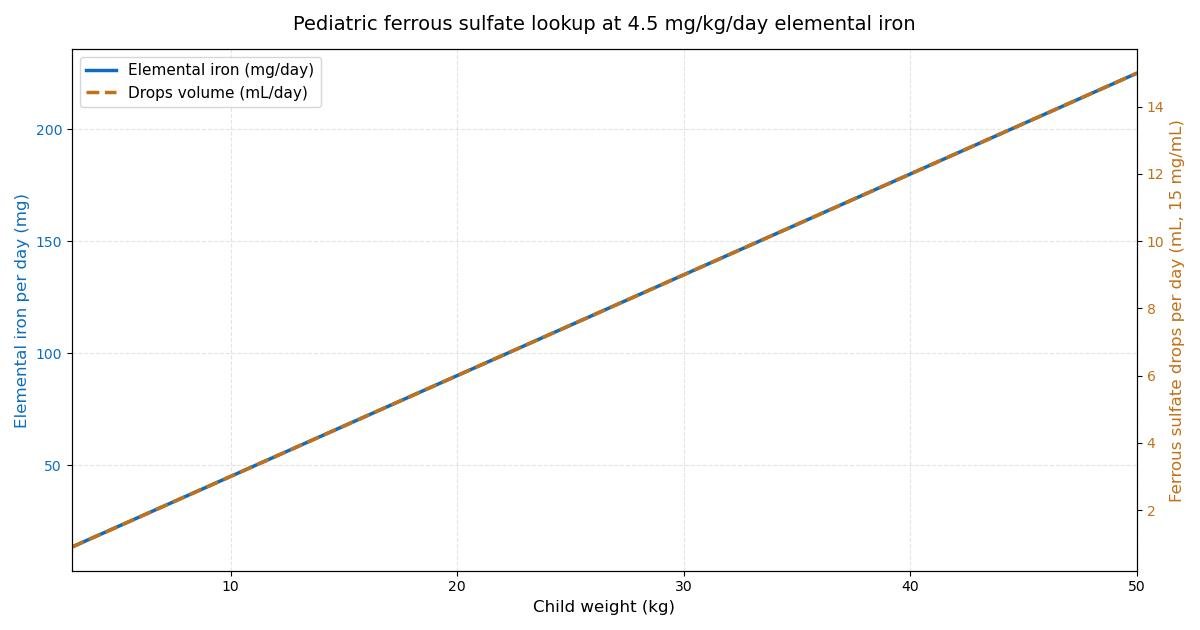
Because prescriptions written under the older guidance are still in circulation, the widget above offers all three positions of the traditional range: low (3), mid (4.5), and high (6 mg/kg/day of elemental iron). A prescription for the older range is not automatically wrong, but families should know that the newest AAP guidance favors the 3 mg/kg once-daily dose for young children, and any dose change should go through the child's own doctor rather than being adjusted at home.
| Group | Elemental iron dose (AAP 2026) | Schedule |
|---|---|---|
| Young children with iron deficiency anemia | 3 mg/kg/day | Once daily |
| Adolescents with iron deficiency anemia | 65 mg/day | Once daily |
| Older guidance range (still seen on prescriptions) | 3 to 6 mg/kg/day | Once daily or divided into 2 to 3 doses |
Preventing deficiency in at-risk infants
Prevention doses are lower than treatment doses because the goal is to top up a diet, not to correct an established deficit. The 2026 AAP report recommends that preterm infants receiving full enteral feeds begin iron fortification or supplementation by 2 weeks of life, targeting an iron intake of 2 to 3 mg/kg/day. Term infants who are exclusively breastfed should receive iron supplementation of 1 mg/kg/day by 4 months of age, since breast milk, while ideal in most respects, contains little iron and the infant's birth stores run down around that age. Families who prefer to wait may instead introduce iron-rich complementary foods at 6 months, but the AAP notes that prolonged exclusive breastfeeding beyond 6 months without iron supplementation raises the risk of deficiency.
Two feeding rules support prevention across the board. Cow's milk, or milk alternatives used in its place, should not be offered before 12 months of age, and after the first birthday milk should be limited to less than 24 ounces (about 700 mL) per day, because excess milk displaces iron-rich foods and its calcium and protein interfere with iron absorption. From 6 months onward, iron-rich complementary foods should be introduced early: meats such as red meat, poultry, and fish supply heme iron, the form the body absorbs most easily, while iron-fortified cereals, legumes, and pastas supply non-heme iron that is better absorbed when eaten with vitamin C-rich fruits or vegetables.
How to give iron so it actually gets absorbed
Iron absorption is famously fussy, and small administration details change how much of each dose reaches the bloodstream. The single most important factor is timing relative to food. Iron is best absorbed on an empty stomach, roughly 1 hour before or 2 hours after eating. In practice, many children tolerate iron poorly on an empty stomach, with nausea or cramps, and pediatricians commonly advise giving the dose with a small amount of food or fruit juice if the empty-stomach schedule causes distress. A slightly smaller absorbed fraction from a dose the child actually keeps down beats a theoretically perfect dose that comes back up.
Vitamin C has a long reputation as iron's helper, and it genuinely does improve the absorption of non-heme iron. Older guidance emphasized giving iron with vitamin C or orange juice. The 2026 AAP report, however, notes that vitamin C co-administration is not required, reflecting trial data showing that routine treatment works well without it. Fruit juice remains a practical vehicle for the drops, but it is optional rather than mandatory. What should be avoided around the dose is milk and dairy: calcium competes with iron for absorption, so the drops should not be mixed into a milk bottle or given right after a large serving of milk, yogurt, or cheese. Tea is another documented inhibitor of iron absorption and has no place in a young child's diet around iron dosing.
For the drops themselves, practical technique matters. The Fer-In-Sol label advises dispensing the measured amount directly into the mouth, aiming toward the inner cheek, or mixing it with formula, fruit juice, cereal, or other foods to improve acceptance, and it notes that a small amount remaining in the dropper tip is normal. Liquid iron temporarily stains the teeth a dark color; the label notes that thorough brushing minimizes this discoloration, and giving the dose toward the back of the mouth rather than letting it pool around the front teeth helps. A second common surprise is the stool: unabsorbed iron darkens the stool to a greenish-black color, which is harmless and expected, though any bright red blood or severe diarrhea should be reported promptly.
How long treatment lasts
Families often expect a short course, like an antibiotic, but iron therapy is measured in months. The AAP recommends a minimum of 3 months of iron therapy for iron deficiency anemia, with follow-up visits at about 1 month and 3 months after starting. The 1-month visit checks whether the treatment is working: a rising reticulocyte count or a hemoglobin increase of around 1 g/dL within the first month confirms that the bone marrow is responding. If there is no response, the dose, adherence, and possible barriers such as ongoing blood loss or poor absorption need review before assuming the diagnosis was wrong.
The reason treatment continues well past the point where the child looks and feels better is that a normal hemoglobin is only half the job. Iron therapy first corrects the anemia, then must refill the body's depleted iron stores, measured by ferritin. Standard practice is to continue iron for about 2 to 3 months after the blood counts normalize, because stopping the day the hemoglobin looks normal leaves stores empty and the anemia frequently returns within months. Severe deficiency may require even longer courses. Throughout, the underlying cause deserves attention alongside the supplement: excessive milk intake should be corrected, menstrual blood loss in adolescents evaluated, and in any child with unexplained or recurrent deficiency, causes such as celiac disease or gastrointestinal blood loss should be considered with the doctor.
Safety: why iron must be treated with respect
Iron is one of the few over-the-counter nutrients that can kill a small child in a single unsupervised episode, and this page would be irresponsible without stating that plainly. The FDA requires every iron-containing product sold in the United States to carry this warning: "Accidental overdose of iron-containing products is a leading cause of fatal poisoning in children under six. Keep this product out of reach of children. In case of accidental overdose, call a doctor or poison control center immediately." The warning exists because the danger is real and historically underappreciated: since 1986, more than 110,000 incidents of children ingesting iron have been reported to US poison centers, with dozens of deaths.
The toxicology is unforgiving because iron tablets look like candy to a toddler and the margin between a therapeutic dose and a dangerous one is narrow. Symptoms of iron poisoning can begin at ingestions above about 10 mg of elemental iron per kilogram of body weight, and published case reviews note that as few as 10 ferrous sulfate tablets, totaling 600 mg of elemental iron, have been fatal to a small child. Early signs include nausea, vomiting, abdominal pain, and bloody diarrhea, sometimes followed by a deceptive quiet period before serious complications involving the liver, circulation, and metabolism develop. Because of that misleading improvement phase, a child who vomits after swallowing iron and then seems fine still needs emergency evaluation.
One special caution for households with a new baby: studies have found that the arrival of a sibling raises the risk of iron poisoning in the older child, because prenatal iron supplements enter the home and are often left in visible, accessible places to help the mother remember them. Almost half of hospital admissions for pediatric iron poisoning in one Canadian study could have been prevented by safer storage in the year before and after a sibling's birth. When a new baby arrives, audit where every iron product in the house is stored.