Pediatric Fluconazole (Diflucan) Dosage Calculator
Weight-based day-1 loading dose and daily maintenance dose for children, plus oral suspension volumes in mL. Every number on this page follows the FDA Diflucan prescribing label (DailyMed, revised 3/2025).
In short: Weight-based day-1 loading dose and daily maintenance dose for children, plus oral suspension volumes in mL. Every number on this page follows the FDA Diflucan prescribing label (DailyMed, revised 3/2025). Use the calculator above, then read the guide below to interpret your result and its limitations.
References and further reading
What fluconazole is
Fluconazole, sold under the brand name Diflucan, is a triazole antifungal medicine. It works by interfering with the fungal cell membrane: it blocks an enzyme the fungus needs to make ergosterol, a building block of its membrane, so susceptible Candida yeasts cannot grow normally. The drug is active against many Candida species and is one of the most widely used systemic antifungals in children.
Fluconazole is absorbed rapidly and almost completely after swallowing it, which is why the label states that the daily dose is the same whether the medicine is given by mouth or by vein. It can be taken with or without food. Because the drug is cleared mainly by the kidneys, the label gives reduced maintenance doses for patients with impaired renal function, and children with kidney problems need prescriber-directed dose adjustment.
In children, fluconazole is most often prescribed for mucosal Candida infections of the mouth, throat, or esophagus, and for more serious systemic Candida infections such as candidemia (yeast in the bloodstream) or disseminated candidiasis. The pediatric dosing in this calculator comes from the "Dosage and Administration in Pediatric Patients" section of the current FDA Diflucan label, which covers children 6 months and older for the mucosal indications and children 3 months and older for systemic infections under Table 6.
Why there is a loading dose on day 1
Fluconazole stays in the body for a long time. In healthy adults the elimination half-life is about 30 hours, so with an ordinary daily dose it takes 5 to 10 days of repeated dosing to reach steady blood levels. To get effective drug levels faster, the label recommends a loading dose on the first day, in general twice the usual daily dose, so that plasma concentrations are close to steady state by the second day of therapy.
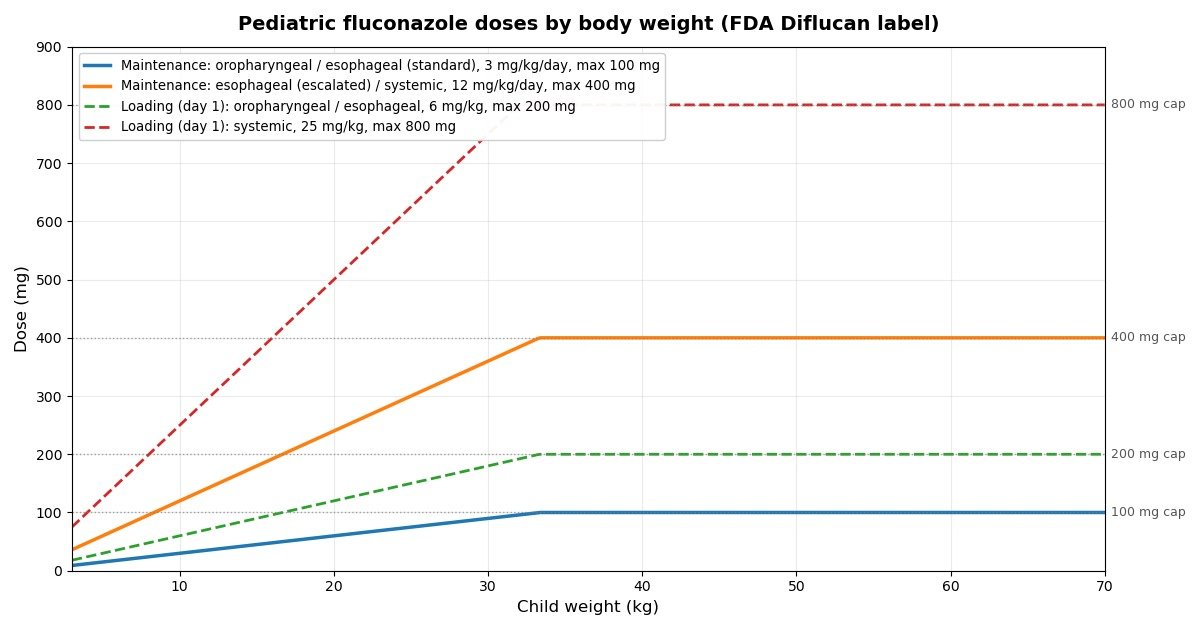
For the mucosal infections this principle gives the familiar pattern: 6 mg/kg on day 1, then 3 mg/kg once daily, where the day-1 dose is exactly double the maintenance dose. For systemic Candida infections the label's Table 6 takes the same principle further, because seriously ill children need therapeutic exposure within the first 24 hours. Pharmacokinetic studies in infants showed that a 25 mg/kg loading dose is needed to reach the target exposure (AUC0-24 above 400 mg*h/L) within 24 hours, followed by 12 mg/kg once daily as maintenance. This is why the systemic loading dose looks much larger than the mucosal one: it is designed to achieve adult-like systemic exposure immediately, then the maintenance dose holds it there.
A loading dose is not an extra or optional dose. It is day 1 of the course, and from day 2 onward the child takes the maintenance dose once daily. Parents sometimes worry that the first dose seems high compared with the rest of the course; the label's pharmacokinetic rationale above is the reason.
The three indications and their labeled doses
The table below summarizes exactly what the current FDA Diflucan label recommends for each pediatric indication covered by this calculator. The calculator applies these numbers, including the labeled maximum doses, and flags whenever a maximum caps the calculated dose.
| Indication | Day-1 loading dose | Daily maintenance dose | Labeled maximum | Minimum duration |
|---|---|---|---|---|
| Oropharyngeal candidiasis (6 months and older) | 6 mg/kg | 3 mg/kg once daily | Adult dose 200 mg day 1, then 100 mg/day (dose not to exceed adult dose) | At least 2 weeks |
| Esophageal candidiasis (6 months and older) | 6 mg/kg | 3 mg/kg once daily; up to 12 mg/kg/day only on the prescriber's judgment of response | Adult dose 200 mg day 1, then 100 mg/day; up to 400 mg/day if escalated | Minimum 3 weeks, and at least 2 weeks after symptoms resolve |
| Systemic Candida infection (3 months and older, Table 6) | 25 mg/kg | 12 mg/kg once daily | 800 mg loading dose; 400 mg/day maintenance | Minimum 3 weeks, and at least 2 weeks after symptoms resolve |
Oropharyngeal candidiasis
Oropharyngeal candidiasis, commonly called thrush, is a yeast infection of the mouth and throat. In children 6 months and older the label recommends 6 mg/kg on the first day followed by 3 mg/kg once daily, with treatment for at least 2 weeks to decrease the likelihood of relapse. In practical terms, a 20 kg child receives a 120 mg loading dose on day 1 and 60 mg once daily afterward, because neither the loading dose (capped at the 200 mg adult dose) nor the maintenance dose (capped at the 100 mg adult dose) reaches its ceiling at that weight.
Esophageal candidiasis
Esophageal candidiasis is a deeper Candida infection of the food pipe and needs a longer course. The label's standard pediatric regimen is the same mg/kg structure as oropharyngeal disease: 6 mg/kg on day 1, then 3 mg/kg once daily, but treatment runs for a minimum of three weeks and for at least 2 weeks after symptoms resolve. The important nuance, and one that older summaries sometimes get wrong, is that 12 mg/kg/day is not the standard maintenance dose. The label says doses up to 12 mg/kg/day may be used based on medical judgment of the patient's response to therapy. This calculator therefore defaults to 3 mg/kg/day and only uses the higher 12 mg/kg/day regimen when you confirm the prescriber has directed escalation, capping it at the labeled 400 mg/day maximum. For example, a 40 kg child on the escalated regimen calculates to a 240 mg loading dose, capped at 200 mg, and 480 mg/day maintenance, capped at 400 mg/day.
Systemic Candida infections
Systemic infections such as candidemia and disseminated candidiasis are treated under the label's Table 6, which was designed to give children the same systemic exposure as adults. For children 3 months and older the regimen is a 25 mg/kg loading dose on day 1, not to exceed 800 mg, followed by 12 mg/kg once daily, not to exceed 400 mg. Treatment runs for a minimum of 3 weeks and for at least 2 weeks after symptoms resolve. Because systemic infection is serious and the doses are high, the loading-dose cap matters: a 32 kg child receives exactly 800 mg on day 1 (25 x 32), while a heavier child is capped at 800 mg and the prescriber must confirm the final dose. Neonates under 3 months follow different rows of Table 6 based on gestational age, so this calculator, which starts at 3 kg, does not compute neonatal doses.
Measuring the suspension correctly
Diflucan for oral suspension comes as a powder that the pharmacy reconstitutes with 24 mL of water. Each bottle delivers 35 mL of suspension at one of two strengths: the 350 mg bottle gives 10 mg/mL and the 1400 mg bottle gives 40 mg/mL. The calculator converts your child's mg dose into mL for the strength you select: divide the mg dose by the mg/mL strength. For instance, a 60 mg maintenance dose is 1.5 mL of the 40 mg/mL suspension, or 6 mL of the 10 mg/mL suspension.
Always measure liquid fluconazole with an oral dosing syringe, never a kitchen spoon, because spoons vary enough to cause meaningful under or overdosing in a small child. Shake the bottle well before every use, since the drug settles. The label instructs storing the reconstituted suspension between 5 C and 30 C, protecting it from freezing, and discarding any unused portion after 2 weeks. Mark the discard date on the bottle when the pharmacy dispenses it.
Doses in this calculator are rounded to the nearest 1 mg and volumes to the nearest 0.1 mL, which matches the graduations of standard oral syringes. If a calculated volume seems impractically small, for example under 0.5 mL, ask the pharmacist whether the lower-strength 10 mg/mL suspension would give a more measurable volume.
Safety: liver, heart rhythm, and drug interactions
Fluconazole is generally well tolerated, but the label carries warnings that parents and prescribers must respect. First, the liver. The label states that fluconazole should be administered with caution to patients with liver dysfunction and that rare cases of serious hepatic toxicity, including fatalities, have occurred, mainly in patients with serious underlying medical conditions. In cases linked to the drug, the injury has usually been reversible when the medicine was stopped. The label instructs that fluconazole should be discontinued if clinical signs and symptoms of liver disease develop that may be attributable to the drug. Warning signs listed in the patient information include dark urine, yellowing of the skin or eyes, severe skin itching, light-colored stools, unusual tiredness, vomiting, and loss of appetite.
Second, the heart rhythm. Some azoles, including fluconazole, have been associated with prolongation of the QT interval on the electrocardiogram, through inhibition of the rectifier potassium channel current. Post-marketing surveillance found rare cases of QT prolongation and torsade de pointes, mostly in seriously ill patients with multiple confounding risk factors such as heart disease, electrolyte disturbances, or other QT-prolonging medicines. Fluconazole is contraindicated with quinidine, pimozide, and erythromycin, and the patient leaflet tells families to report heart rhythm problems, including arrhythmia, and low potassium before starting treatment.
Third, drug interactions. Fluconazole affects liver enzymes that metabolize many other drugs, and the label's interaction section is long. Medicines called out in the patient information include warfarin and other blood thinners, diabetes medicines such as glyburide, tolbutamide, and glipizide, several blood pressure medicines, cyclosporine, tacrolimus, and sirolimus, rifampin and rifabutin, phenytoin and carbamazepine, theophylline, amiodarone, certain antidepressants, and several cancer and HIV medicines. The practical rule is simple: tell the prescriber and pharmacist about every prescription medicine, over-the-counter product, vitamin, and supplement the child takes, and read the full interaction section of the label rather than relying on any summary.
Children with impaired kidney function need special attention because fluconazole is cleared primarily by renal excretion. The label reduces the maintenance dose to 50 percent of the recommended daily dose when creatinine clearance is 50 mL/min or less, after a normal loading dose. This calculator does not adjust for renal impairment; the prescriber must do that. Finally, fluconazole can cause dizziness and, rarely, seizures, so the label advises caution with activities needing alertness until the child's response is known.
Sources
- DIFLUCAN (fluconazole) prescribing information, DailyMed, U.S. National Library of Medicine. Label revised 3/2025; Dosage and Administration in Pediatric Patients (oropharyngeal candidiasis, esophageal candidiasis, systemic Candida infections Table 6, cryptococcal meningitis), Dosage in Patients with Impaired Renal Function, Warnings and Precautions (hepatic injury, QT prolongation), and Directions for Mixing the Oral Suspension. Available at dailymed.nlm.nih.gov.
- DIFLUCAN Patient Information leaflet (contraindicated medicines: quinidine, erythromycin, pimozide; liver warning signs; interaction examples), included in the same DailyMed label.
Editorial note: this calculator follows the current label's Table 6 for systemic infections (25 mg/kg loading dose, then 12 mg/kg/day). Older summaries sometimes quote 6 to 12 mg/kg/day without a loading dose; that wording comes from an older label section describing an open study and has been superseded by Table 6. Likewise, the standard pediatric maintenance dose for esophageal candidiasis is 3 mg/kg/day, with escalation to 12 mg/kg/day only on the prescriber's judgment.
Key takeaways
- The FDA Diflucan label recommends 6 mg/kg on the first day for oropharyngeal candidiasis in children 6 months and older, followed by 3 mg/kg once daily.
- For esophageal candidiasis in children 6 months and older, the label recommends 6 mg/kg on the first day, followed by 3 mg/kg once daily.
- For systemic Candida infections in children 3 months and older, the label's Table 6 recommends a loading dose of 25 mg/kg on the first day (not to exceed 800 mg), followed by 12 mg/kg once daily (not to exceed 400 mg).
- Diflucan for oral suspension is reconstituted to 10 mg/mL or 40 mg/mL.
Frequently asked questions
What is the pediatric fluconazole loading dose for oropharyngeal candidiasis?
The FDA Diflucan label recommends 6 mg/kg on the first day for oropharyngeal candidiasis in children 6 months and older, followed by 3 mg/kg once daily. Treatment should continue for at least 2 weeks to decrease the likelihood of relapse.
What is the pediatric fluconazole dose for esophageal candidiasis?
For esophageal candidiasis in children 6 months and older, the label recommends 6 mg/kg on the first day, followed by 3 mg/kg once daily. Doses up to 12 mg/kg/day may be used based on medical judgment of the patient's response to therapy. Patients should be treated for a minimum of three weeks and for at least 2 weeks following the resolution of symptoms.
What is the pediatric fluconazole dose for systemic Candida infections?
For systemic Candida infections in children 3 months and older, the label's Table 6 recommends a loading dose of 25 mg/kg on the first day (not to exceed 800 mg), followed by 12 mg/kg once daily (not to exceed 400 mg). Patients should be treated for a minimum of 3 weeks and for at least 2 weeks following the resolution of symptoms.
How is the fluconazole oral suspension measured for a child?
Diflucan for oral suspension is reconstituted to 10 mg/mL or 40 mg/mL. Divide the prescribed mg dose by the suspension strength to get the mL volume, and measure it with an oral dosing syringe, not a household spoon. Shake the suspension well before each use, store the reconstituted bottle between 5 C and 30 C, and discard any unused portion after 2 weeks.
What are the main safety concerns with fluconazole in children?
The label warns that fluconazole should be used with caution in liver dysfunction, as rare cases of serious hepatic toxicity including fatalities have occurred, mainly in seriously ill patients. It can prolong the QT interval and is contraindicated with quinidine, pimozide, and erythromycin. It interacts with many medicines, so the prescriber must review every medicine the child takes.
How long does a child take fluconazole for candidiasis?
Per the label, oropharyngeal candidiasis should be treated for at least 2 weeks. Esophageal candidiasis and systemic Candida infections should be treated for a minimum of 3 weeks and for at least 2 weeks following the resolution of symptoms. Stopping too early may lead to recurrence.