What furosemide is
Furosemide, sold under the brand name Lasix, is a loop diuretic. It acts in the ascending limb of the loop of Henle, a section of the kidney tubule where a large share of filtered sodium is normally reclaimed. Furosemide blocks the sodium-potassium-chloride (Na-K-2Cl) cotransporter in that segment, which prevents the kidney from reabsorbing salt and water. The blocked salt and water stay in the tubular fluid and are passed out as urine, which is why urine output rises sharply after a dose.
This mechanism explains both the drug's power and its risks. Because furosemide forces out sodium and chloride, potassium and magnesium follow, and the drug also increases urinary losses of calcium. The FDA label for furosemide injection warns that the drug may cause fluid, electrolyte, and metabolic abnormalities such as hypovolemia, hypokalemia, azotemia, hyponatremia, hypochloremic alkalosis, hypomagnesemia, hypocalcemia, hyperglycemia, or hyperuricemia. That long list is the reason every dose is individualized and every child on the drug has blood tests checked on a schedule.
Furosemide is available as tablets (20, 40, and 80 mg), as an oral solution, and as an injectable solution for intravenous or intramuscular use. The injectable products are supplied at a concentration of 10 mg/mL. The standard Lasix oral solution is 10 mg/mL, although some generic or pharmacy-compounded liquids are 8 mg/mL, so the concentration on the actual bottle should always be checked before measuring a dose.
Why children need furosemide
Children receive furosemide for edema, meaning excess fluid that has accumulated in the body. The FDA label lists the approved indication for both adults and pediatric patients as the treatment of edema associated with heart failure, cirrhosis of the liver, and renal disease, including the nephrotic syndrome. It is also indicated as adjunctive therapy in acute pulmonary edema, where fluid collects in the lungs and makes breathing difficult.
In a child, that edema shows up in recognizable ways. Swelling of the legs, feet, or face, rapid weight gain, or a baby who is breathing fast and struggling during feeds are typical signs that prompt clinicians to consider a diuretic. In heart failure, the heart pumps less effectively, fluid backs up, and removing some of that fluid with a diuretic reduces the workload on the heart and eases breathing. In nephrotic syndrome, the kidneys leak protein into the urine, fluid shifts into the tissues, and furosemide helps mobilize the retained fluid while the underlying condition is treated.
Furosemide is not a treatment for the underlying disease itself. It manages the fluid overload while the heart condition, kidney disease, or liver condition is addressed separately. That is also why furosemide is never given to a child who is dehydrated, anuric (producing no urine), or severely low on blood volume: the label contraindicates it in patients with anuria, and excessive diuresis in an already volume-depleted child can cause circulatory collapse.
Pediatric oral dosing
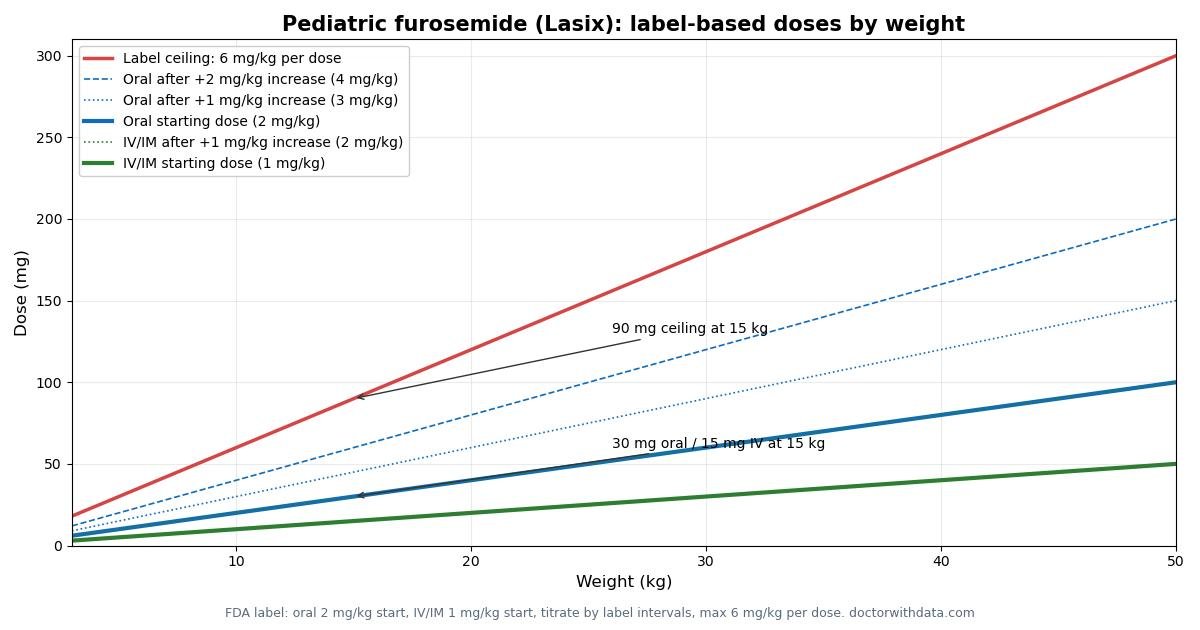
The FDA label gives a clear oral starting point for pediatric patients. The usual initial dose of oral furosemide in pediatric patients is 2 mg/kg of body weight, given as a single dose. If the diuretic response is not satisfactory after the initial dose, the dosage may be increased by 1 or 2 mg/kg, no sooner than 6 to 8 hours after the previous dose. Doses greater than 6 mg/kg of body weight are not recommended. For maintenance therapy, the label directs that the dose be adjusted to the minimum effective level.
Applied to real weights, those rules produce the following reference values. Each row shows the starting dose, the dose after a 1 mg/kg increase, the dose after a 2 mg/kg increase, the 6 mg/kg ceiling, and the millilitres of standard 10 mg/mL oral solution for the starting dose:
| Weight (kg) | Starting dose (2 mg/kg) | After +1 mg/kg | After +2 mg/kg | Ceiling (6 mg/kg) | mL of 10 mg/mL solution (starting dose) |
|---|---|---|---|---|---|
| 3 | 6 mg | 9 mg | 12 mg | 18 mg | 0.6 mL |
| 5 | 10 mg | 15 mg | 20 mg | 30 mg | 1.0 mL |
| 10 | 20 mg | 30 mg | 40 mg | 60 mg | 2.0 mL |
| 15 | 30 mg | 45 mg | 60 mg | 90 mg | 3.0 mL |
| 20 | 40 mg | 60 mg | 80 mg | 120 mg | 4.0 mL |
| 30 | 60 mg | 90 mg | 120 mg | 180 mg | 6.0 mL |
| 40 | 80 mg | 120 mg | 160 mg | 240 mg | 8.0 mL |
| 50 | 100 mg | 150 mg | 200 mg | 300 mg | 10.0 mL |
Two practical points matter for the oral route. First, always confirm the concentration printed on the bottle. Most Lasix oral solution is 10 mg/mL, but 8 mg/mL products exist, and using the wrong conversion would deliver 25 percent too much or too little. Second, oral doses are usually given once or twice daily at individually determined doses, and the label allows the individually determined single dose to be given on an intermittent schedule, because some children do well with furosemide on 2 to 4 consecutive days each week rather than every day.
Pediatric IV and IM dosing
When a rapid onset of diuresis is needed, or when a child cannot reliably take or absorb an oral dose, furosemide is given by injection. The label's pediatric rule for the injection is: the usual initial dose of furosemide injection (intravenously or intramuscularly) in pediatric patients is 1 mg/kg of body weight, administered slowly over 1 to 2 minutes. If the diuretic response to the initial dose is not satisfactory, the dosage may be increased by 1 mg/kg, not sooner than 2 hours after the previous dose, until the desired diuretic effect has been obtained. Doses greater than 6 mg/kg of body weight are not recommended.
Because the starting point is 1 mg/kg and each permitted increase is also 1 mg/kg, the injected dose ladder is simpler than the oral one. The reference values below show the starting dose, the dose after one, two, and three 1 mg/kg increases, and the 6 mg/kg ceiling:
| Weight (kg) | Starting dose (1 mg/kg) | After +1 mg/kg | After +2 mg/kg | After +3 mg/kg | Ceiling (6 mg/kg) |
|---|---|---|---|---|---|
| 3 | 3 mg | 6 mg | 9 mg | 12 mg | 18 mg |
| 5 | 5 mg | 10 mg | 15 mg | 20 mg | 30 mg |
| 10 | 10 mg | 20 mg | 30 mg | 40 mg | 60 mg |
| 15 | 15 mg | 30 mg | 45 mg | 60 mg | 90 mg |
| 20 | 20 mg | 40 mg | 60 mg | 80 mg | 120 mg |
| 30 | 30 mg | 60 mg | 90 mg | 120 mg | 180 mg |
| 40 | 40 mg | 80 mg | 120 mg | 160 mg | 240 mg |
| 50 | 50 mg | 100 mg | 150 mg | 200 mg | 300 mg |
The IV dose starts at half the oral dose because injected furosemide is fully available, while the oral dose must survive absorption through the gut. The injection should always be given slowly, over 1 to 2 minutes, never as a fast push. The label also requires the solution to be inspected visually for particulate matter and discoloration before administration. Intramuscular injection can cause transient injection-site pain, which the label lists among reported adverse reactions.
Premature infants and neonates need special rules
The standard pediatric numbers above do not apply to premature infants. The label sets a strict ceiling for them: the maximum dose for premature infants should not exceed 1 mg/kg per day. It also warns that furosemide use in the first year of life, especially in patients born pre-term, may precipitate nephrocalcinosis or nephrolithiasis (calcium deposits or stones in the kidneys), and directs that renal function be monitored and renal ultrasonography performed in this age group. Hearing loss in neonates, including premature neonates, has been associated with furosemide injection.
Dosing for premature and very young infants is decided by the neonatal team, using neonatal formularies and close monitoring rather than the standard pediatric schedule. The dose lookup widget on this page covers children from 3 to 50 kg and does not cover routine premature infant dosing.
Titration explained: why dosing is response-driven
The central idea in the label's dosing section is individualization. The opening of the dosage section states that therapy should be individualized according to patient response, to gain maximal therapeutic response and to determine the minimal dose needed to maintain that response. In practice this means the starting dose is only the first data point. The clinical team gives it, watches what happens, and then decides whether the same dose is enough, whether it needs increasing, or whether the child can step down to a smaller maintenance dose.
The response the team watches is the diuretic response itself: how much urine the child produces, how breathing improves in pulmonary edema, how fast swollen tissues shrink, and how body weight changes from day to day. The label's titration language is explicitly conditional: dosage may be increased only if the diuretic response to the initial dose is not satisfactory. If the first dose works, there is no reason to increase it, and the maintenance goal is the minimum effective dose.
The intervals between dose increases exist to give the drug time to work. Oral furosemide takes about an hour to begin working and its effect peaks within 1 to 2 hours, so the label's 6 to 8 hour interval before increasing an oral dose ensures the previous dose has had a full chance to act. Injected furosemide works faster, within minutes, so the re-dosing interval can be shorter at 2 hours. Increasing sooner than the label allows, or beyond the 6 mg/kg ceiling, raises the risk of the fluid and electrolyte disturbances the label warns about, without improving the eventual diuresis.
Monitoring during furosemide therapy
The label is unusually specific about what must be checked while a child takes furosemide. Serum electrolytes, CO2, BUN, creatinine, glucose, and uric acid should be monitored frequently during furosemide therapy. Each of these captures a known risk of the drug: electrolytes because furosemide washes out potassium and sodium, CO2 because the drug can cause a hypochloremic alkalosis, BUN and creatinine because the drug can worsen renal function, glucose because it can raise blood sugar, and uric acid because it can raise urate levels.
Potassium deserves special attention. Hypokalemia is one of the most common consequences of loop diuretic therapy, and the risk is highest in children on higher doses, children with inadequate oral electrolyte intake, and children who vomit or have diarrhea. The care team may prescribe potassium supplementation or dietary changes when blood tests show potassium drifting down. Signs that should be reported promptly include unusual muscle weakness, muscle cramps, irregular-feeling heartbeat, and persistent nausea.
Outside the laboratory, the team tracks fluid balance with simple measures. Daily weights, measured at the same time of day on the same scale, are the most reliable way to see whether fluid is leaving the body; a fall of a kilogram or more over a day or two in a child on a diuretic usually reflects fluid loss rather than fat loss. Urine output is recorded, especially in hospital, because a sudden drop in urine with rising BUN or creatinine can signal that the drug is being pushed too hard against failing kidneys. The label warns that if increasing azotemia and oliguria occur during treatment of severe progressive renal disease, furosemide should be discontinued.
Blood pressure is monitored too, because furosemide lowers circulating volume and can cause symptomatic low blood pressure, especially when combined with other antihypertensive drugs. In children with hepatic cirrhosis and ascites, the label notes that sudden alterations of fluid and electrolyte balance may precipitate hepatic encephalopathy and coma, so treatment in such patients is best started in hospital with small doses and careful monitoring.
The ototoxicity warning
Ototoxicity is the label's most serious route-dependent warning. Section 5.3 of the prescribing information states that reports usually associate furosemide ototoxicity with rapid injection, severe renal impairment, the use of higher than recommended doses, hypoproteinemia, or concomitant therapy with aminoglycoside antibiotics, ethacrynic acid, or other ototoxic drugs. That is exactly why the pediatric dosing section repeats the administration instruction: every IV dose must be given slowly, over 1 to 2 minutes.
The practical precautions follow directly from the label. Pediatric IV doses are pushed slowly over 1 to 2 minutes, never rapidly. Doses above the recommended amounts are never used to chase a faster diuresis. In children with severe kidney impairment, the drug is used with extra caution because reduced clearance keeps levels higher for longer. Combinations with aminoglycoside antibiotics should be avoided except in life-threatening situations, and combined use with ethacrynic acid is to be avoided entirely, per the label's drug interaction section.
Parents and caregivers should know the early warning signs. Ringing in the ears (tinnitus), muffled hearing, or any change in a child's hearing after furosemide should be reported to the clinical team immediately. The label specifically notes that hearing loss in neonates, including premature neonates, has been associated with furosemide injection, which is one more reason neonatal dosing stays under specialist control.
Administration
Oral furosemide works best when it fits the child's day. Because diuresis is strongest in the hours after a dose, doses are usually given in the morning or early afternoon so the child is not up all night urinating. The liquid should be measured with an oral syringe, not a household spoon, and the concentration on the bottle should be confirmed every time a new bottle is opened, because 10 mg/mL and 8 mg/mL products both exist. Tablets can be taken with or without food.
For the injection, the label's instructions are brief but strict: inspect the solution visually for particulate matter and discoloration before administration, and give the IV dose slowly over 1 to 2 minutes. The injection is supplied as a sterile solution at 10 mg/mL in single-dose vials of 20 mg/2 mL, 40 mg/4 mL, and 100 mg/10 mL. For high-dose parenteral therapy, which is an adult-context practice, the label specifies a controlled infusion at no more than 4 mg per minute, because the drug can precipitate if mixed with acidic solutions.
Storage follows the label's handling section: store at room temperature, 20 to 25 degrees Celsius, and protect from light. Keep all furosemide products, especially the brightly colored oral liquid, out of the reach of children.
Cautions, contraindications, and interactions
The label lists two absolute contraindications: furosemide is contraindicated in patients with anuria and in patients with a history of hypersensitivity to furosemide. A child who produces no urine gains nothing from a diuretic and can be harmed by one, so anuria is a hard stop.
Furosemide is chemically a sulfonamide, and clinicians exercise caution in children with a history of sulfonamide antibiotic allergy. The label documents severe systemic hypersensitivity reactions with furosemide, including anaphylactic reactions, vasculitis, and severe skin reactions such as Stevens-Johnson syndrome and toxic epidermal necrolysis, so any history of drug allergy should be discussed with the prescribing team before the first dose.
The interaction list in the label is long, and the most important entries for children are the ototoxic combinations already covered: aminoglycoside antibiotics and ethacrynic acid. Other label-listed interactions include cisplatin (additive ototoxicity), salicylates (possible toxicity at lower doses), lithium (reduced renal clearance and high risk of lithium toxicity), and ACE inhibitors or angiotensin receptor blockers (possible severe hypotension and deterioration in renal function). Cephalosporins may carry an increased nephrotoxicity risk when combined with furosemide even with minor renal impairment. None of these means the drugs can never be combined, but every combination is a decision for the clinical team, with monitoring adjusted accordingly.
Children with diabetes need attention because furosemide can raise blood glucose, and children with gout risk are watched because it raises uric acid. The label notes orthostatic hypotension among cardiovascular reactions, so older children should be taught to stand up slowly after starting the drug. As with every medicine on this site, this page is informational: it explains what the label says so families can follow the care plan with confidence, but it does not replace the prescribing clinician.