Topical Hydrocortisone for Children: Fingertip-Unit Dosing Guide
In short: How much hydrocortisone 1% cream to use on a child: the fingertip unit (FTU) method explained, FTU amounts by body area, safety rules for skin thinning, and an FTU dose calculator. Use the calculator above, then read the guide below to interpret your result and its limitations.
Hydrocortisone 1% cream is a low-potency topical steroid used for mild eczema and dermatitis in children. The hard part is not which steroid, but how much: too little leaves the flare smouldering, and too much wastes product and adds side effects. This page explains the fingertip-unit (FTU) method, the standard way of measuring topical steroids, and includes a calculator that adds up FTUs for the body areas you select.
Fingertip-Unit Calculator (educational estimate)
Select the affected body areas. The widget uses adult-reference FTU values and about 0.5 g per FTU. It is an educational estimate, not a prescription.
What topical hydrocortisone is
Hydrocortisone is a corticosteroid, a medicine that reduces inflammation when applied to the skin. The 1% cream or ointment is the standard mild topical steroid used in children: it is available over the counter in many countries, it has decades of safety data behind it, and dermatology guidelines list it as the first-choice steroid for mild atopic eczema and mild irritant or contact dermatitis in childhood. Hydrocortisone 2.5% cream is the slightly stronger sibling; both sit in the lowest potency band of topical steroids, which is exactly why they are the usual starting point for children.
Cream and ointment bases behave differently, and the choice matters in practice. Creams are lighter, easier to spread, and cosmetically acceptable for daytime use, but they contain preservatives and can sting on raw or cracked skin. Ointments are greasier, harder to spread, and cosmetically unpopular with children, yet they lock in moisture better, sting less, and deliver the steroid slightly more effectively into dry skin. A common practical pattern is ointment at night and cream during the day. Lotions and gels exist too, but they are more useful for hairy areas such as the scalp than for general childhood eczema. Whatever the base, the steroid concentration and the fingertip-unit amount described below are what determine the dose.
Hydrocortisone works by dampening the local immune and inflammatory response in the skin: it reduces redness, swelling, itching, and the overgrowth of skin cells that follows chronic scratching. It does not cure eczema, which tends to come and go in flares, and it does not replace emollients (moisturisers), which remain the foundation of daily eczema care. Think of the two as partners: emollients used generously every day keep the skin barrier healthy and reduce the number of flares, while hydrocortisone is brought in for short courses to put out a flare once it starts. Used this way, most children need only brief courses, a few times a year at most.
Potency classes of topical steroids, explained
Topical corticosteroids are ranked by potency into seven classes. Class 7 is the least potent and class 1 is the most potent (the American numbering runs from 1, super-potent, down to 7, least potent). Hydrocortisone 1% and hydrocortisone 2.5% are both class 7, the gentlest band. Above them sit class 6 low-potency options such as desonide 0.05% and hydrocortisone butyrate 0.1%, then the medium-potency classes 5 and 4 (for example triamcinolone 0.1%, mometasone 0.1%), the high-potency classes 3 and 2 (such as betamethasone valerate 0.1% and fluocinonide 0.05%), and finally the class 1 super-potent agents such as clobetasol propionate 0.05%. The full seven-class table is reproduced in many hospital formularies, including the widely referenced UCSF hospital handbook table of topical steroid potency.
Why does the class matter for a parent? Three reasons. First, potency predicts both benefit and harm: stronger classes clear inflammation faster but carry higher risks of skin thinning, stretch marks, and systemic absorption, especially on thin skin. Second, potency is the main safety language doctors use: if a prescription ever says something stronger than hydrocortisone 1% for your child, that is worth a direct conversation about why, how long, and where it will be applied. Third, potency interacts with body area: thin skin (face, eyelids, skin folds, nappy area) absorbs far more steroid than thick skin (palms, soles, knees), so the same class 7 cream is relatively safer on a knee than on an eyelid. Matching the weakest effective steroid to the severity and the site is the core safety rule of topical steroid therapy, and for mild childhood eczema that match is almost always hydrocortisone 1%.
One more distinction parents often miss: hydrocortisone is not the same as hydrocortisone butyrate or hydrocortisone valerate. Those are esterified forms with noticeably higher potency (they sit in the medium classes), even though the names look almost identical on the tube. Always check the exact name and strength printed on the product, and if anything other than plain hydrocortisone 1% or 2.5% has been supplied, confirm with the pharmacist before use.
The fingertip unit method
The fingertip unit, usually written FTU, is the standard method for measuring how much topical steroid to apply. It was described in 1991 by Long and Finlay in the journal Clinical and Experimental Dermatology as a practical answer to a real problem: instructions like "apply sparingly" mean something different to every parent, and vague instructions are one of the main reasons topical steroids appear not to work. The FTU gives the measurement a physical anchor that any parent can reproduce at the bathroom sink.
One FTU is defined as the amount of cream or ointment squeezed from a standard tube (5 mm nozzle) onto an adult index finger, from the fingertip to the first crease. In an adult man this amount weighs about 0.5 g; in an adult woman about 0.4 g. That single FTU covers an area of skin roughly equal to two adult handprints. For the calculator and tables on this page, the standard adult reference of about 0.5 g per FTU is used, and the widget states this openly as an educational estimate.
An important practical point: guidelines express the child's dose in adult FTUs, not in the child's own fingertip. Childhood eczema guidance (for example, the dermatology patient-education material adapted from the FTU system) publishes tables of "adult fingertip units needed per application for children with eczema," broken down by age band, precisely because the adult finger is the calibrated measuring stick. A child's fingertip is smaller and would under-dose the cream; the adult FTU stays constant. So parents measure with their own fingertip, using the age-adjusted tables for how many FTUs each area needs.
The FTU method also solves the prescription-size problem. Steroid courses fail when the tube runs out mid-flare: parents ration what is left, the flare rebounds, and everyone concludes the medicine did not work. Once you know the FTU total for your child's affected areas, you can estimate how many grams each application takes, how many grams a week of treatment will consume, and therefore what tube size to ask for. The calculator above does this arithmetic for you, including an estimate of how many days a 15 g or 30 g tube will last.
FTU amounts by body area
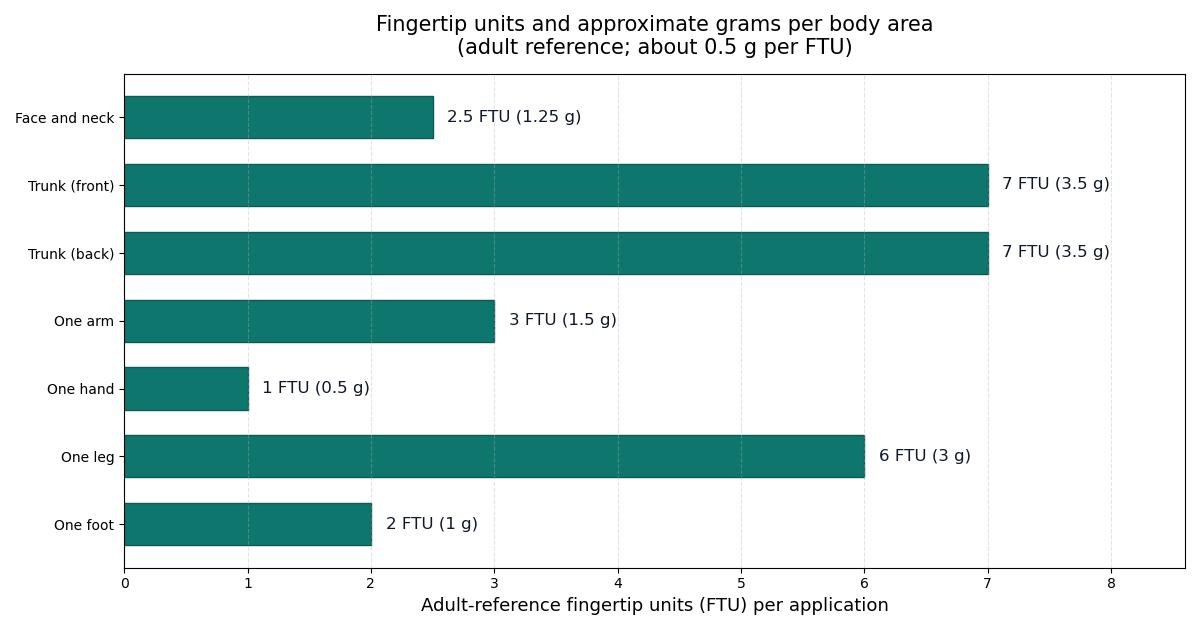
The reference FTU values per body area, as commonly published in dermatology guidance, are: face and neck 2.5 FTU, front of trunk 7 FTU, back of trunk 7 FTU, one arm 3 FTU, one hand 1 FTU, one leg 6 FTU, and one foot 2 FTU. These are adult reference values; they describe the area to be covered, and for a child the clinician adjusts the total by the age-band tables or by clinical judgement. Add the values for every affected area to get the total per application. The worked example in the calculator brief: treating the face, neck (2.5 FTU) plus one arm (3 FTU) gives 5.5 FTU per application, which at about 0.5 g per FTU is about 2.75 g of cream; applied twice daily that is about 38.5 g per week, so a 30 g tube lasts about 5.5 days.
| Body area | Adult-reference FTU | Approx. grams per application |
|---|---|---|
| Face and neck | 2.5 | 1.25 |
| Trunk (front) | 7 | 3.5 |
| Trunk (back) | 7 | 3.5 |
| One arm | 3 | 1.5 |
| One hand | 1 | 0.5 |
| One leg | 6 | 3.0 |
| One foot | 2 | 1.0 |
Notice what this table implies for real families. A child with widespread eczema covering both legs, both arms, and the trunk needs far more cream per application than most parents expect: 7 plus 7 plus 6 plus 6 plus 3 plus 3 is 32 FTU, roughly 16 g per application. Under-dosing is far more common than over-dosing in practice, and it is one of the main reasons eczema appears "steroid resistant" when the real problem is simply too little cream. The FTU table protects against this by turning a vague instruction into a number. For children, published age-band tables scale these values down (for example, guidance tables give a child aged 3 to 5 years about 2 FTU for one arm and hand, and about 1.5 FTU for face and neck), and your child's clinician will advise which figures to use.
Two fine points on measuring. First, the cream should be spread as a thin, even layer that just covers the affected skin: a thick, visible white layer is wasted product, because only the thin film in direct contact with skin is absorbed. Second, treat only the affected skin, not the healthy skin around it; hydrocortisone is for the red, itchy patches, while emollient goes everywhere.
How long to use it, and how to apply it
Hydrocortisone 1% is a short-course medicine. The usual pattern is a thin layer applied once or twice daily to the affected areas until the flare settles, which for mild eczema is typically within one to two weeks, then stop. Evidence reviews summarised in NICE guidance found no clear advantage to applying topical steroids more than once daily for eczema, although twice-daily application remains common practice and the product label usually permits it. More frequent application than twice daily adds nothing but side effects.
Application order matters when emollients are also in use. The practical rule is to leave a gap of about 20 to 30 minutes between the steroid and the emollient so one does not simply dilute or wipe off the other. Many dermatology nurses suggest applying the steroid first to the affected patches, waiting, and then applying emollient generously over everything, though some guidance reverses the order; the gap matters more than the sequence. Wash hands after applying (unless the hands are the treated area) so the steroid is not transferred to the child's eyes or mouth.
When the flare settles, step down. That means stopping the steroid and continuing the emollient alone, which is the maintenance therapy that keeps the next flare away. Some children with frequently recurring flares are given a proactive plan by their doctor, such as twice-weekly steroid on previously affected areas alongside daily emollient, but that is a clinician-directed strategy, not something to improvise. Never extend a course "just to be safe": if the eczema has not clearly improved after about a week of correct FTU-measured use, or if it improves and then flares again immediately, that is information for the doctor, not a reason to keep applying.
Safety: skin thinning, the face, and occlusion
The side effect parents ask about most is skin thinning (atrophy): the skin becoming fragile, shiny, or easily bruised, sometimes with stretch marks or visible small blood vessels. It is a genuine, recognised effect of topical corticosteroids, but the risk profile is strongly tied to potency and duration. It is associated with prolonged use and with higher-potency steroids; short courses of hydrocortisone 1% used in FTU-measured amounts are considered low risk, and early thinning is generally reversible once the steroid is stopped. The practical safeguards are the ones repeated throughout this page: weakest effective steroid, measured amount, short course, no occlusion, and step-down to emollient.
The face and skin folds deserve special caution because thin skin absorbs more steroid. Hydrocortisone should only be used on a child's face, eyelids, nappy area, or skin folds if a clinician has specifically advised it, for the shortest time needed. Keep the cream away from the eyes: repeated exposure around the eyes is linked to glaucoma and cataract in rare cases with prolonged use. The nappy area is a natural occlusion zone (warm, moist, covered), which increases absorption, so steroid use there should always be clinician-directed and brief.
Occlusion means covering treated skin with bandages, wraps, or tight dressings. It multiplies absorption substantially and is never done casually at home. Wet-wrap therapy, where damp bandages are applied over emollient and diluted steroid, is a real hospital-supervised technique for severe flares, but it is a medical procedure with its own dosing rules, not a home improvisation. The same caution applies to applying steroid under a plaster or under tight clothing deliberately to "make it work better".
Two further cautions complete the safety picture. First, do not apply hydrocortisone to skin that looks infected: spreading redness, warmth, pus, yellow crusts, or a sudden worsening with pain can signal bacterial infection, and steroids can mask it while it spreads. Infected eczema needs medical assessment, sometimes with antibiotics, before steroids continue. Second, remember that topical steroids suppress local immunity, which is why they should not be applied to cold sores, impetigo, fungal rashes such as ringworm, or chickenpox spots; steroids can worsen these. When in doubt about what the rash actually is, get a diagnosis before reaching for the tube.
When to see a doctor
Book a medical review if any of the following apply. The eczema does not improve after about a week of correct, FTU-measured hydrocortisone use. Flares keep returning as soon as each course stops, or you find yourself restarting the cream every few weeks. The rash looks infected (spreading redness, warmth, swelling, pus, yellow or golden crusts, fever, or the child seems unwell). The eczema is weeping heavily, bleeding, or causing significant sleep loss despite treatment. You are unsure the rash is eczema at all: psoriasis, fungal infections, scabies, and contact allergies can all mimic eczema and need different treatment. Your child needs the steroid on the face, eyelids, nappy area, or skin folds for more than a few days. Or you notice possible side effects such as thinning, stretch marks, or unusual hair growth where the cream has been used. None of this page replaces that conversation; the FTU method makes home treatment more accurate, but diagnosis and escalation decisions belong with the child's clinician.
Key takeaways
- A fingertip unit (FTU) is the amount of cream squeezed from a standard 5 mm nozzle tube onto an adult index finger, from the fingertip to the first crease.
- Add up the adult-reference FTU values for each affected area: face and neck 2.5 FTU, front of trunk 7 FTU, back of trunk 7 FTU, one arm 3 FTU, one hand 1 FTU, one leg 6 FTU, one foot 2 FTU.
- Yes.
- Hydrocortisone 1% is used in short courses: apply a thin layer once or twice daily to the affected areas until the flare settles, usually within one to two weeks, then stop or step down to emollient alone.
Frequently asked questions
What is a fingertip unit of hydrocortisone cream?
A fingertip unit (FTU) is the amount of cream squeezed from a standard 5 mm nozzle tube onto an adult index finger, from the fingertip to the first crease. One FTU weighs about 0.5 g and covers an area equal to about two adult handprints. The FTU method was described by Long and Finlay in 1991 as a practical way to measure topical treatments.
How many fingertip units does my child need?
Add up the adult-reference FTU values for each affected area: face and neck 2.5 FTU, front of trunk 7 FTU, back of trunk 7 FTU, one arm 3 FTU, one hand 1 FTU, one leg 6 FTU, one foot 2 FTU. For example, treating the face, neck and one arm needs 5.5 FTU per application, about 2.75 g of cream. Children's guidance uses the adult FTU as the reference measure, since it is defined from an adult finger.
Is hydrocortisone 1% cream a weak steroid?
Yes. In the seven-class potency ranking of topical corticosteroids, hydrocortisone 1% and 2.5% sit in class 7, the least potent group. This is why hydrocortisone 1% is the standard first-choice steroid for mild eczema and dermatitis in children.
How long can my child use hydrocortisone 1% cream?
Use it in short courses: a thin layer once or twice daily until the flare settles, usually within one to two weeks, then stop or step down to emollient alone. If the eczema is not improving after about a week of correct use, see the child's doctor or pharmacist rather than extending the course alone.
Can I use hydrocortisone cream on my child's face?
Only if a doctor or pharmacist has advised it. Facial skin is thin and absorbs more steroid, so face use should be for the shortest time needed, in the smallest effective amount. Avoid the eyes and mouth, never use it under occlusion unless a clinician instructs you, and stop once the skin is clear.
Does hydrocortisone 1% thin the skin?
Skin thinning is a recognised side effect of topical corticosteroids, but it is associated with prolonged or high-potency use, not with short courses of hydrocortisone 1% used correctly. FTU-measured amounts, short courses, no occlusion, and stepping down to emollients once the flare settles all minimise the risk.
Sources
- Long CC, Finlay AY. The finger-tip unit: a new practical measure. Clinical and Experimental Dermatology. 1991;16(6):444-447. The original description of the fingertip unit: amount from fingertip to first crease of the adult index finger from a 5 mm nozzle tube, about 0.5 g, covering about two handprints.
- National Institute for Health and Clinical Excellence. Guidance on the use of topical corticosteroids in atopic eczema (Technology Appraisal). Summary of evidence on once-daily versus more frequent application and the treatment pathway for atopic eczema.
- UCSF Hospital Handbook, Topical Steroids table. Seven-class potency ranking listing hydrocortisone 1% and 2.5% in class 7 (least potent), with FTU values per body area: face and neck 2.5, trunk front or back 7, arm 3, leg 6, foot 2.
- Childhood eczema topical steroid patient-education guidance (dermatology formulary material adapted from Long and Finlay): table of approximate adult fingertip units per application for children with eczema by age band, for example face and neck 1 to 2.5 FTU and one arm and hand 1 to 4 FTU from infancy to adolescence.
- Charman CR et al. Topical corticosteroid phobia in patients with atopic eczema. British Journal of Dermatology. 2000;142(5):931-936. Evidence that fear of topical steroids, often driven by vague "use sparingly" advice, leads to under-treatment.