What ondansetron is
Ondansetron, sold under the brand name Zofran, is a 5-HT3 receptor antagonist, the most widely used class of antiemetic medicines. It works by blocking serotonin (5-hydroxytryptamine, 5-HT) at 5-HT3 receptors, which sit on vagal nerve terminals in the gut wall and in the chemoreceptor trigger zone of the brain. Chemotherapy drugs and surgical trauma cause cells in the gut to release large amounts of serotonin; that serotonin signal is what the vomiting center of the brain reads as "vomit now." By occupying the 5-HT3 receptors before the signal arrives, ondansetron interrupts the reflex at its source.
Ondansetron is supplied as conventional tablets (4 mg and 8 mg), orally disintegrating tablets, an oral solution, and an injectable solution. Doses are expressed in terms of ondansetron base, not the hydrochloride salt, so a 4 mg tablet and 5 mL of the standard oral solution deliver the same 4 mg of active drug. The oral solution, conventional tablets, and orally disintegrating tablets may be used interchangeably at the same milligram dose.
The drug is generally well tolerated in children, and pediatric clinical trials found adverse event rates similar to placebo for the PONV indication. The most important safety theme in the label is not tolerability but the heart: ondansetron prolongs the QT interval in a dose-dependent manner, which is why the label sets firm maximum doses, caps infusion rates, and tells clinicians to avoid the drug in congenital long QT syndrome.
The two labeled pediatric indications
The FDA Zofran label establishes exactly two pediatric uses for ondansetron, and every dose on this page belongs to one of them. The first is the prevention of nausea and vomiting associated with initial and repeat courses of emetogenic cancer chemotherapy, including high-dose cisplatin: approved for patients aged 6 months and older for the injection, and with safety and effectiveness established for orally administered ondansetron in children aged 4 years and older for moderately emetogenic chemotherapy. The second is the prevention of postoperative nausea and/or vomiting: approved for patients aged 1 month and older, with pediatric dosing given intravenously.
What is not labeled matters as much as what is. Gastroenteritis, the "stomach flu" that brings dehydrated children to emergency departments, is not an FDA-labeled indication for ondansetron, even though off-label use there is common and studied. Motion sickness, morning sickness in pregnancy, and general "stomach upset" are also not labeled pediatric indications. The dose widget on this page deliberately covers only the two labeled indications; it will refuse to produce a number for anything outside them.
The label also sets expectations about prophylaxis. For PONV it notes that routine prophylaxis is not recommended for patients in whom there is little expectation that nausea and vomiting will occur postoperatively; in patients where vomiting must be avoided, ondansetron is recommended even when the expected incidence is low. For patients who received no prophylaxis and then vomit after surgery, ondansetron may be given to prevent further episodes.
PONV dosing: 0.1 mg/kg up to 40 kg, then a fixed 4 mg
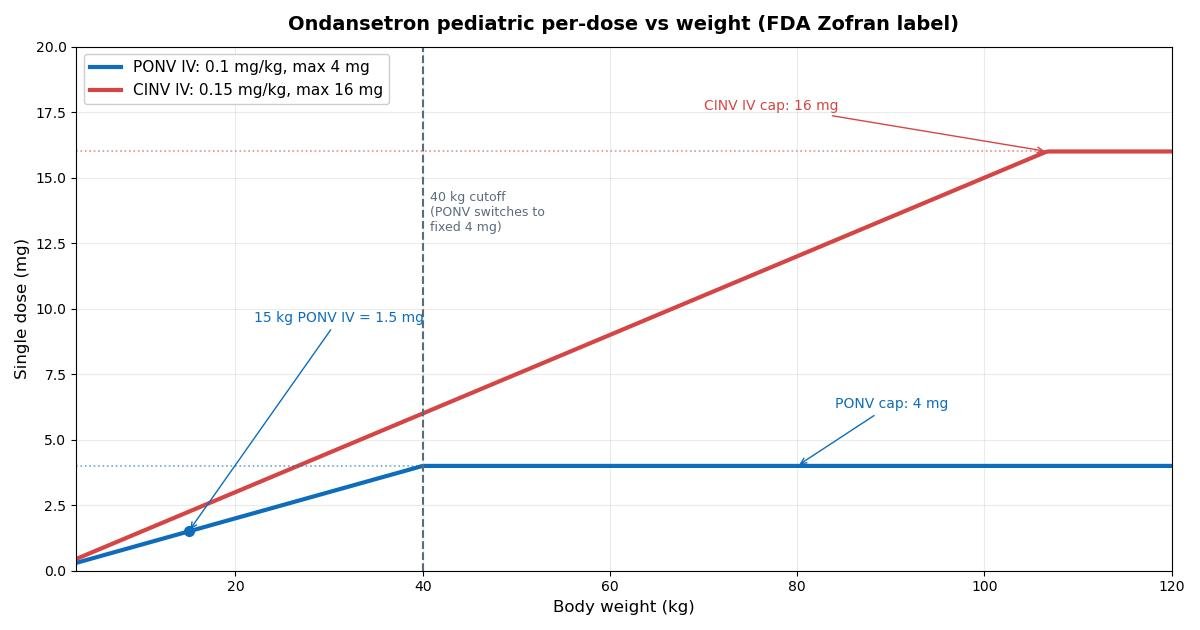
The PONV rule is the simplest in the label and the one this calculator uses most. For pediatric patients 1 month to 12 years of age weighing 40 kg or less, the recommended single dose is 0.1 mg/kg, given intravenously. For the same age group weighing more than 40 kg, the recommended single dose is 4 mg. Adults and pediatric patients older than 12 years receive 4 mg, which may be given intravenously or intramuscularly. The two pediatric bands meet exactly at 40 kg, where 0.1 mg/kg equals 4 mg, so there is no discontinuity at the cutoff.
Applied to real weights, the weight-based band produces these per-dose values: 3 kg gives 0.3 mg, 5 kg gives 0.5 mg, 10 kg gives 1.0 mg, 15 kg gives 1.5 mg, 20 kg gives 2.0 mg, 25 kg gives 2.5 mg, 30 kg gives 3.0 mg, and 40 kg gives 4.0 mg. Any weight above 40 kg in this age band gives the fixed 4 mg. These are single doses, not per-day totals; PONV prophylaxis is a one-time perioperative dose.
Administration details for PONV are strict but simple. Dilution of the injection is not required for PONV dosing in adults or children. The dose is infused or injected over at least 30 seconds and preferably longer, over 2 to 5 minutes. Timing is either immediately before induction of anesthesia, or postoperatively if the patient did not receive prophylactic ondansetron and experiences nausea and/or vomiting within 2 hours after surgery. The label adds two footnotes worth knowing: in adult patients, a second 4 mg postoperative dose after a 4 mg prophylactic dose did not provide additional control, and in pediatric patients 1 month to 12 years, prevention was only studied in patients who had not received prophylactic ondansetron. The label also notes that few patients above 80 kg have been studied, which is why the widget flags lookups above 80 kg for team confirmation.
CINV IV dosing: 0.15 mg/kg, maximum 16 mg, three doses
The chemotherapy IV regimen uses a higher weight-based rate and a higher cap than the PONV regimen, because the emetogenic stimulus of chemotherapy is stronger and more prolonged. For adult and pediatric patients 6 months of age and older, the label recommends 0.15 mg/kg per dose for 3 doses, with a maximum of 16 mg per dose. The first dose is infused intravenously over 15 minutes beginning 30 minutes before the start of emetogenic chemotherapy, and the second and third doses are repeated 4 and 8 hours after the first dose.
Worked per-dose values: 10 kg gives 1.5 mg, 15 kg gives 2.25 mg (rounded to 2.3 mg in practice), 20 kg gives 3.0 mg, 30 kg gives 4.5 mg, 40 kg gives 6.0 mg, 50 kg gives 7.5 mg, 60 kg gives 9.0 mg, and 80 kg gives 12.0 mg. The 16 mg cap is reached at about 106.7 kg (16 divided by 0.15), so within the widget's 3 to 120 kg range only very heavy adolescents trigger it; when they do, the widget states the cap explicitly.
Unlike PONV dosing, CINV IV dosing requires dilution. The injection is diluted in 50 mL of 5% dextrose injection or 0.9% sodium chloride injection before administration. For pediatric patients between 6 months and 1 year of age and/or weighing 10 kg or less, the label allows dilution in 10 to 50 mL, depending on the fluid needs of the patient. The diluted solution is inspected for particulate matter and discoloration before administration and discarded if either is present; after dilution it should not be used beyond 24 hours. The label warns not to mix the injection with solutions of unestablished compatibility, particularly alkaline solutions, in which a precipitate may form.
CINV oral dosing: by age, not by weight
Oral CINV dosing breaks the pattern of everything above it: it is determined by age bands, not by weight. For children 4 to 11 years of age, the regimen is 4 mg orally three times on day 1, with the first dose given 30 minutes before the start of moderately emetogenic chemotherapy and the subsequent doses given 4 and 8 hours after the first dose, followed by 4 mg orally every 8 hours for 1 to 2 days after the completion of chemotherapy. For patients 12 years of age and older, the regimen is 8 mg orally twice on day 1, with the first dose 30 minutes before chemotherapy and the second dose 8 hours later, followed by 8 mg orally every 12 hours for 1 to 2 days after chemotherapy.
The age cutoff is exact: a child who is 11 years and 11 months old receives the 4 mg regimen, and one who has turned 12 receives the 8 mg regimen. The widget implements this boundary directly, so an age of 11.9 returns 4 mg and an age of 12.0 returns 8 mg. Note that the oral CINV indication is established for moderately emetogenic chemotherapy in children 4 years and older; for highly emetogenic regimens such as high-dose cisplatin, the IV regimen above is the labeled approach, and combination antiemetic strategies are decided by the oncology team.
Because the oral doses are fixed tablets or measured liquid rather than weight-based calculations, the main practical task is the continuation schedule after day 1. Families sometimes focus on the pre-chemotherapy dose and lose track of the every-8-hour or every-12-hour follow-on doses for the 1 to 2 days after chemotherapy, which are part of the labeled regimen, not optional extras. The chemotherapy team provides the written schedule; this page reproduces the label's timing so families can follow it.
Measuring the oral solution: 4 mg per 5 mL
Zofran oral solution contains 4 mg of ondansetron per 5 mL, which is a concentration of 0.8 mg/mL. This single fact converts every oral dose on this page into a volume: a 4 mg dose is 5 mL, and an 8 mg dose is 10 mL. The widget shows the millilitre equivalent for every oral lookup, because the most common home-dosing error is confusing the milligram dose with the millilitre volume, which would deliver only 80 percent of the intended dose (1 mL contains 0.8 mg, not 1 mg).
Liquid doses must be measured with an oral syringe, never with a household teaspoon, which can vary by a factor of two. The bottle should be shaken as directed on its label, and the concentration printed on the actual bottle should be confirmed whenever a new bottle is opened, because pharmacy-compounded liquids can differ. Conventional tablets, orally disintegrating tablets, and the oral solution may be used interchangeably at the same milligram dose, so a child prescribed 4 mg can take one 4 mg tablet, one 4 mg orally disintegrating tablet, or 5 mL of solution.
The QT-prolongation warning
The QT warning is the label's most serious precaution for ondansetron and the reason the widget carries a permanent warning box. Section 5.2 of the prescribing information states that ondansetron prolongs the QT interval in a dose-dependent manner, which means higher doses carry more risk, and that postmarketing cases of Torsade de Pointes, a potentially fatal ventricular arrhythmia, have been reported. The label recommends ECG monitoring in patients with electrolyte abnormalities such as hypokalemia or hypomagnesemia, congestive heart failure, bradyarrhythmias, or in patients taking other medicinal products that lead to QT prolongation.
For families, the practical meaning is straightforward. Any child with a known heart rhythm condition, a family history of sudden cardiac death or long QT syndrome, or one who takes other medicines known to affect the QT interval should have that history reviewed with the clinical team before ondansetron is given. Vomiting itself depletes potassium and magnesium, which is one reason the label singles out electrolyte abnormalities for ECG monitoring. The 16 mg IV cap and the fixed 4 mg PONV dose are part of the same safety logic: the dose-dependent nature of the QT effect is why the label never allows open-ended weight-based escalation.
Gastroenteritis: widely used, but off-label
Many parents encounter ondansetron in the emergency department when a child has gastroenteritis, the vomiting-and-diarrhea illness often called stomach flu. Multiple randomized trials and meta-analyses have shown that a single oral dose, commonly 0.1 to 0.15 mg/kg, reduces vomiting and improves the success of oral rehydration therapy in children at risk of dehydration, and pediatric gastroenterology guidance recognizes ondansetron as effective for aborting vomiting in this setting. This is, however, an off-label use: gastroenteritis is not an FDA-labeled indication for ondansetron, and references such as the British National Formulary for Children explicitly note that it is not licensed for this indication.
This page presents gastroenteritis dosing only as background information, never as a labeled recommendation, and the widget does not calculate gastroenteritis doses. The distinction matters because off-label dosing is a clinical decision that weighs the trial evidence against the individual child's cardiac risk factors, dehydration status, and electrolyte picture. A family reading that "trials used 0.1 to 0.15 mg/kg" should understand that this describes what researchers studied, not what the regulator approved, and that the treating team makes the call.
Side effects from the label
In the PONV trials, the adverse reactions reported in at least 2 percent of adults receiving 4 mg intravenously over 2 to 5 minutes were headache (17 percent), drowsiness or sedation (8 percent), injection-site reaction (4 percent), fever (2 percent), cold sensation (2 percent), pruritus (2 percent), and paresthesia (2 percent), though the label notes these rates were not significantly different from the placebo group, since patients were receiving multiple concomitant perioperative medicines. In pediatric PONV patients, adverse reaction rates were similar between ondansetron and placebo groups; diarrhea was seen more frequently with ondansetron (2 percent versus less than 1 percent) in the 1-month to 24-month age group.
In the chemotherapy trials using three 0.15 mg/kg doses, the reactions reported in more than 5 percent of adults were diarrhea (16 percent), headache (17 percent), and fever (8 percent), and constipation was reported in 11 percent of chemotherapy patients receiving multiday ondansetron. Rare but serious label-listed events include hypersensitivity reactions with anaphylaxis, transient ECG changes including QT and QTc prolongation (rarely and predominantly with the intravenous form), arrhythmias, serotonin syndrome particularly with concomitant serotonergic drugs, and myocardial ischemia reported predominantly during intravenous administration, with coronary artery spasm as the most common underlying cause. The label also warns that ondansetron may mask a progressive ileus and gastric distension after abdominal surgery or during chemotherapy, because it does not stimulate gut motility and must not be used instead of nasogastric suction.
Contraindications, liver impairment, and interactions
The label lists two absolute contraindications. Ondansetron is contraindicated in patients with known hypersensitivity to the product or any of its components, and the concomitant use of apomorphine with ondansetron is contraindicated, based on reports of profound hypotension and loss of consciousness when the two were combined. Hypersensitivity reactions including anaphylaxis and bronchospasm have also been reported in patients who reacted to other selective 5-HT3 receptor antagonists, so a history of reacting to a related antiemetic counts.
Severe liver impairment changes the dosing picture. In patients with severe hepatic impairment (Child-Pugh score of 10 or greater), the label recommends a single maximal daily dose of 8 mg infused over 15 minutes beginning 30 minutes before emetogenic chemotherapy, and notes there is no experience beyond first-day administration in these patients. The widget does not adjust for liver impairment; hepatic dosing is a specialist decision.
The interaction list centers on serotonin and the heart. Serotonin syndrome has been reported with 5-HT3 antagonists, mostly with concomitant serotonergic drugs such as SSRIs, SNRIs, MAO inhibitors, mirtazapine, fentanyl, lithium, tramadol, and intravenous methylene blue, and some reported cases were fatal; the label advises monitoring and stopping ondansetron if symptoms such as agitation, confusion, rapid heart rate, unstable blood pressure, tremor, rigidity, or hyperthermia appear. Medicines that prolong the QT interval add to the cardiac risk already described. None of these combinations is automatically forbidden except apomorphine, but each one is a reason for the clinical team to review the plan, and families should make sure every prescriber knows all the medicines a child takes.