What oseltamivir is and how it works
Oseltamivir, sold under the brand name Tamiflu, is an antiviral medicine used to treat and prevent influenza, the illness caused by influenza A and B viruses. It belongs to a drug class called neuraminidase inhibitors. After an influenza virus enters a respiratory cell and replicates, new virus particles need the neuraminidase enzyme to cut themselves free from the host cell and spread to neighbouring cells. Oseltamivir blocks that enzyme, so newly formed viruses stay stuck to the infected cell instead of spreading. The medicine does not kill the virus or repair already infected cells; it slows the spread of infection through the airways, which is why it works best when started early, before the viral load has peaked.
Oseltamivir is a prodrug, meaning the swallowed capsule or liquid is inactive until the liver converts it into its active form, oseltamivir carboxylate. That conversion is efficient and the active metabolite concentrates in the respiratory tract, where it is needed. The medicine is approved for the treatment of acute, uncomplicated influenza and for post-exposure and seasonal prophylaxis in specific age groups. It is not an antibiotic and has no effect on bacterial infections, and it is not a substitute for yearly influenza vaccination, which remains the primary protection.
Treatment dosing for children 1 to 12 years: the four weight bands
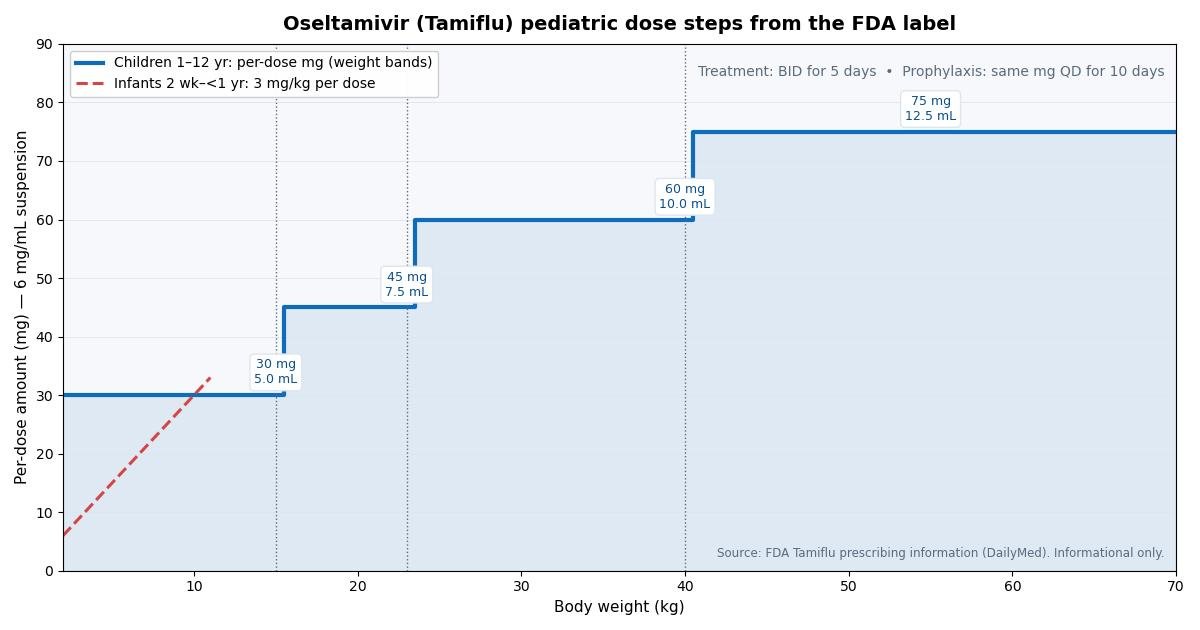
The FDA label does not give one single milligram-per-kilogram dose for children; instead it divides children 1 to 12 years of age into four weight bands, each with a fixed per-dose amount. This banded design keeps dosing simple and keeps each dose within a safe and effective range without requiring caregivers to do arithmetic. The treatment bands, each taken twice daily for 5 days, are: 15 kg or less, 30 mg per dose; 15.1 kg to 23 kg, 45 mg per dose; 23.1 kg to 40 kg, 60 mg per dose; and 40.1 kg or more, 75 mg per dose. A child of exactly 15 kg falls in the lowest band and receives 30 mg, while a child of exactly 40 kg receives 60 mg.
The band boundaries matter because a few hundred grams can change the dose, so an accurate recent weight is essential. Home scales that round to the nearest kilogram can easily misclassify a child sitting on a boundary: a child recorded as 23 kg who actually weighs 23.4 kg belongs on the 60 mg band, not the 45 mg one. Wherever possible, dosing should be based on a weight taken on a calibrated clinic scale rather than an estimate or a months-old measurement. The label phrases the bands as starting at the decimal, writing them as 15.1 kg to 23 kg and 23.1 kg to 40 kg, precisely to remove doubt about which band a boundary weight belongs to. The widget above implements exactly these cut-offs: anything up to and including 15 kg gets 30 mg, anything over 15 kg up to 23 kg gets 45 mg, over 23 kg up to 40 kg gets 60 mg, and anything over 40 kg gets 75 mg.
| Weight | Treatment dose (5 days) | Prophylaxis dose (10 days) | mL of 6 mg/mL suspension per dose | Capsules to dispense |
|---|---|---|---|---|
| 15 kg or less | 30 mg twice daily | 30 mg once daily | 5.0 mL | 10 capsules (30 mg) |
| 15.1 kg to 23 kg | 45 mg twice daily | 45 mg once daily | 7.5 mL | 10 capsules (45 mg) |
| 23.1 kg to 40 kg | 60 mg twice daily | 60 mg once daily | 10.0 mL | 20 capsules (30 mg) |
| 40.1 kg or more | 75 mg twice daily | 75 mg once daily | 12.5 mL | 10 capsules (75 mg) |
Notice that the treatment and prophylaxis doses use the same milligram amounts; what changes is the frequency. Treatment is twice daily, prophylaxis is once daily. That design reflects the different jobs: treatment must keep drug levels high enough to suppress an active infection, while prophylaxis only needs to maintain a lower protective level in a person who is not yet ill. Families sometimes assume a preventive dose should be larger; the label is explicit that it is smaller in total daily amount, not larger.
Infants under 1 year: the 3 mg/kg rule and its limits
For patients from 2 weeks to less than 1 year of age, the label drops the band system and uses true weight-based dosing: 3 mg/kg twice daily for treatment, for 5 days. Because there are no fixed bands at this age, the per-dose amount scales smoothly with weight. A 4 kg infant receives 12 mg per dose, a 6 kg infant 18 mg, and an 8 kg infant 24 mg. In millilitres of the 6 mg/mL suspension, the volume is exactly 0.5 mL per kilogram of body weight per dose, so the same 6 kg infant gets 3.0 mL per dose.
Two boundaries are strict here. First, dosing starts at 2 weeks of age; infants younger than 2 weeks are not covered by the standard schedule and their dosing belongs to the neonatal team. Second, prophylaxis is not approved for patients under 1 year: the label's prophylaxis rows apply only to the banded groups aged 1 to 12 years and older. The widget above enforces both limits with named errors rather than guessing. Small volumes need accurate measuring devices, and the label specifically directs that for patients under 1 year an appropriate dosing device that can accurately measure small volumes must be provided.
The 6 mg/mL suspension: measuring each dose correctly
Tamiflu for oral suspension is reconstituted by the pharmacist to a concentration of 6 mg per millilitre. Dividing each band dose by 6 gives the millilitres: 30 mg becomes 5.0 mL, 45 mg becomes 7.5 mL, 60 mg becomes 10.0 mL, and 75 mg becomes 12.5 mL. The label notes one practical subtlety: the 12.5 mL dose for the heaviest band is delivered as two administrations, 10 mL followed by 2.5 mL, because the dosing dispenser provided with the product is a 10 mL device. This is a measuring detail, not a dosing change; the child still receives the full 75 mg.
Measuring discipline matters more with this suspension than with many liquid medicines, because the volumes are not round numbers a household spoon could approximate. The label directs the use of an oral dosing dispensing device that measures the appropriate volume in millilitres, and a 10 mL oral dosing dispenser is provided with the oral suspension. If that dispenser is lost or damaged, another dispenser capable of delivering the correct volumes may be used, but a kitchen teaspoon or tablespoon must never substitute. Caregivers should shake the bottle well before each use, draw the dose at eye level to read the meniscus accurately, and rinse the dispenser after each use so residual medicine does not throw off the next measurement.
Capsules for children who can swallow them
Children who can reliably swallow capsules do not need the suspension. Tamiflu capsules come in 30 mg, 45 mg, and 75 mg strengths, and the label lists how many capsules of which strength are dispensed for each band: 10 capsules of 30 mg for the lowest band, 10 capsules of 45 mg for the second band, 20 capsules of 30 mg for the 60 mg band (two capsules per dose), and 10 capsules of 75 mg for the heaviest band. The suspension remains the preferred formulation for any patient who cannot swallow capsules, which includes most young children and all infants.
Capsules can be taken with or without food. Taking them with food or milk is a practical step for children who feel nauseated, because nausea and vomiting are the most commonly reported side effects of oseltamivir. If a child vomits shortly after a dose, the label does not prescribe an automatic replacement dose; whether to re-dose is a decision for the prescribing clinician, who will weigh how much of the dose was likely absorbed against the risk of an extra dose.
Timing: the 48-hour window and why it matters
Oseltamivir works by trapping newly formed virus particles, so its benefit is greatest while the virus is still replicating strongly, which is the first two days of illness. The label and treatment guidelines align on starting treatment within 48 hours of symptom onset for the fullest effect. In clinical trials, starting within this window shortened the duration of illness by roughly a day and reduced the severity of symptoms in children, and the benefit falls off as initiation is delayed.
That said, the window is not a cliff for every child. Guidelines allow later initiation for children who are hospitalized, have severe or progressive illness, or are at high risk of complications, because even late antiviral treatment can reduce the risk of deterioration in these groups. The practical message for families is straightforward: do not wait to see if the flu gets worse before calling. If a child develops sudden fever, cough, body aches, or sore throat during flu season, contact the clinician the same day, because every hour of delay narrows the treatment benefit. The widget on this page calculates the dose, but the decision to treat and the timing belong to the clinician.
Side effects families should know about
The most common side effects of oseltamivir in children are nausea and vomiting, which are usually mild and tend to lessen after the first day or two. Giving the dose with food or milk often helps. Abdominal pain and headache are also reported. These gastrointestinal effects are the reason the label discusses tolerability prominently, but they rarely require stopping the medicine.
Rare but serious neuropsychiatric events have been reported with oseltamivir, mostly in children and adolescents: confusion, abnormal behaviour, delirium, hallucinations, agitation, and, very rarely, self-injury. These events were reported primarily in Japan during influenza outbreaks, and it is not established whether the medicine, the influenza itself (which can cause encephalopathy), or both are responsible. The label carries this warning so families know to watch for it: if a child on oseltamivir becomes confused, agitated, or behaves unusually, seek medical attention immediately and do not leave the child unattended. Skin reactions including rash are also reported and should be mentioned to the clinician.
Because influenza itself can cause similar symptoms, distinguishing drug effects from the illness can be difficult. The practical rule is to report anything new or worsening after starting the medicine rather than trying to diagnose the cause at home. The clinician can then decide whether to continue, adjust, or stop treatment.
When oseltamivir should not be used, and what it does not do
Oseltamivir is contraindicated only in patients with known serious hypersensitivity to the drug or its components, including anaphylaxis. Beyond that absolute contraindication, the label's precautions centre on renal function: the active metabolite is cleared by the kidneys, so patients with kidney impairment need adjusted doses, and dosing in that setting is decided by the clinician rather than by any standard table.
Equally important is what oseltamivir does not do. It does not prevent bacterial complications of influenza such as pneumonia or ear infections from developing in every case, it does not make a child non-contagious immediately, and it does not replace vaccination. A child treated with oseltamivir should still stay home from school or daycare until fever-free and improving, following local public health guidance, and household contacts should discuss prophylaxis with their own clinician if they are at high risk.
For families managing multiple children, note the prophylaxis rules carefully: post-exposure prophylaxis is 10 days at the once-daily band dose for children 1 to 12 years, while seasonal or outbreak prophylaxis can extend up to 6 weeks (up to 12 weeks in immunocompromised patients), with the amount of medicine supplied adjusted accordingly. Prophylaxis is not approved under 1 year of age, so exposed infants are managed by their clinician with other measures.