What prednisone and prednisolone are
Prednisone and prednisolone are systemic corticosteroids. Synthetic versions of cortisol, the steroid hormone the adrenal glands make every day. They are prescribed for the same conditions, at the same milligram doses, and guidelines quote them interchangeably. They are not literally the same molecule, though: prednisone is a prodrug. After a child swallows a prednisone tablet, the liver converts it into prednisolone, which is the active form that actually calms inflammation. In children with normal liver function this conversion is fast and complete, so 5 mg of prednisone has the same glucocorticoid effect as 5 mg of prednisolone.
Both drugs are roughly four to five times as potent as hydrocortisone (natural cortisol), which is why effective pediatric doses are counted in single milligrams per kilogram rather than tens of milligrams. They work inside cells: the steroid binds its receptor, moves into the nucleus, and switches off the genes that produce inflammatory signals such as cytokines, while also reducing the movement of white blood cells into inflamed tissue. That single mechanism explains why the same medicine treats three very different childhood problems: the inflamed airways of an asthma flare, the immune-mediated injury to the kidney filter in nephrotic syndrome, and the swollen upper airway of croup.
For children, the most useful formulation is the liquid: prednisolone sodium phosphate oral solution, with the standard concentration of 15 mg of prednisolone base per 5 mL. That is 3 mg per mL. Prednisone also comes as tablets (1, 2.5, 5, 10, 20, and 50 mg) for older children who can swallow pills, and prednisolone as standard tablets and orally disintegrating tablets. Every milligram dose on this page refers to prednisone or prednisolone base, so 5 mL of the standard solution always delivers 15 mg.
Asthma exacerbation dosing
The National Heart, Lung, and Blood Institute (NHLBI) recommendation, reproduced verbatim in the FDA label for prednisolone oral solution, is the anchor for asthma dosing: 1 to 2 mg/kg/day of prednisone, prednisolone, or methylprednisolone, given in single or divided doses. The “burst” is continued until the child reaches 80% of their personal-best peak flow or symptoms resolve, which usually takes 3 to 10 days. The NHLBI expert panel sets the maximum at 60 mg/day. Steroids should be given early. Ideally within the first hour of an emergency department visit. Because the anti-inflammatory effect takes 4 to 6 hours to begin. Oral steroids work as well as intravenous steroids for most exacerbations, so an IV is reserved for children who are vomiting or too breathless to swallow.
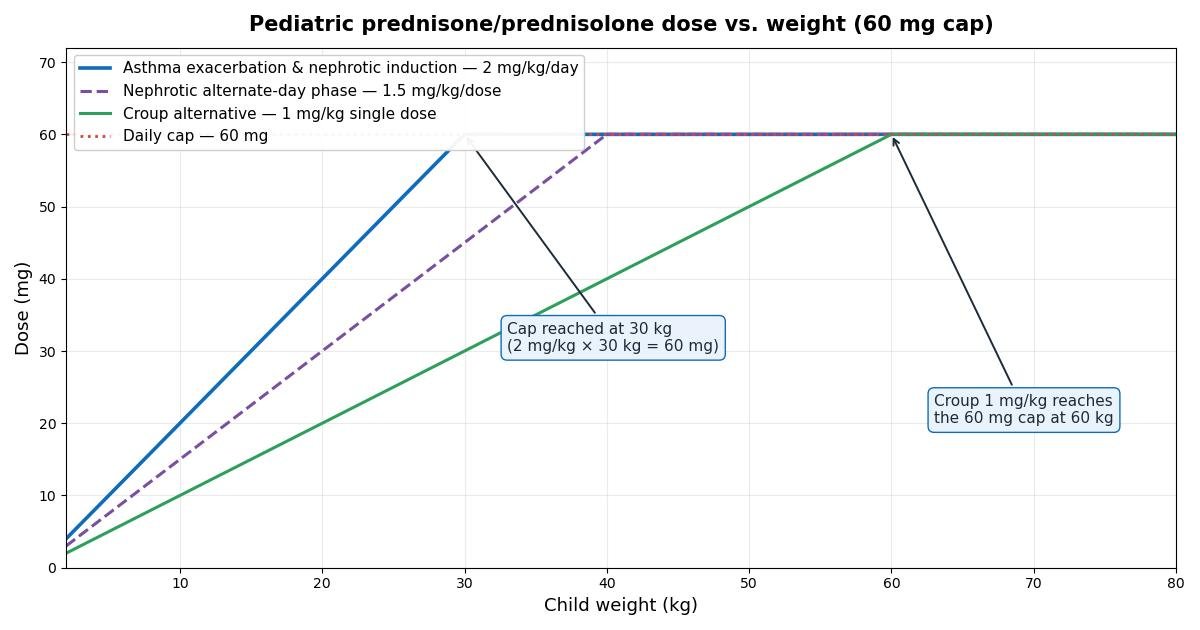
The calculator on this page uses 2 mg/kg/day, the top of the NHLBI range, because that is the dose used in most emergency protocols (a first dose of 2 mg/kg up to the 60 mg maximum). It may be given once daily or split into two doses 12 hours apart. Two refinements are worth knowing. First, the GINA 2025 guidance uses lower age-tiered maxima for young children: 20 mg/day under 2 years and 30 mg/day for ages 2 to 5, with courses of 3 to 5 days that are stopped without tapering. Second, short bursts do not need a taper: the FDA label states explicitly that there is no evidence tapering the dose after improvement prevents a relapse. Inhaled corticosteroids and other controller medicines should be continued during the oral burst, not paused.
The table below applies the 2 mg/kg/day rule with the 60 mg/day cap, and converts each dose to millilitres of the standard 15 mg/5 mL (3 mg/mL) solution. Children above 30 kg all receive the capped 60 mg dose. That is 20 mL of solution:
| Weight (kg) | Daily dose (2 mg/kg, max 60 mg) | mL of 15 mg/5 mL solution |
|---|---|---|
| 5 | 10 mg | 3.3 mL |
| 10 | 20 mg | 6.7 mL |
| 15 | 30 mg | 10.0 mL |
| 20 | 40 mg | 13.3 mL |
| 25 | 50 mg | 16.7 mL |
| 30 | 60 mg | 20.0 mL |
| 40 | 60 mg (capped) | 20.0 mL |
| 50 | 60 mg (capped) | 20.0 mL |
Asthma flares are always treated together with a quick-relief bronchodilator such as albuterol (salbutamol), which opens the airways within minutes while the steroid dose builds its slower anti-inflammatory effect over hours. The steroid is the drug that shortens the episode; the bronchodilator is the drug that relieves it minute by minute.
Nephrotic syndrome dosing
Childhood nephrotic syndrome. Usually minimal-change disease. Is treated with much longer steroid courses than asthma, and this is where dosing must be followed exactly as the nephrology team prescribes. The original International Study of Kidney Disease in Children (ISKDC) regimen, still the backbone of treatment worldwide, is 60 mg/m²/day, which is roughly equivalent to 2 mg/kg/day with a 60 mg/day maximum, given for 4 weeks. About 94% of children with steroid-sensitive disease achieve remission. Protein-free urine. Within those 4 weeks of daily therapy.
After the daily phase, treatment switches to alternate-day dosing: 40 mg/m²/day, roughly 1.5 mg/kg per dose, as a single morning dose every other day for 4 weeks. The KDIGO 2021 glomerular diseases guideline advises daily prednisone for at least 4 weeks in the first episode, then alternate-day therapy, and then a slow taper over the next 2 to 5 months. Alternate-day dosing is deliberately preferred for the maintenance phase because linear growth is less affected than with continued daily dosing. An important consideration in growing children facing months of treatment.
Three honest caveats matter here. First, weight-based dosing gives a lower total dose than body-surface-area dosing in larger children, and the guideline notes there is no evidence that one method is clinically superior. Either may be used, and the calculator uses the weight-based 2 mg/kg and 1.5 mg/kg figures. Second, the exact taper after the 8-week ISKDC course varies between centres (the UK PREDNOS trial compared the standard 8-week course against a 16-week extended course), so this page does not invent a step-by-step taper: the taper is planned by the nephrology team. Third, failure to reach remission after 8 weeks of steroids (4 weeks daily plus 4 weeks alternate-day) defines steroid-resistant nephrotic syndrome and triggers a kidney biopsy and different treatment. It is never a signal to simply keep increasing the steroid dose at home.
Croup: dexamethasone is first-line, prednisolone is the alternative
Croup is a viral infection that swells the airway just below the vocal cords, producing the classic barking “seal-like” cough and noisy breathing (stridor). A single steroid dose dramatically reduces the swelling. The first-line treatment, recommended by the American Academy of Pediatrics, is dexamethasone 0.15 to 0.6 mg/kg as a single oral dose: improvement typically begins within 2 to 3 hours and lasts 24 to 48 hours, and studies show the lower and higher ends of that range work equally well.
Prednisolone enters the picture only when dexamethasone is unavailable. The accepted alternative is prednisolone 1 mg/kg as a single oral dose. A dose matched for potency to dexamethasone 0.15 mg/kg in the key trial. Families should know the trade-off honestly: in the Sparrow and Geelhoed randomized trial of 133 children with mild to moderate croup, 29% of those given single-dose prednisolone re-presented for medical care, compared with 7% given dexamethasone. Prednisolone works, but its shorter duration of action means relapse and re-attendance are more common. If stridor or the barking cough persists the next day, some guidelines advise a second 1 mg/kg dose of prednisolone. A decision for the treating clinician, not a standing instruction.
If a child with croup cannot swallow any oral steroid, nebulized budesonide 2 mg as a single dose is another guideline-listed alternative (see the budesonide pediatric guide). Severe croup with stridor at rest or respiratory distress needs emergency care regardless of which steroid is given.
Formulations and measuring the liquid correctly
Most dosing errors with prednisolone in children are measuring errors, not prescribing errors. The standard prednisolone sodium phosphate oral solution contains 15 mg of prednisolone base per 5 mL, which equals 3 mg per mL. So every milligram dose divides by 3 to give the millilitres. A 40 mg dose is 13.3 mL; a 50 mg dose is 16.7 mL; the capped 60 mg dose is 20 mL. Always use an oral syringe marked in 0.1 mL increments, and never a kitchen teaspoon or tablespoon, which can vary by 50% or more and have caused both under- and overdoses.
Before measuring, read the concentration printed on your own bottle. Although 15 mg/5 mL is the standard this page uses, 10 mg/5 mL, 20 mg/5 mL, and 25 mg/5 mL products also exist. Using the wrong conversion would deliver the wrong dose by a wide margin. Give the liquid with food or milk if it upsets the stomach, and give morning doses at roughly the same time each day so the level in the blood stays steady. For children who can swallow tablets, prednisone tablets come in 1, 2.5, 5, 10, 20, and 50 mg strengths, which can be easier to dose exactly than measuring large volumes of liquid.
Steroid potency equivalents
When a child is switched from one steroid to another. For example from prednisolone to dexamethasone for croup. The doses are matched by glucocorticoid potency, not by milligrams. The FDA label for prednisolone oral solution gives the equivalence directly: 15 mg of prednisolone base is equivalent to 15 mg of prednisone, 60 mg of hydrocortisone, 75 mg of cortisone, 12 mg of methylprednisolone, 12 mg of triamcinolone, 6 mg of paramethasone, and 2.25 mg each of betamethasone and dexamethasone. Scaled to the familiar 5 mg prednisone tablet, that is:
| Steroid | Dose equivalent to 5 mg prednisone |
|---|---|
| Prednisone | 5 mg |
| Prednisolone | 5 mg |
| Hydrocortisone | 20 mg |
| Cortisone | 25 mg |
| Methylprednisolone | 4 mg |
| Dexamethasone | 0.75 mg |
This table explains the croup doses on this page: dexamethasone 0.15 mg/kg is potency-matched to prednisolone 1 mg/kg (a 1:6.7 ratio, matching the label's 2.25 mg dexamethasone = 15 mg prednisolone). It also shows why dexamethasone is dosed in fractions of a milligram while prednisolone is dosed in whole milligrams. Dexamethasone is roughly seven times as potent per milligram and lasts much longer in the body.
Adrenal suppression, tapering, and stress dosing
The same suppression is why children on prolonged steroids need “stress dosing.” During unusual stress. Fever, a significant infection, surgery, or major injury. A healthy body would surge its own cortisol; a suppressed adrenal gland cannot. The FDA label states that patients on corticosteroid therapy who are subjected to unusual stress require increased dosage before, during, and after the stressful situation. Parents of children on the nephrotic syndrome course should have a written sick-day plan from the nephrology team and should tell every emergency clinician that the child is on long-term steroids.
Alternate-day dosing, used in the second month of the nephrotic syndrome regimen, exists partly to let the adrenal axis breathe: giving the steroid every other morning allows some recovery of natural cortisol production on the off days, which is also why growth is less affected than with daily dosing.
Side effects: short bursts versus long courses
The side-effect profile of prednisone and prednisolone depends almost entirely on dose and duration, and parents should expect something very different from a 5-day asthma burst than from a 4-month nephrotic course.
With short bursts, the common effects are increased appetite, mood and behavior changes (hyperactivity, irritability, tearfulness, or unusual silliness), trouble falling asleep, stomach ache or nausea, and headache. Blood sugar can rise temporarily, which matters for children with diabetes. These effects are dose-related, peak while the drug is being taken, and resolve within days of stopping. Which is another reason short bursts are simply stopped, not tapered.
With weeks to months of therapy, the list lengthens and becomes more serious: rounded “moon” face and central weight gain, slowed height growth, high blood pressure, persistently raised blood sugar, thinning of the bones, cataracts and raised eye pressure with very prolonged use, thinning skin with easy bruising and stretch marks, and increased susceptibility to infections. Children on long courses have their blood pressure, weight, and growth chart checked at every visit, and eye checks are arranged for prolonged therapy. Two infection warnings deserve emphasis: children on corticosteroids who are exposed to chickenpox or measles without immunity need prompt medical advice, because these infections can be unusually severe; and live vaccines are generally deferred during high-dose or prolonged steroid therapy. The immunization schedule should be reviewed with the pediatrician.
When to seek medical care promptly
Call the child's doctor or seek urgent care if any of the following occur: severe or worsening breathing difficulty despite treatment; repeated vomiting of the steroid dose; signs of adrenal crisis after a long course is reduced or stopped (severe unusual weakness, repeated vomiting, dizziness, fainting, or confusion); known exposure to chickenpox or measles in a non-immune child taking steroids; severe mood or behavior changes, including aggression or hallucinations; signs of infection with fever during a long course; black or bloody stools or severe stomach pain; or swelling, weight gain, or blood pressure readings that are clearly climbing during prolonged therapy. As with every medicine on this site, this page is informational: it explains what the guidelines and the label say so families can follow the care plan with confidence, but it does not replace the prescribing clinician.